Innovative PSD to Email Conversion Techniques to Embrace in 2025
Updated on
Published on

For all the talk about drag-and-drop editors and AI-powered design tools, one truth hasn’t changed in 2025: brands still need pixel-perfect emails.
Not almost right. Not “close enough.” But, Perfect.
That’s why PSD to email conversion still matters. Because inboxes aren’t standardized. Email clients aren’t predictable. Rendering rules are inconsistent. Accessibility standards keep rising. And every brand wants an email experience that feels intentional, polished, unmistakably theirs.
This is where PSD to email conversion workflows rise above templates and builders. Where designers craft the vision. Developers translate the vision. And brands earn the outcome.
Emails that load beautifully, render consistently, and stand up to every device, client, and accessibility constraint of 2025 are the ones.

Let’s cut to the chase.
Table of Contents
- Significance of PSD to email conversion in 2025 and beyond
- Why PSD to Email remains essential in the age of builders?
- Key shifts influencing PSD to email conversion in 2025
- Innovative PSD to Email conversion techniques for 2025
- Technical considerations for 2025-ready PSD to Email builds
- Why do these innovations matter for email success in 2025?
- Final thoughts and actionable best practices
Significance of PSD to email conversion in 2025 and beyond
Brands still rely on design files because they offer:
- Total control over spacing, alignment, and brand elements
- High-fidelity representation for approvals
- Guardrails for enterprise teams managing complex visuals
Pixel-perfect slicing, asset optimization, and layout mapping remain foundational. Without them, even the strongest campaigns crumble in the inbox. So, when your focus is to convert PSD to email, remember why you do it in the first place.
Why PSD to Email remains essential in the age of builders?
Drag-and-drop editors are convenient, but convenience has limits. Big brands outgrow them fast. And builders often struggle with:
- Custom animations
- Accessibility nuances
- Strict brand guidelines
- Complex layouts
- Dark mode variations
- Precision spacing and typography
Here are a few industries that still depend heavily on PSD-driven workflows.
- Retail and eCommerce (high visual demand)
- Financial services (compliance and structure-heavy)
- Enterprise SaaS (global campaigns)
- Multi-brand agencies (modularity and velocity)
Builders can assist. But hand-coded emails still win. And in 2025, they win bigger, because the technical environment is changing fast.
Key shifts influencing PSD to email conversion in 2025
Here are 4 key shifts that have influenced PSD to email conversion in 2025 already.
- The rise of mobile-first email consumption
More than 70% of email opens occur on mobile devices. The thumb rules everything. So, modern layouts must consider:
- Simplified grids
- Scannable spacing
- Larger tap targets
- 16px+ base font sizes
- More vertical rhythm
- Hybrid coding that adapts gracefully
In mobile-first design, clarity becomes strategy.
- Evolving email client rendering engines
Gmail. Outlook. iOS Mail. Same message. Different interpretations. Here are the changes 2025 brought.
- More CSS support in Gmail
- Slow progress in Outlook desktop
- Partial support for container queries
- Improved dark mode detection
Email developers must code defensively. Graceful fallback is no longer optional; it’s standard practice.
- Accessibility-driven email requirements
Accessibility isn’t retrofitted anymore. It’s designed from the first sketch. WCAG-aligned expectations require:
- High contrast
- Navigable HTML
- Live text over images
- Logical reading order
- Alt text with meaning
- Role and ARIA labeling
This means PSDs must be accessibility-aware before code even begins.
- Modular, reusable, component-based email architecture
Design systems aren’t just for websites. Email has entered its modular era. PSDs now mimic reusable components, such as –
- Card blocks
- CTA sets
- Hero variations
- Promo modules
- Footers and legal sections
A modular PSD reduces production time and raises template consistency across campaigns and brands.
Now, let’s see what innovative PSD to email conversion techniques have excelled in 2025 so far.
Innovative PSD to Email conversion techniques for 2025
Here are 10 innovative techniques PSD-to-email conversion services integrate in 2025 and beyond.
- Hybrid coding for maximum client compatibility
Hybrid coding blends fluid and responsive design. It’s the sweet spot between rigidity and flexibility.
Here is why it wins in the end –
- It works across Outlook, Gmail, and Apple Mail
- It maintains mobile fluidity
- It allows a fixed desktop width
- It handles complex layouts better than pure responsive
Hybrid is the new baseline in 2025.
- AI-assisted slicing and layer optimization
AI now accelerates slicing:
- Auto-detecting layout sections
- Compressing assets intelligently
- Identifying redundant layers
- Exporting retina-ready versions
But AI can misinterpret overlapping layers or masking. Manual developer review is still essential, especially for accessibility and dark mode layers.
- Using CSS grid with progressive enhancement
Grid has finally earned cautious adoption in email, with fallback planning.
Here is what developers use Grid for –
- Complex product layouts
- Modular feature blocks
- Editorial grids
Fallbacks are built using tables to ensure compatibility with Outlook. Progressive enhancement ensures modern clients get the best, while legacy clients never break.
- Dark mode optimized email coding
Dark mode adoption continues to surge. PSD designs now include:
- Dark mode color palettes
- Reversible logo variations
- High-contrast CTA layers
Developers code with:
- Preferred color scheme queries
- Image inversion overrides
- Conditional color adjustments
Dark mode is no longer an afterthought; it’s a design system requirement.
- Accessibility-first HTML email techniques
Accessibility begins in the PSD and matures in the code.
Here is what developers implement.
- Semantic tables with <th>
- Logical reading order
- ARIA labels for interactive sections
- Alt text that conveys meaning
- Live HTML text on top of backgrounds
- Bulletproof layouts for screen-reader clarity
Accessibility-first coding ensures your email speaks clearly across every assistive device.
- Vector-based icons and modern asset handling
SVG support expanded but remains inconsistent. Developers adopt hybrid strategies, like:
- You can use SVG for Apple Mail and Gmail (mostly)
- You can use fallback PNGs for Outlook desktop
Retina slicing ensures crisp resolution across devices.
- Advanced media queries for responsive precision
In 2025, responsive email strategies embrace:
- High-density screen queries
- Fluid typography
- Spacing that adjusts dynamically
- Component-based PSD mapping
This creates emails that feel native across every device size.
- Micro-interactions and animation with safe CSS
Animation is evolving. GIFs are heavy. CSS is lighter. Here is what developers use –
- Subtle fades
- Hover reveals
- Gradient shifts
- Image swaps
PSDs now include animation hints in layered mockups. But every animation includes a static fallback to maintain accessibility.
- Modular template systems for scale
Agencies now design entire libraries using:
- Hero blocks
- Product cards
- Footers
- Copy modules
- Testimonial sets
These modules plug into tools and platforms like:
- Marketo
- HubSpot
- Salesforce
- Braze
- Klaviyo
Giving teams faster production cycles and unified branding across channels.
- AI and automation in QA testing
Email QA is complex. AI now simplifies it. AI tools test:
- 90+ client renderings
- Link integrity
- Alt text presence
- Contrast ratios
- Accessibility levels
- Outlook-specific quirks
Predictive error-detection flags likely render issues before they surface.
Now, let’s discuss what technical considerations you need to consider to ensure smooth and effective PSD to email conversions.
Technical considerations for 2025-ready PSD to Email builds
Here are 4 technical considerations for 2025-ready PSD to Email builds.
- File structure and naming conventions
Good PSD hygiene saves hours because of:
- Clean layer naming
- Flattened unnecessary groups
- Logical sections
- Asset-ready folder structure
Developers shouldn’t have to guess what “Layer Copy 14” means.
- Code structure and clean HTML standards
Despite modern features, email HTML still thrives on tables. Clean code matters more than ever. Here are a few quick guidelines to help you out.
- Remove unused declarations
- Minimize inline styles
- Adopt bulletproof buttons
- Avoid unnecessary divs
- Use responsive-safe table structures
Clean HTML improves deliverability and reduces breakage.
- Optimizing emails for speed and deliverability
Speed is everything. Deliverability too. So, you need to optimize your designs with:
- Compressed assets
- Light HTML footprint
- CDN-hosted images
- Avoiding spam-trigger terms
- Pre-header optimization
A fast email is an email that gets opened. A trusted email is a delivered one. You need to focus on both.
- Ensuring multi-ESP compatibility
Each ESP has quirks. A 2025 email must adapt. Here are some examples.
- Marketo strips certain classes
- Salesforce Marketing Cloud merges CSS differently
- Klaviyo prefers specific syntax
- HubSpot auto-rewrites code blocks
- Braze limits certain embedded styles
Developers must test for each ecosystem, not assume compatibility across platforms.
Why do these innovations matter for email success in 2025?
In 2025, email success hinges on:
- Deliverability
- Accessibility
- Consistency
- Personalization
- Speed
And in 2026, things will only get better from here because innovative PSD-to-email techniques ensure emails:
- Render beautifully
- Respect accessibility
- Load quickly
- Scale across campaigns
- Maintain brand integrity
Future-proofing email templates reduces production cost and increases campaign velocity.
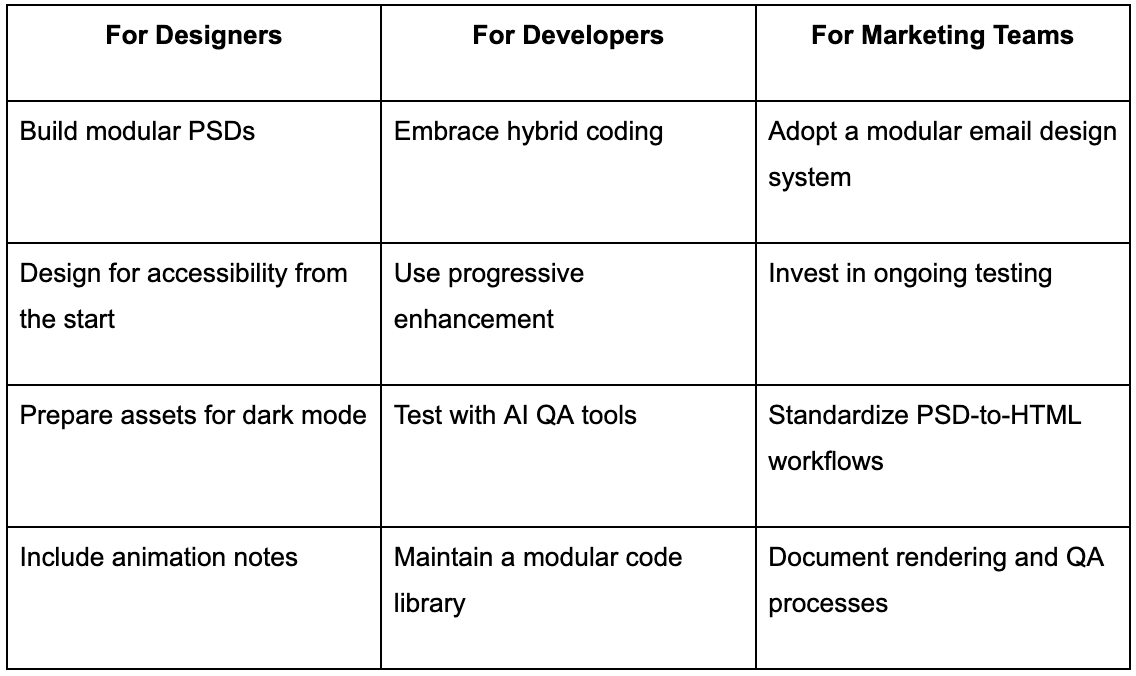
Need some advanced implementation tips? We have got you covered.
Final thoughts and actionable best practices
Here are some best practices our experts suggest you should follow for effective implementation.
Wrapping up
That brings us to the business end of this article, where it’s fair to say that PSD to email conversion isn’t outdated, but it’s evolving.
And 2025 demands more precision than ever.
Responsive frameworks. Accessible layouts. Modular systems. AI-assisted QA. This is the new frontier of custom email development.
Brands that embrace these innovations will deliver emails that feel modern, seamless, and unmistakably “on brand”, no matter the device, client, or context.
Now is the moment to audit your workflow. Revamp your templates. Adopt the techniques shaping modern email development.
Your audience and your metrics will feel the difference. Time to create an actionable strategy.