
30 Most Important Marketing Terms: Definitions, Metrics, and Examples
Updated on
Published on
Marketing terms are not just vocabulary. They shape how budgets get approved, how campaigns get briefed, and how performance gets defended in leadership meetings.
The problem is that the same term can mean different things across teams. “Lead” can mean a form fill, a demo request, or a meeting booked. “Attribution” can mean last-click reports or a full measurement program. When definitions drift, reporting becomes political, and execution slows down.
This glossary is a practical reference from our team at Brand Vision. It focuses on 30 marketing terms that show up most often in strategy work, funnel planning, channel execution, and measurement.
The 30 Marketing Terms You Must Know
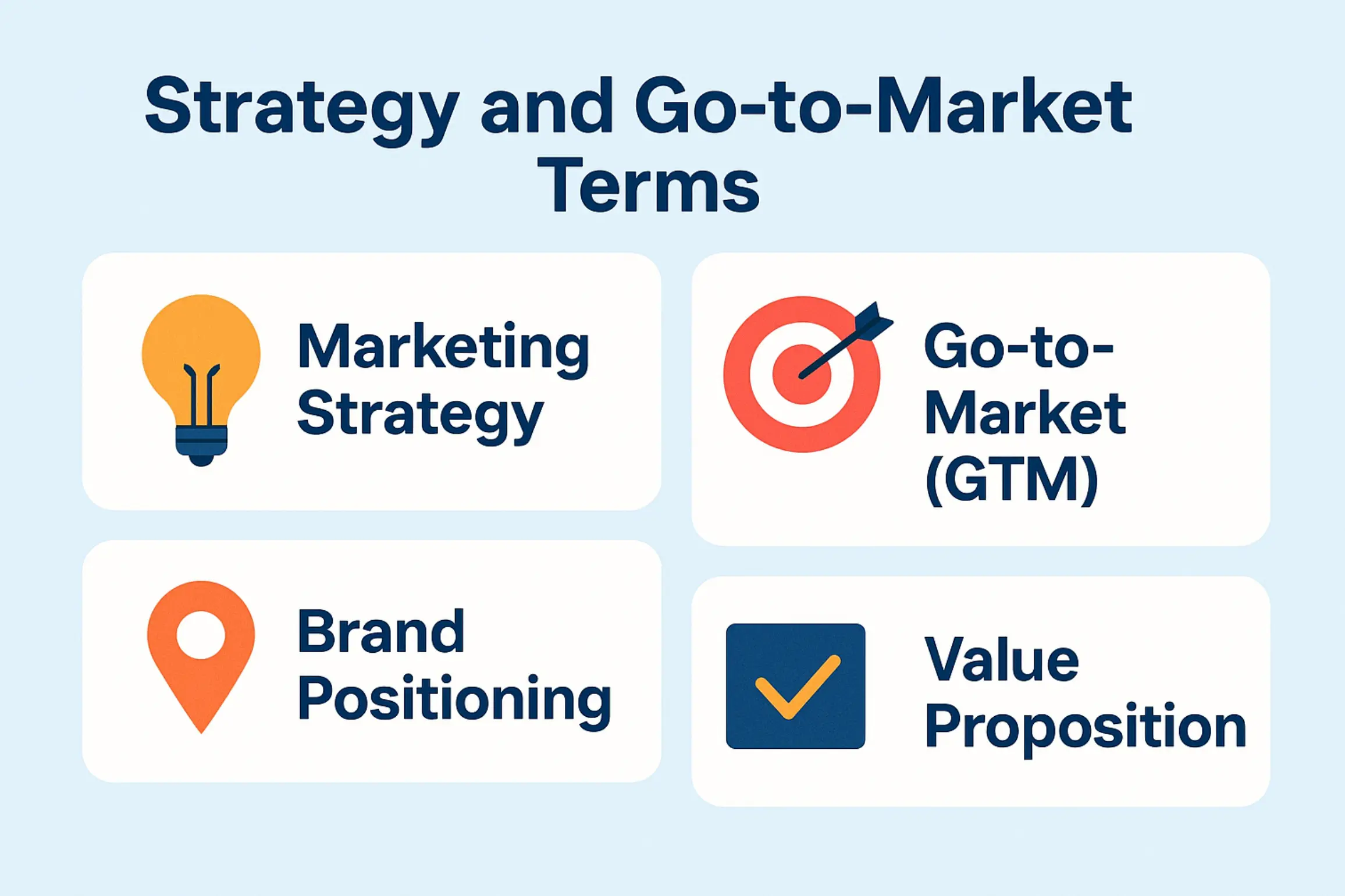
Strategy and Go-to-Market
- Marketing Strategy
- Go-to-Market (GTM)
- Brand Positioning
- Value Proposition
Audience and Research
- Ideal Customer Profile (ICP)
- Buyer Persona
- Segmentation
- Customer Journey
- Voice of Customer (VoC)
Funnel and Lifecycle
- Marketing Funnel
- Lead
- Marketing Qualified Lead (MQL)
- Sales Qualified Lead (SQL)
- Lead Nurturing
Channel and Distribution
- Search Engine Optimization (SEO)
- Pay-Per-Click (PPC) Advertising
- Content Marketing
- Email Marketing
- Omnichannel Marketing
Measurement and Performance
- Key Performance Indicator (KPI)
- Conversion Rate
- Customer Acquisition Cost (CAC)
- Customer Lifetime Value (LTV or CLV)
- Return on Ad Spend (ROAS)
- Marketing Attribution
Data, Privacy, and Modern Search
- First-Party Data
- Customer Relationship Management (CRM)
- Customer Data Platform (CDP)
- Content Management System (CMS)
- Zero-Click Search, AEO, and GEO
Methodology
This is not an A to Z dictionary. It is a curated set of terms that appear most often in real planning and reporting: strategy decks, creative briefs, media plans, CRM stages, analytics dashboards, and board updates.
Each definition is platform-agnostic. Where helpful, it includes a simple formula, a practical example, and the most common misunderstanding to watch for. The goal is shared language, faster decisions, and cleaner measurement.
Strategy and Go-to-Market Terms
Marketing Strategy
Marketing strategy is the set of decisions that define who you are trying to reach, what you are offering, and how you will create demand over time. It is direction, not a list of tactics.
- Where you will see it: Annual planning, positioning work, budget discussions, and agency scopes.
- Why it matters: Without a strategy, teams default to channel activity and short-term output.
- Example: “We target midmarket buyers with a compliance need, position on risk reduction, and win through search-driven content plus partner channels, measured by qualified pipeline.”
Go-to-Market (GTM)
Go-to-market is the plan for launching or scaling a product, service, or offer in a specific market. It connects product, marketing, and sales into one coordinated approach.
- Where you will see it: Launch plans, revenue forecasts, enablement materials, and campaign roadmaps.
- Why it matters: A GTM plan prevents mismatches between the promise in marketing and what sales can deliver.
- Example: A GTM plan may include ICP definition, pricing and packaging, channel mix, messaging, sales motion, and onboarding.
Brand Positioning
Brand positioning is the place a brand aims to hold in a buyer’s mind relative to alternatives. It clarifies the category, the difference, and the reason to believe.
- Where you will see it: Messaging frameworks, websites, pitch decks, and competitive comparisons.
- Why it matters: Positioning reduces confusion. It also makes creative and channel decisions easier to justify.
- Example: “The most reliable option for teams that cannot afford downtime.” For deeper positioning work, see brand strategy and positioning services.
-1.webp)
Value Proposition
A value proposition is the specific value a customer gets, stated in clear terms. It is the “why choose this” statement that can be tested on a landing page and defended in a sales call.
- Where you will see it: Homepages, product pages, paid ads, and outbound sequences.
- Why it matters: Many campaigns fail because the value proposition is vague, generic, or not credible.
- Example: “Reduce onboarding time by 30% with a guided workflow and audit trail.” When this work needs a full system, it often overlaps with a branding agency scope.
Audience and Research Terms
Ideal Customer Profile (ICP)
An ICP is a description of the type of company or account that is most likely to buy and succeed with your offer. It is common in B2B, but the logic applies to any targeted growth effort.
- Where you will see it: Account lists, ABM programs, sales qualification, and pipeline analysis.
- Why it matters: A tight ICP reduces wasted spend and improves lead quality.
- Example: “50 to 500 employees, regulated industry, multiple approvers, and a clear compliance trigger.”
Buyer Persona
A buyer persona is a representation of a decision-maker, influencer, or user. It captures goals, constraints, objections, and what “proof” they need before committing.
- Where you will see it: Content planning, email messaging, ad creative, and sales enablement.
- Why it matters: Personas prevent generic messaging and help teams write to real objections.
- Example: A finance lead persona may care about risk, payback period, and auditability, not feature depth.
Segmentation
Segmentation is the practice of grouping an audience into meaningful clusters so you can tailor messaging, offers, and experiences. Good segmentation is based on real differences, not just demographics.
- Where you will see it: Email lists, paid targeting, lifecycle programs, and pricing experiments.
- Why it matters: Segmentation improves relevance and reduces acquisition costs over time.
- Example: Segment by use case, urgency, maturity, or constraints, then align the offer to each segment’s decision logic.
Customer Journey
The customer journey is the end-to-end path from awareness to consideration to purchase and beyond. It includes touchpoints across channels, not only a website.
- Where you will see it: Journey maps, website IA planning, onboarding flows, and lifecycle campaigns.
- Why it matters: Journey clarity helps teams remove friction. It also prevents “random acts of marketing.”
- Example: A prospect might discover you through search, validate through case studies, request a demo, and then need a structured onboarding sequence. This is where a UI UX design agency and marketing team often align around user intent and usability.
Voice of Customer (VoC)
Voice of customer is the practice of capturing customer language and feedback in a structured way. It includes interviews, surveys, win and loss analysis, support logs, and call transcripts.
- Where you will see it: Messaging refreshes, product roadmaps, and content strategy.
- Why it matters: VoC replaces assumptions with language buyers already use, which improves relevance and conversion.
- Example: Pull the exact phrases customers use to describe pain, impact, and the moment they started looking.

Funnel and Lifecycle Terms
Marketing Funnel
A marketing funnel is a simplified model of how prospects move from awareness to purchase. It often includes stages like awareness, consideration, and conversion.
- Where you will see it: KPI reporting, campaign planning, and budget allocation.
- Why it matters: A funnel helps teams align actions to outcomes, but it can become misleading if it ignores the real journey.
- Example: If “awareness” is measured by impressions but “conversion” is measured by revenue, define what sits between them and what triggers stage movement.
Lead
A lead is a person or account that has shown some form of interest. The definition varies, which is why teams should specify what counts.
- Where you will see it: CRM stages, lead reports, and demand generation dashboards.
- Why it matters: If “lead” is too broad, it inflates performance and breaks alignment with sales.
- Example: Separate “inquiries” from “qualified leads,” and set minimum criteria such as role, intent signal, or required fields.
Marketing Qualified Lead (MQL)
An MQL is a lead that meets agreed-upon criteria, suggesting a higher likelihood to buy. The criteria can be behavioral, firmographic, or both.
- Where you will see it: Lead scoring systems, CRM workflows, and marketing to sales handoff rules.
- Why it matters: MQL definitions determine what sales works on and what marketing gets credit for.
- Example: In many B2B marketing systems, an MQL might require an ICP match plus an intent action like a pricing page visit or a demo request.
Sales Qualified Lead (SQL)
An SQL is an MQL that sales has accepted as ready for direct engagement. It often reflects a stronger intent signal or a verified need.
- Where you will see it: Sales dashboards, pipeline tracking, and revenue attribution discussions.
- Why it matters: SQLs are closer to revenue, so they are often a better “north star” than raw lead volume.
- Example: An SQL might require a discovery call to be completed, a budget range to be confirmed, and a defined timeline.
Lead Nurturing
Lead nurturing is the process of educating and moving prospects forward when they are not ready to buy today. It is usually delivered through email, content, and retargeting, with timing tied to intent.
- Where you will see it: Lifecycle email programs, drip campaigns, and content sequences.
- Why it matters: Nurturing turns early interest into qualified demand without overusing paid spend.
- Example: A three-part sequence that answers common objections, offers a relevant case study, and then invites a conversation with a low-friction CTA.

Channel and Distribution Terms
Search Engine Optimization (SEO)
SEO is the practice of improving visibility in organic search results. It includes technical performance, content quality, and authority signals.
- Where you will see it: Content roadmaps, technical audits, and organic traffic reports.
- Why it matters: SEO compounds. It also sets expectations for how much demand you can capture without paying for every click.
- Example: A search-focused plan might prioritize high-intent pages, internal linking, structured content, and performance improvements. For support, see SEO strategy.
.webp)
Pay-Per-Click (PPC) Advertising
PPC is paid digital advertising where you pay for clicks or outcomes. It often includes search ads, social ads, and retail media.
- Where you will see it: Media plans, Google Ads dashboards, campaign briefs, and budget pacing reports.
- Why it matters: PPC is fast feedback. It also gets expensive when tracking is weak or the landing experience is poor.
- Example: A strong PPC program pairs tight targeting with message clarity, a relevant landing page, and disciplined testing.
Content Marketing
Content marketing is the creation and distribution of useful content to attract and nurture an audience. It is not only blogs. It includes guides, tools, webinars, newsletters, and case studies.
- Where you will see it: Editorial calendars, SEO programs, lifecycle nurture, and sales enablement libraries.
- Why it matters: Content builds trust at scale, supports sales conversations, and reduces dependence on paid acquisition.
- Example: One high-quality guide can support search demand, email nurturing, and sales follow-up for months if it stays current.
Email Marketing
Email marketing is the use of email to communicate with prospects and customers. It includes newsletters, lifecycle sequences, retention messaging, and transactional emails.
- Where you will see it: CRM automation, product onboarding, event promotion, and customer updates.
- Why it matters: Email is one of the few channels you control. It also creates measurable loops for offers and messaging.
- Example: A lifecycle program might deliver onboarding education, then shift to use-case content, then introduce an upgrade path when usage signals appear.
Omnichannel Marketing
Omnichannel marketing is a coordinated approach where messaging and experience feel consistent across channels. The goal is continuity, not simply being present everywhere.
- Where you will see it: Brand campaigns, lifecycle programs, and multi-touch journeys that span web, email, social, events, and sales.
- Why it matters: Buyers rarely convert from one touchpoint. Omnichannel consistency reduces friction and improves recall.
- Example: A campaign can start with search and social, continue through email, and close through a sales conversation, all using the same positioning. This is common in category-specific work like real estate marketing, where multiple stakeholders evaluate the same project across different channels.

Measurement and Performance Terms
Key Performance Indicator (KPI)
A KPI is a metric chosen to track progress toward a goal. A KPI is not every number in a dashboard. It is the small set leadership uses to judge performance.
- Where you will see it: Executive reporting, quarterly goals, and campaign scorecards.
- Why it matters: KPI discipline prevents teams from optimizing for noise.
- Example: A pipeline KPI could be “sales-qualified opportunities created,” supported by diagnostic metrics like conversion rate and cost per lead.
Conversion Rate
Conversion rate is the percentage of users who complete a desired action. The action depends on the goal: purchase, demo request, form submit, signup, or qualified call booked.
- Where you will see it: Website analytics, funnel reports, and experiment results.
- Why it matters: Conversion rate turns traffic into outcomes. It is where messaging, UX, and performance all show up in one number.
- Formula: Conversions ÷ Total visitors (or sessions) × 100
- Example: Many improvements come from fundamentals: faster load times, clearer page hierarchy, fewer form fields, accessible design, and a more direct CTA. This is where a web design agency can influence pipeline by reducing friction and improving clarity.
Customer Acquisition Cost (CAC)
CAC is the average cost to acquire a new customer. It typically includes marketing and sales costs tied to new customer acquisition.
- Where you will see it: Financial models, growth dashboards, budget planning, and pricing discussions.
- Why it matters: CAC tells you whether growth is efficient, and whether it is improving over time.
- Formula: Total acquisition spend ÷ New customers acquired
- Example: If CAC rises, the fix may be in targeting, positioning, landing experience, or sales conversion, not only media buying.
Customer Lifetime Value (LTV or CLV)
LTV is the estimated total value a customer generates over the life of the relationship. It can be measured as revenue, contribution margin, or profit.
- Where you will see it: Retention planning, pricing strategy, paid media constraints, and unit economics.
- Why it matters: LTV helps teams decide what they can afford to spend on acquisition and still grow sustainably.
- Example: A simple model uses average revenue per customer per month times expected retention months, adjusted for margin if needed.
Return on Ad Spend (ROAS)
ROAS measures how much revenue is generated for every dollar spent on advertising. It is a paid media metric, not a full business profit metric.
- Where you will see it: Paid search and paid social reporting, ecommerce dashboards, and weekly budget decisions.
- Why it matters: ROAS helps manage paid efficiency, but it can mislead if it ignores margin, discounts, and repeat purchases.
- Formula: Revenue attributed to ads ÷ Ad spend
- Example: A ROAS target should reflect contribution margin and payback window, not only a platform benchmark.
Marketing Attribution
Attribution is the method used to assign credit for outcomes across marketing touchpoints. Common models include last-click, first-click, linear, time-decay, and data-driven approaches.
- Where you will see it: Analytics platforms, CRM reporting, marketing attribution software, and “what drove pipeline” conversations.
- Why it matters: Attribution shapes where teams invest. Weak attribution leads to over-crediting the last touch and underfunding demand creation.
- Example: Many teams use a practical blend: directional attribution for daily decisions, and broader measurement like experiments or MMM for budget planning. Privacy and tracking changes are part of the reason attribution requires more care, as described in Google’s Privacy Sandbox updates. (Google)

Data, Privacy, and Modern Search Terms
First-Party Data
First-party data is information collected directly from your audience through your own channels. It includes website behavior, email engagement, product usage, and CRM records, within privacy and consent rules.
- Where you will see it: CRM, analytics, email platforms, and personalization systems.
- Why it matters: First-party data is more durable than third-party tracking and supports better segmentation and measurement.
- Example: Improving form capture, newsletter opt-ins, and preference centers can make measurement and personalization more reliable. Google’s third-party cookie guidance is a useful reference for how tracking norms are shifting.
Customer Relationship Management (CRM)
A CRM is the system of record for customer and lead relationships. It tracks contacts, accounts, stages, activities, and outcomes.
- Where you will see it: Pipeline reporting, lifecycle programs, sales workflows, and customer success operations.
- Why it matters: A clean CRM makes attribution and funnel reporting possible. A messy CRM makes every metric a debate.
- Example: Align lead stages, define required fields, and audit duplicate records. Then ensure marketing and sales agree on definitions.
Customer Data Platform (CDP)
A CDP centralizes customer data from multiple sources and makes it available for segmentation and activation. It is often used to connect web behavior, product usage, and CRM records.
- Where you will see it: Advanced personalization, cross-channel analytics, and identity resolution discussions.
- Why it matters: A CDP can reduce data fragmentation, but it only helps if teams have clear use cases and governance.
- Example: A CDP might unify event data from a product with CRM attributes so lifecycle programs can reflect real usage.
Content Management System (CMS)
The marketing term CMS is the platform used to create, manage, and publish website content. It shapes how fast teams can ship content, maintain pages, and enforce brand standards.
- Where you will see it: Website governance, content operations, SEO execution, and design system decisions.
- Why it matters: CMS choices influence speed, accessibility, and consistency. They also influence how easily teams can update high-intent pages without developer bottlenecks.
- Example: A well-structured CMS supports reusable page components, clean URLs, and editorial workflows with approvals.
Zero-Click Search, AEO, and GEO
Zero-click search refers to search experiences where users get an answer without clicking through to a website. AEO (Answer Engine Optimization) and GEO (Generative Engine Optimization) are emerging terms for optimizing content to be cited or summarized by AI-driven answer systems.
- Where you will see it: SEO planning, content strategy discussions, and analytics, where impressions rise but clicks do not.
- Why it matters: Visibility alone does not guarantee traffic. Teams need content that earns trust, gets cited, and still converts when users do land on-site.
- Example: Build pages with clear definitions, structured sections, and strong proof points so they can be extracted and referenced. Bain’s research on zero-click behavior outlines why this shift affects organic performance. (Bain)
FAQs
Which marketing terms matter most for leadership teams?
The most leadership-relevant marketing terms are the ones tied to decisions: positioning, ICP, funnel stages, CAC, LTV, conversion rate, and attribution. These terms determine where money goes and how performance gets evaluated.
What is the difference between ROI and ROAS?
ROAS measures revenue generated per advertising dollar. ROI looks at net return relative to total investment and should account for costs beyond ad spend. ROAS helps run paid media. ROI helps judge whether growth is worth it.
How do CAC and LTV work together?
CAC is what you pay to acquire a customer. LTV is what that customer is worth over time. Healthy growth usually requires LTV to be meaningfully higher than CAC, with a payback window that matches cash flow reality.
What is a good conversion rate?
A good conversion rate depends on the goal, the channel, and the offer. A demo request page and a newsletter signup page should not have the same benchmark. The useful question is whether the conversion rate is improving, and which friction points are most responsible.
What is marketing attribution in simple terms?
Attribution is how you decide what helped cause a result. It is never perfect. The goal is not total certainty. The goal is consistent rules so you can make better budget and channel decisions month over month.
How does zero-click search change SEO and content?
It increases the value of clarity and credibility. Content needs a clean structure, direct answers, and proof points that can be cited. It also increases the importance of on-site experience, because fewer clicks mean fewer chances to convert.
Vocabulary For Your Team's Success
If this glossary is only used as a reference, it will help. If it becomes a shared standard, it will change how a team operates.
Start with three actions:
- Write down your official definitions for lead, MQL, SQL, and conversion. Then enforce them in your CRM and reporting.
- Choose a small KPI set that matches business goals, not channel activity. Use diagnostic metrics to explain changes, not to replace goals.
- Audit the moments where buyers hesitate. Most performance gaps trace back to unclear positioning, weak proof, slow pages, or confusing flows.
When a team needs an external perspective on definitions, measurement, and the website experience that supports conversion, a structured audit is often the fastest starting point. Start a conversation through our marketing consultation and audit.
.png "Best Branding Agencies in Toronto (2026)")
%20(1).png "10 Best Web Design Companies in Toronto (2026)")