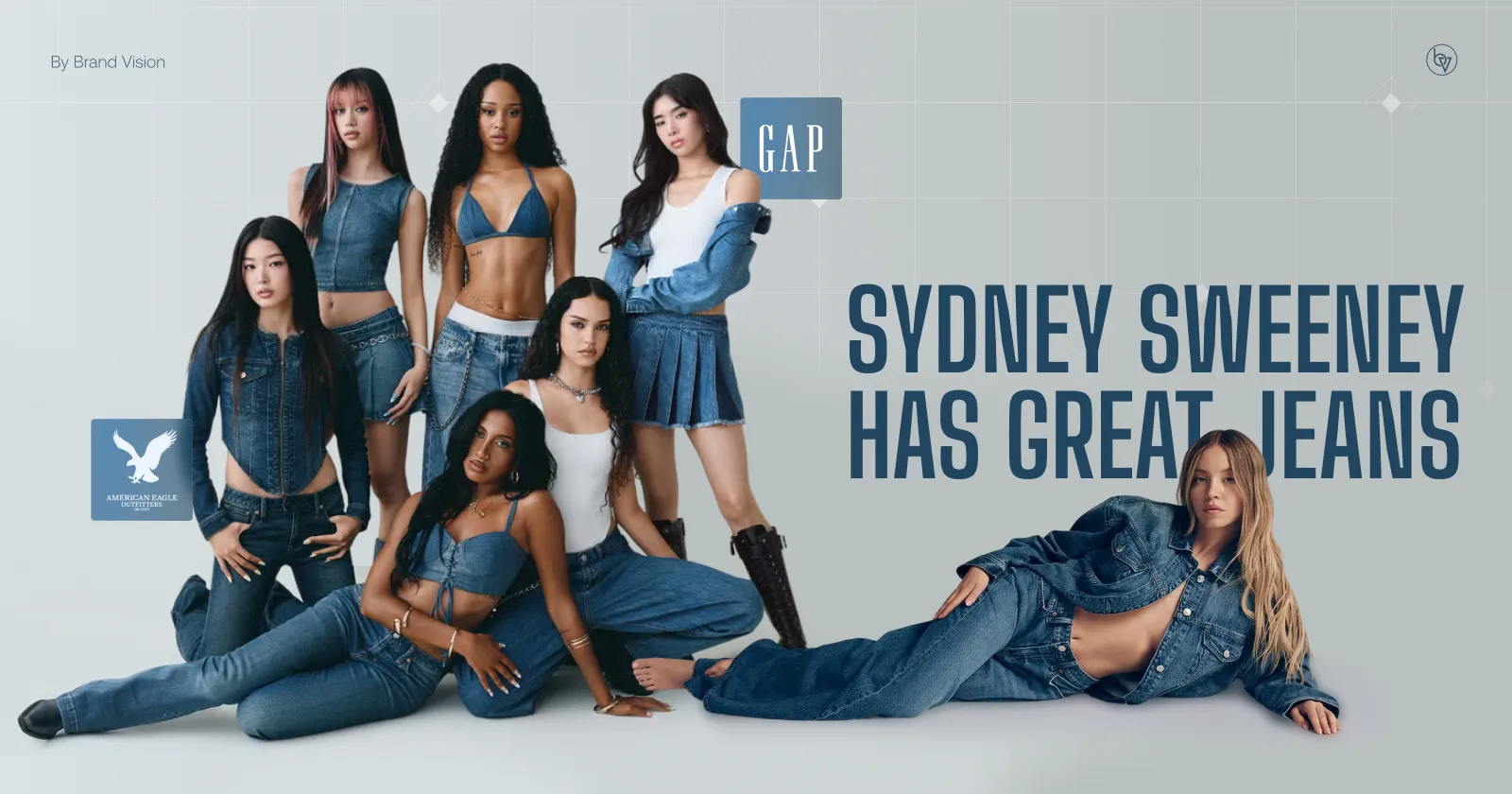
In 2025, Gap and American Eagle turned denim advertising into two very different cultural events. Gap’s “Better in Denim,” featuring KATSEYE, leaned into music, dance, nostalgia, and a visibly inclusive cast. American Eagle’s “Sydney Sweeney Has Great Jeans” used celebrity, wordplay, spectacle, and controversy to drive extraordinary attention and reported customer acquisition. Both campaigns show how brands use cultural cues and social distribution to make a familiar category feel current. This comparison looks at the marketing tactics, reported results, public reaction, and later business context without treating any single campaign metric as proof of long-term causation.
This analysis uses the brand and growth lens of Brand Vision, a branding agency. The goal is to translate Gap’s and American Eagle’s denim advertising into practical campaign decisions: what matched the brand, what created narrative risk, what moved reported customer behaviour, and which metrics are useful when comparing two very different creative systems.
At a glance: key numbers
Gap x KATSEYE
- 20 million views in 3 days; by late August Gap reported 400M+ views and 8B+ impressions, plus the No. 1 TikTok search. Gap later updated the campaign to 600M+ views in one month.
- 1.7 million dollars EMV with record engagement
- Foot traffic up 2.8 percent in August and up 8.5 percent in the first full week after launch
- The limited KATSEYE hoodie sold out quickly
American Eagle x Sydney Sweeney
- 700,000+ new customers and 40 billion impressions credited to the Sweeney and Travis Kelce programs
- AE reports 790,000 new customers in the first six weeks (and ~320,000 new social followers), with 40B impressions.
- AE’s CMO calls it the brand’s most expensive campaign to date.
- an Economist/YouGov poll found 39% called the AE ad “clever” vs. 12% “offensive.”
- For Q2 (ended Aug. 2), AEO Inc. reported total net revenue down 1% and American Eagle comparable sales down 3%. Because the Sweeney campaign launched late in July, most of its reported customer-acquisition effects would fall after much of that quarter.
- The jacket sold out in one day, jeans in one week; Sydney Jean restock is planned for the holidays.
- Foot traffic was down 1.3 percent in August at AE stores.
- Shares jumped sharply on September 4 as the results and campaign updates hit the wires.
Channel Strategy: Paid, Owned & Earned
American Eagle leaned into paid spectacle and celebrity tentpoles: Sphere Exosphere OOH, 3D billboards, a Snapchat AR lens, and AI try-on features, all anchored by Sydney Sweeney and later Travis Kelce. That mix created mass paid visibility and earned conversation. It is a classic integrated marketing problem: the celebrity, media, product drop, social response, and conversion path all have to work as one system.
Gap kept the core campaign more participation-led: a dance-driven short film with KATSEYE, Times Square OOH, and a deliberate wave of creator seeding to encourage remixing and imitation. The campaign was distributed across Gap’s owned and earned channels globally, with creator activity extending the social loop.
Why these two denim ads are being compared right now
Gap and American Eagle were competing for more than denim sales. Both launched major fashion campaigns within weeks of each other in mid-2025, but with different theories of attention. Gap revived music-and-dance brand codes with KATSEYE, while American Eagle used a celebrity-first concept designed to dominate conversation. For marketers, the comparison is useful because it separates creative fit, earned controversy, customer acquisition, and retail behaviour instead of collapsing them into one idea of “viral success.” It is also a practical B2C marketing case study in how awareness has to connect to product and purchase.
Ad 1: Gap “Better in Denim” featuring KATSEYE
What the ad shows on screen
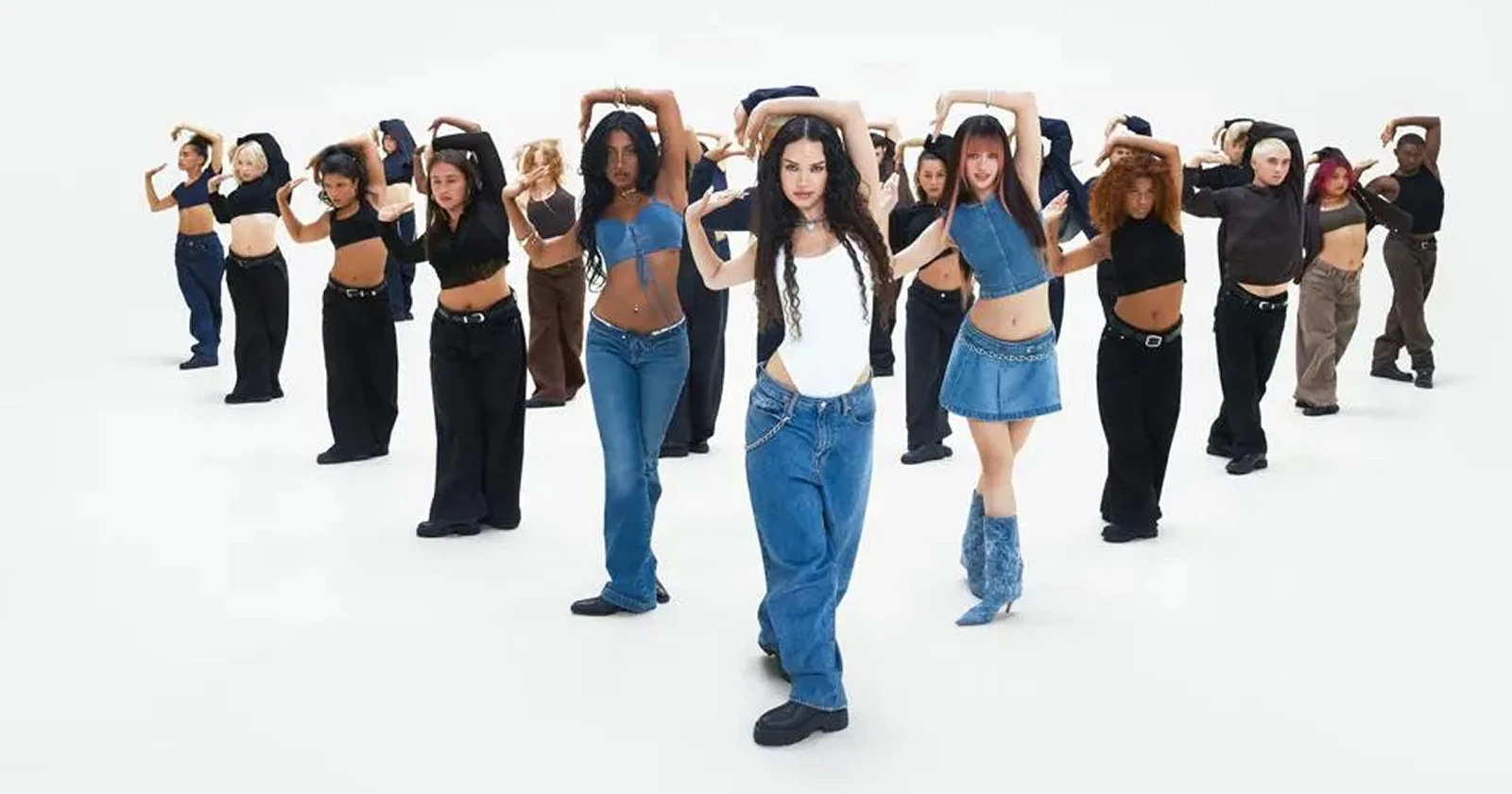
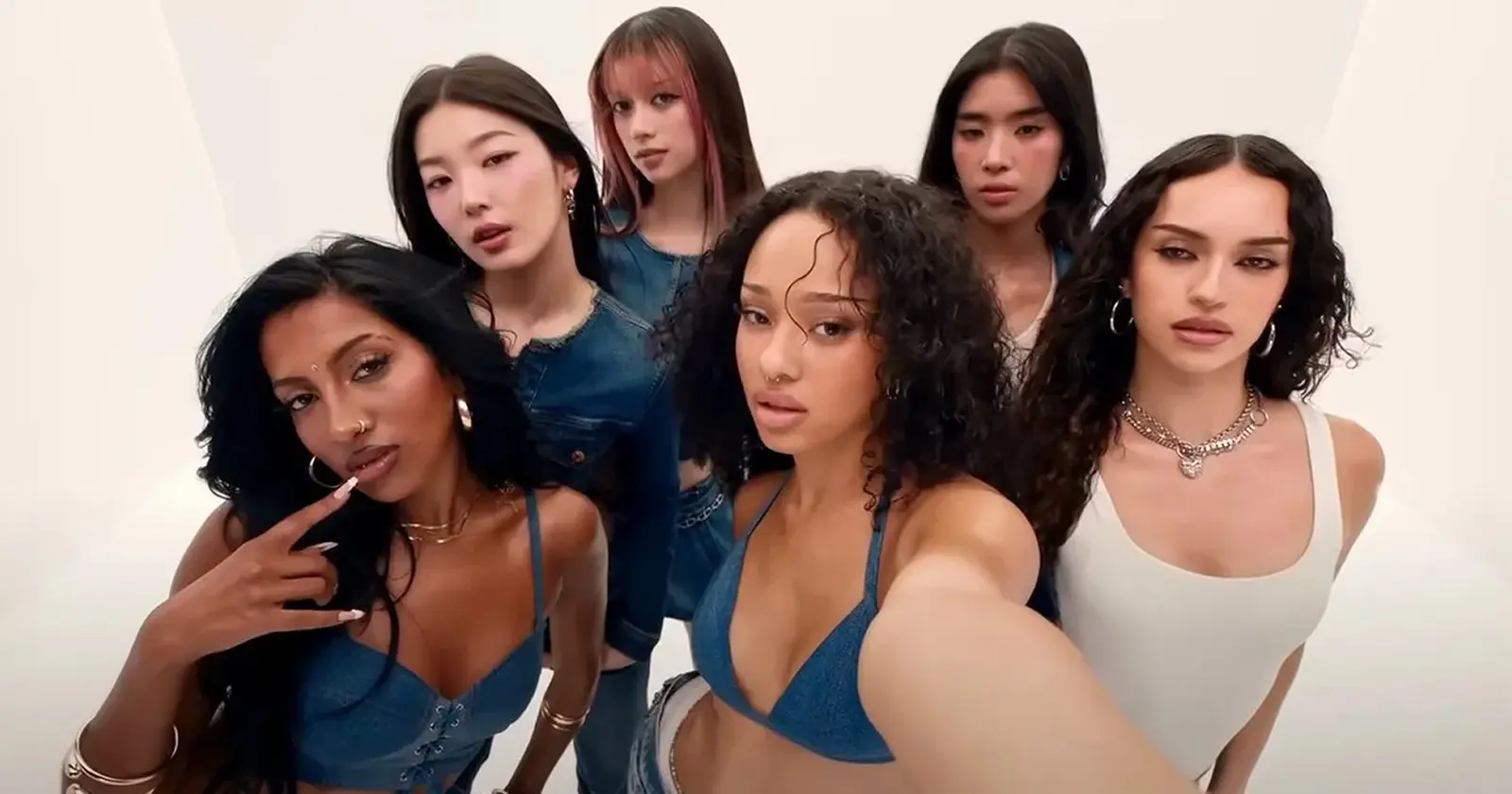
Gap’s 90-second film opens with all six members of KATSEYE performing to a remix of Kelis’ “Milkshake.” As choreography builds, more dancers join and form circular patterns that highlight movement and denim. The set was custom-built in Los Angeles, with Bethany Vargas directing, Robbie Blue choreographing, and Bjorn Iooss shooting stills. Wardrobe leans into a Y2K revival with low-rise jeans, pleated mini skirts, and a refreshed “Long & Lean” fit. The rollout included a Times Square billboard, a limited KATSEYE logo hoodie pre-order, and global distribution across digital, social, in-store, and influencer channels.
The marketing strategy at work
- Heritage codes refreshed: Gap revived its long history of dance-driven ads and paired it with Y2K nostalgia, a strong brand strategy move because the new execution still resolves back to familiar Gap memory structures.
- Creator flywheel: Gap says it worked with 400 creators to extend storytelling around denim hits like the Horseshoe Jean and NAP hoodie, a social-first approach CEO Richard Dickson outlined on the earnings call (Gap earnings remarks).
- Cross-channel orchestration: Distribution spanned owned social, stores, OOH, and YouTube, a PESO-style playbook that amplifies paid and owned with earned conversation and creator posts (Business of Fashion).
For background, see Brand Vision’s guides on digital PR for earned attention and brand awareness through SEO.
How it performed
- The film reached 20 million views in its first 72 hours. By late August Gap said it had passed 400M views and 8B impressions and become the top TikTok search during launch week; in October, Gap updated the total to 600M+ views in one month (Gap earnings remarks, Business Insider, Gap Inc.).
- Record engagement and EMV: 1.7 million dollars in EMV and top engagement since launch (Business of Fashion).
- Store traffic lift: +2.8 percent year over year in August and +8.5 percent the first full week after launch, based on Pass-by data shared with Retail Brew (Retail Brew).
- Merch heat: The limited KATSEYE x Gap logo hoodie sold out quickly (Yahoo Entertainment).
Public reaction and any controversy
Coverage framed the ad as on-brand and widely praised for inclusivity and craft, often contrasted with the American Eagle debate (Business of Fashion). The broader lesson is to separate social applause from actual perception change; structured brand research is the cleaner way to test whether a campaign strengthened the associations the brand intended to own.
Weak spots to note
Impressions and EMV are top-funnel; they show attention, not conversion. Broader corporate headwinds, such as tariff pressure, still shaped investor reads for the quarter, which limited any stock reaction to cultural buzz.
Ad 2: American Eagle “Sydney Sweeney Has Great Jeans”
What the ad shows on screen
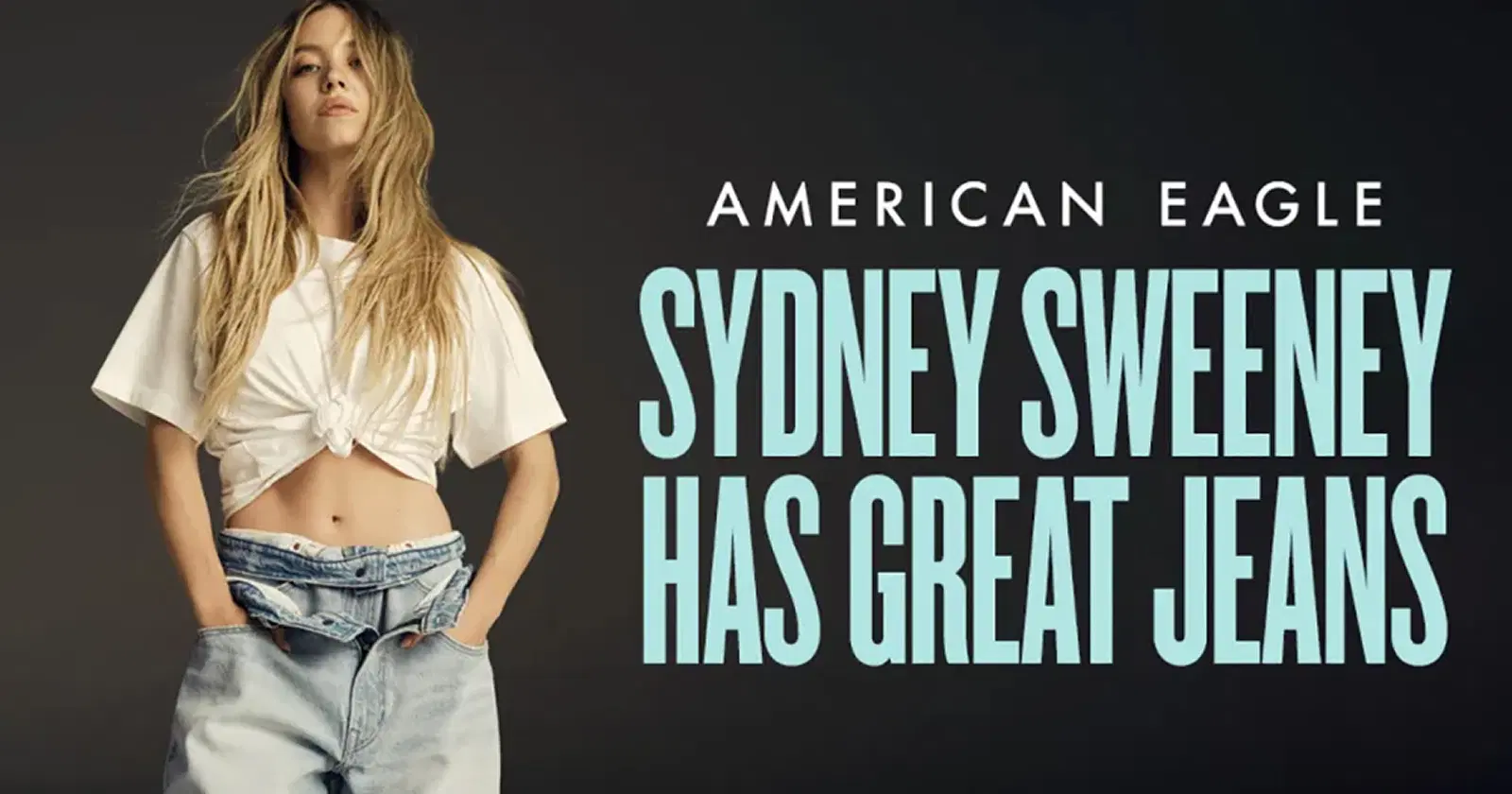
The Sydney Sweeney x American Eagle campaign rolled out as a series of short videos built around the actress. The most criticized spot used the “genes/jeans” wordplay alongside a close visual focus on Sweeney, which some commentators read as racially coded. Another clip used the line “Eyes up here.” PRWeek reported that some criticized videos disappeared from AE’s feeds, while the CMO later told Marketing Brew that no assets were removed entirely (PRWeek, Marketing Brew). Beyond social, AE invested in the Las Vegas Sphere exosphere, a Snapchat AR lens, and AI try-on, plus limited items like The Sydney Jean and a curated denim jacket. One hundred percent of the purchase price of The Sydney Jean goes to Crisis Text Line (AE investor release).
The marketing strategy at work
- Provocation for attention: The “genes, jeans” pun was designed to be sticky, but in a polarized climate it was quickly reinterpreted by commentators as a “good genes” narrative, which escalated controversy.
- Celebrity stacking: AE paired Sweeney’s rollout with Travis Kelce, broadening reach across fashion, sports, and entertainment. That is an entertainment marketing advantage, but it also makes attribution harder when several celebrity programs run close together.
- OOH plus social mechanics: Sphere, 3D billboards, AR, and AI try-on made the campaign unavoidable and meme-ready, supporting a drop-style product strategy (AE investor release).
How it performed
- Customer acquisition and reach: Reuters reported more than 700,000 new customers and 40 billion impressions across the Sweeney and Travis Kelce programs.
- Six-week CMO snapshot: American Eagle CMO Craig Brommers separately told Marketing Brew the Sweeney rollout had generated 790,000 acquired customers, nearly 320,000 new social followers, and 40 billion impressions after six weeks (Marketing Brew). These are company-reported snapshots with different framing, so they should not be added together.
- Product sell-outs: The Sydney Jacket sold out in a day, and the Sydney Jean sold out in a week, with restocks planned (Retail Brew, People).
- Investor reaction: Shares jumped about 33 percent on September 4 as results and updates hit the wires.
- Foot traffic vs. hype: Pass-by measured a 1.3 percent decline in August foot traffic at AE stores despite the buzz (Retail Brew).
Public reaction and controversy
The most viewed clip drew criticism for white, blonde, blue-eyed “good genes” connotations, covered by national and fashion media. As discourse spread, sentiment flipped to 63.7 percent favorable across TikTok and X in the first nine days, according to PeakMetrics data provided to Retail Brew (Retail Brew).
Weak spots to note
The strategy ceded narrative control and required continuous communications response. While online metrics and sell-outs were strong, store traffic softened at first, a reminder that national media attention does not always translate into local footfall.
Head-to-head: which strategy was better?
Brand fit and creative clarity
Gap’s film is a case study in brand codes. Music, movement, and denim are recognizable Gap shorthands, which makes the work feel like a natural extension of the brand (Business of Fashion). The campaign also shows why visual identity is more than a logo: casting, styling, choreography, type, and retail imagery can all reinforce the same memory structure. American Eagle’s idea was memorable too, but it accepted more narrative risk.
Lesson: Creativity that matches brand codes builds trust and recall. Provocation can deliver buzz, but if it strays from your DNA, it can erode credibility.
Reach and customer acquisition
American Eagle led on reported customer acquisition: the company cited 40 billion impressions and customer counts ranging from more than 700,000 in broader reporting to 790,000 in the CMO’s six-week snapshot (Marketing Brew). Gap did not disclose a comparable new-customer figure for “Better in Denim,” but reported 400M+ views and 8B+ impressions by late August (Business Insider) and later 600M+ views in one month. For a consumer marketing team, that distinction matters: reach and acquisition are different KPIs.
Lesson: Awareness is not acquisition. Define KPIs before launch. Are you chasing reach or customers?
Real-world traffic
Gap’s store visits were up 2.8 percent in August and up 8.5 percent in the first full week post-launch. AE’s were down 1.3 percent in August (Retail Brew).
Lesson: Offline conversion still matters. Retail campaigns need to move bodies, not just feet.
Merch sell-outs and hype
Both programs delivered quick sell-outs, showing the power of scarcity. Gap’s KATSEYE hoodie sold out quickly (Yahoo Entertainment). AE’s jacket sold out in a day and the jeans in a week (Retail Brew, People). AE’s clear sell-outs and Gap’s hoodie disappearing online show that social buzz translated into real purchase behavior, not just impressions. AE confirmed additional Sydney Jean inventory is coming back for the holiday season.
Lesson: Limited merchandise tied to campaign momentum can be both a conversion driver and a heat gauge. Sell-outs become part of the story.
Reputation management
Gap’s ad drew praise as engaging, inclusive, and on-brand. AE’s sparked backlash over “good genes,” then rebounded to 63.7 percent favorable in early social listening as the story polarized and spread (Retail Brew).
Lesson: Controversy can supercharge reach, but it raises risk and demands tight narrative management.
Later fiscal 2025 results add useful context without proving campaign causation. Gap brand finished fiscal 2025 with net sales up 5% and comparable sales up 6%, while American Eagle brand comparable sales were flat for fiscal 2025 and up 2% in Q4 (Gap Inc., AEO Inc.). Those are brand-level results influenced by product, pricing, operations, and other marketing, so they are context rather than clean campaign ROI.
@marissaktandon Katseye’s Gap campaign has gone viral for the exact opposite reasons the American Eagle campaign with Sydney Sweeney did. But it makes sense: from the beginning, Hybe x Geffen set out to create a global girl group that stepped out of the world of K-pop, and represented as many people as possible. #katseye #gap #sydneysweeney #netflix #hybe ♬ original sound - marissaktandon
Bottom line for marketers
- If the KPI is reported customer acquisition and sheer conversation volume, American Eagle has the stronger disclosed numbers.
- If the KPI is brand equity, store-traffic response, and brand-fit clarity, Gap has the stronger evidence in this comparison.
There is no single campaign “winner” across every metric. Gap demonstrates the power of recognizable brand codes and participation; American Eagle demonstrates how celebrity and provocation can recruit customers while increasing narrative risk. The right conclusion depends on the KPI chosen before launch.
What marketing professionals can learn
Start with brand codes
Campaigns work best when they build on existing memory structures. Gap modernized music-driven heritage and used dance and denim as instant brand shorthand.
Lesson: Align to brand codes to build trust and recall.
Design for participation, not just views
Gap gave people choreography to copy, then fueled it with 400 creators across TikTok and Instagram, turning content into a cultural moment (Gap earnings remarks).
Lesson: Package behaviors people can share, then power the flywheel with creators.
Match channels to the creative
The AE’s Sphere takeover, AR lens, and AI try-on features are designed to align with a celebrity tentpole event. Gap’s TikTok-first dance and Times Square amplification fit a culture play.
Lesson: Put the idea where it naturally thrives.
Measure the whole funnel
- Attention: Gap reported 400M+ views by late August and later 600M+ views in one month, alongside 8B+ impressions; Business of Fashion reported $1.7M EMV (Business of Fashion).
- Engagement: Both drove conversation; AE’s controversy extended debate.
- Behavior: Gap’s +2.8 percent August traffic and +8.5 percent post-launch week show offline lift, while AE’s sell-outs prove product pull even as store visits dipped (Retail Brew).
- Acquisition: AE converted attention into 700k to 790k new customers (Marketing Brew).
Lesson: Look past top-funnel metrics. The proof of value lies in acquisition and store behavior.
Prepare for narrative risk
Gap stayed in positive territory. AE triggered backlash, yet sentiment flipped to 63.7 percent favorable in nine days as the debate spread (Retail Brew).
Lesson: If a concept can be reframed, assume it will be. Build escalation plans, message maps, and monitoring.
How Business Owners Can Apply This in 2026
If you’re planning a 2026 campaign, the Gap vs. American Eagle takeaway is simple: attention only matters if it strengthens what your brand already stands for, and if it moves customers in the direction you can actually fulfil. Viral reach is a tool, not a strategy. The brands that win over time are the ones that pair a clear point of view with execution that feels intentional across creative, channels, and conversion.
At Brand Vision, we usually start by locking the brand foundation first, then building the campaign system around it. That can mean refining positioning with a branding agency, translating it into an explicit brand strategy, tightening the shopping experience with a web design agency, and making sure the demand engine is measurable and scalable with an SEO agency. If you want a clear plan before you spend, a focused marketing consultation can help you choose the right channels, set the right KPIs, and avoid campaigns that create noise without lift.
Practical ways to apply this right now
- Build from brand codes: Identify the 3 to 5 signals people already associate with you, then make sure the campaign amplifies them instead of fighting them.
- Pick one primary win condition: Customer acquisition, store traffic, retention, or brand perception. Don’t pretend you’re optimising for all four at once.
- Design for participation: Give people a behaviour they can repeat, remix, or share, then seed it with creators who match your audience.
- Make the conversion path frictionless: If the campaign spikes demand, your site needs to keep up on mobile, speed, and clarity. That’s where strong UI UX design turns momentum into revenue.
- Plan for narrative risk: If your concept could be reframed, assume it will be. Build a response plan and social listening cadence before launch.
FAQ
Was Gap’s ad a response to AE’s?
Despite the timing, Gap and its agency say ‘Better in Denim’ was conceived and filmed before AE’s campaign and wasn’t a response. The spot was shot in early July for back-to-school, then happened to drop after AE.
Did Gap’s KATSEYE merch sell out?
Yes. The limited KATSEYE x Gap logo hoodie sold out quickly after launch (Yahoo Entertainment).
Did American Eagle remove the controversial videos?
PRWeek reported that some videos were pulled, while AE’s CMO later told Marketing Brew that no assets were removed entirely (PRWeek, Marketing Brew).
Did AE’s campaign raise money for a cause?
Yes. One hundred percent of the purchase price of The Sydney Jean goes to Crisis Text Line (AE Investor Release).
Which ad drove more store traffic in the first month?
Gap. Pass-by data via Retail Brew shows Gap up in August and the week after launch, while AE was down in August (Retail Brew).