
Alo Yoga's marketing strategy is often reduced to celebrity visibility, but the stronger explanation is the system underneath it. Positioning, creator content, retail, digital wellness, and retention reinforce one another, so no single channel has to carry the whole brand.
For Brand Vision, the useful question is what other businesses can learn from that system. Our work spans branding, web, and marketing, including branding support in Chicago, but Alo is treated here strictly as an independent case study, not a Brand Vision client example.
Alo Yoga Marketing Strategy at a Glance
Alo's marketing works because it does not lean on one channel. It is a connected system that turns wellness into culture, then culture into commerce.
- Positioning: wellness sold as a premium lifestyle, not just activewear.
- Distribution: a direct-to-consumer core, plus "sanctuary" stores that work as brand stages.
- Demand engine: creator seeding that becomes owned content, then gets amplified across every surface.
- Retention: habit loops through content and community, reinforced by product drops.
- The 2026 edge: retail, content, and community are built to make the brand feel everywhere without feeling generic.
Alo Yoga Growth Signals and Business Scale in 2026
Alo is privately held, so exact brand-level revenue is not publicly reported. Reuters reported in 2023 that Alo's parent explored a first outside investment at a valuation that could have reached roughly $10 billion. A June 2026 Reuters update reported that Alo had more than 150 stores globally and had become the larger business within its founders' group.
That distinction matters because valuation discussions and parent-company estimates are not the same as Alo-only revenue. Forbes estimated in 2025 that revenue for Alo's parent company was approaching $2 billion, while one Statista estimate tracks a much narrower online figure around $250 million. For marketers, the more useful signal is the scale of Alo's retail footprint, product expansion, and owned audience rather than one unverified revenue number. Understanding how those channels contribute to growth can require deeper acquisition, retention, and attribution analysis, which is why some brands work with a marketing analytics agency as they scale.
The Brand Positioning: Why Alo Marketing Feels Premium Without Luxury Codes
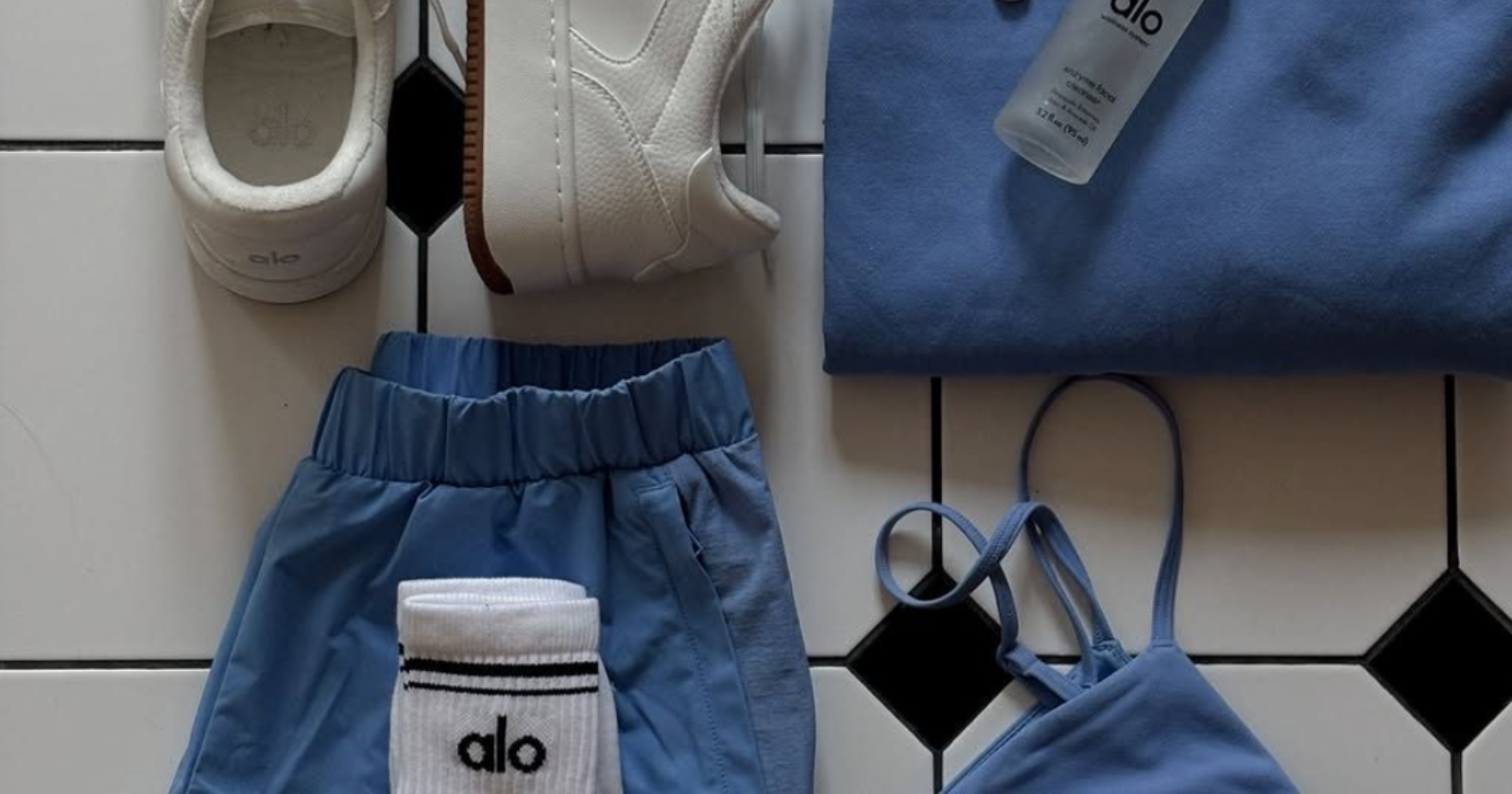
Alo feels premium because it is controlled, not because it is loud. The visuals stay minimal. The tone stays clean. The product is styled like an everyday uniform. That consistency is the whole point. In 2026 attention is fragmented, and the brands that win are the ones a customer can recognize in half a second.
The transferable lesson is that positioning has to be clear before campaigns scale. When a website, product page, and campaign tell different stories, the customer has to work harder to understand the offer. That is where coherent brand identity work becomes the foundation every channel sits on.
- Alo's messaging keeps returning to wellness, intention, and routine.
- The look holds steady across social, retail, and product pages.
- The brand reads as elevated because it is restrained, not because it shouts.

Alo Marketing Strategy Lever 1: Influencer Seeding That Becomes Owned Creative
Alo's real advantage is not the celebrities. It is what Alo does with them. The brand treats seeding as the start of an owned-content pipeline, not the finish line. Kendall Jenner's "Luxury Is Wellness" campaign is the visible part. The repeatable part is what happens next: Alo carries that same visual language across email, paid social, product pages, and in-store screens.
If you run a business, the takeaway is not "use celebrities." It is "build a repeatable content system."
- Use creator content to feed your owned channels, not replace them.
- Build a visual template so every asset reads as the same brand.
- Keep landing pages and product journeys aligned with the campaign. Strong UI/UX fundamentals support the experience, while a focused UX audit can help identify friction when the problem is harder to diagnose.
Alo Marketing Strategy Lever 2: Retail as a Media Channel, Not Just a Store
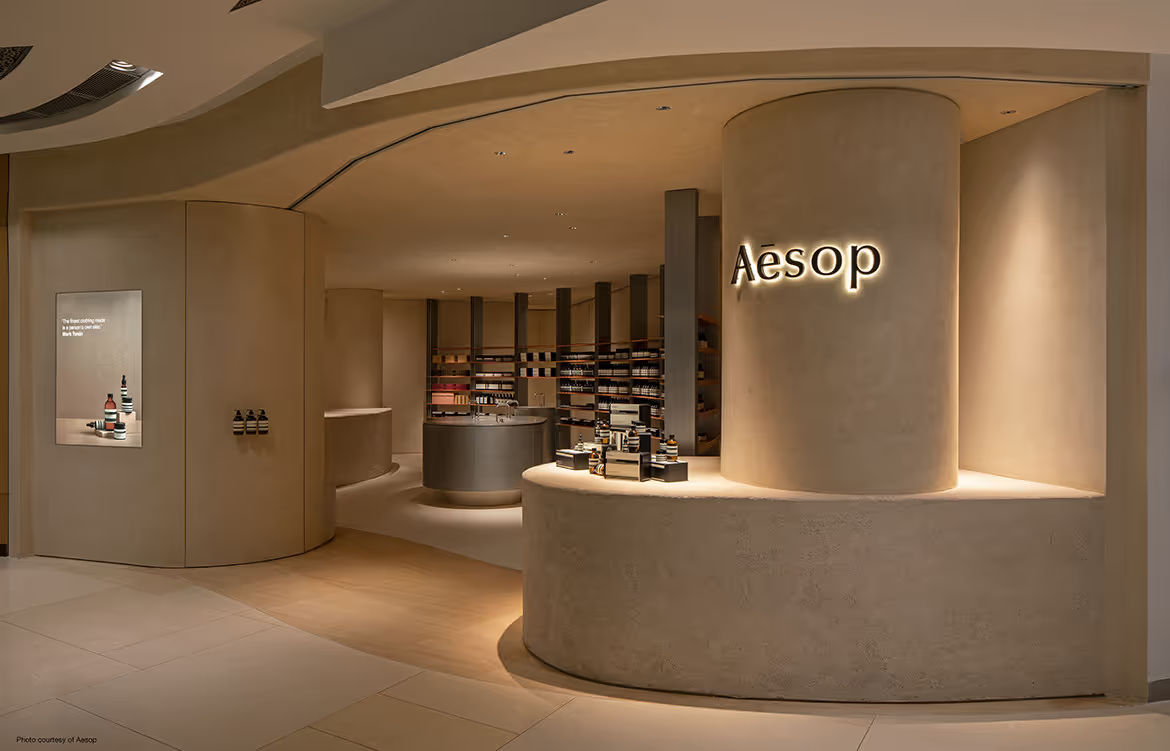
Alo's stores are built as sets, not shops. The lighting, the layout, the calm neutrality, and the product presentation are all designed for filming, photos, and social storytelling. This is retail as media, and it is one of the most transferable parts of the playbook.
You do not need stores to think this way. A showroom, a clinic, a studio, even your packaging and unboxing can be designed as content. When the environment is consistent, content costs drop and trust rises. Alo's international push reads the same way: its move into the UK and Europe treats physical presence as a growth lever, not a cost line.
- Design spaces customers want to photograph.
- Match the physical environment to the digital brand identity.
- Treat retail and experience as a marketing surface that compounds.
- For multi-location retailers, local SEO for retail locations helps customers find accurate addresses, opening hours, and useful location pages before a visit.
Alo Marketing Strategy Lever 3: Experiential Marketing That Matches the Product
Alo's events work because they reinforce the core promise instead of decorating it. That is why its New York Fashion Week activations feel credible. Alo does not pretend to be a traditional luxury house. It shows up as the wellness operator inside a fashion ecosystem, which is the shape of its IMG partnership for NYFW wellness programming. The value is association, not just visibility. Alo places itself where culture is happening, then routes the attention back to the practice.
The 2026 lesson for smaller brands: experiential only works if it reinforces your positioning. Random events leave a weak brand memory.
- Build experiences that show the product promise in real life.
- Use events to generate months of content, not one weekend of noise.
- Point every activation at a clear conversion path, which is where web design matters. If the existing site no longer supports the journey, a website redesign may be the more appropriate fix.
Alo Marketing Strategy Lever 4: Retention Through Alo Wellness Club
Alo's ecosystem does not stop at apparel. The platform that became Alo Moves has since evolved into the Alo Wellness Club, which now offers thousands of on-demand wellness classes and programs for free. That makes the retention lesson even clearer: the brand can stay in a customer's routine even when no product is being purchased.
For a wellness brand, that kind of utility turns content into a relationship layer. It also fits a broader health and wellness marketing principle: education, routine, and community can reinforce trust between transactions.
For other businesses, the question is what keeps a customer engaged between purchases or need-states. Education, routines, community, tools, or useful content can each create a reason to return.
- Build a content rhythm that keeps customers engaged.
- Create a next step that is not always a purchase.
- Use owned content to reduce dependence on paid channels, backed by an SEO strategy that compounds.
Alo Marketing Strategy Lever 5: Category Expansion With a Wellness Rationale
Alo expands categories without losing the frame. Skincare, footwear, and premium capsules are all positioned as wellness-adjacent, which is why the brand can stretch into beauty and keep its credibility.
The best category expansion is not "what can we sell next." It is "what can we sell next that still makes sense inside our story." That is how a brand avoids dilution, and it leans hard on a consistent visual identity system across every new line.
- Expand only when you can explain why it fits the promise.
- Keep the visual system consistent across every new category.
- Make sure your information architecture supports growth: navigation, collections, and filtering.
Digital Culture Plays: Roblox, Social Proof, and the Modern Brand Loop
Alo's Roblox experience, Sanctuary, is a lesson in restraint, not trend-chasing. It still looks and feels like Alo. The brand did not abandon its identity to chase a platform.
That is where many brands get digital culture wrong: they reach for "viral" without brand consistency. Alo uses new platforms as an extension of the same ecosystem rather than as a separate personality. Glossier's community-led marketing offers a different beauty-category example of the same principle, where audience participation works because the core brand remains recognizable.
- Test new platforms only when you can stay on-brand.
- Build experiences that create content, not just impressions.
- Keep your brand cues consistent across every channel.
Values and Credibility: Alo Gives as a Proof Point
Alo's values marketing works because it is structured and visible, not because it is loud. Alo Gives provides free yoga and mindfulness resources aimed at schools and families, which backs the wellness claim with something concrete.
For business owners, the takeaway is not "start a cause." It is "build proof." If your brand claims a value, show the work in a way a customer can verify.
- Build one visible proof point that supports your brand promise.
- Make it repeatable, not a one-time campaign.
- Tie credibility to community and education, not only messaging.
What Brands Can Learn From Alo Yoga's Marketing Strategy
- Write one positioning sentence your customers can repeat, and let your brand strategy flow from it.
- Turn creator visibility into a repeatable owned-content system.
- Treat your physical environment as a marketing surface.
- Create a retention loop that keeps customers engaged between purchases.
- Expand categories only when the brand story makes the move feel inevitable.
- Tighten UX so attention turns into action with less friction. The same fundamentals apply whether you run an ecommerce or B2C brand or sell services.
- Invest in compounding channels like organic search.
- Keep the brand identity consistent across every touchpoint. The same discipline applies in Brand Vision's branding support for San Francisco businesses, from websites and email to luxury packaging.
Alo Marketing Strategy: Frequently Asked Questions
What is Alo Yoga's marketing strategy?
Alo Yoga's marketing strategy is a connected system rather than a single tactic. Positioning sets wellness as a premium lifestyle, creator seeding feeds an owned-content pipeline, stores act as media stages, Alo Wellness Club keeps the brand inside a customer's routine, and category expansion stays inside the wellness frame. The strength is that each part reinforces the others.
How does Alo Yoga use influencer marketing?
Alo treats influencer and celebrity seeding as the start of a content pipeline, not the goal. It turns moments like Kendall Jenner's "Luxury Is Wellness" campaign into owned assets it reuses across email, paid social, product pages, and in-store screens. The repeatable system, not any single post, is the real advantage.
How much revenue does Alo Yoga generate?
Alo is privately held, so exact brand-level revenue is not public. Reuters reported that its parent explored a 2023 investment at a valuation of roughly $10 billion, while Forbes later estimated parent-company revenue was approaching $2 billion. Those figures should not be presented as Alo-only revenue.
What makes Alo Yoga's branding feel premium?
Alo's branding feels premium because it is controlled, not loud. The visuals stay minimal, the tone stays clean, and the product is styled like an everyday uniform, so the brand is recognizable in half a second. Premium reads as restraint here, not as luxury codes.
What can a small business learn from Alo's marketing?
The transferable lesson is to build a system, not a campaign. Get the positioning crisp, turn content into a repeatable pipeline, design your physical and digital touchpoints to match, and add a retention loop that keeps customers engaged between purchases. You do not need Alo's budget to apply the structure.
How to Apply Alo's Marketing Strategy to Your Brand in 2026
Strip Alo's marketing down to fundamentals and it becomes a system: identity, content, retail, digital utility, and retention reinforce one another. A practical order is to make the positioning unmistakable, align the visual identity, make the website easy to use, then add growth loops such as creator content, owned media, and retention.
Alo's real lesson is not the celebrities or the stores. A brand that feels present across many channels usually decided early what it wanted to mean and kept repeating that idea consistently.
If your team is deciding which parts of that system need attention first, Brand Vision's marketing consultation can help map the priorities without forcing every tactic into the same plan.


.avif)