
Sports marketing is easiest to overstate when attention and business performance are treated as the same thing. The campaigns below are enduring examples because they created memorable brand platforms, distinctive athlete associations, or unusually large cultural moments. Where revenue, sales, or volume figures are available, they are presented as business context rather than proof that one campaign caused the result. For a broader framework, Brand Vision’s brand strategy work starts with the same question: what should the audience remember when the campaign is over?
These ten examples span long-running slogans, athlete partnerships, event production, sponsorship activation, and product-led storytelling. Their common thread is not one media format. It is consistency between the promise, the creative system, and the customer experience. The message also has to stay recognizable when people move from awareness to research, shopping, or signup.
1) Nike, “Just Do It” (1988 →)
“Just Do It” gave Nike a durable platform broad enough to work across sports, athletes, and generations. Its strength is strategic rather than numerical: the line can hold highly specific stories while keeping the same underlying invitation to act. Nike reported $9.553 billion in fiscal 1998 revenue, a useful marker of the company’s scale a decade after the platform launched, but that figure should not be read as revenue caused by the slogan alone. (Q4 Capital)
The lesson is platform discipline. A sports campaign can stay useful for decades only when product, athlete storytelling, distribution, and creative execution keep renewing the idea. For brands building a similarly repeatable system, the challenge is to make the branding recognizable while the stories change, and make the web design carry that same promise through to action.
- Why it mattered: a simple behavioral idea that could flex across sports and audiences.
- Business context: Nike’s later company growth shows the scale of the brand system, not a standalone attribution result.
2) PUMA, Usain Bolt Olympic era (2008–2016)
Usain Bolt gave PUMA an unusually clear athlete association: speed, confidence, and celebration. That fit helped the brand create a distinctive story during a period when it was competing with larger sportswear rivals. Reuters reported that PUMA’s quarterly sales rose 7% to €827 million while Bolt remained a central brand figure, but the result reflects the broader business and should not be attributed to one athlete alone (Reuters).
The more transferable lesson is athlete-brand fit. Strong partnerships compress a complicated positioning idea into a person audiences understand quickly. That same principle matters when building a brand identity: distinctiveness improves when the people, visual system, and message point in the same direction.
- Why it mattered: a highly legible athlete association strengthened PUMA’s speed positioning.
- Business context: Reuters reported sales growth during the Bolt era, without establishing Bolt as the sole cause (Reuters).
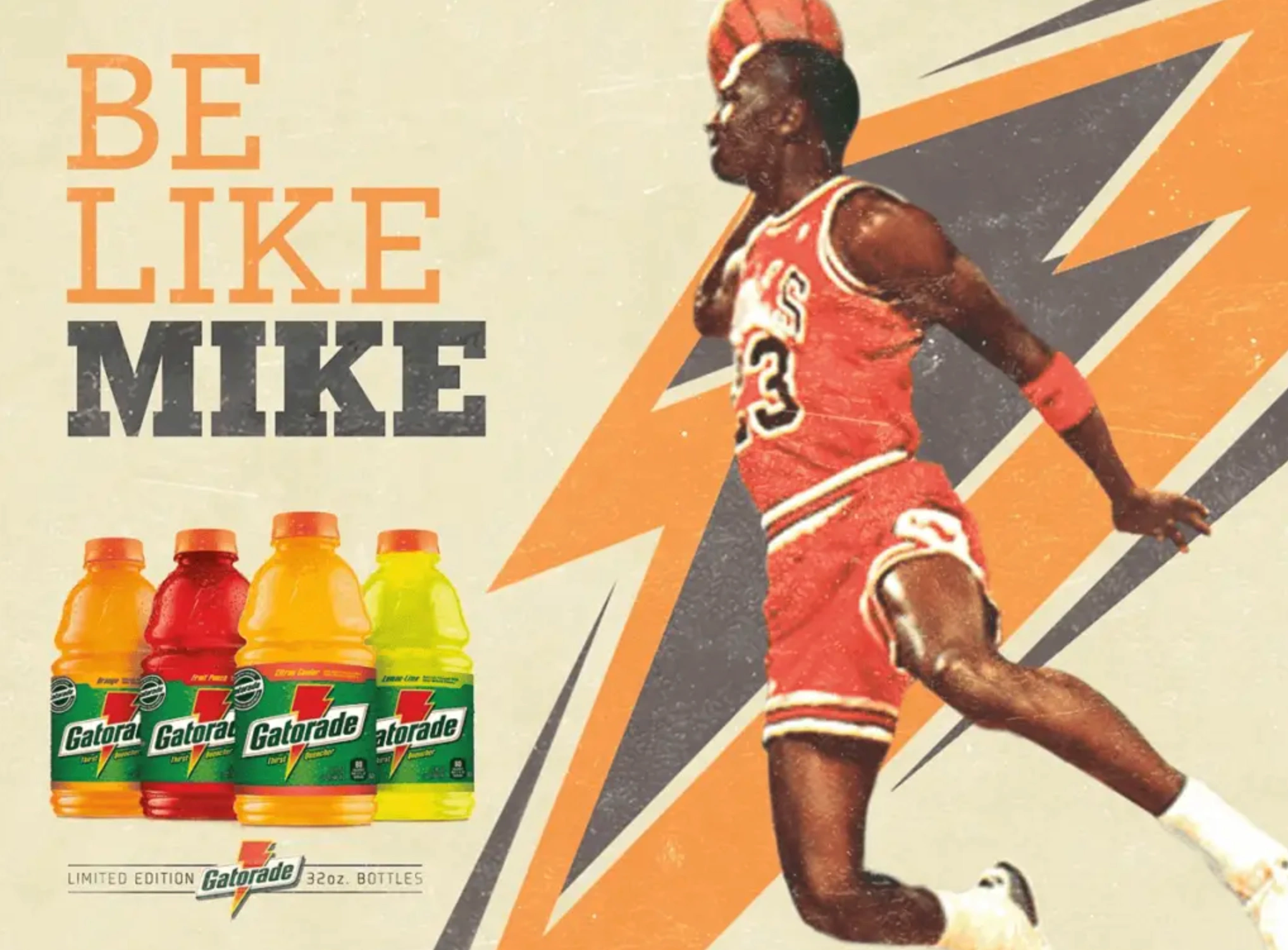
3) Gatorade, “Be Like Mike” (1991)
“Be Like Mike” connected Gatorade’s functional role in sport with the aspiration surrounding Michael Jordan. The campaign did not need to explain every product attribute. It made the drink part of a recognizable athlete story and helped turn performance hydration into a cultural image. Without a campaign-specific audited revenue figure in this article’s sources, the strongest conclusion is about positioning and memory rather than direct sales attribution.
That distinction matters. The best sports campaigns often make a product easier to remember before they make it easier to measure. At Brand Vision, the comparable task is aligning messaging with a consistent visual identity so repeated exposure builds recognition rather than a series of disconnected impressions.
- Why it mattered: linked product utility to an athlete identity audiences already understood.
- Measurement lesson: evaluate brand memory, consideration, and commercial performance separately rather than assuming one proves the other.
4) Red Bull, “Stratos” (2012)
Red Bull Stratos turned a branded event into global media. YouTube’s official recap says the mission drew more than 8 million concurrent livestream viewers, while Forbes separately reported the same milestone in business media (YouTube Blog; Forbes). That scale makes Stratos one of the clearest examples of a brand producing the spectacle rather than only buying media around one.
Stratos is useful because the evidence matches the claim: the campaign generated extraordinary live attention and a reusable content library. It does not require an unsupported revenue claim to be strategically important. Brand Vision applies the same long-tail logic when campaign content is designed to keep working across channels after launch.
- Why it mattered: demonstrated brand-as-broadcaster at global scale.
- Measured result: more than 8 million concurrent livestream viewers on YouTube (YouTube Blog).
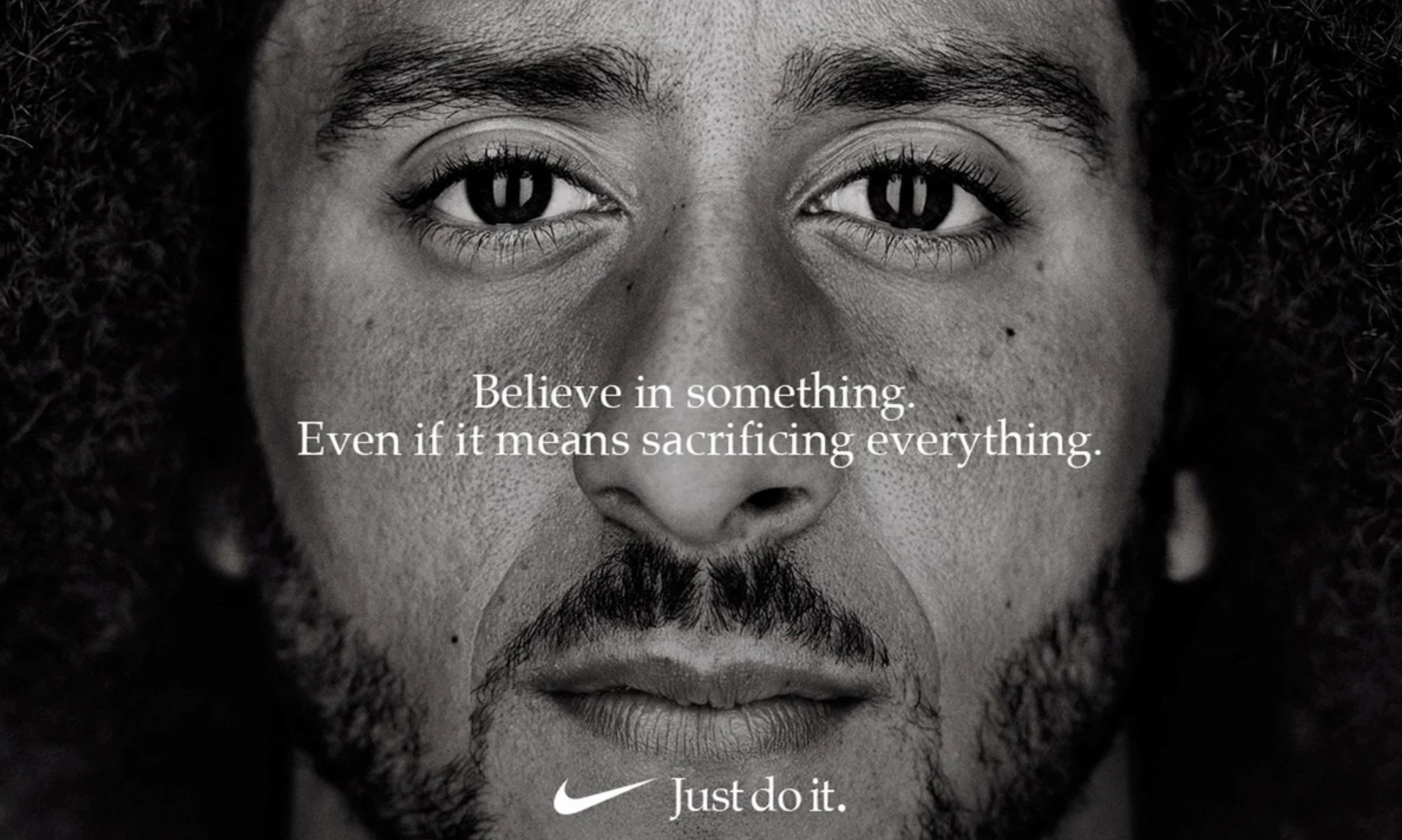
5) Nike, “Dream Crazy” (2018, Colin Kaepernick)
Nike’s “Dream Crazy” made a deliberate values-based choice with Colin Kaepernick at the center. TIME reported an Edison Trends estimate that Nike online sales rose 31% from Sunday through Tuesday after launch compared with the same period a year earlier (TIME). That is useful short-term context, but it is an outside estimate over a narrow window and does not prove the campaign caused Nike’s longer-term business performance.
The strategic lesson is audience clarity. Values-based creative can strengthen relevance when the position is credible, but it also creates real disagreement. Brand Vision treats that as a positioning decision rather than a shortcut to growth: the claim, audience, and customer experience have to support one another.
- Why it mattered: put a clear social position inside a major sports platform.
- Measured context: Edison Trends estimated a short-term online sales increase after launch; the figure is not a long-term causal study (TIME).
6) Under Armour, “Protect This House” (2003 →)
“Protect This House” gave Under Armour a locker-room phrase that people could repeat. Under Armour’s corporate history identifies it as the company’s first national television ad in 2003. The company later surpassed $1 billion in annual revenue in 2010 after nearly quadrupling revenue over five years. Its 2010 Form 10-K reported $997.8 million in net revenues for that fiscal year (SEC). Those growth figures describe the company’s rise, not a revenue number attributable to one slogan.
The campaign is still instructive because it shows how an emerging brand can enter a category with a strong point of view. Repetition, team identity, and a clear voice made the brand easier to recognize before Under Armour had the scale of older competitors.
- Why it mattered: established a repeatable team-first voice for an emerging performance brand.
- Business context: Under Armour scaled rapidly through the period, as documented in public filings, without isolating the campaign as the cause (SEC).
7) Air Jordan and Jordan Brand, athlete as empire (1984 →)
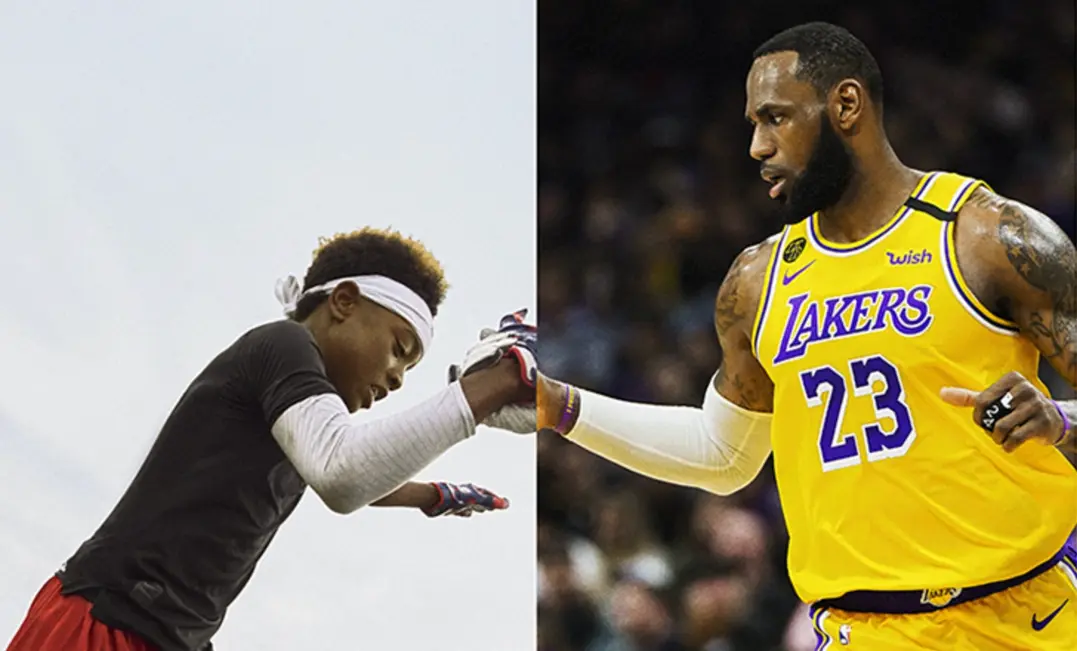
Air Jordan is less a single campaign than a long-running athlete-led brand system. A signature shoe became Jordan Brand, with its own products, visual language, athlete roster, and cultural meaning. Reuters reported in 2024 that Jordan Brand represented about 16% of Nike’s wholesale revenue, showing the scale the sub-brand eventually achieved inside Nike (Reuters). That current scale should not be treated as an attribution number for the original 1984 launch.
The durable lesson is ecosystem design: an athlete partnership can grow beyond endorsement when the product, identity, community, and distribution develop together. Brand Vision applies that system view across branding and web design, where the brand has to remain coherent as the offer expands.
- Why it mattered: helped establish the modern model for athlete-led product and brand building.
- Business context: Jordan Brand later became material to Nike’s wholesale mix, illustrating the scale of the ecosystem rather than the isolated effect of one campaign.
8) Coca-Cola, FIFA World Cup 2010 activation
Coca-Cola’s 2010 FIFA World Cup program shows how sponsorship can connect a global event with local commercial execution. In Q2 2010, The Coca-Cola Company reported 5% worldwide volume growth and 7% growth in Latin America. More specifically, it said Brand Coca-Cola volume in Latin America rose 7% in the quarter, driven by strong activation of its FIFA World Cup programs (The Coca-Cola Company Q2 2010 results). That company attribution is stronger evidence than simply matching tournament timing with total global performance.
The lesson is operational: sponsorship becomes more useful when media, retail, distribution, and local activation reinforce the same idea. For a consumer brand, that is a B2C marketing challenge as much as a media-buying one. Search can also capture demand after an activation, which is where an SEO program can support the broader journey.
- Why it mattered: linked a global sports property to coordinated local activation.
- Measured context: Coca-Cola explicitly connected Latin American Brand Coca-Cola volume growth to strong World Cup activation in its Q2 2010 results.
9) Beats by Dre, “The Game Before The Game” (2014 World Cup)
Beats framed headphones as part of an athlete’s pre-game mental ritual rather than as a generic electronics accessory. That made the product relevant to sport without requiring Beats to own the tournament itself. Existing case-study coverage discusses how the campaign used athlete emotion, preparation, and football culture to widen attention around the brand (FIU).
Ritual is powerful because it gives a product a role in behavior. The caution is measurement: awareness, purchase intent, and sales are different outcomes and should be tracked separately. The same principle applies in digital journeys, where UI UX should remove friction without pretending interface changes alone caused every downstream conversion.
- Why it mattered: made a tech product feel native to athlete preparation and sports culture.
- Measurement lesson: separate attention and intent signals from verified commercial outcomes.

10) Nike, “Write the Future” (2010 World Cup)
“Write the Future” turned football decisions into cinematic ripple effects around the 2010 World Cup. Nike’s official campaign release says the three-minute film was directed by Alejandro G. Iñárritu, rolled out through Facebook, YouTube, and QQ.com, and aired across 32 countries. That distribution plan is a useful example of creative built to travel across paid, owned, and shared channels (NIKE).
The campaign’s lesson is reach through narrative, not a claim that attention automatically produced a specific revenue result. Timing, stars, production, and distribution helped Nike insert itself into the tournament conversation even though it was not the official FIFA sportswear sponsor.
- Why it mattered: paired cinematic storytelling with a deliberately global distribution plan.
- Business lesson: measure attention, brand response, and commercial outcomes separately instead of treating visibility as sales.
FAQ
What makes a sports marketing campaign successful?
A memorable campaign has a clear role for the brand, distinctive creative, and evidence matched to the outcome being claimed. Attention, brand lift, sales, and long-term company growth should not be treated as interchangeable metrics.
Which examples show the value of athlete-brand fit?
PUMA with Usain Bolt, Gatorade with Michael Jordan, and the long-running Air Jordan system show different ways athlete associations can sharpen positioning and product meaning.
Do values-based sports campaigns drive revenue?
They can influence behavior, but attribution needs discipline. For “Dream Crazy,” the clearest figure here is Edison Trends’ estimated short-term online sales lift reported by TIME, not a claim that the campaign caused Nike’s later company performance.
Are major-event sports activations still useful?
Yes, when the event connects to distribution, retail, content, or a measurable customer action. Coca-Cola’s 2010 reporting is a useful example because the company explicitly tied Latin American Brand Coca-Cola volume growth to strong World Cup activation.
When Story Meets Scoreboard
The ten examples here are worth studying because they show different mechanisms: a durable platform, athlete fit, aspiration, owned spectacle, values, category entry, sub-brand building, sponsorship activation, ritual, and cinematic distribution. The evidence is not equally strong for every commercial claim, so the useful discipline is to match the metric to the story. Brand memory can be meaningful without a revenue attribution model, and company growth can provide context without proving a campaign caused it. Brand Vision’s marketing metrics guide offers a practical framework for separating acquisition, conversion, retention, and brand signals.
How Business Owners Can Apply These Sports Marketing Lessons
Sports campaigns look like entertainment, but the transferable mechanics are straightforward. Start with one promise people can repeat, support it with a recognizable visual system, and build a customer journey that makes the promise credible. A regional activation needs the same discipline. For example, a business comparing a Chicago marketing agency for an event-heavy campaign should look for local execution that still fits the master brand rather than a disconnected one-off.
Brand Vision approaches campaigns as connected systems. Strong branding clarifies the promise, web design gives demand somewhere useful to land, and UI UX reduces friction after interest is created. The goal is not to copy Nike or Red Bull’s scale. It is to make strategy, creative, distribution, and measurement agree. If you are building a campaign platform of your own, you can contact Brand Vision to discuss the brand and digital system behind it.