Best 7 AI Chatbot Apps for Your Mental Health in 2026
Updated on
Published on

Mental health support is evolving rapidly, and in 2026, AI chatbot apps have become an increasingly mainstream resource for people managing stress, anxiety, depression, and emotional burnout. Recent surveys show that over one in three adults has used an AI chatbot for mental health support, with usage as high as 64 % among 25–34-year-olds, highlighting just how widespread these tools have become as traditional services struggle with long wait times and rising costs.
Clinical research also supports the potential benefits of these tools: meta-analyses of more than 29,000 participants show small-to-moderate improvements in depressive, anxiety, and stress symptoms when users engage with AI chatbots, and programmes that integrate evidence-based CBT techniques can yield measurable symptom reduction. Yet experts continue to urge caution, recent reports reveal that some general-purpose AI chatbots struggle to handle crisis situations appropriately, and regulatory and safety concerns are making headlines in 2025 as courts and health authorities scrutinise their use.
While no AI chatbot replaces a licensed therapist, these tools are bridging gaps in access and affordability by offering 24/7 support, mood tracking, CBT-based exercises, and personalised insights that many users find helpful in day-to-day emotional regulation. This guide reviews the best 7 AI chatbot apps for mental health in 2026, ranking them on effectiveness, usability, innovation, safety, and trustworthiness, so you can find the right digital support for your emotional well-being.
What Are AI Chatbots?
AI chatbots are software applications powered by artificial intelligence and natural language processing (NLP) that can understand, respond to, and learn from human conversation.
In mental health, AI chatbots are designed to:
- Simulate supportive, empathetic conversations
- Deliver evidence-based techniques like Cognitive Behavioral Therapy (CBT)
- Help users track mood, thoughts, and behaviors
- Offer coping strategies for stress, anxiety, and emotional overwhelm
Research shows that AI mental health chatbots can lead to 20–30% reductions in anxiety and depression symptoms in short-term use, especially for mild to moderate conditions. Their greatest strength lies in accessibility and consistency, offering support anytime users need it.
How We Selected the Best AI Chatbots
Selecting the best AI chatbots for mental health requires more than popularity or flashy features. For this list, we focused on real-world usefulness, trust, and mental health relevance, not just technical capability.
Each AI chatbot was evaluated using the following criteria:
1. Mental Health Specialization
We prioritized chatbots built specifically for emotional support and mental wellness, not general-purpose AI assistants retrofitted for therapy use. Apps needed a clear focus on anxiety, stress, mood regulation, or emotional reflection.
2. Evidence-Based Techniques
Preference was given to chatbots that use or reference established psychological frameworks such as:
- Cognitive Behavioral Therapy (CBT)
- Mindfulness-based stress reduction
- Emotional regulation and reflective journaling
Tools grounded in evidence-based practices consistently show 20–30% symptom reduction in mild to moderate anxiety and depression when used regularly.
3. User Experience & Engagement
Mental health tools only work if people actually use them. We assessed:
- Conversational tone (empathetic vs. robotic)
- Ease of use and onboarding
- Daily engagement features like reminders, summaries, and check-ins
Apps that feel supportive and intuitive scored higher than those that felt clinical or overly technical.
4. Privacy, Trust & Transparency
Because mental health data is deeply personal, we evaluated:
- Clarity of privacy policies
- Data control options (opt-out, deletion)
- Clear disclaimers that the app is not a replacement for professional care
Trustworthy platforms were ranked higher than apps with vague or opaque data practices.
5. Innovation & Long-Term Value
Finally, we looked at whether the chatbot offered:
- Personalization over time
- Emotional pattern recognition
- Insights that evolve as the user continues using the app
Best AI Chatbots for Mental Health in 2026
1. Abby.gg — Best Overall AI Mental Health Companion (Editor’s Pick)
Abby.gg earns the top spot for its well-rounded, deeply personalized approach to mental wellness. More than just a chatbot, Abby functions as a daily AI thought and emotional companion, combining empathetic conversation with reflective journaling and long-term emotional insights.
What makes Abby stand out is its ability to summarize emotional patterns over time, helping users understand recurring stressors, mood shifts, and triggers. The app feels less like a tool and more like a supportive presence that grows with you.
Key Features:
- AI-driven emotional conversations
- Reflection and journaling tools
- Personalized insights and summaries
- Voice and text input options
- Strong focus on self-awareness and balance
Best for: Daily emotional support, reflection, and long-term mental clarity
Why it’s #1: Abby offers the most holistic, companion-style experience among AI therapy apps.
2. Wysa — Best Clinically Grounded AI Chatbot
Wysa is one of the most established AI mental health chatbots, used by millions worldwide. It relies heavily on CBT, DBT, and mindfulness techniques, guiding users through structured exercises to challenge negative thoughts and manage stress.
Wysa also offers optional access to human coaches, making it a strong hybrid solution for users who want both AI and human support.
Best for: Evidence-based CBT exercises and anxiety management
Standout strength: Clinical credibility and structured programs
3. Woebot — Best CBT-Focused AI Therapist
Designed by psychologists, Woebot is built specifically around CBT principles. It uses short, daily conversations to help users identify cognitive distortions, reframe thoughts, and build emotional resilience.
Clinical studies have shown Woebot can significantly reduce symptoms of anxiety and depression when used consistently.
Best for: Users who want science-backed CBT in bite-sized form
Standout strength: Strong research foundation
4. Youper — Best for Mood Tracking & Personalization
Youper combines AI conversations with detailed mood tracking. It uses emotional data to tailor sessions and insights, helping users recognize patterns and triggers over time.
The app is particularly appealing to people who like seeing data-driven insights into their emotional well-being.
Best for: Mood tracking and personalized emotional insights
Standout strength: Analytics-driven self-awareness
5. Replika — Best for Emotional Companionship
With tens of millions of users, Replika is one of the most popular AI companions globally. While not a clinical therapy app, it excels at offering non-judgmental conversation and emotional presence, which many users find helpful for loneliness or social anxiety.
Best for: Emotional companionship and daily conversation
Standout strength: Deeply personalized conversational AI
6. Elomia — Best for Human-Like Therapeutic Dialogue
Elomia is designed to feel like talking to a human therapist. Its conversations focus on self-reflection, emotional processing, and cognitive reframing, making it appealing to users who prefer deeper dialogue rather than structured exercises.
Best for: Reflective, therapist-style conversations
Standout strength: Natural, empathetic interaction
7. Tess (by X2AI) — Best for Multilingual & Global Use
Tess is widely used by organizations, healthcare providers, and NGOs. It delivers CBT-based mental health support via multiple platforms (web, SMS, social apps) and supports several languages, making it highly accessible worldwide.
Best for: Global accessibility and multilingual support
Standout strength: Scalability and broad reach
Quick Comparison Table
The table below offers a high-level snapshot to help readers quickly identify which AI chatbot best fits their needs. While all seven tools support mental well-being, their strengths vary significantly.
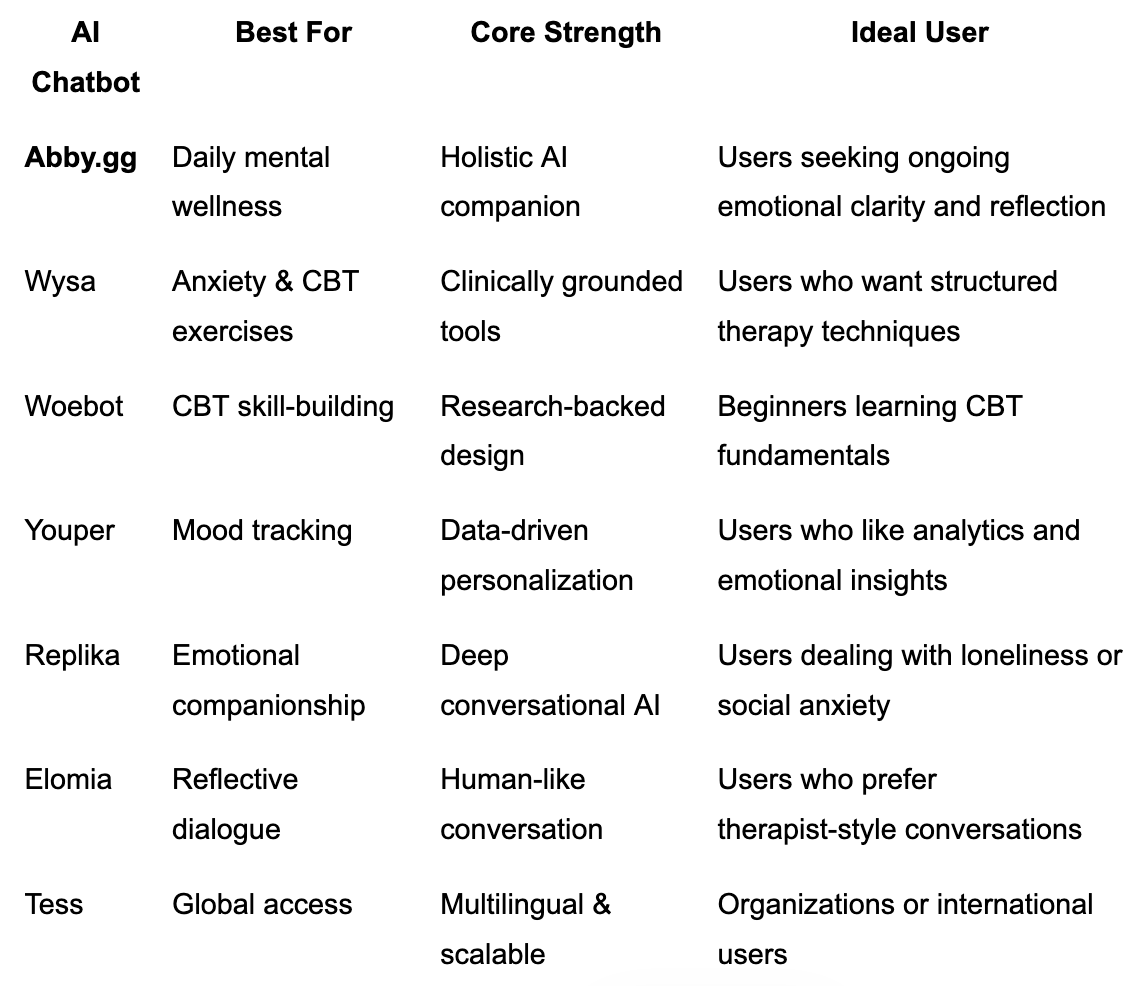
This comparison highlights an important takeaway: there is no single “best” chatbot for everyone, but there is a best option depending on your mental health goals, preferences, and comfort level.
Why AI Chatbots Matter for Mental Health
AI chatbots matter because the mental health system is under strain worldwide. Demand continues to rise, while access to licensed professionals remains limited by cost, location, and long wait times.
AI-powered mental health chatbots help address this gap in several important ways:
24/7 Accessibility
Unlike traditional therapy, AI chatbots are available anytime, late nights, weekends, or during moments of sudden emotional distress. This immediacy can prevent small issues from escalating.
Lower Barriers to Entry
Many people delay seeking help due to stigma, fear, or uncertainty. Chatbots provide a low-pressure, judgment-free starting point, helping users ease into mental health support.
Affordability at Scale
With many apps offering free or low-cost plans, AI chatbots make mental health support accessible to people who might never afford traditional therapy.
Consistency & Self-Awareness
Regular check-ins and journaling help users build emotional awareness. Over time, this consistency leads to better coping skills and early recognition of stress patterns.
Supplement — Not Replace — Human Care
AI chatbots work best as support tools, not replacements. They complement therapy by reinforcing skills, tracking progress, and offering daily guidance between sessions.
As research continues to evolve, AI chatbots are becoming a meaningful part of the mental health ecosystem, especially for early intervention and ongoing self-care.

Are AI Chatbots Effective for Mental Health in 2026?
AI chatbots for mental health have moved far beyond novelty. In 2026, they represent a practical, scalable, and increasingly trusted form of emotional support.
From Abby.gg’s companion-style approach to Woebot’s CBT precision and Wysa’s clinical grounding, today’s best AI chatbots offer something previous generations of mental health tools could not: personalized support at any moment it’s needed.
That said, these tools are most powerful when used responsibly. They are not substitutes for licensed therapists, especially for severe or complex mental health conditions. Instead, they act as bridges, helping people build awareness, resilience, and healthier habits over time.
For millions facing stress, anxiety, or emotional overload, AI chatbots are no longer “nice to have.” They are becoming essential tools for everyday mental well-being.