Branding terms are the shared language behind decisions like “Are we premium or practical?” and “Do we need a rebrand or a redesign?” When teams use the same words differently, projects drift, feedback gets subjective, and measurement turns into argument.
The pressure is real. In May 2024, Nielsen reported that 70% of marketers planned to increase performance marketing spend at the expense of brand building. When short-term goals dominate, the only way brand work survives is if it is clear, scoped, and tied to real choices.
At Brand Vision, we treat branding as a system, not a set of files. Systems scale across campaigns, teams, and touchpoints, including the ones you do not think of as “marketing.”
Where vocabulary typically breaks a project:
- Someone asks for a “new brand” but really needs tighter positioning and message pillars.
- A team debates the logo for weeks because the promise and audience priorities were never agreed.
- Marketing reports clicks while leadership expects preference, pricing power, and trust.
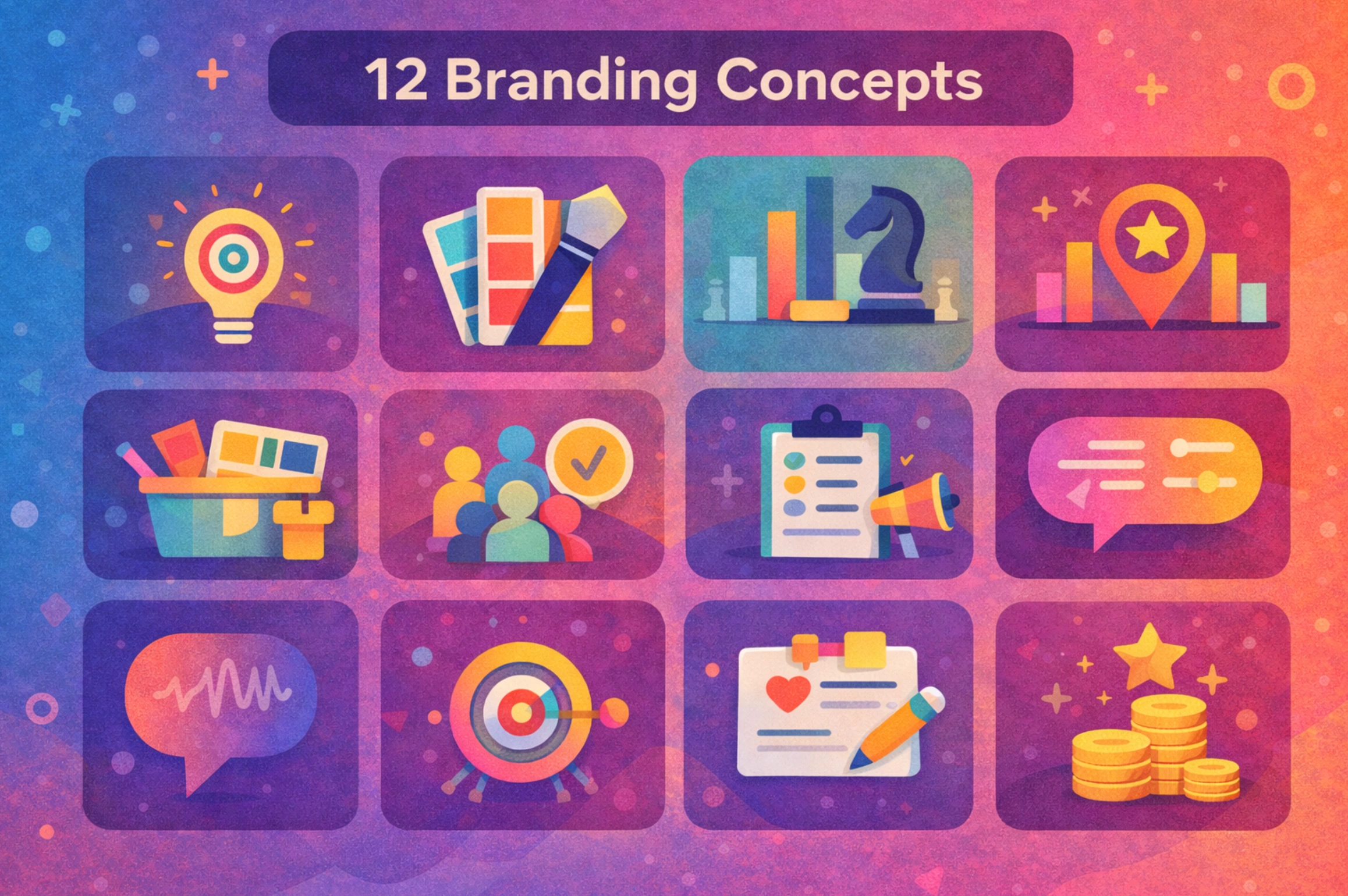
At A Glance: 12 Branding Terms Most Teams Use Weekly
These are the terms that show up in briefs, decks, design reviews, and campaign planning sessions.
- Brand: The associations people hold about you, plus the cues that trigger them.
- Branding: The work of shaping those associations through choices you control.
- Brand Strategy: The decisions that define who you serve and how you win.
- Brand Positioning: The space you want to own in a buyer’s mind versus alternatives.
- Value Proposition: The specific value a customer gets and why it is credible.
- Target Audience: The group you are choosing to serve, defined to a usable level.
- Messaging Framework: The structured set of messages used across channels.
- Brand Voice: Your consistent personality in words.
- Tone of Voice: How that voice flexes by context (support vs. launch).
- Visual Identity: The visual system people recognize (logo, type, color, imagery).
- Brand Guidelines: The rules and examples that keep teams consistent.
- Brand Equity: The extra value your name carries, based on familiarity and trust.
How We Chose the “Most Important”
Branding has hundreds of terms. This list focuses on the ones most teams use to make real decisions.
We prioritized terms that are:
- Frequent: used weekly across leadership, marketing, product, and creative
- High-impact: misunderstood terms create rework and weak differentiation
- Deliverable-linked: the term shows up in a brief, a deck, or a system someone has to maintain
Where definitions vary, we anchor the basics to widely used industry definitions, including the American Marketing Association.
Core Strategy Terms (The Ones That Drive Direction)
These terms set direction. If they are clear, creative gets faster and brand stays consistent under pressure.
High-impact terms:
- Brand: What people associate with you and what they expect when they choose you.
- Common confusion: brand is not a logo. The logo is a cue for the brand.
- Branding: The ongoing work of shaping what the brand means in the market.
- Practical test: if it changes behavior over time, it is branding. If it is just a file, it is an asset.
- Brand Strategy: The set of choices that guide positioning, messaging, identity, and experience over time.
- Where it shows up: strategy decks, creative briefs, go-to-market planning, hiring narratives.
- Helpful reference: see our guide to brand strategy.
- Brand Positioning: The space you want to own in a buyer’s mind, for a specific audience, relative to real alternatives.
- Mini example: “The fastest way for mid-market finance teams to close the month without spreadsheet chaos.”
- If you want patterns across categories, use these brand positioning examples.
- Positioning Statement: The internal sentence you use to express positioning with precision. It is not always customer-facing, but it keeps teams aligned.
- A common template: “For [target audience], [brand] is the [category] that [primary benefit] because [reason to believe].”
- Common mistake: writing a positioning statement that is really a mission statement, or that avoids competitors entirely.
- Category: The mental bucket buyers put you in, which shapes comparisons and proof expectations.
- Common mistake: trying to be “category-free” while buyers still compare you to something.
- Differentiation: The reason a buyer should choose you over the next best option, beyond price.
- Common mistake: calling every feature a differentiator. A differentiator changes preference.
- Value Proposition: The specific value a customer gets, stated in a way they recognize and can validate.
- Common mistake: using vague claims like “everything you need” without proof.
- Unique Value Proposition (UVP): The narrowest, clearest version of your value proposition for a defined audience.
- Mini example: “Same-day refunds for SMB travel, with policy-level controls for finance.”
- Practical deep dive: our guide to a unique value proposition breaks down how to write and test one.
- Unique Selling Proposition (USP): A single, defensible claim often used as a campaign hook.
- Common confusion: USP is usually narrower than positioning. A promo is not a USP.
- Brand Promise: What customers can reliably expect when they choose you, across product, service, and experience.
- Common mistake: promising what only the best-case experience delivers.
Supporting strategy terms (useful, but often over-written):
- Brand Platform: The core statements that explain why the brand exists and how it behaves.
- Purpose: The deeper reason you exist beyond profit, stated in a way that guides priorities.
- Mission: What you do today and for whom.
- Vision: The future you are working toward.
- Values: The behaviors you protect and enforce, even when it costs you something.
-1.webp)
Audience And Market Terms (Who It’s For And What You’re Competing Against)
These terms keep you honest about who you serve and what the buyer is actually choosing between.
- Ideal Customer Profile (ICP): The type of customer or company that gets outsized value from your offer.
- Common mistake: defining ICP so wide that your messaging becomes generic.
- Buyer Persona: A model of a person involved in the decision, including motivations, objections, and context.
- Common mistake: turning personas into stereotypes instead of decision tools.
- Jobs To Be Done (JTBD): A way to define what the customer is trying to accomplish in a situation, including the progress they want and the tradeoffs they accept.
- Why it matters: JTBD language often produces clearer positioning than demographics.
- Mini example: “Help me get a contract approved without chasing six people on email.”
- Segmentation: Dividing the market into groups with meaningfully different needs or buying triggers.
- Practical note: the best segments are need-based, not just demographic.
- Target Audience: The segment you choose to serve first, defined to a level that guides creative and channel choices.
- Common mistake: targeting “everyone” and hoping the market self-selects.
- Competitive Set: The shortlist a buyer compares you against, including substitutes and internal options.
- Common mistake: listing only the brands you admire, not the ones you lose to.
- Category Alternatives: The “do nothing” or “use what we have” options. In many markets, inertia is the biggest competitor.
- Customer Insight: A true, specific observation about what buyers need or fear, backed by evidence.
- Common mistake: treating assumptions as insights.
- Reasons To Believe (Proof Points): The evidence that makes your claims credible, such as metrics, demos, reviews, or third-party validation.
- Common mistake: listing features instead of proof.

Messaging And Voice Terms (How The Brand Sounds)
Messaging turns strategy into language people remember and repeat. Voice makes that language feel consistent across channels and writers.
- Messaging Framework: The structured set of messages used across channels, often including pillars, key messages, and proof points.
- Common mistake: treating the framework as copy you paste everywhere, instead of building blocks.
- Message Pillars: The 3 to 5 themes you want to be known for.
- Common mistake: making pillars so broad they could fit any competitor.
- Key Messages: Short statements that support each pillar and are easy to say out loud.
- Practical test: if it does not survive a sales call, it is not a key message.
- Brand Narrative: The coherent story of who you are, why you exist, and why now.
- Common mistake: writing a narrative that is inspirational but not specific.
- Tagline: A long-lived line that captures the brand idea and often sits near the logo.
- Slogan: A campaign-level line that can change by season, product, or promotion.
- Brand Personality: The human traits you want associated with the brand (direct, optimistic, precise, playful).
- Brand Voice: Your consistent personality in writing, regardless of channel.
- Tone of Voice: How that voice flexes by context while staying recognizably “you.”
Don’t Confuse Voice, Tone, And Messaging
Teams mix these up because they all show up in copy.
- Voice is the baseline personality (consistent over time).
- Tone is the situation-specific expression of that voice (varies by moment).
- Messaging is what you are saying (your strategic content, organized into pillars and proof).
A quick way to test the difference:
- If you rewrite the same message for a press release and a support article, the message stays similar but the tone changes.
- If the team cannot agree on what the message is, you have a strategy or positioning problem, not a tone problem.
A simple mini example, same voice, two tones:
- Launch page tone: “Get to clarity faster with reporting you can trust.”
- Support tone: “We’ll help you fix this quickly and make sure it does not happen again.”

Visual Identity And Brand System Terms (What People See And Experience)
Most brand decisions happen in touchpoints: websites, apps, decks, emails, packaging, and support. These terms help you build a system that stays consistent.
Core identity terms:
- Brand Identity: The set of elements you control that represent the brand, including visuals, language, and behaviors.
- Visual Identity: The visual system that makes you recognizable, including logo, type, color, layout rules, and imagery.
- Brand Image: How people actually perceive you, based on experience and reputation. Image can differ from intended identity.
Common visual system terms:
- Logo: The primary mark that identifies the brand. It supports recognition but cannot carry the whole strategy.
- Wordmark: A logo made primarily of the brand name in a specific typographic style.
- Logomark (Symbol): An icon or symbol used to represent the brand, sometimes paired with a wordmark.
- Typography: The font system and rules for hierarchy, spacing, and weights.
- Color Palette: The color system and usage rules that create recognition and hierarchy.
- Imagery Style: Photography, illustration, and motion choices, plus rules for subjects and editing.
- Iconography: The icon set used across product and marketing, designed to feel consistent.
Operational terms teams use daily:
- Brand Assets: Reusable building blocks like logo files, templates, icon sets, and approved imagery.
- Brand Collateral: The materials used to communicate the brand, like decks, one-pagers, email templates, and signage.
- Helpful reference: here is a practical breakdown of brand collateral.
- Brand Guidelines: The rules and examples that show how to use the identity and voice. Good guidelines reduce subjective debate.
- Brand Book: A broader document that often includes strategy context plus identity rules.
- Design System: The reusable components and rules for digital products, including UI patterns, states, and accessibility standards.
- Common mistake: building a design system that ignores brand, then creating two competing systems.
- Brand Touchpoints: The moments where people experience the brand, from ads to onboarding to invoices.
- Brand Experience: The total feel of interacting with the brand across touchpoints, including clarity, speed, and reliability.
Digital experience terms that show up in modern brand work:
- UX (User Experience): How usable and intuitive an experience feels, especially in digital products.
- UI (User Interface): The visual and interactive layer of a digital product.
- Practical tie-in: your website is often the highest-impact touchpoint, which is why teams treat web design and UX and UI design as part of brand consistency.
.webp)
What Goes In Brand Guidelines (Minimum Viable vs Mature)
A guideline doc is only useful if it helps someone make a decision quickly.
Minimum viable guidelines usually include:
- Logo usage rules (spacing, minimum size, color variations)
- Color palette with contrast and accessibility notes
- Typography system (primary and secondary fonts, hierarchy examples)
- Imagery rules with a few do and don’t examples
- Voice and tone basics (a few examples, not a thesis)
- A small set of templates (slides, social, email)
More mature guidelines often add:
- Positioning and message pillars for context
- Component rules that connect to a design system
- Copy patterns for key pages (homepage, product, support)
- Governance: who approves what and how updates are managed
- Examples of common edge cases (partner logos, co-marketing, sub-brands)

Brand Architecture And Growth Terms (How The Portfolio Works)
Architecture terms matter when you expand, acquire, launch new products, or serve different segments. They prevent accidental brand sprawl.
- Brand Architecture: How your master brand, sub-brands, and products relate to each other.
- Branded House: One strong master brand across products (Brand X Product A, Brand X Product B).
- House of Brands: Separate brands for different products, often with minimal parent visibility.
- Endorsed Brand: A distinct brand supported by a parent (Product Y, by Brand X).
- Sub-Brand: A named offering under a master brand that shares equity but signals a distinct promise.
- Naming System (Nomenclature): The logic behind how you name products, plans, and features.
- Co-Branding: Two brands appear together to create joint value (partnership product, campaign, or integration).
- Brand Extension: Moving into a new category using the same brand name.
- Line Extension: Expanding within the same category (new tiers, sizes, versions).
- Trademark: A word, phrase, symbol, design, or combination that identifies your goods or services and distinguishes you from others. The USPTO has a clear overview.
- Practical note: trademark strategy is legal work. Branding teams should know the basics and involve counsel early.
Measurement And Equity Terms (How You Know It’s Working)
Brand measurement is where vague language becomes expensive. If the team cannot agree on success, the brand will be judged on whatever is easiest to count.
Core funnel terms:
- Brand Awareness: Whether people know you exist and can recognize you.
- Recognition: “I’ve seen that brand before.”
- Recall: “I can name a brand in this category without a prompt.”
- Consideration: Whether you make the shortlist when someone is actively choosing.
- Preference: Whether someone would choose you over alternatives, given similar price and availability.
Equity and value terms:
- Brand Equity: The added value your name carries in people’s minds, tied to recognition, perception, and trust.
- Brand Value vs. Brand Valuation: Brand value is the concept that a brand contributes economic value beyond product features. Brand valuation is the method of estimating that value in money terms.
- One reference point: Kantar BrandZ describes a valuation approach that combines financial analysis with measures of brand equity.
Tracking and proxies:
- Brand Health Tracking: Repeated measurement of awareness, consideration, preference, and perceptions over time.
- Share of Voice (SOV): Your share of category exposure, often based on spend, impressions, or mentions.
- Share of Search: Your share of category-related search demand, often proxied by branded search volume versus competitors.
- Helpful reference: this explainer on branded search covers what it can and can’t tell you.
- Brand Lift: Measured change in awareness or perception after a campaign, usually via controlled surveys.
A simple “minimum measurement stack” many teams can start with:
- Awareness and recall (category-level)
- Consideration (shortlist inclusion)
- Preference (choice among alternatives)
- One behavioral proxy tied to brand interest (like share of search), tracked consistently
A practical measurement note: pick a small set of metrics that match the goal, then keep the method stable long enough to learn from it. A brand tracker that changes every month is just noise with a dashboard.

Key Takeaways: How To Use These Terms In A Brand Brief
If you want fewer circular debates and faster execution, treat a brand brief like a decision document. It should force clarity on the terms that matter most.
A simple brand brief checklist:
- Context and goal: what changed, and what decision you need to make.
- Audience focus: ICP and key personas, plus the buying trigger you are solving for.
- Competitive reality: the real shortlist and the “do nothing” alternative.
- Category framing: what you want to be compared against.
- Positioning statement: one sentence that pins down audience, value, and differentiation.
- Value proposition and proof: the claim, plus 3 to 5 reasons to believe.
- Message pillars: the themes you will reinforce across channels.
- Voice and tone: how you will sound, with a few do and don’t examples.
- Identity and touchpoints: what must be consistent across the website, product, and collateral.
- Measurement: which metrics you will track, how often, and what “good” looks like.
If you only produce four artifacts, make them these:
- Positioning statement (and the assumptions behind it)
- Messaging framework (pillars, key messages, proof points)
- Brand guidelines (minimum viable rules and examples)
- Measurement plan (awareness, consideration, preference, plus one or two proxies)
Frequently Asked Questions
What’s the difference between brand identity and visual identity?
Brand identity is the full set of elements you control to represent the brand, including language and behavior. Visual identity is the visual system inside that.
Brand positioning vs. value proposition: do you need both?
Positioning sets the space you want to own in the market. A value proposition makes that space concrete for a specific customer.
What is a USP vs a UVP?
A UVP is your clearest statement of distinct customer value for a defined audience. A USP is often a single claim used to support campaigns. A strong brand can have one UVP and multiple USPs.
What is a brand platform, and do small teams need one?
A platform is the shared foundation (purpose, mission, vision, values). Small teams can keep it lightweight, but it reduces decision drift as you grow.
What should brand guidelines include at minimum?
At minimum: logo rules, color and type systems, imagery rules, and a short voice and tone guide. Add templates if you want daily adoption.
What is brand equity, in plain English?
Brand equity is the extra confidence and preference your name earns. It shows up when people are willing to pay more, switch less, and assume you will deliver.
When should you rebrand vs. refresh?
Refresh when the strategy is sound but the identity system is dated or inconsistent. Rebrand when positioning, audience, or reputation needs a reset.
Is branded search a reliable brand metric?
It can be a useful directional signal when tracked consistently and compared to competitors. It should not replace direct measures like awareness and consideration.
Clear branding terms do not make work more complicated. They reduce debate, tighten briefs, and make strategy, creative, and measurement decisions easier to repeat at scale.



%2520(1).png)