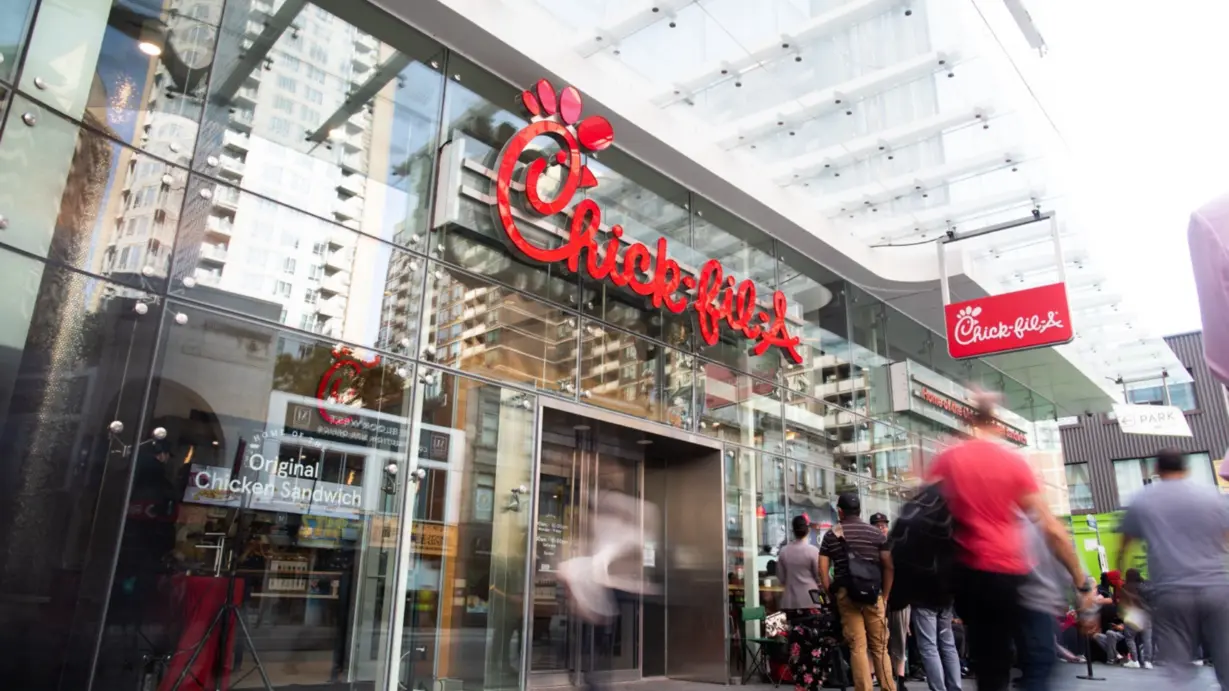
Chick-fil-A's marketing strategy combines a focused menu, recognizable creative assets, a distinctive operator model, digital loyalty, and a service culture that is part of the product experience. By 2025, the chain generated about $23.9 billion in U.S. systemwide sales and remained the largest U.S. chicken chain by sales, while continuing to expand beyond its home market.
The useful marketing lesson is not simply that the cows are memorable. Chick-fil-A connects advertising, operations, local ownership, restaurant design, and hospitality into one system. For companies working in food and beverage marketing, that consistency is more instructive than any single campaign.
1. Company History & Growth
Origins: From Dwarf Grill to Chicken Pioneer
In 1946, founder S. Truett Cathy opened a small diner called the Dwarf Grill (later the Dwarf House) in Hapeville, Georgia. At that unassuming eatery, he experimented with pressure-cooked chicken. By 1964, he had perfected a sandwich recipe that cooked a chicken breast quickly but kept it juicy, eventually branding it “Chick-fil-A.” That “A,” by the way, was a nod to Grade-A quality. In 1967, Cathy debuted the first Chick-fil-A in an Atlanta mall, an unusual move, but one that shaped the brand’s early success in mall food courts.
- Fun Fact: Mall owners worried about smoke and garbage from a restaurant. Cathy had to assure them that his pressure-cooking method wouldn’t create big issues.
This mall strategy helped the brand establish a repeatable format before freestanding restaurants became a larger part of the system. Chick-fil-A now operates more than 3,000 restaurants across the U.S. and international markets. The growth model has generally emphasized local Owner-Operators, controlled site selection, and consistent operating standards rather than rapid franchising at any cost.
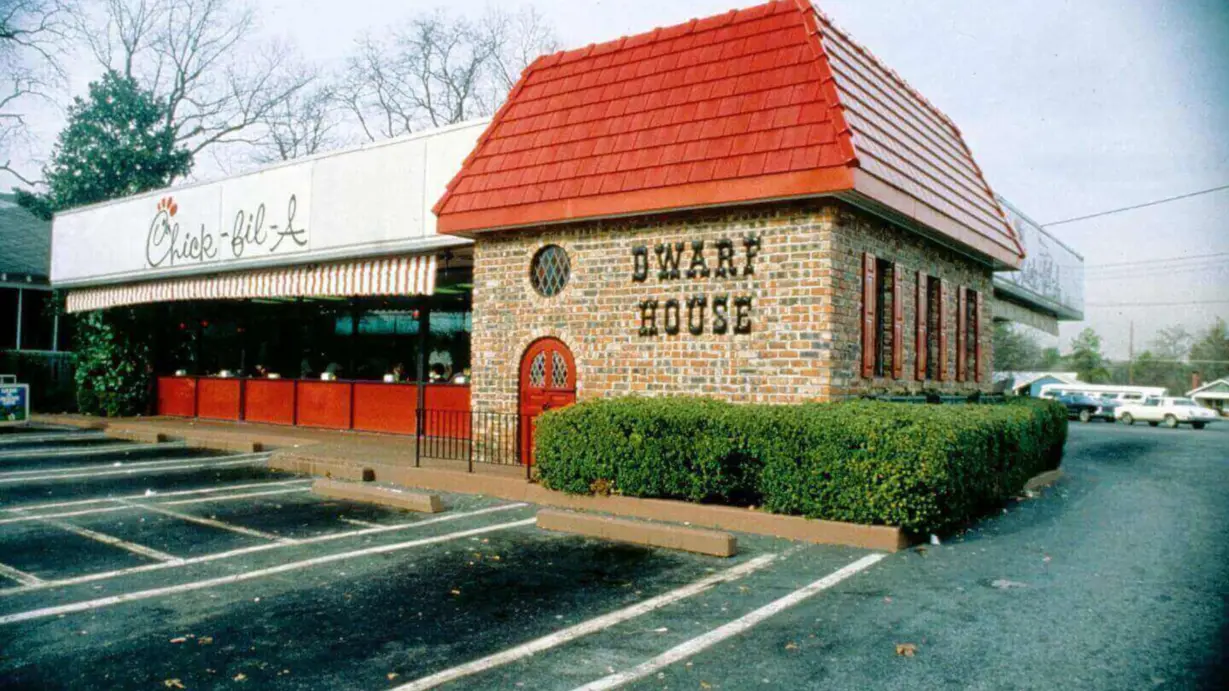
Closed on Sundays
One of Chick-fil-A’s most defining features is its Sunday closure policy. This tradition dates back to 1946, rooted in Cathy’s Christian faith. Despite some people thinking it’s a revenue sacrifice (losing out on weekend crowds), it has become a brand differentiator, earning Chick-fil-A both respect and curiosity. The company sees it as a principle that fosters employee well-being. Some folks even joke that being closed on Sunday fuels more demand the other six days, whether that’s true or not, it’s undeniably part of Chick-fil-A’s identity.
Key Milestones
- 1946: The Dwarf Grill opens in Hapeville, Georgia.
- 1967: The first Chick-fil-A restaurant opens in an Atlanta mall.
- 1995: The “Eat Mor Chikin” cow campaign launches.
- 2013: Chick-fil-A passes KFC in U.S. system sales.
- 2024: U.S. systemwide sales reach about $22.7 billion.
- 2025: U.S. systemwide sales rise to about $23.9 billion, while permanent restaurants open in the U.K. and Singapore.
- 2026: The company operates in the U.S., Puerto Rico, Canada, the U.K., and Singapore and continues exploring additional international markets.
2. Marketing & Branding Strategies
The Cows Say “Eat Mor Chikin”
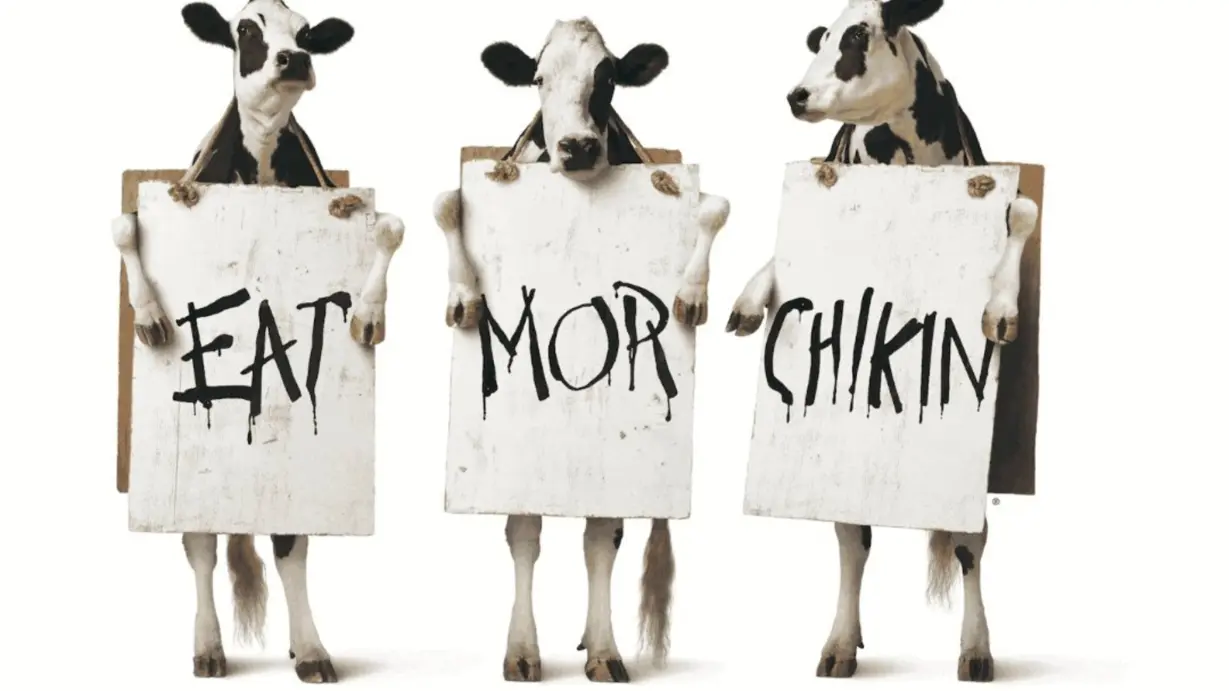
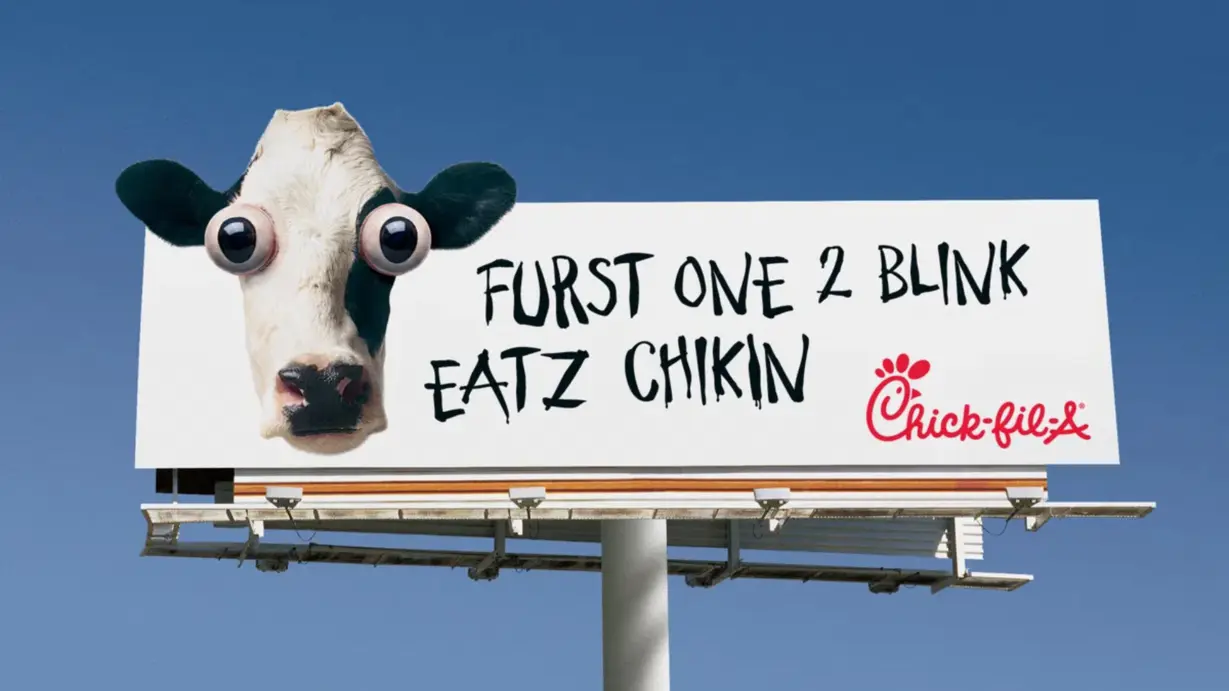
Introduced in 1995, Chick-fil-A’s cow mascots might be the simplest but most effective advertising concept in modern fast food: Holstein cows urging people to eat chicken instead of beef. It’s a goofy, instantly memorable angle. The chain plastered 3D cow figures on billboards painting the phrase “EAT MOR CHIKIN” with comedic misspellings and half-finished letters.
- Impact: The cows gave Chick-fil-A a distinctive visual and verbal device that could work across billboards, television, digital content, merchandise, and in-store promotions. The campaign is a useful example of how a consistent brand identity can remain flexible without losing recognition.
Humor, Consistency, and Grassroots
Chick-fil-A's national advertising is reinforced by local Owner-Operators who participate in community events and local promotions. Brand Vision's older local SEO guide covers one part of local discoverability, while businesses that need implementation support can use local SEO services. The distinction matters because local visibility and local community marketing are related, but they are not the same tactic.
Strong Digital & Social Media Presence
- Social channels: Chick-fil-A extends campaign characters, menu launches, and community stories across major social platforms.
- Participation: Cow-themed promotions and games turn advertising assets into customer participation rather than one-way media.
- App and loyalty: Chick-fil-A One connects ordering, rewards, and promotions. For brands building a similar digital layer, UI/UX design matters because convenience, account flows, and redemption mechanics become part of the brand experience.
Service as Marketing
Service is a central part of Chick-fil-A's positioning. The company explains the familiar customer service phrase “my pleasure” as part of a broader hospitality culture. That operational consistency can support word-of-mouth marketing, but the experience still depends on execution at individual restaurants.
3. Business Model & Competitive Advantage
High Control Franchise
Chick-fil-A’s approach to franchising is unusual:
- Initial fee: Chick-fil-A currently requires $10,000 in non-gifted, non-borrowed funds for the initial franchise fee.
- Hands-on model: Operators are expected to work full time in the business rather than treat the restaurant as a passive investment.
- Typical unit structure: Initial applicants are generally considered for one location, although Chick-fil-A says high-performing Operators may occasionally be offered another business opportunity.
The model gives Chick-fil-A more control over site selection, assets, and operating standards than many conventional franchise systems. Brand Vision's restaurant strategy guide provides broader context on how restaurant operating models influence marketing and growth.
Quality + Speed
Chick-fil-A combines a relatively focused core menu with high-volume drive-thru operations, face-to-face order taking, and restaurant-format experimentation. The Restaurant Dive report linked through accelerates actually separates satisfaction from speed: Chick-fil-A led satisfaction in that study, while Taco Bell led speed. It should not be read as proof that a smaller menu alone makes Chick-fil-A the fastest drive-thru.
Sunday Closure
The Sunday closure remains a distinctive and consistently applied operating choice. Chick-fil-A describes it as a decision to give Operators and Team Members a day to rest, spend time with family and friends, or worship if they choose. Claims that the closure itself increases demand are speculative, so the stronger marketing point is simply that the policy is memorable and operationally consistent.
Competition
- KFC and Popeyes: Chick-fil-A overtook KFC in U.S. sales around 2013 and has since widened the system-sales gap. Popeyes, Raising Cane's, Wingstop, and other chicken concepts continue to increase category competition.
- McDonald's: McDonald's operates a much larger U.S. footprint. Brand Vision's ranking of chains by locations is useful for footprint context, but it should not be used as evidence of customer satisfaction or loyalty.
Chick-fil-A's competitive advantage is better described as a combination of high restaurant volumes, strong brand recognition, operator involvement, and service consistency rather than one isolated marketing tactic.
4. Sales & Financial Growth
Key Financial Stats
Older reports of Chick-fil-A's yearly sales show the scale of its long-term growth. More recent U.S. systemwide figures put the chain at approximately $21.6 billion in 2023, $22.7 billion in 2024, and $23.9 billion in 2025.
Growth has moderated from the double-digit pace common in earlier years. U.S. system sales increased about 5.4% in 2024 and 5.2% in 2025, with much of the recent growth coming from new restaurants rather than rising volumes at existing units. QSR's 2026 ranking estimated 2025 average U.S. sales per unit at about $7.7 million across the system.
Market Share
Rather than use an ambiguous category-market-share percentage, the clearest comparison is system sales. QSR's 2026 ranking estimated Chick-fil-A at $23.9 billion in 2025 U.S. systemwide sales, compared with about $5.7 billion for Popeyes and $4.7 billion for KFC. Chick-fil-A ranked third among U.S. limited-service chains overall, behind McDonald's and Starbucks.
Going International
Chick-fil-A is still concentrated in the U.S., but its international footprint is no longer only a future plan. The company opened permanent restaurants in the U.K. and Singapore in 2025 and continues expanding in Canada and Puerto Rico. Businesses planning national or international food-service growth can use a marketing agency in Canada or a marketing agency in Dallas for market-specific strategy; these are reader-facing examples and do not imply that Brand Vision works with Chick-fil-A.
5. Challenges & Controversies
Values and Political Backlash
Chick-fil-A's corporate purpose is explicitly shaped by the Christian faith of its founder, and the company has also faced sustained public controversy over comments and charitable giving connected with LGBTQ issues. Those debates became especially visible in 2012 and affected how different customer groups perceived the brand.
- Corporate response: Chick-fil-A later changed its corporate charitable-giving priorities and now emphasizes areas such as education, hunger relief, and community support. The commercial effect of the earlier controversy cannot be reduced to one sales trend because advocacy, opposition, restaurant expansion, pricing, and broader category growth occurred at the same time.
Competitive Wars
The “chicken sandwich wars” heated up in 2019 when Popeyes introduced a popular sandwich. Social media buzz saw Popeyes momentarily overshadow Chick-fil-A’s top dog status, but Chick-fil-A’s consistent service and loyal following helped them remain strong. Meanwhile, McDonald’s and others introduced new premium chicken items to chase the “Chick-fil-A effect,” but none matched the brand’s single-minded approach.
Operational Hurdles
One ongoing challenge is the enormous traffic each location sees, long drive-thru lines can cause local traffic snags, and some communities resist new sites due to potential congestion. But Chick-fil-A’s response is high-efficiency drive-thru management. They also face typical industry challenges like labor shortages, supply chain hiccups, and competitor promotions. As a private company, Chick-fil-A has the flexibility to address these systematically, but friction arises occasionally.
These issues show that a strongly defined brand can create both loyalty and disagreement. For marketers, the practical lesson is to separate evidence about sales or satisfaction from assumptions about why customers support or reject a company.
6. Customer Loyalty & Public Perception
High Satisfaction Rankings
Chick-fil-A remains a high performer in customer satisfaction. The 2025 American Customer Satisfaction Index gave Chick-fil-A a score of 83, the highest score among the named quick-service restaurant brands in that study. Brand Vision's fast-food footprint ranking is useful for scale comparisons, but it is not the evidence for that satisfaction result.
Possible Reasons:
- The genuine courtesy from staff, who consistently respond “my pleasure.”
- Cleanliness and well-managed lines.
- Simple, quality food that rarely disappoints.
Involving Community & Workers
- Team Member scholarships: In 2026, Chick-fil-A awarded more than $29 million in scholarships to over 16,000 Team Members and reported more than $245 million in scholarship support since 1973.
- Local community programs: Owner-Operators support local organizations, while the Shared Table program redirects surplus food to nonprofits. These programs add a community layer to the brand, but their impact should be evaluated separately from advertising performance.
Building a Strong Fan Culture
Chick-fil-A has built unusually visible customer participation around store openings, cow-themed promotions, loyalty rewards, and family routines. It is more useful to describe that as strong brand engagement than to assume every customer has the same emotional relationship with the chain.
What Marketers Can Learn From Chick-fil-A
Chick-fil-A's growth comes from the interaction of operations and marketing: a recognizable product, memorable creative assets, service standards, local operator involvement, digital loyalty, and controlled expansion. Its recent sales growth has slowed to the mid-single digits, but the chain still operates at exceptional scale and restaurant productivity within the U.S. quick-service market.
- What truly drives Chick-fil-A’s success?
- A “keep it simple” approach to the menu, focusing on well-made chicken.
- A unique franchising method that demands local owner-operators be deeply involved.
- A strong brand identity shaped by creative marketing (talking cows) and exceptional hospitality.
- Values-based decisions, from giving employees Sundays off to philanthropic efforts, which resonates with many consumers (while alienating some).
The company also shows why different metrics should not be mixed together. Restaurant count, system sales, satisfaction scores, and campaign recognition each describe a different part of performance. Brand Vision's fast-food brand coverage is useful for footprint context, while the Starbucks marketing strategy offers a contrasting food-and-beverage case built around seasonal products, loyalty, and store experience.
The cow campaign remains a memorable example of marketing consistency, but the larger lesson is operational: the promise in the ad has to be supported by the restaurant, app, employee interaction, and local experience. For help translating that principle into a brand or customer-experience plan, contact Brand Vision.
More Marketing Strategy Case Studies