
A custom website is worth the extra investment when it delivers a specific capability or an original brand experience that matters to the business, at a cost the business can justify and maintain. A template is a sound choice when its structure, flexibility, and publishing tools meet the brief.
The difficult part is deciding what needs to be custom. You might need a distinctive visual system, a better way to organize services, or a particular customer workflow. Each calls for different work. Paying for a fully bespoke build makes little sense if the requirement can be met through a focused change. Equally, forcing an ambitious design brief into an unsuitable template can leave the business paying for repeated compromises.
At Brand Vision, we predominantly undertake custom website projects. Our preference comes from designing around each business’s particular needs and the importance we place on distinctiveness. For a buyer, the next step is to make those objectives concrete: what should the extra work accomplish, and how will you judge the result?
Custom Websites and Templates: What Are You Buying?
A template-based website begins with an existing set of layouts and components, which the team adapts to the business’s content and requirements. “Custom website” can describe an original design built on an established content management system, a heavily adapted theme, or software developed for a particular function. Those options have different costs and responsibilities.
Start by separating the design from the platform. The design determines how information is organized and presented. The platform provides capabilities such as content management and publishing. Custom functionality adds behavior the chosen system does not already provide in the required form.
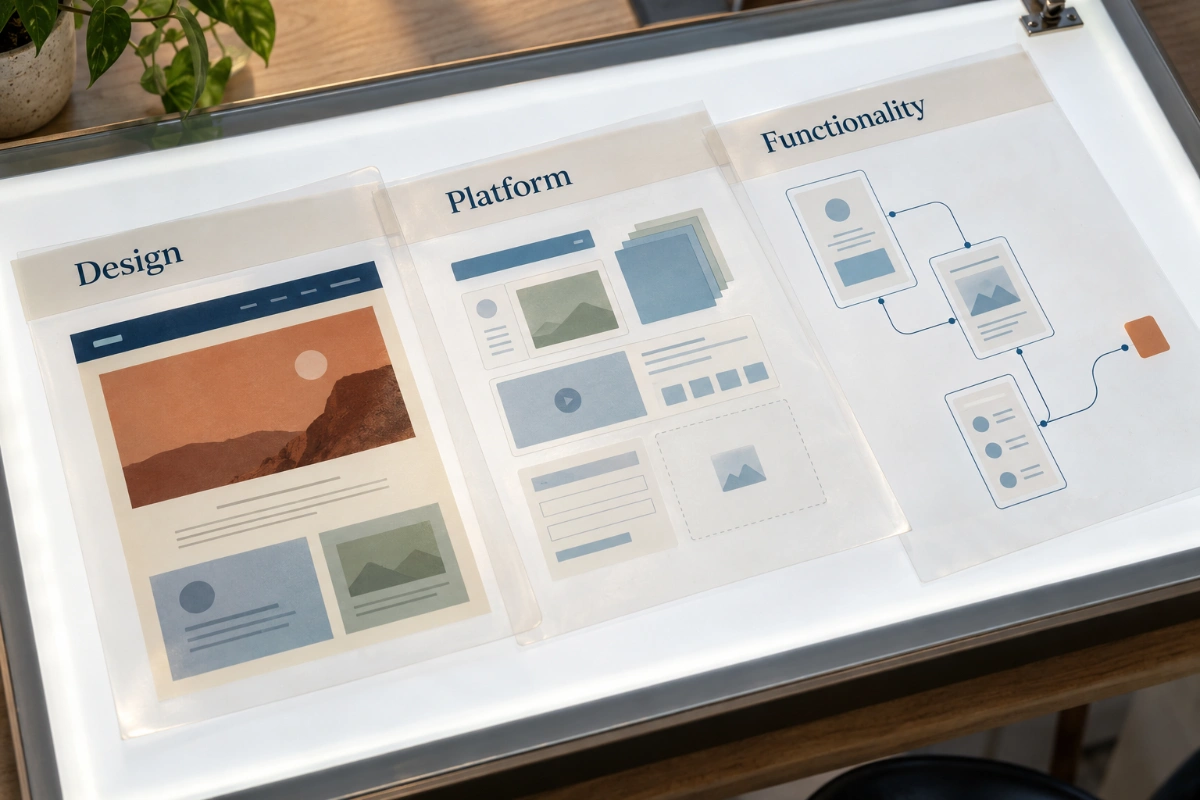
An original design can use an established CMS, standard libraries, and reusable components. It does not require every line of code to be written from scratch. Similarly, starting from a template does not necessarily lock the site into its demo appearance. Webflow’s template documentation, for instance, permits changes to layout and design as well as text and images. The flexibility needs to be assessed within the particular product.
Also separate customization from professional delivery. Research, content planning, accessibility review, and testing can be included in either a template-based or custom project. If one proposal includes those services and another omits them, the price difference does not measure the cost of custom design alone.
Ask providers to identify what they will reuse, adapt, and create. That description is more useful than a package name.
When Original Design Serves a Business Objective
A website can meet its functional requirements and still fall short of the identity a business wants to express. Original design may be a legitimate investment even when an existing template could technically hold all the necessary pages.
The objective needs more definition than “make us look different.” Consider a hypothetical specialist manufacturer. Its sales story might depend on explaining a complex process, showing applications, and making technical evidence accessible to different buyers. An original design could give those elements a deliberate sequence, supported by diagrams, photography, and reusable product components.
The proposed value lies in how that work expresses the business and helps visitors examine its offer. It does not establish that a distinctive layout will generate a particular increase in inquiries.
When commissioning custom website design services, identify the outputs that matter: original art direction, page structures, responsive layouts, or a visual system that can extend across future content. Review the design against those objectives, including whether intended users understand the message and can find the information they need.
A well-adapted template may also achieve a distinctive result. Compare credible design directions using your own content and imagery. The decision should account for the creative work required to reach the intended result through each approach.
If the team cannot explain the offer clearly or agree on the intended audience, brand strategy support can help define positioning and messaging before website design begins. Original design needs a clear brief to work from.
Test the Requirements Before Expanding the Scope
Before approving a larger custom scope, test the requirement that could change your decision. A demonstration can reveal whether the issue concerns one component, the overall design, or the platform underneath.
If you already have a website, a UX audit of the existing experience can help identify issues in navigation, content hierarchy, and key journeys before you decide how much needs rebuilding.
Use a shortlisted template or an early prototype for three practical checks:
- Populate a representative page. Use actual service explanations, images, and supporting evidence. Include a longer realistic heading and a page with more complex content than the demo.
- Walk through an important customer task. Follow the steps to compare an offering, find supporting information, and submit the relevant inquiry. Check the experience on the screen sizes your audience needs.
- Try a routine publishing task. Ask the intended editor to add a page or update a service. Note where the work requires developer assistance or risks disrupting the layout.

These checks should produce a specific description of the gap. “The website needs more flexibility” is too broad to price. “Editors need to create service pages with different evidence sections while keeping consistent spacing and navigation” gives a team something to design and demonstrate.
Suppose a candidate template fits the main site, but its service pages cannot accommodate the required comparison of two offerings. A tailored comparison component might solve the problem. If the same mismatch appears across most important pages, a new design system may be more coherent than repeated alterations.
Integrations require a similar distinction. Needing a CRM connection does not establish that the whole website needs bespoke development. Specify which information must move, what triggers the transfer, and what should happen if it fails. The scope of website integrations and custom functionality should follow those requirements.
Ask the provider to explain the proposed remedy, its limitations, and how it will be maintained. A solution that works once in a demonstration still needs an operational plan.
Compare the Full Cost of a Template and a Custom Website
Comparing a template’s purchase price with a complete agency engagement leaves out most of the work. The template still needs appropriate content, configuration, implementation, testing, and someone responsible for launch.
Compare proposals against the same finished result. Establish which includes content preparation, original assets, integrations, accessibility evaluation, performance work, migration, training, and support. Identify the work your own team would have to supply.
Then isolate the additional customization. Is the premium buying original design, a different content structure, a particular function, or more extensive research? A useful web design proposal makes those deliverables and exclusions explicit.
Consider the delivery schedule as well. Reusing a suitable design can reduce the work required to create layouts, but the project still depends on content, approvals, and testing. Request a schedule that identifies those dependencies rather than accepting a launch promise based solely on the build category.
Ongoing costs belong in the comparison. Include the relevant subscriptions, licenses, maintenance, internal effort, and anticipated changes over a planning period that suits the business. The broader comparison of website scope and ownership costs can help establish that baseline.
Where additional sales are part of the justification, make the arithmetic explicit. In a simplified hypothetical comparison, suppose the more customized option costs an additional US$8,000 over three years, including its extra operating costs. If each additional customer contributes US$400 during that same three-year period, after all relevant variable costs, recovering the premium would require 20 additional customers attributable to that work.

That calculation establishes a hurdle, not a forecast. Run the comparison with no additional sales as well. If the investment only makes sense under an optimistic conversion assumption, the commercial case needs stronger support.
Operating benefits need the same care. Time saved on publishing can create useful capacity, but it does not automatically reduce payroll expenditure. Avoid counting the same freed hours as both cash savings and additional sales capacity.
An original brand experience may have objectives that cannot be reduced to that calculation. State those objectives separately and decide what the business is prepared to invest in them. Do not give an unmeasured design benefit the appearance of a guaranteed financial return.
Check Quality, Everyday Editing, and Future Changes
A buying decision is incomplete until the proposed site has clear quality requirements and an owner for the work after launch. Apply those requirements to both approaches.
Test Performance and Accessibility
For responsiveness, Google’s web.dev guidance identifies causes of slow interactions such as third-party scripts, complex page structures, and expensive processing. It recommends using real-user observations, where available, to investigate the interactions causing problems. A label such as “lightweight custom code” does not replace testing.
Request checks on representative pages with the content and functionality the finished site will use. Agree on the test conditions, which issues must be addressed before launch, and who will investigate problems that appear afterward.
Accessibility also requires more than an automated score. W3C’s guidance on accessibility evaluation explains that automated tools cannot check every aspect of accessibility and that human judgment is necessary. Include appropriate manual evaluation of the completed experience in the scope, whichever design route you choose.
SEO promises deserve similar scrutiny. Google’s page-experience documentation says Core Web Vitals are used by its ranking systems, while good scores do not guarantee top rankings. That guidance provides no basis for promising a ranking advantage simply because a design is custom.
Ask what will be delivered and checked, including content structure, crawlability, metadata, and redirects where relevant. Keep the assessment tied to the finished website.
Plan Editing and Maintenance
Turn the earlier publishing test into a handoff requirement. Define who can create pages, which design controls they can change, and when specialist support is needed. Include the training and documentation required for those responsibilities.
A visually flexible editor is useful only if the team can use it consistently. A more controlled set of components may suit a team that needs to publish quickly within an approved design. The right arrangement depends on the tasks and responsibilities involved.
For a customized theme, ask how modifications will be maintained. WordPress documents how child themes keep changes separate from parent-theme files, allowing those changes to remain when the parent is updated. Its guidance also warns that extensive customization can become a management burden and may justify creating a full theme.
That is a practical limit to evaluate, not a fixed number of changes after which every template becomes uneconomical. Keeping modifications intact also does not remove the need to check compatibility.
Understand What Can Move
Changing a supplier, changing a design, and moving to another platform are separate decisions. Establish what each would involve before committing. When a full rebuild is justified, website redesign services should include the transition itself: content, URLs, integrations, and the team’s publishing workflow.
For example, Webflow’s export documentation distinguishes downloadable front-end files from hosted functionality. Exported code does not reproduce features such as CMS operation, form processing, ecommerce, and site search. CMS data can be exported separately, but that data is not a functioning replacement website.
This affects a custom Webflow design as well as a template-based one. Original visual design does not remove the platform’s migration requirements.
Confirm access to the relevant accounts, design files, code, and content. Document what the agreement says about deliverables and rights, alongside the practical work needed to move. A promise of “full ownership” is too vague to answer all of those questions.
Choose What to Build Now
Once the objectives, demonstrations, and costs are clear, choose the approach that fits the actual brief.
A template is a reasonable choice when it supports the content, customer tasks, editing workflow, and intended presentation with manageable adaptation. Selective customization makes sense when the gaps are concentrated in a few components or functions and the underlying system remains suitable.
An original design merits consideration when the business has a defined visual direction to express, or when important content and customer journeys need a more coherent structure than the candidate designs provide. More extensive engineering becomes relevant when verified functional requirements exceed the chosen system’s capabilities.

Keep uncertain future needs separate from confirmed requirements. A possible customer portal in two years is a reason to investigate options and dependencies, not enough information to commission the portal today. A small prototype or technical investigation can help establish what would be involved before committing to a larger build.
Starting with a focused site can be a deliberate choice. A later redesign may reflect requirements that were unknown or unnecessary at launch. Evaluate the initial investment against what it was intended to accomplish during that period.
Before approving the extra spend, connect each substantial custom deliverable to a business requirement or design objective, and agree on how the finished work will be evaluated.
If you’re deciding whether a custom website is worth the investment, talk to Brand Vision about your website. Share your current site or project brief, what needs to change, and your priorities for design, functionality, timeline, and budget. We’ll review those requirements with you and outline what a custom approach would involve.