
A customer segmentation strategy should help you choose where to compete, how to serve those customers, and when to change or stop investment. The strongest immediate opportunity is one your business can reach and serve credibly, with economics that justify the commitment. An attractive customer group may still require more budget, a stronger offer, or capabilities you have yet to build.
Making that choice requires separate judgments about the market, your competitive readiness, customer profitability, and the likely return from a particular action. High revenue does not settle whether a segment deserves more acquisition spending. Weak recent results do not establish that it should be abandoned.
What Should a Customer Segmentation Strategy Decide?
Segmentation groups customers or prospects by differences relevant to serving them. Targeting selects the groups the business will prioritize. An ideal customer profile describes the characteristics of a suitable customer, while a buyer persona helps explain an individual buyer’s needs and role. Each can inform the others, but a detailed profile still leaves the investment decision to be made.
A useful segment should change something consequential: the offer, acquisition approach, pricing, delivery model, or level of investment. Industry and company size can help identify a group, but they need a connection to those decisions. Two companies of similar size may need very different implementation support. Two companies in different industries may buy for the same reason and accept the same delivery model.
There is also no requirement to create a separate strategy for every identifiable group. OpenStax’s discussion of target market strategies recognizes that separate marketing programs may be unjustified when meaningful customer differences are limited. Additional segmentation should earn its complexity.
For B2B businesses, distinguish customer segments from the people involved in a purchase. Finance, operations, and technical stakeholders may need different evidence to support a shared buying-committee decision. That does not automatically make them three separate markets requiring three different positions.
Start by stating the decision you need segmentation to improve. Choosing a market to enter, prioritizing existing accounts, and allocating a retention budget require different analyses, even when they draw on the same customer data.
Choose Segments You Are Ready to Compete In
A segment can have substantial demand and attractive customers while remaining difficult for your business to win. You need to understand the alternatives buyers already have, what would persuade them to switch, and what delivering that promise would require.
The U.S. Small Business Administration’s guidance on market research and competitive analysis brings these questions together. Alongside demand, market size, and pricing, it recommends examining competitors’ strengths, entry barriers, and indirect alternatives. Market opportunity and competitive conditions belong in the same assessment.
In our client work at Brand Vision, competitive readiness has sometimes changed which segment we recommend pursuing first. A group may look like the ideal customer base, yet the budget or value proposition needed to compete there is beyond the client’s current readiness. In those situations, we have sometimes recommended starting elsewhere and returning to the opportunity later.
When you defer a segment, specify what would make it worth reconsidering. The missing requirement might be a stronger product capability, credible proof, more delivery capacity, or enough funding to support the route to market.
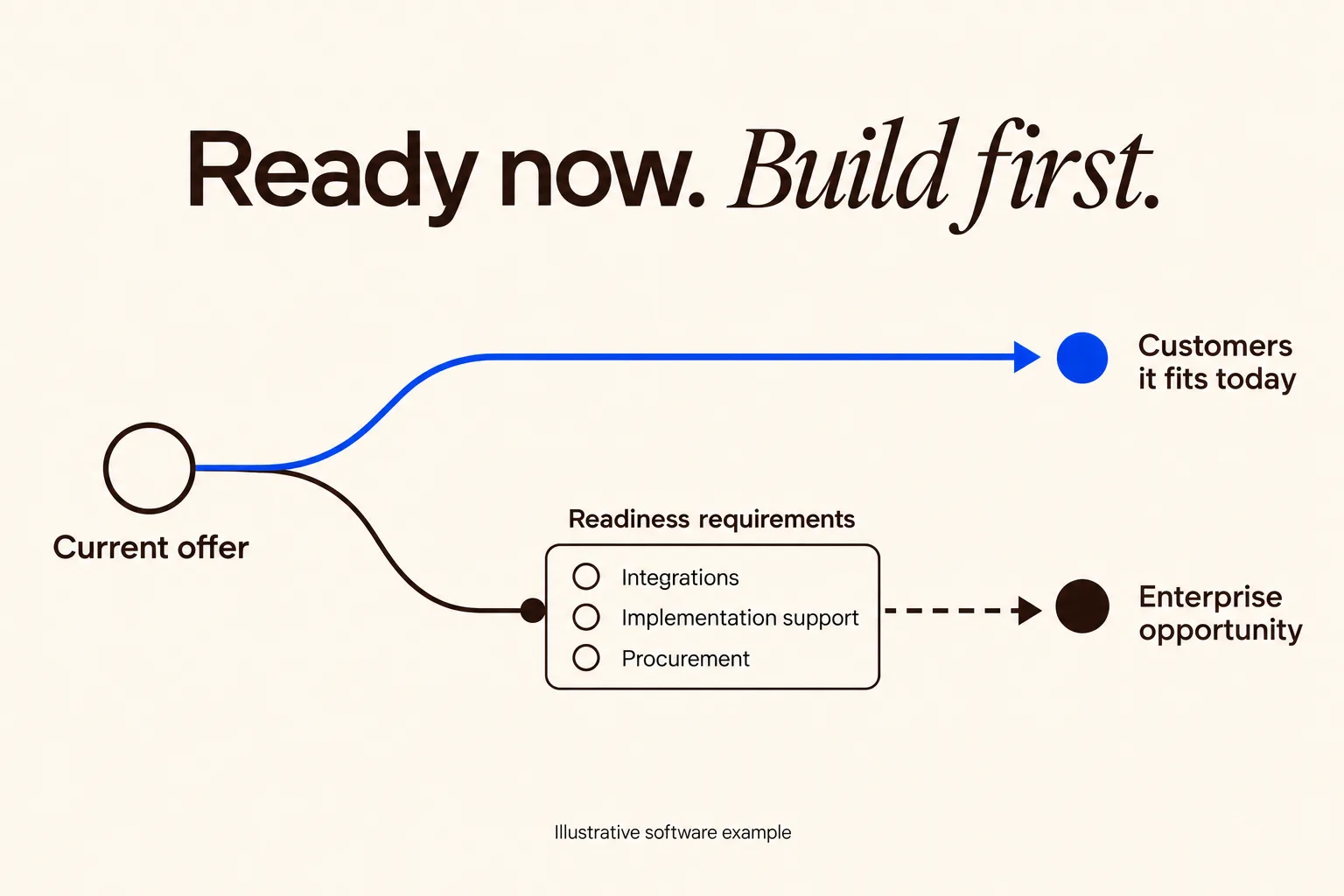
Consider a hypothetical software business attracted to large enterprise contracts. Its proposed enterprise offer might require integrations, implementation support, and procurement work that it cannot currently provide. A smaller customer group could be a more suitable starting point if the existing product meets its needs. The reasoning depends on fit, not an assumption that smaller customers are always easier or cheaper to acquire.
Structured customer and market research can help clarify these requirements. Include current customers, lost opportunities, and former customers where possible. Current customers tell you about people you have already reached and converted; other groups can expose objections and constraints that the existing customer base does not reveal.
Keep the distinction between evidence and inference visible. A buyer naming a missing feature is evidence of that buyer’s objection. Treating the feature as the main barrier across the segment remains a hypothesis until you have enough support for that conclusion.
Compare Segment Economics and Set Expectations Before Investing
Segment economics should reflect what the business receives and what it must commit to earn that return. Revenue is the starting point. Discounts, delivery costs, onboarding, customization, support, and the effort required to win and retain customers can change the picture.
Separate Current Contribution From Future Potential
Review both the segment’s overall contribution and the differences among its customers. An average can conceal accounts that need fundamentally different service arrangements. Before changing the whole segment’s treatment, check whether a more specific group explains the problem.
A 2024 qualitative study of customer profitability analysis, conducted across six units of one manufacturing division, examined how managers combined accounting information with customer characteristics and strategic context. Its findings support investigating service complexity and customer-specific costs. They do not supply a universal cutoff for deciding which customers to retain.
Customer tenure is also an incomplete guide. In their 2002 article The Mismanagement of Customer Loyalty, Reinartz and Kumar reported only a weak to moderate relationship between tenure and profitability across four studied firms. This older observational research challenges the assumption that longstanding customers are necessarily economical to serve; it does not establish that loyalty is generally unprofitable.
For new customers, include the expected cost of acquisition and onboarding. For existing customers, distinguish money already spent from expenditure that a future decision could avoid. Historical acquisition spending cannot be recovered simply by ending the relationship.
Future value deserves the same discipline. State the period being assessed and the assumptions about purchasing, retention, service costs, and expansion. A recently acquired cohort with limited history should not receive a precise lifetime-value estimate without acknowledging how much rests on assumptions.
Identify Which Costs Would Actually Change
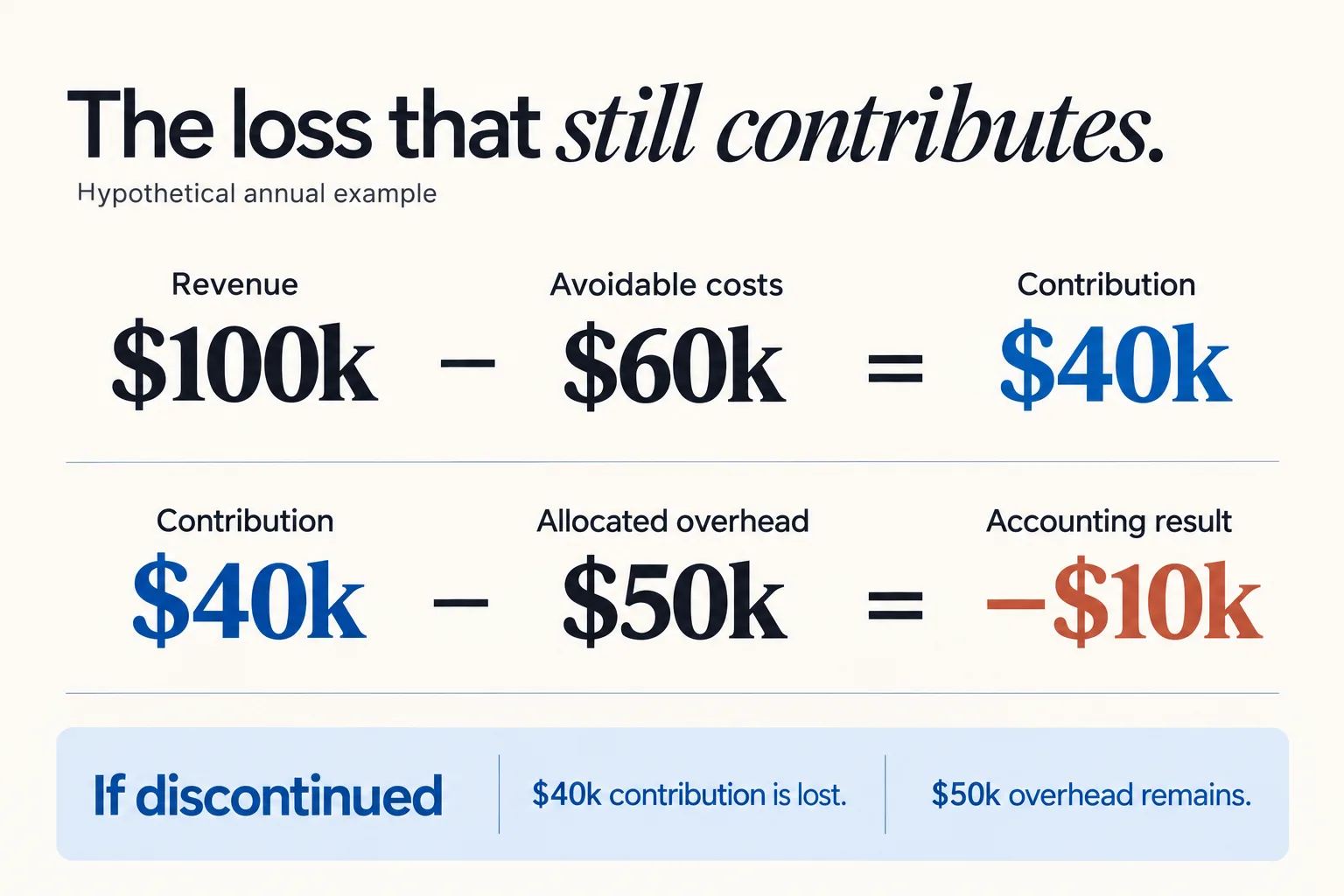
A reported loss does not, by itself, establish that withdrawing would improve the business’s result. OpenStax’s treatment of keeping or discontinuing a segment explains why allocated common costs can obscure the decision. Compare revenues and costs that would change under each alternative.
Suppose a hypothetical segment generates $100,000 annually, incurs $60,000 in costs that would disappear if it were discontinued, and receives $50,000 in allocated overhead. It shows a $10,000 accounting loss.
If the revenue and the $60,000 of avoidable costs disappear while the overhead remains, discontinuing the segment removes $40,000 of contribution. Without another change, the business becomes worse off by that amount.
This calculation does not settle the long-term strategy. It establishes what must be replaced or saved for withdrawal to improve the result. Staff time released from an account is not automatically a cash saving, although it may have value if it can be redeployed productively.
Define Downside, Expected, and Strong Scenarios
When planning segment investment, we typically research its potential and consider poor, expected, and strong outcomes before committing. The purpose is to establish expectations that can later be examined, rather than judging performance against an ambition that was never made explicit.
For your own decision, define the outcome, period, investment, and assumptions behind each scenario. Depending on the business, relevant measures could include contribution, acquisition cost, sales-cycle length, onboarding effort, or retention.
The scenarios should describe different operating conditions
- A downside case might assume slower conversion, more delivery work, or weaker repeat purchasing. Identify the resulting exposure and what would prompt intervention.
- An expected case should reflect the evidence available, including gaps. Calling it expected does not make it a statistically established average.
- A strong case should explain what produces the improvement and whether the business has the capacity to deliver it.
Use the scenarios to expose dependencies. If the investment works only when acquisition costs fall, retention improves, and service effort drops simultaneously, the decision requires confidence in all three changes. An attractive total can otherwise conceal a demanding set of assumptions.
Audit Underperformance Before Changing Segment Priorities
When a segment falls short, the immediate question is what the gap tells you. The opportunity may be weaker than expected, but the offer, execution, investment assumptions, or forecast may also need revision.
When results fall materially below expectations, we typically review what has been done, how much has been invested, possible mistakes, overlooked considerations, and new information about the segment. The next action varies by case. An audit can support changing the approach, reducing investment, or accepting that the original expectation was too optimistic.
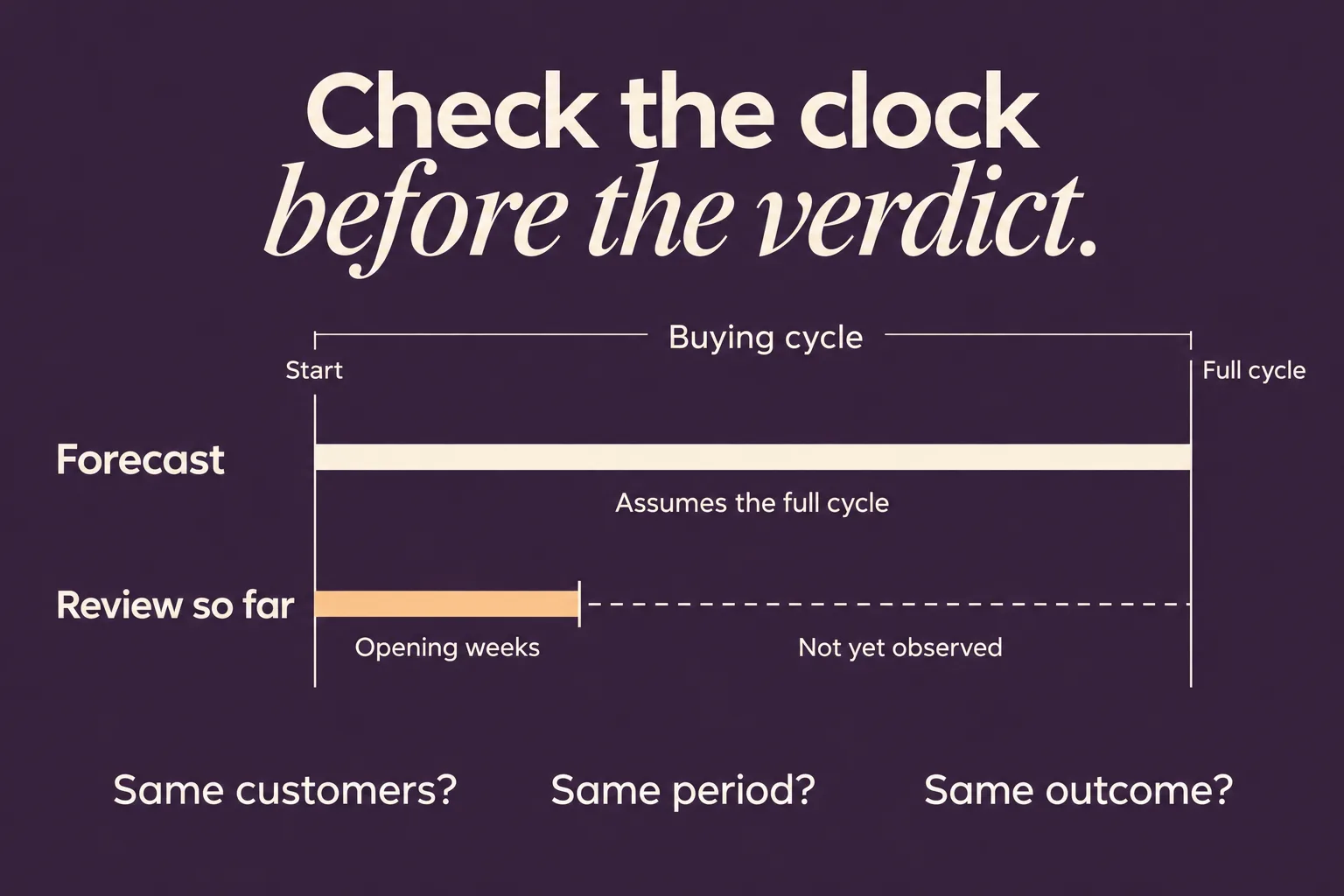
Establish whether the comparison is fair before interpreting it. Check the population, reporting period, and outcome definition. If a forecast assumed a completed buying cycle but the review covers only its opening weeks, the apparent shortfall may be premature. If delivery costs were omitted from the original model, the forecast itself needs correction.
Then examine whether the intended approach was actually delivered. Review the offer, qualification criteria, sales follow-up, onboarding, and capacity committed. Document specific gaps rather than treating execution as a convenient explanation for every disappointing result.
Next, ask what has been learned about the customers. Their willingness to pay, buying constraints, or service needs may differ from the assumptions used to select them. A few conversations can identify issues worth investigating without establishing how widespread those issues are.
The audit should end with a decision or a bounded test. If another test is justified, specify the uncertainty it will resolve, the resources it needs, and the evidence that would change the decision. Further investigation should not become an open-ended reason to keep spending.
Decide Whether to Invest, Defer, Change the Offer, or Stop
The next action should address the cause of the problem and the alternatives available. Reducing acquisition spending, changing pricing, withholding a retention incentive, and ending an existing relationship have different consequences.
Use the evidence to choose a specific action:
- Increase investment when competitive fit, delivery capacity, and the expected return from the additional commitment support it.
- Run a limited test when a material uncertainty can be resolved at an acceptable cost.
- Defer entry when the opportunity is attractive but a necessary capability, proposition, or resource is missing.
- Change pricing, scope, or delivery when the current arrangement creates a mismatch between customer needs and the cost of serving them.
- Reduce discretionary spending when the proposed activity lacks a credible incremental return, even if the customer relationship remains worthwhile.
- Plan withdrawal when the forward-looking economics and strategic consequences support it after considering feasible alternatives.
These actions do not form a mandatory sequence. A pricing problem may justify renegotiation; a missing capability may justify deferral. Neither requires treating every customer in the segment as undesirable.
Change the Investment Before Assuming the Relationship Must End
Retention provides a useful illustration. A valuable customer with a high predicted risk of leaving may seem an obvious candidate for an incentive. But risk and responsiveness are different questions.
Eva Ascarza’s 2018 research on retention targeting analyzed randomized field experiments in prepaid wireless service and membership renewal. Customers at greatest predicted risk were not necessarily the best targets for the studied interventions. Both studies assessed retention over one month. For a retention budget, the practical implication is to examine what an intervention changes, what that change is worth, and what the intervention costs.
A business can also change its sales model while preserving customer relationships. In its FY2025 Form 10-K, Zoom reported transitioning approximately 26,800 Enterprise customers with lower monthly recurring revenue away from direct sales teams, resellers, or strategic partners during the quarter ended April 30, 2024. These customers became part of its Online category.
The disclosure illustrates a sales-channel change, without establishing that those customers were unprofitable or that the transition caused a profit increase. Its relevance is the distinction between changing the model and ending the relationship.
Compare Withdrawal With the Available Alternatives
Return to the hypothetical segment contributing $40,000 before unavoidable overhead. Compare keeping it with replacing it over the next 12 months. Suppose the replacement would generate $55,000 in contribution during that same period, after its incremental operating costs. Assume the transition costs $5,000 and the common overhead remains unchanged.
Under those assumptions, the first-year improvement would be $10,000: $55,000 of replacement contribution, less $40,000 of lost contribution and $5,000 of transition costs. The case for withdrawal now rests on the replacement opportunity, not the original accounting loss.
Test the timing and credibility of that replacement. If demand takes longer to arrive, the first-year comparison changes. Do not treat a resource cost as saved if the business will still incur it to deliver the replacement work. The decision needs one consistent account of what changes.
Turn Segment Priorities Into Operating Commitments
A segment decision becomes actionable when it changes the work. Specify which prospects the business will pursue, which offers it will make, what delivery it will support, and where resources will move.
Keep a concise record of the chosen action, supporting evidence, unresolved assumptions, accountable owner, and budget or capacity commitment. Add the conditions for reconsideration. A deferred segment needs a readiness condition; an active investment needs evidence that would support continuation, adjustment, or withdrawal. Review timing should reflect the buying and service cycle.
Carry the decision into brand strategy and positioning. The priority audience, promised value, and supporting proof should agree with what the business has decided to fund and deliver. Then translate segment priorities into messaging, using relevant benefits and proof while keeping the underlying position coherent.
Start with one segment whose next investment decision is unresolved. Set out the opportunity, readiness requirements, economics, and uncertainty, then choose the next action and the evidence needed to reconsider it. That gives the strategy a concrete purpose: directing the next commitment of money and effort.


.webp)