
Message testing is the process of showing proposed brand messages to the intended audience and evaluating how people interpret and respond to them. Before investing in a website or campaign, use it to assess understanding, relevance, and perceived credibility. Review the evidence supporting the claims separately, then decide what needs to change before production.
Those findings can shape more than a headline. A proposition that needs explanation may affect the website’s sections, page structure, and customer journey. A promise that creates the wrong expectation may require a change before it becomes the foundation for advertising and sales materials.
The aim is to resolve enough consequential uncertainty to make the next investment decision. That requires matching each question to the right kind of evidence and translating the findings into requirements a production team can use.
What message testing can establish before you invest
A useful message test separates several questions that can otherwise become one vague judgment about whether the copy “works.”
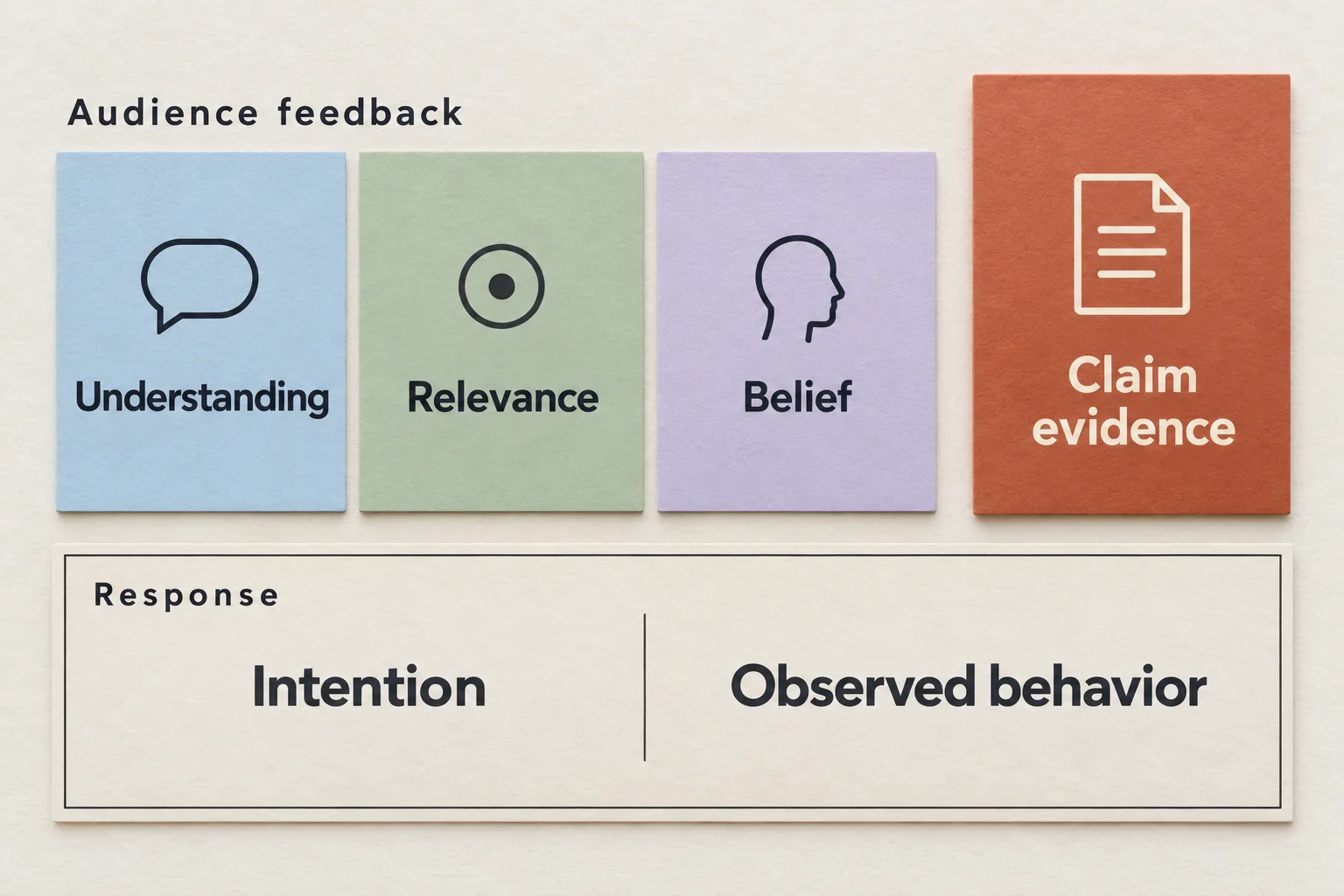
Comprehension concerns what people believe you are saying. Relevance concerns whether that promise matters to their situation. Perceived credibility concerns whether they believe it. Substantiation concerns whether the business has appropriate evidence behind the claim. Response concerns what people intend to do or actually do after encountering it.
These questions can produce different answers. Someone may understand a promise and believe it without considering it important. Another person may find a claim compelling while interpreting it more broadly than the business intended.
A brand messaging framework provides the underlying positioning, value proposition, claims, and proof. Testing examines how those choices are received and what needs clarification before they guide execution.
Objective claims also require a separate evidence review. In the United States, the FTC’s advertising substantiation policy requires a reasonable basis for express and implied objective claims before dissemination. In Canada, the Competition Bureau’s performance-claims guidance requires adequate and proper testing before making covered performance claims. Audience belief does not substitute for that support.
Nor should a favorable intention score become a conversion forecast. A 2021 analysis of persuasive-message research found that relative effectiveness on intention measures often aligned with relative effectiveness on behavioral measures. That supports using intentions thoughtfully when comparing messages. The research distinguishes relative persuasiveness from absolute effectiveness and cautions about small differences and statistical power. It also questions whether repeatedly asking the same intention question after numerous candidate messages produces dependable results.
A test may therefore help you choose between credible alternatives while leaving the commercial outcome uncertain.
Identify the message decisions that shape the website or campaign
Before choosing a research method, identify the decision the findings must inform. Selecting a homepage proposition, explaining a complex service, and choosing an advertising claim involve different commitments.
Record the proposed wording, who should understand it, the intended meaning, the available support, and any conditions that materially limit the promise. Then consider what would change if the audience interpreted it differently.
Some uncertainties affect a sentence. Others affect what the website needs to contain.
Consider a hypothetical software company proposing the claim “Set up in one day.” The team needs to define what setup includes. Does it mean opening an account, configuring a workspace, importing data, or completing an operational rollout? Does the timing depend on the customer supplying clean data or obtaining internal approvals?
Those distinctions should be settled before asking people which version they prefer.
If the promise refers only to configuring a workspace, the headline may need greater precision. If buyers also need to understand migration requirements, an explanatory section could be necessary. If onboarding involves several decisions, a dedicated page might help them assess the process. These are possible responses to an information need, rather than automatic reasons to expand the sitemap.
The same thinking applies to campaigns. A short advertisement and its destination page should be planned together so the team can examine the expectation created by the first and the explanation provided by the second.
This is why unresolved messaging deserves attention during website planning. It can leave teams making structural decisions before they understand what the audience needs to learn.
That does not require every word to be final before design begins. Rough page concepts and prototypes can help resolve the uncertainty. The useful milestone is having sufficient clarity to approve consequential choices about page roles, content, and production.

Choose message testing methods and participants
Start with the question you cannot yet answer. Then select the people and method capable of addressing it.
Recruit for the buying decision
Describe participant eligibility in terms relevant to the decision: their role, problem, experience with the category, involvement in purchasing, and familiarity with the brand.
Existing customers may help explain how the promise compares with delivery. Prospective buyers can help examine what someone understands before becoming a customer. Users and purchase approvers may need different information.
None of these groups should automatically stand in for another. For a campaign entering a new segment, familiarity among current customers does not answer whether the new audience understands the proposition.
If groups disagree, investigate the context before averaging their responses. They may be interpreting the same words differently, evaluating different needs, or bringing different knowledge to the task. Broader audience and brand research may be appropriate when the uncertainty concerns audience priorities or category perceptions rather than a particular sentence.
Match the method to the question
Interviews are useful when you need to explore how someone interprets a phrase and why it raises an objection. A structured survey can compare defined reactions across suitable groups. A page or prototype allows you to examine the message alongside its explanation and supporting evidence. A live A/B test can compare a specified behavioral outcome between randomly assigned groups.
The way alternatives are presented also matters. Showing each participant one candidate allows you to examine it without requiring a side-by-side comparison. Showing several alternatives can reveal perceived differences, but answers then reflect the comparison task. Choose deliberately, and keep presentation conditions consistent with the question.
For qualitative interviews, avoid treating a fixed participant count as a guarantee of completeness. The proposed information power framework considers the study’s aim, sample specificity, use of established theory, dialogue quality, and analysis approach when assessing sample adequacy. A focused question within a narrow audience is different from comparing several buying roles.
Quantitative comparisons need planning around the differences you need to detect and the precision the decision requires. A small numerical lead does not automatically provide a sound reason to commit.
For live experiments, Microsoft’s pre-experiment guidance emphasizes explicit hypotheses, appropriate randomization, and statistical power. It also calls for success measures and guardrail metrics that check for unwanted effects. There is no universal monthly-traffic figure that makes every message test useful.
If a website cannot support a meaningful behavioral comparison within a practical period, narrow the decision. Interviews or prototype work may resolve a misunderstanding, even though they cannot establish a conversion increase. Record that remaining uncertainty rather than turning qualitative feedback into a numerical performance claim.
Ask message testing questions that reveal understanding
Begin by finding out what the participant takes away without your explanation.
A question such as “How clearly does this communicate our fast onboarding?” supplies both the intended meaning and a favorable characterization. It tells you less about whether the person would reach that interpretation independently.
Pew Research Center’s questionnaire-design guidance explains how wording, response options, and question order can influence answers. Earlier closed questions can introduce concepts that participants later repeat in open responses. That is a reason to establish unaided understanding before presenting detailed evaluation criteria.
A short discussion sequence might ask:
- What do you think this company is offering?
- Who does it appear to be for?
- What would you expect to receive?
- What conditions do you think apply?
- Which parts matter to your situation?
- What would you need to see before relying on the promise?
- What, if anything, would you consider doing next?
Follow up on the participant’s language. If they describe the service differently from the intended proposition, explore that interpretation before correcting it. Once the moderator supplies an explanation, subsequent answers should be understood in that context.
For the hypothetical setup claim, ask what the participant expects to have completed at the end of the day. Then examine what they believe happens before the clock starts and what work remains afterward. A high credibility rating is less useful if it applies to a promise the company never intended to make.

Test website messaging in context
Examine the message within a realistic page or campaign concept, and ask participants to use the available information to address a relevant decision. If the same people have already discussed the wording, treat this as a follow-up informed by that discussion. Use fresh participants when you need to examine a first encounter with the page.
For the software example, that could mean assessing whether the setup process would fit their situation and finding the prerequisites they would need to meet. Observe which information they use, what they overlook, and where they need clarification.
The CDC’s guidance on testing communication materials, developed for health communication, recommends examining whether people can use information to complete tasks. Applied cautiously to commercial work, this provides a useful way to move beyond asking whether a page is liked.
When the question involves navigating information or completing a digital task, prototype and usability testing can help investigate the experience.
Keep the interpretation of the findings specific. If you change the headline, explanation, and page layout together, the test examines the combined execution. It does not isolate which individual change caused a difference.
Use mixed findings to decide what happens next
Research should help determine whether a revision is warranted and what it needs to address. It should also preserve evidence that supports keeping the current message.
Review misunderstandings, objections, favorable responses, and differences between relevant audiences. Keep the underlying answers available so a summary score does not erase the reason behind it.
When the evidence points to a revision
A useful revision responds to a specific problem.
If participants misunderstand the category, clarify what the business offers. If they understand the benefit but question the mechanism, explain how it is delivered and present suitable evidence. If they infer conditions the business cannot support, narrow or reconsider the claim before production.
The response may involve wording, explanation, proof, or structure. It should not default to a more assertive headline.
In the setup example, suppose the offer covers workspace configuration and excludes data migration. A candidate revision could be “Your workspace configured in one day,” accompanied by the prerequisites and migration exclusion. This wording would still need supporting evidence and testing: the term “configured” might remain unclear to buyers. Check whether the revised execution communicates the intended scope before approving it.
Some evidence may point beyond copy. If the intended buyers understand the proposition but see little relevance to their needs, the work may need to return to brand positioning and messaging. Rephrasing the same benefit does not establish that the benefit matters.
Avoid combining all findings into an unexplained readiness score. Strong preference cannot compensate for an unsupported objective claim. Equally, a supportable promise still needs to be understandable and relevant to the audience.
When the result remains inconclusive
An inconclusive result may reflect small differences between alternatives, a study unable to distinguish them adequately, or a measure that did not resolve the decision.
Those possibilities call for different responses.
If both messages are understood and supportable, and no meaningful advantage has been established, operational fit or ease of explanation may guide the choice. If a strategically important segment remains poorly understood, a focused follow-up may be more useful than repeating the entire study. If the uncertainty concerns actual behavior, another preference survey may leave the same gap.
Before commissioning more research, state what result could change the decision. Then weigh the value of that information against the cost and delay.
A limited launch can be reasonable when the claim is supportable, the remaining uncertainty concerns response, and the team can observe outcomes and change course. Decide in advance what would justify continuation, revision, or stopping. A click increase, for instance, does not by itself establish an improvement in qualified inquiries or sales.
Further testing is worthwhile when it resolves a consequential uncertainty. It should not become a requirement to keep studying until one option receives an attractive score.
Turn the findings into a production brief
The final output of message testing should give writers, designers, and campaign teams a clear basis for their next decisions.
Record:
- The approved claims and their intended meaning.
- Qualifications and supporting evidence that must accompany them.
- Buyer questions the page or campaign needs to answer.
- Implications for sections, page roles, and the sequence of information.
- Unresolved questions, responsible owners, and planned follow-up measures.
Include the reasoning behind important requirements. “Add an onboarding section” is less useful than explaining which question that section must answer and what the audience needs to understand afterward.
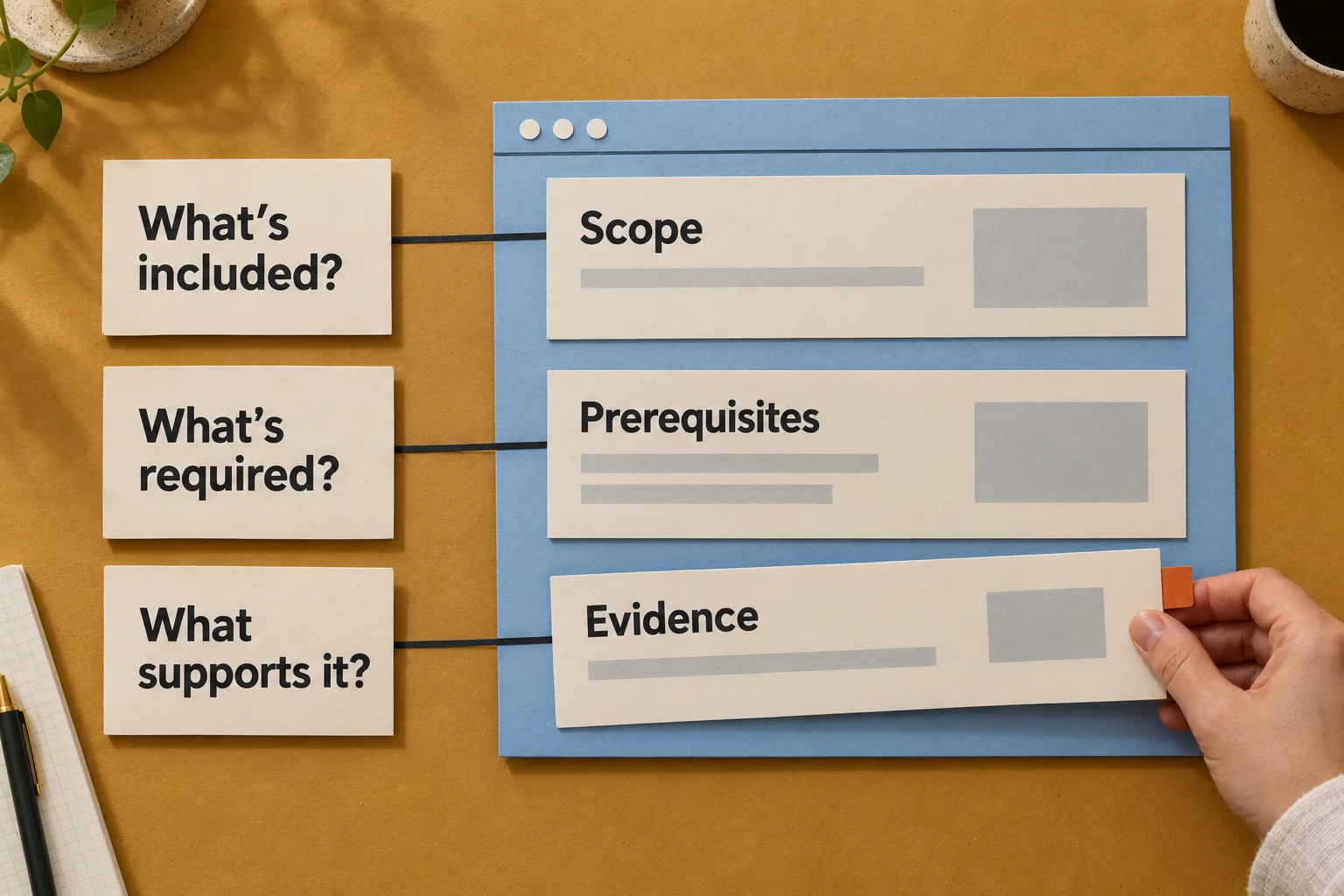
For the hypothetical software company, the brief might specify a precise setup promise, visible prerequisites, an explanation of what remains outside the stated timeframe, and evidence supporting the claim. Whether that requires a paragraph, a section, or a separate page should follow the information need.
For a campaign, preserve the relationship between the advertisement and its destination. Review whether shortened copy, a different visual, or removed qualifications changes the promise people are likely to take away.
A positive message test also leaves other performance questions open. When diagnosing why a website is not converting, continue to examine the offer, audience acquisition, pricing, trust, and usability rather than treating message approval as proof that the whole experience is effective.
Before authorizing detailed production, name what is ready, what remains uncertain, and who owns the next check. The team should be able to trace a consequential content or design requirement back to the question it needs to answer.