
Demand generation builds awareness, understanding, and preference for a company’s offering. Lead generation identifies potential customers and creates opportunities to qualify and follow up with them. Within a broader demand-generation program, lead generation is one part of the work.
For a B2B business, the distinction matters when deciding what to improve. You might need more people to understand your offer, a better way to capture existing interest, or a clearer match between the buyers you attract and the work you want. More leads will not resolve all three problems.
How demand generation and lead generation differ
Demand generation can include education before a buying project begins, evidence that helps someone evaluate an offer, and communication that develops their interest over time. Its purpose extends beyond making a company recognizable.
Some teams use the term narrowly to describe awareness activity. This article uses the broader meaning, consistent with Microsoft’s definition, which includes qualification, nurturing, and coordination with sales.
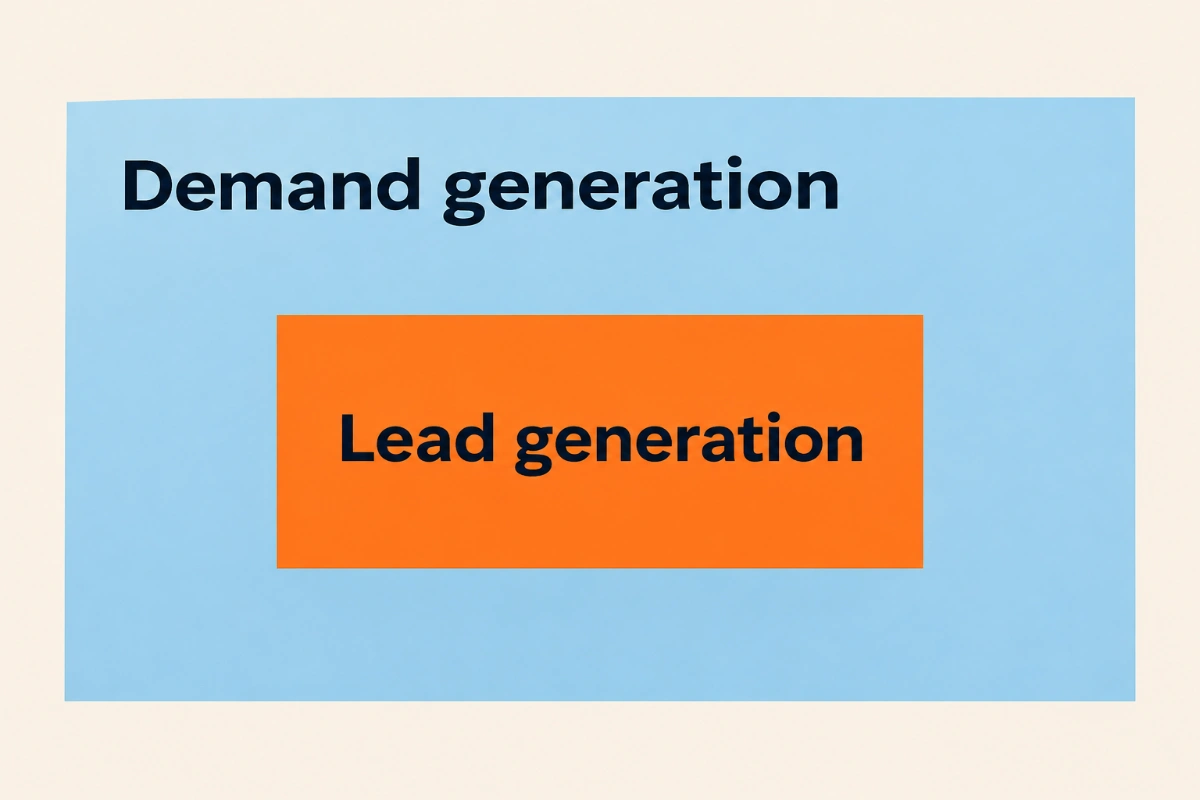
Lead generation creates an identifiable prospect through an interaction such as an inquiry, event registration, or request for a consultation. That interaction establishes something about the person’s interest, but its meaning depends on what they requested. Someone downloading a planning checklist has made a different commitment from someone asking for a proposal.
It also helps to distinguish demand creation, demand capture, and lead capture. Demand creation develops interest in a problem or solution. Demand capture responds to people already seeking a solution. Lead capture records someone’s details so the business can continue the conversation. Capturing a contact does not tell you which of the first two situations applies.
The progression from contact to customer requires further evidence of fit and readiness. That is why lead conversion needs its own attention, even when campaigns generate plenty of inquiries.
How the two work together in a buying journey
Consider a hypothetical IT services company that helps businesses plan and deliver systems upgrades.
The company publishes a guide explaining how to scope an upgrade. Its SEO content strategy connects practical buyer questions with educational and service content. A reader may find the guide while researching a future project, learn how the provider approaches the work, and remember it when the project becomes active.
The company also offers a webinar. Registration identifies interested contacts and enables it to send access details. The session can educate those people while demonstrating the provider’s expertise. One activity therefore supports both demand development and lead generation.

Registration alone does not make every attendee ready for a sales call. The follow-up should reflect the offer and expectations set during registration. A requested resource can be delivered without assuming the recipient wants a proposal.
Whether to gate a resource depends on the next step it supports. An event may need registration details; a general explanation of the service may be more useful when anyone can read it. Gating a report can identify readers for relevant follow-up, but it also makes access conditional on sharing information. Request details that help deliver the offer or establish fit, and explain how they will be used. The decision should reflect the reader’s task as well as the business’s need for contacts.
Later, a buyer might visit a service page and request a discovery meeting. The company needs to align that landing page with the offer, explaining the work, relevant proof, and what the meeting involves.
Another buyer may arrive through a referral and request a meeting immediately. Nobody has to complete every content step.
Coordinating this kind of B2B marketing work means connecting audience needs, content, the website, and follow-up. A useful starting point is to map offers and handoffs across the marketing funnel, giving each interaction a purpose without treating the sequence as compulsory.
Why more leads may not produce more opportunities
When lead volume looks healthy but sales do not, examine what those leads actually represent.
At Brand Vision, we recommend assessing the nature of the inquiries before assuming that sales skills or the sales cycle explain the problem. That means asking whether prospects want the service being offered, whether their budgets fit its scope, and whether they value the business’s competitive advantage.
For the hypothetical IT provider, a campaign emphasizing low-cost support could create expectations that conflict with a detailed, specialist upgrade service. The resulting inquiries would require a different conversation from those attracted by the provider’s planning expertise.
Review a sample of inquiries alongside the targeting, message, content or ad format, and offer that generated them. Record the requested work, relevant needs, budget compatibility where known, timing, and reasons prospects were accepted, deferred, or declined. Distinguish a suitable buyer with a future project from someone seeking a service the company does not provide.
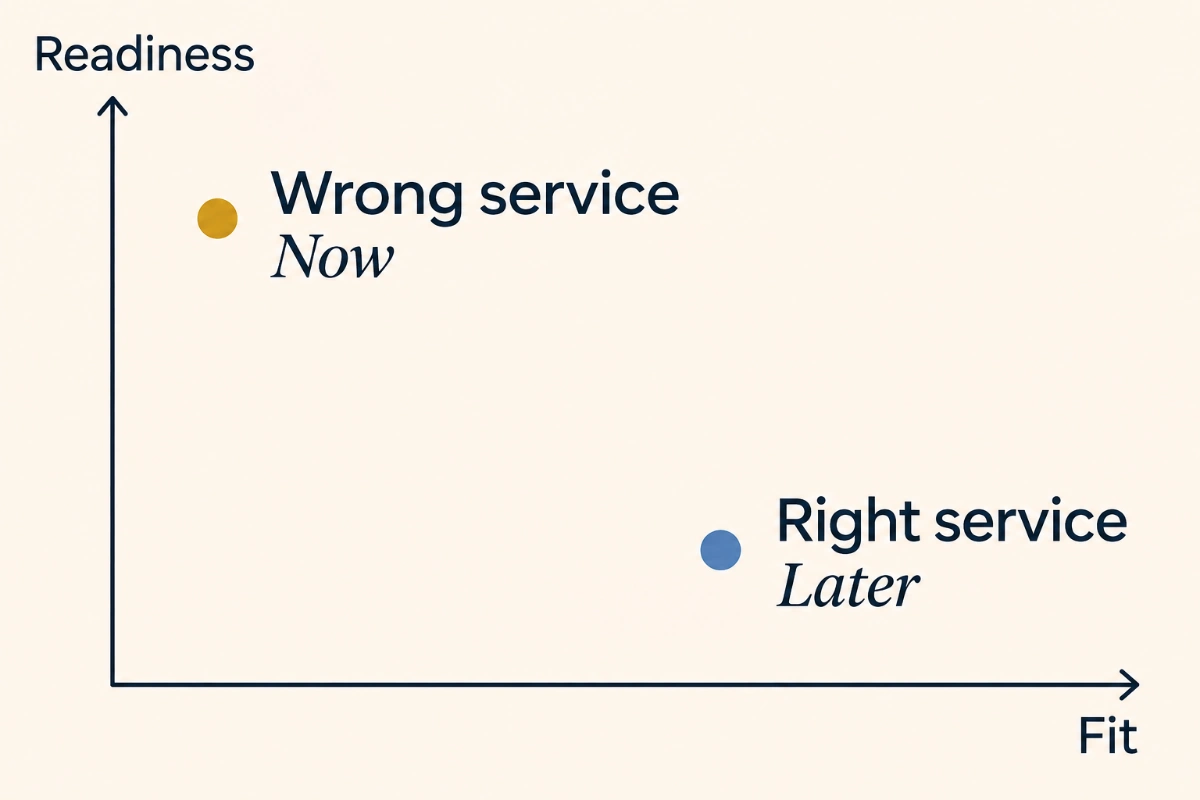
Where the business does not understand those expectations, customer perception research can help investigate them. If the offer is difficult to distinguish, brand strategy work can clarify the audience, relevant difference, and supporting message.
If buyers do not value the advantage behind a higher-priced offer, the decision may concern packaging, pricing, or the target market. A more persuasive campaign cannot resolve every mismatch between what the business sells and what prospects need.
This investigation should sit alongside evidence about follow-up and sales execution. Suitable inquiries that receive unclear answers or disappear during handoff warrant a process review. The purpose is to locate the constraint before spending more money on the wrong intervention.
How your website can shape who inquires
We also recommend examining website presentation when inquiries do not match the clients a business wants.
Consider what the site’s visual style, language, and examples suggest about price and company size. A presentation focused on affordability may encourage expectations of low-cost services. An enterprise-focused presentation may suggest that smaller projects are unwelcome, even when they would suit the business. These are possibilities to investigate with buyer feedback; appearance alone cannot establish their effect on inquiries.
For the IT provider, a website showing only large deployments could leave a smaller business unsure whether its project qualifies. The response might be to clarify suitable project scopes, explain different service arrangements, and show relevant evidence. Making the entire site look less sophisticated would not address the underlying ambiguity.

The aim is accurate commercial positioning. A smaller-budget inquiry can be valuable when its scope and economics fit the service.
Before commissioning website design, identify what visitors need to understand about the offer. Review the service descriptions and supporting proof as part of your B2B branding. Do they make the intended customer and appropriate project types clear?
Then distinguish perception problems from interaction problems. Someone may understand the offer but struggle to find the right service, evaluate options, or complete an inquiry. That calls for examining the user experience design.
Use usability testing to investigate where prospective customers hesitate, including what they believe the company offers and whom it serves. Combine those observations with inquiry records. The CRM shows who contacted you; it cannot, by itself, explain how many suitable visitors decided against doing so.
Where to invest next when time and budget are limited
Start with the business deadline and the constraint you have evidence for. Urgency affects sequencing, but it does not make every fast-to-launch activity appropriate.
If an offer already converts suitable prospects and relevant reach is limited, a bounded paid campaign may be worth testing. Define the audience, offer, budget, and commercial outcome you want to assess. Existing conversion performance provides a reason to test; it does not prove the same results will hold with a new audience or greater spend.
Separate the ability to launch from the time required to judge performance. Google’s Smart Bidding guidance notes that new campaigns without historical data can experience fluctuations, and that adaptation depends on conversion volume, conversion delay, and campaign settings. A campaign delivering traffic is not yet evidence of qualified pipeline.
If inquiries repeatedly mismatch the offer, investigate targeting and messaging before expanding distribution. If suitable visitors cannot evaluate the service or complete the next step, targeted page and journey improvements may be appropriate. A full redesign needs a broader justification than a disappointing month of leads.
For longer-term plans, sustained content and SEO work can form part of the effort to build discovery and consideration. A substantial redesign or rebrand may also be appropriate when the existing website or positioning no longer reflects the business. These projects solve different problems and should have different objectives.
When the evidence points in several directions, bring it together in a marketing audit covering acquisition, positioning, website experience, and measurement. Document the recommended first change and the evidence that would justify the next investment.
Paid media, SEO, branding, and website improvements can each support demand development and lead generation. Choose according to the problem each activity needs to solve.
How to measure whether the approach is working
Follow leads through qualification and revenue
Measure the immediate job of an activity, then connect it to commercial progress.
For lead capture, form completion and cost per lead help assess how efficiently contacts are acquired. Qualification adds information about whether those contacts suit the offer. Opportunities and revenue show what happened further along the process.
Keep these categories separate. HubSpot’s lifecycle-stage definitions, for example, distinguish a lead from a marketing-qualified lead, sales-qualified lead, opportunity, and customer. Businesses can customize their definitions, but the distinction between an interaction and a commercial opportunity remains useful.
Record why leads are accepted or rejected, not just how many enter the database. A lower cost per lead is less informative if the additional contacts consistently need something you cannot provide.
For demand development, examine whether you are reaching relevant buyers and whether they understand the offer. Buyer feedback, audience engagement, and branded-search trends can inform that assessment. Treat them as signals alongside commercial outcomes.
Compare groups with similar time to progress. This month’s new inquiries should not be judged against older leads that have already completed a lengthy sales process. Define the denominator for each conversion rate so the team knows whether it measures all contacts, qualified prospects, or opportunities.
Separate attribution from incremental impact
Connecting website activity with contact and deal records through CRM tracking helps explain recorded journeys. Those interactions and assigned credit do not establish causation.
Advertising measurement research on selected large U.S. Facebook campaigns run in 2015 found that observational methods and randomized experiments often produced different estimates of effectiveness, even with detailed behavioral and demographic data. A campaign can receive credit for a sale without establishing whether that sale would have happened anyway.
A controlled study asks how outcomes differ when an audience receives an intervention compared with an appropriate control group. Tools such as Google Ads Conversion Lift support that approach where access, data, and study conditions permit. Smaller programs may need to rely on more limited evidence and keep their conclusions correspondingly narrow.
Marketing and sales should agree on the intended audience, qualification criteria, handoff responsibilities, and evaluation period before changing investment. That agreement makes the next decision more specific: develop interest, reach more suitable buyers, clarify the offer, or improve the path from inquiry to sale.