
A brand promise is the benefit or experience customers are led to expect consistently from a business. It may be stated directly or communicated through products, service, messaging, and behaviour. It answers a practical question: what should someone be able to count on when they choose this brand?
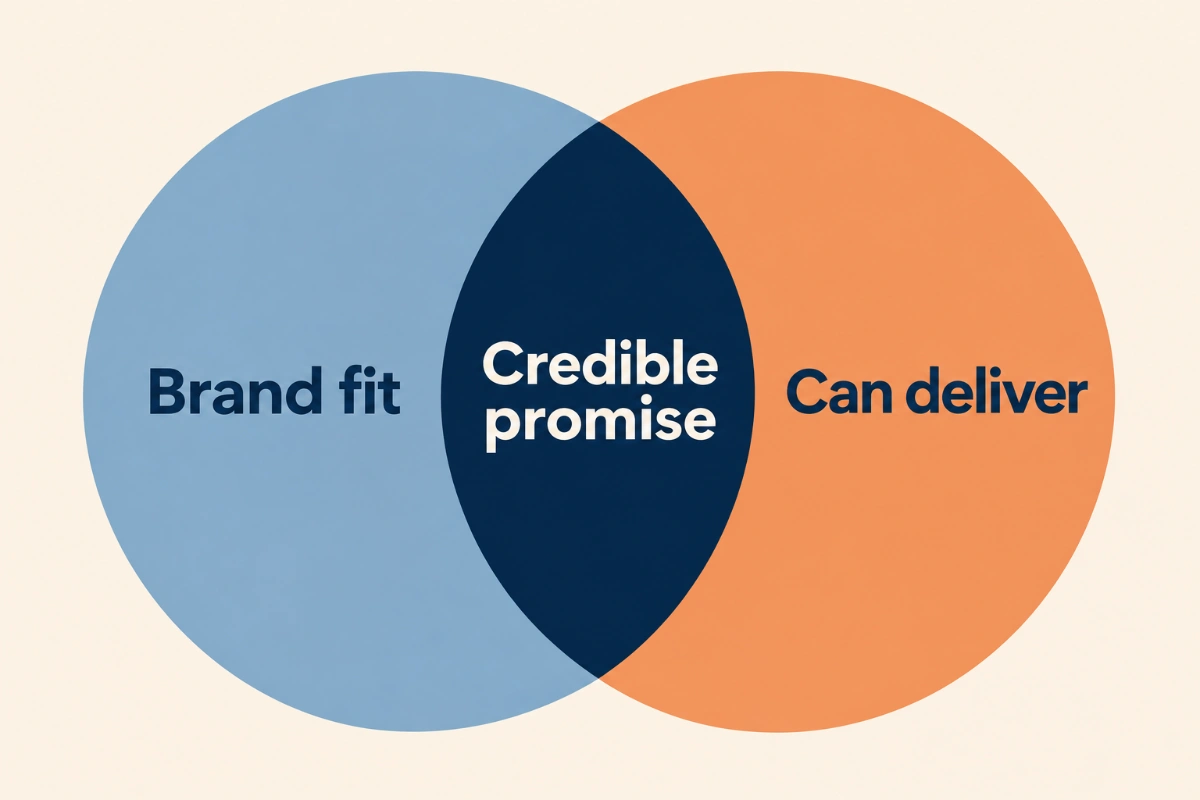
A credible promise fits both the brand’s positioning and its ability to deliver. Ambition can make that promise meaningful, but the expectation it creates needs support. A statement can sound entirely right for a brand while asking its employees, products, or service systems to deliver something they cannot yet provide.
What a brand promise commits you to
A promise gives customers an expectation and gives the business a standard for decisions. If a company promises simplicity, that commitment should influence how it explains prices, designs onboarding, and handles problems. The wording becomes useful when people can translate it into choices.
For a digital product, that promise should inform user experience design, from navigation and onboarding to error messages. Ask whether customers can complete the tasks the product promises to make easier, including when something goes wrong.
This internal role matters. Lumen Learning’s guidance on brand positioning and alignment describes the promise as a customer experience that also guides employees and other internal audiences.
The promise does not have to appear verbatim in every advertisement. A team might use it internally to coordinate work, while customers encounter its meaning through more specific messages and experiences.

However, keeping the statement internal does not eliminate customer expectations. A website that emphasizes personal attention, for instance, should prompt the business to examine what happens when someone needs help. The promise is expressed partly through what the business encourages people to anticipate.
Brand promise vs. mission, values, and value proposition
Leadership teams can confuse these concepts because they all describe something important about the business. Separating their roles makes it easier to decide what belongs in each statement.
- A mission explains the organization’s purpose and what it exists to accomplish.
- Values describe principles intended to guide behaviour and decisions.
- A value proposition explains why a particular customer should choose an offering.
- A brand promise identifies the benefit or experience customers should be able to expect.
- A tagline gives the brand a concise, memorable expression.
These roles can overlap. A tagline may communicate a promise, and a mission may help explain it. The useful test is whether each statement helps someone make the decision it is meant to support.
Consider a hypothetical repair business. Its mission could concern extending the useful life of household equipment. Its values might include honesty and resourcefulness. Its value proposition could emphasize convenient repairs for local households. Its promise would need to explain what customers can depend on during that experience.
A guarantee makes a more specific commitment, usually with defined conditions and remedies. It may support the broader promise, but it does not necessarily describe everything the brand stands for.
A clear brand messaging framework connects these elements so that purpose, customer benefits, supporting evidence, and public language reinforce one another.
What makes a brand promise credible?
An ambitious promise can give a brand direction and help customers understand what it is trying to offer. The difficulty begins when the statement stretches beyond either the brand’s identity or its operating capability.
Assess those dimensions separately.
First, consider whether the promise fits the position the business wants to occupy. A specialist built around careful, individual attention should examine how a promise of maximum speed would affect its service. Speed might be a useful improvement, but making it the central commitment could create expectations that compete with the attention customers are meant to value.
That alignment should carry into visual identity design. Review whether the imagery, typography, and presentation set expectations compatible with the language. A promise of calm, careful guidance should give the design team a clear direction for how the brand presents information.
Second, examine what delivery requires. A promise of personal attention needs more than a warm tone of voice. The business should determine who provides that attention, when customers can access it, and how the experience holds up as demand increases.
A promise can pass one assessment and fail the other. It may be strategically appropriate but operationally premature. It may also be achievable while emphasizing something peripheral to the brand’s chosen direction.
Research gives a reason to take credibility seriously. A 2006 study of brand credibility and choice, using survey and experimental data on orange juice and personal computers across seven countries, found that credibility’s effect on choice varied with consumer characteristics. That finding concerns how people evaluate brands; it does not establish that publishing a promise produces a particular sales result.
There is also a distinction between sounding believable and being supported. Customers may find a statement convincing before the business has established that it can deliver it. Audience feedback can reveal interpretation and perceived credibility. Operational evidence must establish whether a performance commitment is achievable.
For an emotional promise, that evidence may include observable service practices alongside customer feedback. A business promising reassurance could examine whether people receive clear explanations, understand their options, and know what happens next. The public statement need not contain a number for the organization to define meaningful delivery standards.
Brand promise examples and what supports them
These examples show different kinds of commitments. The official sources establish what the companies say and which supporting practices or policies they describe. They do not establish how consistently every customer receives the promised experience.
Target: A broad promise about value
Target explicitly identifies “Expect More. Pay Less.” as its brand promise. Its explanation connects desirable products and brands with affordability.
The statement brings two expectations together. Customers are encouraged to care about what they receive as well as what they spend. Interpreting it simply as “always the cheapest” would go beyond the published commitment.
Target connects that broad positioning to specific policies. Its current U.S. price-match process sets out eligibility conditions, evidence requirements, and exclusions.
The relationship between the statement and policy is useful. Broad language expresses the strategic benefit, while a supporting process explains how a particular part works. A business making a similar promise needs to examine both the appeal of the statement and the terms customers encounter when they act on it.
Red Hat: An ambitious B2B promise
Red Hat’s brand platform explicitly names its promise as “We unlock opportunities for innovation, everywhere.” It separately identifies its brand mantra, “No one innovates alone,” and explains that the mantra is not a marketing tagline.
The promise contains no numerical target. Red Hat connects it to customer interactions, including interfaces and support. As an example of its broader brand platform in action, the same page points to PatternFly, an open-source design system that provides interface standards, guidance, and tools.
That gives readers something concrete to examine beneath the ambition: resources intended to help people do their work. For a business considering similar language, the useful question is which capabilities, resources, and support make the promised opportunity possible.
The wording concerns opportunities. It should not be expanded into a guarantee that every customer will achieve an innovation or business outcome.
Starbucks: A promise about the customer experience
Starbucks publishes a mission, values, and stakeholder promises separately. Its customer promise is “Serve the world’s finest coffee, with a moment of connection.”
The wording combines a product claim with an experiential commitment. “World’s finest” is Starbucks’ own description, rather than an independently established ranking. The promise also asks readers to expect something from the interaction surrounding the drink.
For a team studying this example, connection raises practical questions about employee attention, service behaviour, and how transactions are handled. Those are delivery requirements to investigate, rather than findings about performance across Starbucks locations.
The separation of mission and customer promise is useful. A mission can describe a broader purpose, while a customer promise brings that purpose into the experience of choosing the business.
Patagonia: A guarantee that makes accountability concrete
Patagonia’s UK Ironclad Guarantee describes repair, replacement, or refund remedies for dissatisfaction or insufficient product performance. The same page explains exclusions, including normal wear and certain forms of misuse, modification, and external damage.
This is a product guarantee illustrating how a commitment can be supported. It should not be treated as a complete statement of Patagonia’s overall brand promise.
The policy gives customers a route to raise a problem and describes possible responses. Its boundaries matter alongside its opening commitment. These are the published UK/European terms, not an unconditional worldwide promise of free replacement for any product in any condition.
For other businesses, the useful principle is to make accountability understandable: what is covered, how someone seeks help, and what the business commits to doing.

How to develop a brand promise your business can keep
Start with audience and brand research to identify an expectation that matters to the intended customer. Examine interviews, feedback, support conversations, and the reasons people choose or reject the business. Look for a need the organization can meaningfully address.
Then make a strategic choice. Trying to promise every desirable quality can leave the business with a statement that gives employees little direction. Choosing what the brand should stand for is part of brand strategy and positioning, and it should happen before polishing the sentence.
Write an initial version in plain language. Ask what a reasonable customer would expect after reading it, including expectations the team did not intend to create.
Return to the hypothetical repair business. Suppose it is considering a same-day service promise. A customer might understand that as a completed repair, while the business means a technician visit. That difference is substantial, even if both sides interpret “service” reasonably.
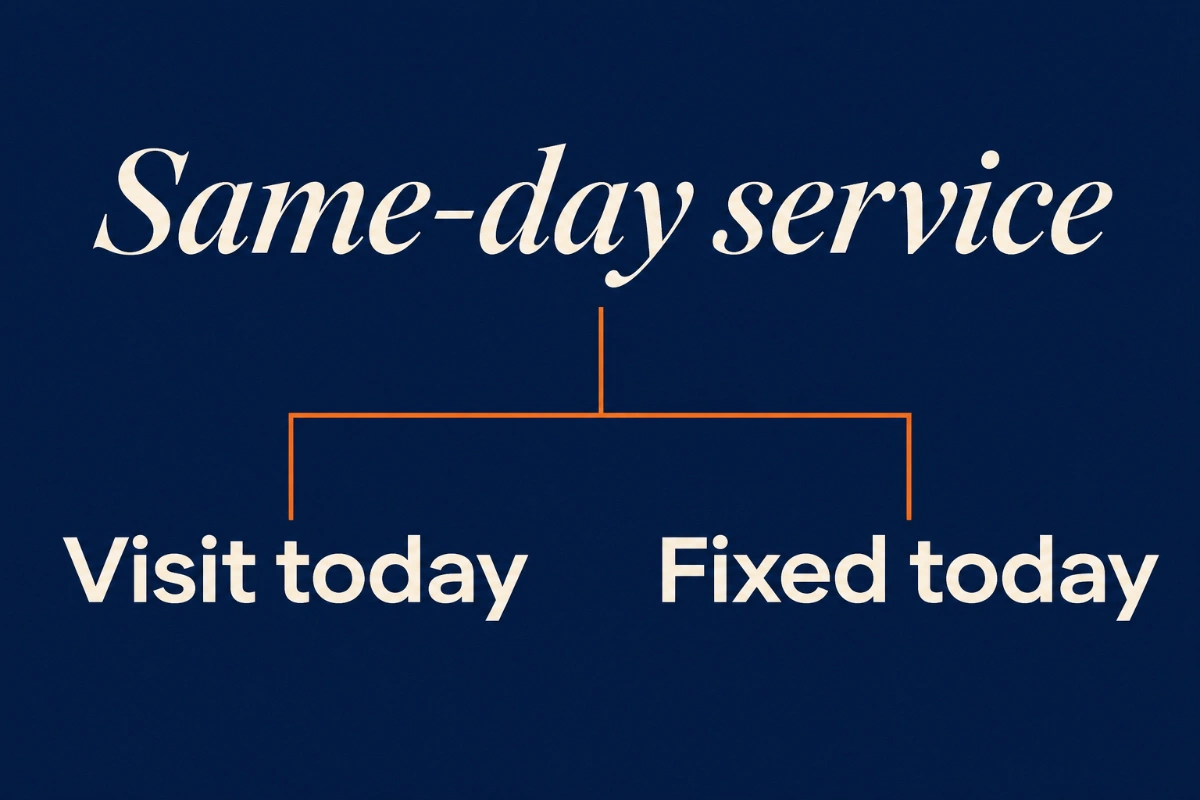
Before publishing the claim, the business would need to examine scheduling capacity, service area, technician availability, and parts requirements. If those conditions support same-day assessment but not completed repairs, the wording should make that distinction clear.
That leaves several possible decisions:
- Clarify the language when the business can deliver the intended service but the wording creates a broader expectation.
- Narrow the commitment when it is reliable only for particular jobs, locations, or conditions.
- Improve delivery capability when the broader promise is strategically important but cannot yet be supported.
The right choice depends on the customer need and the cost of meeting it. Narrowing a promise is not automatically the best answer. If the narrower version removes the benefit customers care about, the business may need an operational change rather than another round of copywriting.
Next, test how customers interpret the promise. Ask people to explain what they expect in their own words and what would count as a disappointing experience. Positive reactions to the language are useful, but they cannot establish that the company’s performance claims are true.
Carry the commitment into website design: explain the offer clearly, place important conditions where people make decisions, and make the route to help easy to find. For the repair business, the booking page should distinguish the technician’s arrival time from an estimate of when a repair could be completed.
Finally, assign responsibility. Identify who monitors delivery, which evidence they review, and who can change the wording or operating process. A promise should have an owner after the launch, especially when products, staffing, or service conditions change.
What to do when the promise and experience diverge
A failure should prompt both a response to the affected customer and an examination of its cause. An isolated mistake, a recurring capability gap, and an unclear statement require different corrections.
When the underlying service can support the commitment, investigate the breakdown and provide an appropriate remedy. If failures recur under ordinary conditions, examine whether staffing, systems, suppliers, or the promise itself need to change. Repeatedly asking employees to make exceptional efforts is a weak basis for a routine commitment.
It is also worth questioning the assumption that every promise needs to be exceeded. In 2014 experiments on interpersonal promises, Ayelet Gneezy and Nicholas Epley found that breaking promises attracted worse evaluations than keeping them, while exceeding them did not attract correspondingly better evaluations.
That research does not establish that extra service never benefits a business. It does provide a reason to reconsider automatic “underpromise and overdeliver” advice. Before investing in additional gestures, assess whether the business is reliably providing the experience people already expect.
When customers consistently interpret the promise more broadly than intended, examine the full context in which it appears. Images, headlines, sales conversations, and supporting claims may create an expectation that a narrowly worded qualification cannot resolve. Correct the communication and address the expectations already created.
If a changed audience, offer, or business direction makes the old commitment inaccurate, reassessing the promise may become part of a broader rebranding effort. Explain the change and make the replacement expectation clear. A new sentence cannot retroactively change what existing customers were led to expect.