
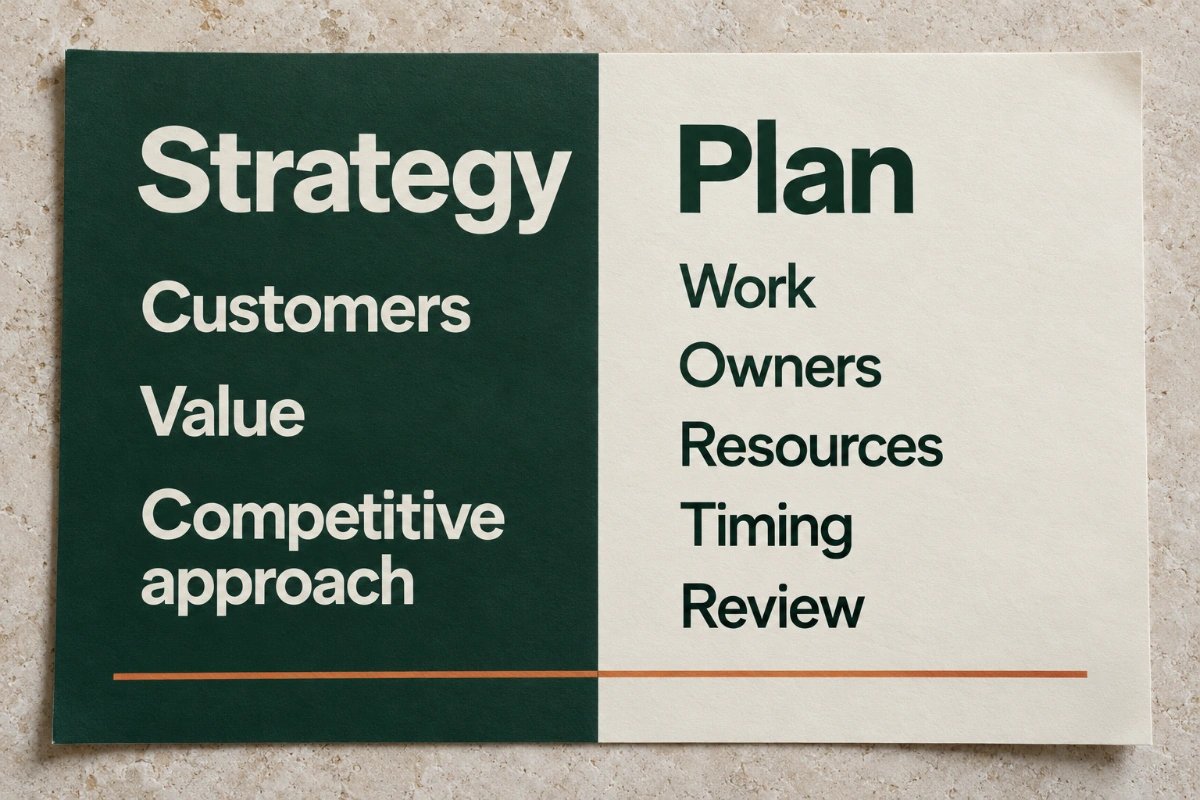
A marketing strategy defines which customers a business will prioritize, what value it will offer and how it intends to compete. A marketing plan records that direction and organizes the activities, resources, responsibilities and timing needed to put those choices into practice.
The distinction matters because a business can have a detailed campaign calendar while important strategic decisions remain unresolved. It can also have a clear strategic direction without giving its team an executable plan.
Strategy and planning do not require separate documents. OpenStax’s explanation of a marketing plan’s structure includes strategy alongside action programs, budgets and controls. The important distinction is between the decisions that guide the work and the commitments that make it happen.
Understanding that relationship helps a team identify what it needs next: better information, clearer choices or a more practical approach to delivery.
What a Marketing Strategy Needs to Decide
A strategy should explain how marketing will contribute to the business’s objectives. Increasing revenue is an objective. Deciding which customers to pursue, what to offer them and why they should choose the business begins to establish a strategy.
Researcher Rajan Varadarajan’s definition of marketing strategy emphasizes connected choices about products, markets, marketing activities and resources. This helps explain why an audience description or a list of channels can contribute to a strategy without completing it.
In our client work at Brand Vision, businesses arrive with different levels of strategic clarity. Sometimes a business knows its broad audience and has ideas about what it wants to do, but has not clearly defined the market segment it will prioritize, its competitive advantage or how it intends to reach and win those customers.
Those gaps affect the decisions that follow. “Small businesses” might describe a broad audience, but it leaves considerable room for different needs, buying processes and service expectations. Choosing which customer segments to prioritize becomes meaningful when that choice changes the offer, message, sales approach or use of resources.
The proposed competitive advantage needs similar scrutiny. “Better service” is difficult to act on until the business explains what better means to the intended customer and whether it can consistently deliver it. Clarifying that position and the messages supporting it is part of brand strategy consulting.
Strategic choices also extend beyond promotion. Pricing, distribution and major resource commitments can shape how a business competes. A channel decision may be strategic when it changes how customers buy; scheduling individual advertisements within that channel is an implementation decision.
Research the Choices Before Planning the Activity
Our recommendation is to complete substantive research before committing to the company’s marketing strategy and campaign plan. The client may already hold useful evidence, or brand and audience research may need to be included in the engagement before strategic decisions are made.
That research should clarify customer needs, buying criteria, competing alternatives and the business’s ability to support its proposed advantage. Business Queensland’s guidance on writing a marketing strategy and plan identifies desk research, quantitative research and qualitative research as ways to understand the market.
The method should follow the decision. Customer interviews may help investigate how buyers describe a problem. Existing sales records may help identify which customers the business currently serves. Reviewing competing offers can help test whether a proposed difference is distinctive.
Keep evidence separate from interpretation. A customer comment may suggest a promising message, but it does not establish that the whole market shares that preference. A proposed advantage remains an assumption until there is a credible basis for it.
Even thorough research leaves uncertainty. Record what is known, what is inferred and what still needs testing. The depth of investigation should reflect the consequences of getting the decision wrong. Entering an unfamiliar market may justify more research than adapting an established campaign for an audience the business already understands.
What a Marketing Plan Needs to Make Executable
Once the strategic choices are clear enough to guide action, the marketing plan translates them into work the team can carry out.
A usable plan should make the following clear:
- The activities and deliverables selected to support the strategy.
- The people responsible for delivery, approval and coordination.
- The timing, milestones and dependencies between tasks.
- The budget and capacity available for the work.
- The measures and review points that will inform subsequent decisions.
These elements need to agree with one another. A launch date means little if the required product demonstration cannot be prepared in time. A media budget is incomplete if nobody has accounted for the content, design and follow-up needed to support the campaign.
A campaign is a coordinated initiative within that broader plan. Tactics are the specific activities used to carry it out. A product-launch campaign might include a landing page, demonstration, email sequence and sales outreach. The plan establishes how those pieces fit together.
The plan should also explain what success means. Publishing every asset on time demonstrates delivery. It does not, by itself, establish whether the work reached the intended customers or contributed to the business objective.
Choose marketing metrics tied to business decisions. For example, a team may need to distinguish general enquiries from enquiries that meet its customer criteria. It should decide how that distinction will be recorded before the campaign begins.
The document’s length is secondary to its usefulness. A small team may keep strategic choices and implementation details in one working document. A larger organization may need separate plans for products, regions or campaigns, provided those plans remain connected to the same strategic direction.
A Marketing Strategy and Marketing Plan Example
Consider a hypothetical company selling scheduling software. Suppose its objective is to acquire customers it can onboard and support with its current team. Its initial marketing proposal is to target small businesses, run paid advertisements and publish more content.
That proposal identifies an audience category and some activities. It does not yet explain which businesses the company is best placed to serve, what would motivate them to switch or how the available budget should be used.
The Strategic Choices
For this example, suppose the company is considering smaller HVAC businesses as a potential segment. It believes that straightforward setup and scheduling could be a useful point of difference.

Those are assumptions to investigate. The company would need to understand whether scheduling is an important problem for these buyers, what they currently use, what makes switching difficult and whether its software can support the promised experience.
If the evidence supports the choice, the company could prioritize smaller HVAC businesses and compete on straightforward adoption and practical scheduling support. It would also need to decide which opportunities to defer. Pursuing large enterprises with extensive integration requirements might conflict with the proposed offer and the team’s delivery capacity.
This is where strategy becomes more than targeting. The choice affects the product promise, the proof required, the sales conversation and the customers the company is prepared to serve.
The Implementation Plan
The marketing plan would turn that direction into a coordinated set of commitments.
The product lead would first confirm which setup and scheduling capabilities could be demonstrated accurately. The marketing lead would then oversee a segment-specific landing page and demonstration using those capabilities. The sales lead would prepare follow-up questions to establish whether an enquiry fits the intended customer group.
Each deliverable would have an owner and an approval date. Advertising would depend on the landing page, tracking and follow-up process being ready. The budget would account for production and staff time as well as media spending.
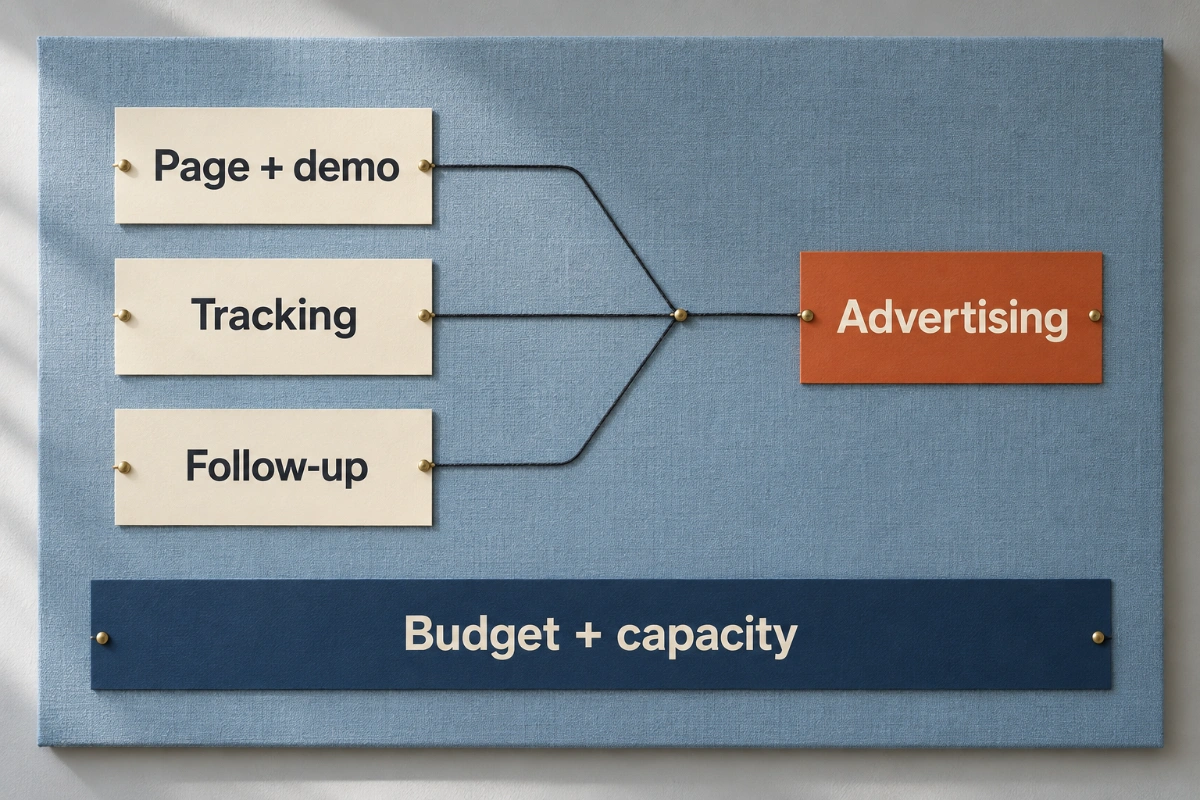
If the team could support only a limited number of demonstrations, the plan would need to reflect that constraint. Generating more enquiries than the team can handle would create a different problem from generating too few.
Measurement would distinguish delivery from response and commercial progress. The team could track whether relevant buyers requested demonstrations, whether suitable prospects became customers and whether those customers could be onboarded and supported within the available capacity. These would be planned measures, not evidence that the strategy had already succeeded.
Before committing the next portion of the campaign budget, marketing and sales would review enquiry quality and feedback from demonstrations. If suitable prospects were confused about setup, the team could investigate the explanation and demonstration. If conversations instead suggested that the chosen customers did not value the proposed advantage, the team would have reason to investigate the underlying strategic assumption.
The strategy supplies the rationale. The plan makes the work, constraints and learning process explicit.
Which Comes First: Marketing Strategy or Marketing Plan?
Initial strategic direction should guide substantial campaign commitments. Without it, teams have little basis for choosing between competing activities or deciding which opportunities deserve resources.
That does not mean every strategic question must be settled permanently before any work begins. Research can reveal new questions, and a limited test can help assess an assumption before a larger commitment.
A test designed to investigate a specific customer assumption can contribute to strategic development. When using a campaign for that purpose, decide before launch what evidence would support or challenge the assumption. The plan can then specify what to measure and when to review it.
Research informs the choices, strategy guides the plan, and execution provides further evidence. The process continues as the business learns.
When to Change the Plan or Revisit the Strategy
Changing a deadline, replacing an asset or reallocating work usually concerns the plan. Reconsidering the customer segment, the value proposition or the route to market may require a strategic decision.
The scale of a change alone does not settle the distinction. A small budget adjustment might support the existing approach. A larger shift toward a different customer group could change the strategy, even if it is presented as routine campaign optimization.
Mintzberg and Waters’s work on deliberate and emergent strategy recognizes that strategy can reflect both intended choices and patterns that develop through action. This provides a useful qualification to the idea that strategy is completed once and then left untouched.
Poor results still require investigation. A campaign may underperform because the work was delayed, the message was unclear, measurement was unreliable, the target was unrealistic or a strategic assumption was weak. The result alone does not identify the cause.
Before changing direction, examine what happened at each stage. Confirm that the intended work was delivered, that relevant customers encountered it and that the measures capture the outcome being assessed. Then consider whether the evidence supports the assumptions behind the approach.
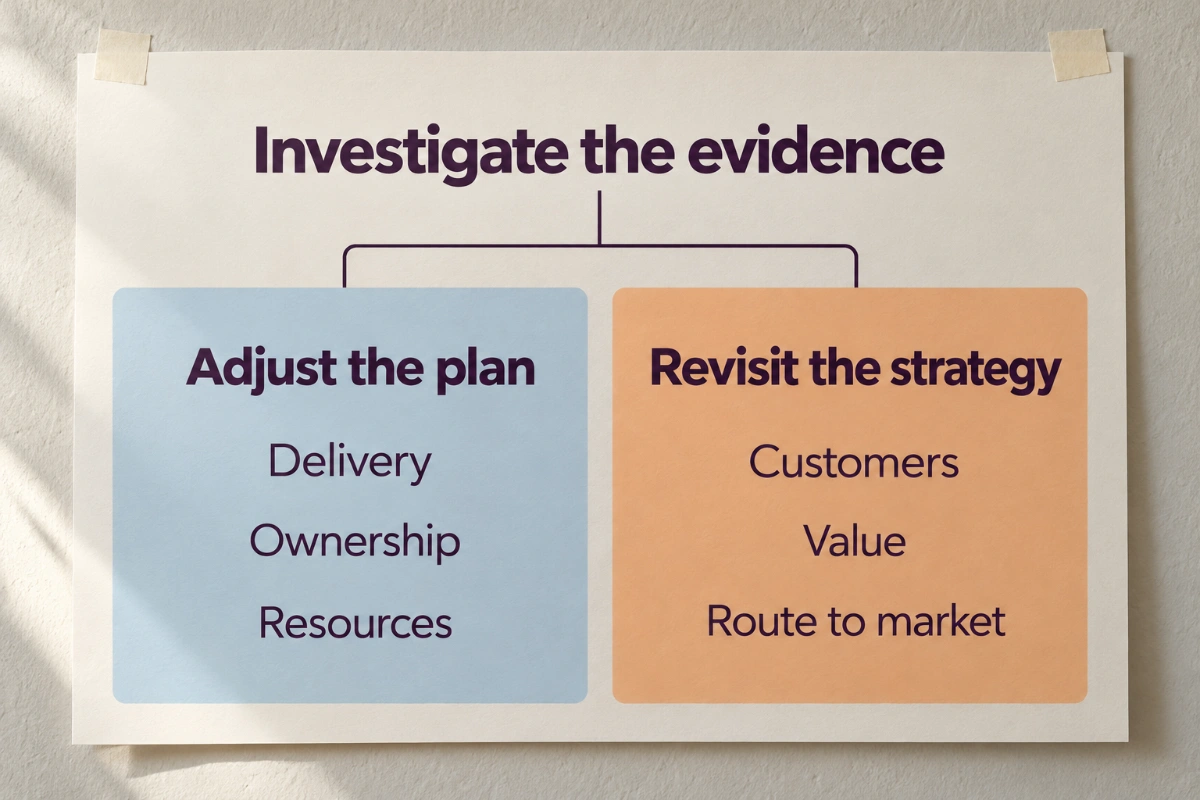
A team with unresolved customer and competitive choices needs to strengthen its strategy. A team with clear choices but missing owners, budgets or dependencies needs a more executable plan. A team with both should examine delivery and results before deciding what to revise.
Build a Clearer Marketing Strategy and Plan
Brand Vision’s marketing strategy consultation examines audience priorities, messaging, channels and investment decisions to help define a practical roadmap. If your business needs clearer strategic choices or a plan your team can carry out, talk to Brand Vision about your market, priorities and next steps.