
Red Bull marketing has never been about selling an energy drink louder than everyone else. It is about building a world people want to join, then distributing that world with the discipline of a media company. That is why Red Bull's campaigns still set the pace in 2026, in a market crowded with creators, sponsorships, and short-form everything.
At Brand Vision, we read campaigns like these less as ads and more as systems. The mechanics travel across categories. Attention is only worth something when it lands on a clear brand story and a website that makes the next step obvious. Get that right and marketing stops being a run of launches and starts behaving like an engine.
At a Glance
- Red Bull's biggest marketing campaigns work because the story leads and the product follows.
- Each campaign is built as a long-term content asset, not a one-day event.
- Owned media and recurring platforms make every new campaign cheaper to scale than the last.
- The transferable lesson for 2026 is systems over stunts: one promise, repeatable proof, a clear next step.
The Scale Behind the Strategy (and Why It Matters)
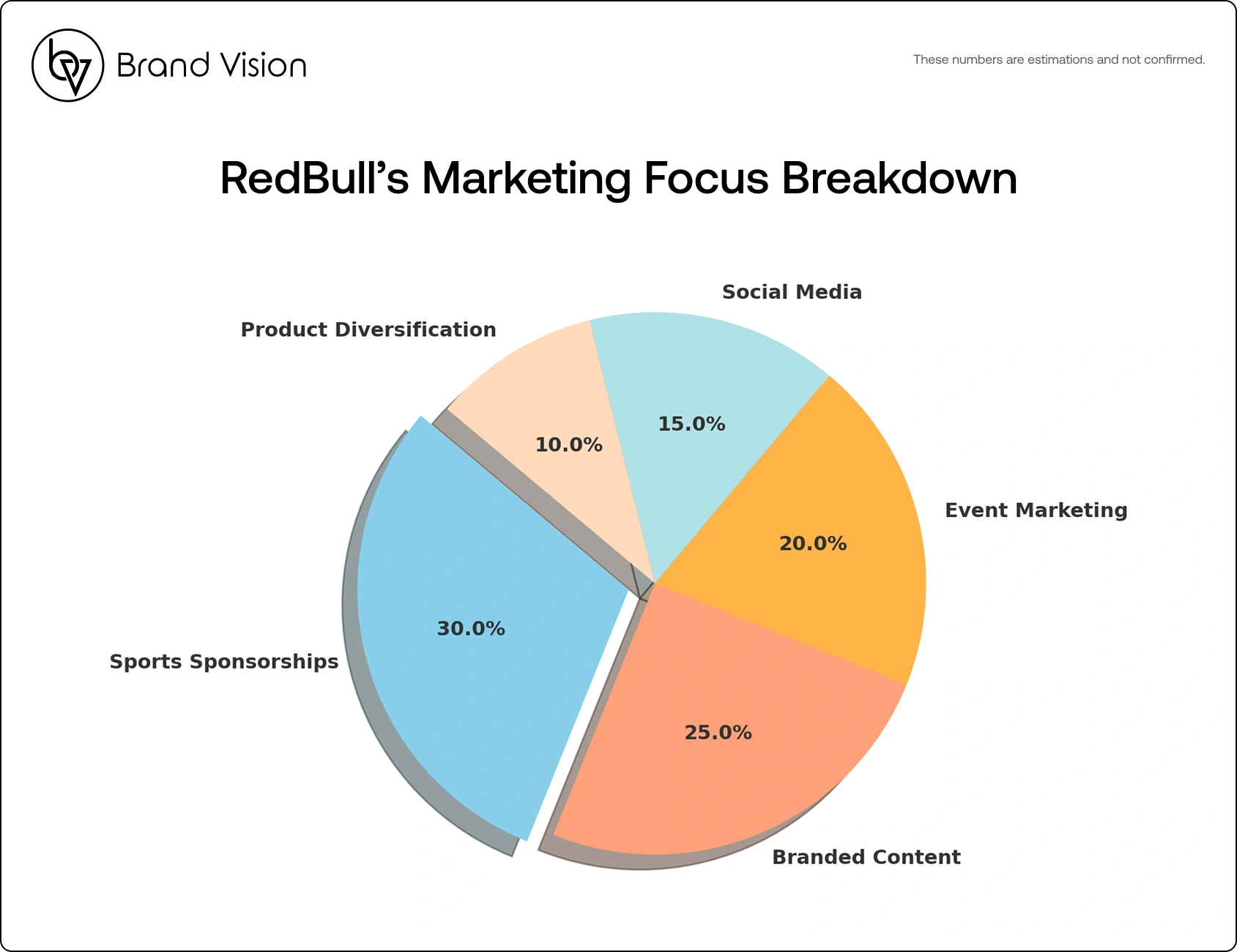
Red Bull's consistency makes more sense once you see the size of the operation. As of 2025 the company reports selling 13.969 billion cans worldwide, with group turnover up to EUR 12.196 billion (Red Bull company profile). That scale funds what most brands cannot sustain: premium production, recurring events, and year-round storytelling that does not disappear when a campaign ends.
Scale is not the strategy, though. The strategy is how Red Bull turns that spend into compounding demand. Big moments are treated as long-term assets rather than one-day wins. Content is planned as a library from the start, the highlight, the behind-the-scenes, the follow-up. And distribution is designed in at the beginning, not bolted on at the end.
The Red Bull Marketing Strategy Blueprint (Built Like a Flywheel)
Red Bull's marketing strategy is best read as a flywheel with four connected parts: positioning that stays stable, proof that feels real, publishing that never stops, and platforms that generate repeatable stories. Each part feeds the next, which is why the campaigns compound instead of resetting every quarter.
Red Bull formalized the publishing side through Red Bull Media House, which runs as a multi-platform media company built around sports, culture, and lifestyle. That structure is the quiet advantage behind the loud campaigns.
From a Brand Vision lens, this is the line between running marketing and building a marketing system. A good partner does not just make posts. It protects the positioning, engineers the proof, and connects every campaign to a website journey that converts.
Stratos: Turning a Single Moment Into a Global Broadcast
Stratos worked because it was built as a story people wanted to watch live and then rewatch for years. Training, risk, tension, the jump, the aftermath. The arc was clear before anyone switched on a camera.
The distribution proof is public. YouTube's own newsroom put the livestream peak at more than 8 million concurrent viewers (YouTube newsroom), the most concurrent views the platform had ever seen at the time. Red Bull still keeps the project alive through its dedicated Stratos hub, which is the tell: the brand treats a campaign as an ongoing media asset, not an expiring ad.
Why it worked
- A simple narrative anyone could retell in a sentence.
- Built-in replay value and real demand for the behind-the-scenes.
- A brand promise delivered through proof, not copy.
The transferable move is to design one flagship moment that can feed a whole content library and to build the place you are sending people to before you spend on the attention.

F1: Sponsorship as a Platform, Not a Placement
For Red Bull, Formula 1 is not a logo on a car. It is a platform that manufactures storylines every season, with weekly moments and year-round content. The team lays out its history and structure on the Oracle Red Bull Racing pages, and Formula 1's year-by-year record reinforces the continuity that makes the sponsorship read as identity rather than advertising.
That is why Red Bull stays present without feeling repetitive. The platform writes new episodes on its own.
Why it worked
- Ongoing proof through performance and consistency.
- A built-in content cadence: races, rivalries, engineering stories, fan culture.
- An identity that never needs reinventing.
The lesson is to choose platforms that generate repeatable stories instead of one-time exposure, and to treat partnerships as content infrastructure. The same platform thinking shows up in Nike's marketing strategy and how it builds presence across recurring cultural moments.
Flugtag: Experiential Marketing Engineered for Sharing
Flugtag is participation disguised as entertainment, and the format is the distribution. Teams build human-powered flying machines, launch them off a pier, and the spectacular failures become content people share without being asked. Red Bull runs the Flugtag event series across cities worldwide, so local events roll up into one global identity.
This still matters in 2026, because community-made content travels further than polished brand content when the mechanic is right.
Why it worked
- Participation produces the content automatically.
- The tone is approachable, not exclusive.
- Recognition, not a discount, is the reward.
For a smaller brand, the move is the same at a smaller scale: build a simple mechanic customers can join in minutes, and make being featured the prize.
.webp)
The Art of Flight: Premium Content as Brand Equity
The Art of Flight shows the strategy at its most patient. Rather than borrow culture, Red Bull funded it. The brand treated a feature-length snowboarding film like premium entertainment and kept it inside its own media library, which turns one production into an asset with a long shelf life.
For a marketing partner that is the useful part: one premium piece can fuel months of cutdowns, highlights, clips, and social hooks. Build a content hub that keeps a visitor moving to the next story, the way our own Insights hub is meant to. Even luxury brands run this play; the patient, equity-first approach in Louis Vuitton's marketing strategy rewards the same restraint.
Why it worked
- Quality high enough to earn attention rather than demand it.
- Cultural credibility bought with real investment.
- Repurposing potential that lasts for years.
.webp)
"Red Bull Gives You Wings": The Message That Holds Everything Together
Plenty of brands confuse activity with strategy. Red Bull does not. The tagline is a promise that stays fixed across wildly different executions, which is how Red Bull's campaigns can move from extreme sports to culture to everyday social rituals and still feel instantly like the same brand.
This is the hardest part for most businesses to hold, and it is not creativity. It is discipline. The job is to write one promise and protect it, then use branding to turn that value into language people repeat. A stable line is also why McDonald's has stretched "I'm Lovin' It" across two decades; the discipline behind McDonald's marketing strategy is the same one at work here.
Why it worked
- A promise flexible enough to stretch across categories.
- Consistency that builds memory and recall.
.webp)
Social-First Campaigns: Broadening Relevance Without Diluting Identity
Not every Red Bull campaign needs a stunt. The brand also wins by turning everyday identity into a shareable ritual, tying itself to belonging and social energy. That matters in 2026, when not everyone wants to watch a man jump from the edge of space, but almost everyone wants to feel part of something.
The mechanic is the same promise in a quieter setting: build something simple that invites participation, start small, and expand what works. For a contrast case, Duolingo's TikTok strategy shows how a brand builds cultural presence through repeatable social mechanics rather than budget.
Why it worked
- A simple mechanic that encourages sharing on its own.
- Everyday relevance that raises how often the brand shows up.

What You Can Apply to Your Own Brand
Red Bull's campaigns look intimidating because the outputs are enormous. The transferable part is the structure, and it is smaller than it looks. This is the playbook we adapt most often when we act as a long-term marketing partner, and none of it needs a Stratos budget.
1. Write a promise that can survive a hundred campaigns
If the core idea keeps changing, your audience never builds memory. Write one sentence that says what you do and why it matters, specific enough to mean something and broad enough to scale, then keep the message and the visual cues locked together across your site, social, and campaigns.
2. Build proof that people can see, not claims they have to trust
Red Bull earns belief through real-world proof. Yours can be smaller, but it has to repeat. Turn your expertise into something visible, a challenge, a demo, a transformation series, and publish the outcomes and the lessons on a schedule rather than when you remember to.
3. Design participation into the campaign
Flugtag works because the audience becomes the content. Pick a mechanic a customer can join in minutes, then build a recognition loop that spotlights people, features submissions, and celebrates results. Make the sharing feel natural by anchoring it in identity, not discounts.
4. Treat content like a product line
The Red Bull engine never stops, and random posting builds no recall. Choose two or three formats you can sustain for a full year, a weekly insight, a monthly story, a quarterly hero asset, and run them on a real process with clear owners and approvals. In food and beverage marketing, that repetition matters because recognition is built through consistent category presence.
5. Make your website the closer, not the brochure
Attention is only worth something if the landing experience converts, and this is where most campaigns leak. Map each campaign to one primary action, whether that is an inquiry, a booking, or a subscription, and build dedicated pages that answer the decision questions quickly with as little friction as possible.
6. Build partnerships that work as credibility infrastructure
Red Bull does not chase random sponsorships. Its partnerships line up with the promise and produce proof. Choose partners who validate your message in public, structure the relationship to create stories rather than logos, and let that content live on your own site so it keeps earning attention. Our deeper look at Red Bull's extreme sports sponsorships shows how that model compounds over time.
7. Create internal pathways so your marketing compounds
The best brands never let a reader hit a dead end. Link campaign content to its supporting proof, then to the relevant service, so each page strengthens the next instead of standing alone.
8. Measure the metrics that compound
Views are not value. Track the marketing metrics tied to memory and conversion, repeat visits, branded search interest, sign-ups, and conversion rate by content type, and give the system a full cycle before you judge it. Keep what compounds and cut what spikes without payoff.
Frequently Asked Questions
What are Red Bull's most famous marketing campaigns?
Red Bull's best-known campaigns are Stratos (Felix Baumgartner's jump from the edge of space), the Flugtag flying-machine events, the snowboarding film The Art of Flight, its Formula 1 team Oracle Red Bull Racing, and the long-running "Red Bull Gives You Wings" platform. Each was built to keep producing content long after the moment itself passed.
What is Red Bull's marketing strategy?
Red Bull's marketing strategy runs like a flywheel: stable positioning, real-world proof, nonstop publishing through Red Bull Media House, and platforms such as Formula 1 that generate repeatable stories. The product follows the story rather than leading it.
Why is Red Bull's marketing so effective?
It works because Red Bull treats every campaign as a long-term media asset, not a one-off ad. One stable promise carries across formats, owned media keeps the content alive, and the scale of the business, 13.969 billion cans sold in 2025, funds production most brands cannot match.
Can a small business copy Red Bull's campaign strategy?
Yes, but copy the structure, not the budget. The transferable part is one protected promise, a proof format you can repeat, and a website that turns attention into action. We see that smaller version working far more often than the stunt-led one.
Red Bull's campaigns look expensive to copy and easy to misread. The budget is not the lesson. The discipline is: one promise, proof you can rerun, and a clear place to send the attention. If that last piece is where your campaigns leak, conversion-focused web design is the part we would fix first.
Build the system and the math changes. Your marketing stops being a run of separate campaigns and starts being one engine that compounds.









.webp)