

The way people search for information has fundamentally shifted. In 2026, users are no longer limited to scanning ten blue links on a results page. They ask ChatGPT questions in natural language. They consult Perplexity for synthesized research. They receive instant summaries through Google AI Overviews before a single organic result comes into view. In this environment, the debate around SEO vs AEO is not theoretical. It is one of the most consequential strategic decisions a modern marketing team can make.
Understanding SEO vs AEO starts with recognizing that these are not competing philosophies. They are complementary disciplines that address different dimensions of search visibility. Brands that treat them as an either-or choice risk losing ground on two fronts simultaneously, while brands that integrate both build a compounding visibility advantage that compounds over time.
What Is SEO vs AEO? Defining Each Strategy
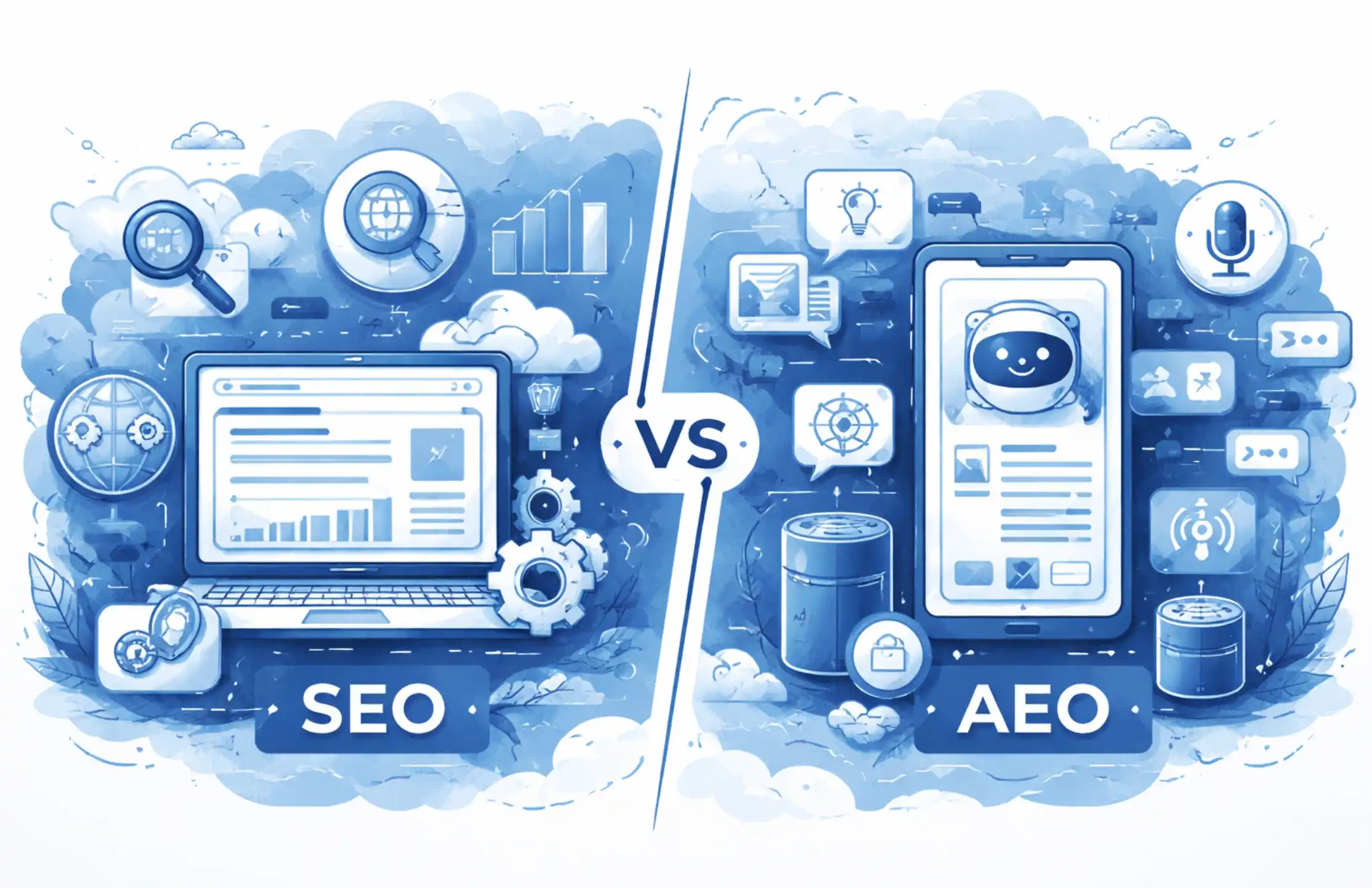
SEO, or Search Engine Optimization, is the practice of structuring and strengthening your website so it ranks prominently in traditional search engine results pages. It encompasses technical site performance, keyword targeting, backlink acquisition, content depth, and on-page optimization. SEO has been the cornerstone of organic digital visibility for over two decades, and it remains foundational in 2026 as the indexed web continues to grow.
AEO, or Answer Engine Optimization, is a more recent and rapidly maturing discipline. It focuses on structuring content so that AI-powered platforms, including Google AI Overviews, ChatGPT, Perplexity, and voice assistants, can extract, understand, and present your content as a direct answer to a user's question. Where SEO aims to rank, AEO aims to be cited. That distinction carries significant strategic weight.
The SEO vs AEO distinction is critical because both strategies operate on different success criteria. SEO measures rankings, click-through rates, and organic traffic volumes. AEO measures citation frequency, brand mentions within AI-generated answers, and visibility in zero-click environments where the answer appears before the user ever reaches a link. Building clarity around both is the foundation of a modern search strategy.
Why the Search Landscape in 2026 Demands Both SEO and AEO
The data makes the urgency of addressing SEO vs AEO concrete. A comprehensive Semrush analysis of over 10 million keywords found that Google AI Overviews now appear for approximately 16% of all search queries, with that figure having surged as high as 25% during peak periods in 2025. A Bain study widely referenced across industry research found that 60% of searches in traditional search engines now end without the user clicking any result.
These statistics do not signal the death of SEO. They signal the emergence of a parallel visibility layer that demands equal strategic attention. Brands asking only how to rank on Google are missing a critical second question: how do they become the source that AI systems select when generating answers?
The SEO vs AEO conversation is also shaped by conversion data. Research from Semrush found that visitors arriving from AI-generated answers convert approximately 4.4 times better than traditional organic search visitors. AI-referred sessions have also seen a 527% year-over-year increase according to Search Engine Land data. This means that AEO-driven traffic, while often smaller in volume, is frequently higher in intent and quality. That finding alone reframes the SEO vs AEO debate. Both channels are valuable. Both must be structured and maintained.
A Search Engine Land analysis of Ahrefs and Amsive data further found that when Google AI Overviews are present, position-one click-through rates can drop by as much as 34.5%. That means even a brand ranking first in traditional search may be effectively invisible for a growing share of queries. The implication for any SEO vs AEO strategy is clear: optimizing for rankings alone is no longer sufficient.
What Separates SEO from AEO Operationally
To build a strategy that incorporates both dimensions, it is necessary to understand where SEO and AEO diverge in day-to-day execution. The SEO vs AEO split is not philosophical. It is tactical.
SEO focuses on:
- Keyword research and targeting to align content with search demand across the funnel
- Technical infrastructure, including site speed, crawlability, Core Web Vitals, and mobile optimization
- Authority building through backlinks, digital PR, and domain credibility
- On-page optimization of title tags, meta descriptions, header structure, and internal linking
- Content depth and topical coverage across core service and category areas
AEO focuses on:
- Structuring content to answer specific questions clearly, directly, and near the top of each page
- Implementing schema markup and structured data so AI systems can parse information accurately
- Writing in a conversational tone that mirrors how users phrase questions to voice assistants and large language models
- Building E-E-A-T signals so AI platforms recognize your brand as a credible, citable source across the web
- Formatting content with FAQ sections, clear definitions, and standalone paragraphs that AI systems can extract and attribute
As AirOps outlines in their answer engine optimization guide, AEO does not replace SEO. It changes what success looks like once AI systems answer the question before a click ever happens. Understanding this distinction is foundational to addressing SEO vs AEO with the right level of strategic precision.
The Real Cost of Addressing Only One Side of the SEO vs AEO Equation
Brands that invest exclusively in SEO are discovering that strong rankings no longer guarantee adequate visibility across the full search experience. When AI Overviews dominate the top of a results page, organic results are pushed further down and frequently bypassed. The SEO vs AEO imbalance creates a scenario where a brand has strong technical authority but no presence in the answer surfaces where high-intent users increasingly begin their research.
Conversely, brands that abandon SEO fundamentals in favor of AEO-only positioning expose themselves to a different structural risk. AI systems, particularly Google AI Overviews, draw heavily from Google's own index. Content that is not well-indexed, technically sound, and authoritative is unlikely to be cited regardless of how carefully it is formatted. Strong SEO is the infrastructure on which AEO is built. Without it, AEO efforts lack the credibility signals that AI platforms use to determine which sources to trust.
This is precisely why the SEO vs AEO question is ultimately a false binary. The two strategies reinforce each other in a continuous loop. Strong SEO makes content discoverable and indexable. Strong AEO makes that content extractable and selectable. Together, they build compounding organic authority across every surface where modern buyers begin their decision-making process.
How to Build an Integrated SEO and AEO Strategy in 2026
Combining both dimensions of the SEO vs AEO framework into a unified content and visibility strategy requires deliberate execution across several core practice areas.
Search engines and AI systems alike reward brands that demonstrate comprehensive expertise within a defined subject area. Rather than producing isolated blog posts targeting individual keywords, develop structured content clusters that map every relevant angle of a topic. A capable SEO agency structures content architecture this way by design, ensuring that every piece of content contributes to a broader topical authority framework rather than existing in isolation.
.webp)
Structure every piece of content for extractability. AEO demands that key answers appear clearly, early, and without ambiguity. Write opening paragraphs that state the primary answer immediately, then expand with supporting context and depth. Avoid introductions that delay the core message, as both AI systems and time-pressed readers will move on before the value becomes clear.
Implement structured data systematically. Schema markup for FAQs, how-to content, articles, and organization profiles helps AI systems parse your content accurately and associate it with the right queries. This is a technical SEO practice that also directly supports AEO performance. It is one of the strongest levers available in the SEO vs AEO integration toolkit.
Build E-E-A-T across every channel. AI systems evaluate authority not just from your website but from how your brand appears across the broader web. Citations in reputable publications, consistent expert presence on LinkedIn, and credential-attributed content all strengthen your profile as a citable, trustworthy source. According to the CXL comprehensive guide to AEO, both traditional backlinks and broader digital authority signals continue to influence which sources AI systems select when generating answers.
Incorporate question-based headings and FAQ sections. Conversational queries are the dominant format for AI search. Structuring headings as direct questions increases the likelihood of being cited in AI-generated answers and featured snippets. An FAQ section at the close of a blog post or service page targets additional long-tail queries while simultaneously creating highly extractable content blocks.
Refresh content on a structured cycle. Research referenced in the LLMrefs answer engine optimization guide indicates that content updated within the past three months averages significantly more AI citations than outdated pages. A disciplined content refresh calendar is as strategically important as new content production in any serious SEO vs AEO framework.

How Brand Vision Approaches SEO and AEO for Ambitious Brands
Navigating SEO vs AEO with precision requires a partner that understands both the technical foundations of traditional search and the structural demands of AI visibility. At Brand Vision, we approach organic visibility as a unified, measurable system rather than a collection of disconnected tactics.
Our SEO services are built to perform across both traditional and AI search environments. We architect content strategies around topical authority, structure content for extractability, and build the technical foundations that allow brands to appear across every search surface where their buyers are active. Whether you are a B2B organization scaling demand generation or a growth-stage brand establishing credibility in a competitive category, an integrated SEO vs AEO strategy is the infrastructure that makes organic growth compound rather than plateau.
We also integrate brand strategy and web design into the broader visibility architecture because in 2026, how your brand is positioned and how your website performs are inseparable from how you rank and how you are cited. Our marketing consultation and audit process begins by assessing both dimensions so that every investment is aligned to measurable, compounding outcomes. Our branding services further ensure that the authority signals your brand sends across the web are consistent and credible, which is a direct input into AEO citation performance.
-1.webp)
Frequently Asked Questions About SEO vs AEO
Is SEO still relevant in 2026 with AEO becoming more important?
Yes, absolutely. SEO remains the foundational layer of digital visibility. AI systems, including Google AI Overviews and ChatGPT, draw from indexed, authoritative web content. Strong SEO is what makes your content eligible to be cited through AEO mechanisms in the first place. The SEO vs AEO relationship is additive and reinforcing, not competitive. Reducing investment in SEO to pursue AEO exclusively would undermine the very infrastructure that makes AEO performance possible.
What is Generative Engine Optimization (GEO) and how does it relate to SEO vs AEO?
GEO is the broader framework that addresses how content is selected, cited, and reused across generative AI systems. AEO is a focused subset of GEO, concentrated specifically on structuring information for direct question-and-answer visibility. SEO vs AEO vs GEO represents a spectrum of modern visibility strategies, each addressing a different layer of how search and AI discovery operate in 2026. Most serious content strategies address all three.
How quickly does AEO produce results?
AEO visibility can develop within weeks for brands that already have a strong SEO foundation. Sites with established authority, structured content, and clear expertise signals tend to see faster citation gains across AI platforms. Brands starting with weaker technical foundations should expect a longer runway as both the SEO base and AEO layers are built in parallel. This is another reason the SEO vs AEO integration approach is more efficient than treating the strategies sequentially.
How do I measure AEO performance alongside traditional SEO?
AEO measurement requires tracking AI citations, featured snippet ownership, brand mentions in AI-generated answers, and referral traffic from sources such as ChatGPT and Perplexity. Tools like Semrush, Ahrefs, and emerging AI visibility platforms provide this data alongside traditional rank tracking and traffic metrics. The Search Engine Land report on AI Overviews data provides useful context for understanding how AI visibility evolves over time and what metrics to prioritize when benchmarking SEO vs AEO performance across both channels.
The Future of Search Belongs to Brands That Integrate Both
The SEO vs AEO conversation will only grow more urgent through 2026 and into the years that follow. AI search adoption is accelerating, user behavior is evolving in structural ways, and the brands that treat both disciplines as strategic priorities are the ones that will hold and compound their organic visibility across every surface that matters.
SEO vs AEO is not a question of which strategy to choose. It is a question of how effectively you implement both, how well they are integrated, and how consistently they are maintained and refreshed. The brands earning lasting visibility in this environment are those that build strong technical and content foundations through SEO, then layer AEO practices to become the authoritative, citable source that AI systems select when generating answers for high-intent users.
If your organization is ready to build a visibility strategy that performs across every modern search surface, Brand Vision is the structured partner to make that happen. Explore our SEO agency services or begin with a marketing consultation and audit to assess where your current strategy stands and where an integrated SEO vs AEO approach will deliver the highest, most durable return.



%2520(1).png)






