The debate over webflow vs custom code has been running in product and marketing circles for years, but it has rarely been settled with real data. Assumptions drive most of the conversation: that custom development is the serious, scalable choice, and that Webflow is for teams that cannot write code. Our research team at Brand Vision decided to test those assumptions directly.
At a Glance:
What Brand Vision Found: 40-Site SaaS/Tech Homepage Study
- Webflow sites averaged 15.7 total external dependencies per page vs 23.6 for custom-coded sites, a 33% difference in external load requests
- 100% of Webflow sites returned lightweight HTML payloads under 500KB. Only 15% of custom-coded sites matched that threshold.
- Webflow sites averaged 2.0 unique external stylesheets vs 7.8 for custom-coded, nearly 4x fewer external CSS dependencies
- Custom-coded sites ranged from 0 to 90 external dependencies per page; every Webflow site in the sample landed in the lightweight category
- GitHub (90 deps), Stripe (73 deps), and Linear (59 deps) shipped the heaviest marketing pages in the sample
What the Webflow vs Custom Code Debate Actually Comes Down To
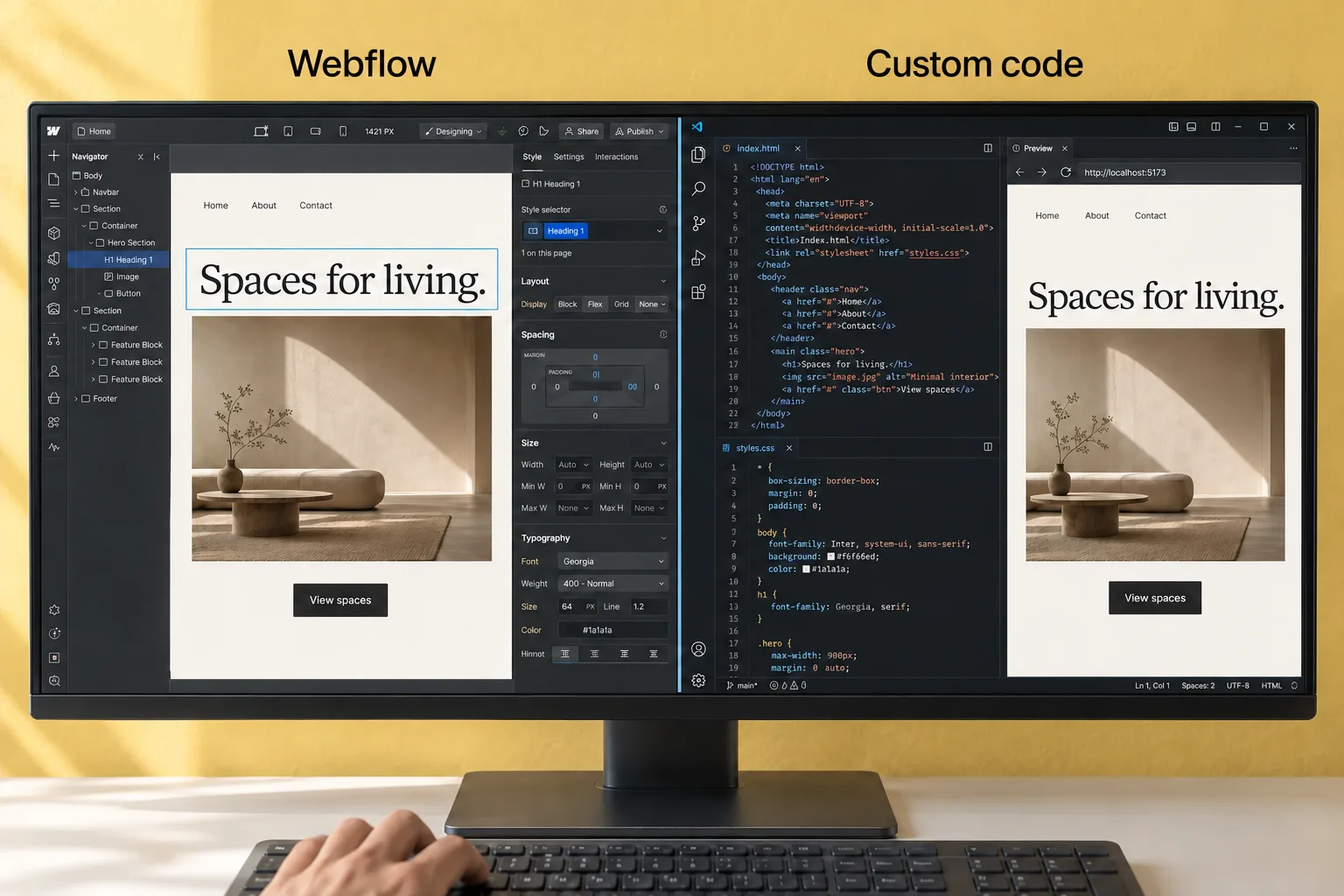
When marketers and founders weigh webflow vs custom code, they are asking one underlying question: which approach produces a better site for the resources available? Webflow is a visual builder that generates production-ready HTML, CSS, and JavaScript without writing code manually. Custom development means building from a chosen stack, Next.js, React, or Ruby on Rails, where every component is hand-coded.
The webflow vs custom code question is not purely technical. It involves development cost, launch timelines, maintenance overhead, and the performance outcomes that affect SEO and conversion. The right choice depends on project requirements, not platform preference.

Webflow Wins on Lean Page Structure
In our study of the webflow vs custom code sample, Webflow sites averaged 15.7 total external dependencies per page vs 23.6 for custom-coded, a 33% difference in external load requests before any content renders. The gap was sharpest on stylesheets: Webflow averaged 2.0 external CSS files vs 7.8 for custom-coded, nearly 4x fewer.
Page weight was the most significant finding. Every single Webflow site returned a lightweight HTML payload under 500KB. Among the custom-coded sites, only 3 of 20 met that threshold. Eighty percent returned moderate payloads and one returned a heavy payload. The 100% vs 15% split on lightweight HTML is a clear structural signal in the webflow vs custom code comparison.
Why Page Weight Matters for Core Web Vitals and SEO
External dependency count and HTML payload weight are upstream inputs to Core Web Vitals metrics, particularly Largest Contentful Paint. According to Google's page experience documentation, Core Web Vitals are ranking factors in organic search. A leaner dependency stack gives a page a structural head start before any optimization work begins.
The Nielsen Norman Group's research on response time limits establishes that users begin to lose focus at delays above one second. Fewer external requests mean faster rendering, which translates into lower bounce rates and more qualified engagement. Our Core Web Vitals guide covers the specific metrics and improvement paths in detail.
The Custom Code Ceiling Is Higher, and So Is the Floor
Custom-coded sites in the study showed far more variance than Webflow sites. Three teams, specifically Figma, Vercel, and Notion, scored zero external dependencies by self-hosting every asset through their own CDN infrastructure. That ceiling is not reachable in Webflow, where some external dependency loading is structural to the platform.
But the floor in custom development is significantly lower. GitHub loaded 90 external dependencies, Stripe 73, and Linear 59. These are world-class engineering teams, and their marketing pages carried heavier stacks than any Webflow site in the sample. More latitude in the stack does not automatically mean a leaner output. That is one of the clearest findings in our webflow vs custom code study: the widest variance belongs to the custom side.

When Webflow Is the Right Choice
The webflow vs custom code comparison favors Webflow when launch speed is a priority. An experienced Webflow design and development agency can reach production in weeks rather than months, which carries real commercial value for a startup marketing agency or growth-stage SaaS team.
Webflow also wins on marketing team autonomy. Non-technical team members can update content, add pages, and adjust layouts without developer involvement. For B2B marketing teams running high-volume content programs or landing page tests, that independence is a material operational advantage. Our SaaS website design guide covers the layouts and UX patterns that matter most for conversion on a Webflow-built marketing site.
Performance consistency is the third reason the webflow vs custom code decision favors Webflow for many teams. Our data showed that Webflow enforces structural discipline regardless of which team built the site. Whether a site carried 3 external dependencies like Hotjar or 34 like UserPilot, every Webflow site in the sample landed in the lightweight HTML category. That consistency is harder to guarantee on custom stacks where each team makes independent infrastructure decisions.
When Custom Development Is the Right Choice
The webflow vs custom code calculation shifts when requirements involve deep application logic, complex integrations, or database-driven content that exceeds Webflow's CMS. Custom development is appropriate when the marketing site and product application share a codebase, authentication system, or API layer. It is also the right call when compliance requirements, including SOC 2 or ISO 27001, demand end-to-end infrastructure visibility. Our technology and SaaS marketing page covers how Brand Vision handles platform selection for compliance-driven technology teams.
For content-heavy platforms, the webflow vs custom code decision is clearer. Complex tagging or multi-dimensional relational structures will reach the limits of Webflow's CMS before those of a custom architecture. In these scenarios, the webflow vs custom code decision resolves clearly in favor of custom development. Our web design agency recommends custom development when the organization can staff and sustain the infrastructure investment that the best-performing custom sites require.
-1.webp)
Performance Data, Conversion, and What CrUX Tells Us
According to the web.dev documentation on LCP, a score under 2.5 seconds is the threshold for a good user experience. Sites carrying heavier dependency stacks, particularly render-blocking scripts and stylesheets, face a structural disadvantage in hitting that threshold across devices and network conditions.
The Chrome UX Report from Google's CrUX dataset measures real-user Core Web Vitals at scale and shows that platform-level decisions, including CDN delivery, image compression, and asset management, produce measurable differences in field data. Webflow's built-in CDN delivery and automatic image optimization are structural contributors to the lightweight payloads we found across all 20 Webflow sites in the study.
How Platform Structure Affects UX and Dwell Time
A leaner page does not just load faster in a technical sense. It holds more user attention through the first seconds of a visit, which reduces bounce rates and increases the quality of engagement. For SaaS companies where the marketing site is the primary acquisition channel, these performance margins compound across every campaign and organic visit. Our UX design guide covers how design decisions at the structural level affect session length and platform retention.
Framing the webflow vs custom code decision through user experience clarifies a lot. Webflow defaults enforce the structural decisions most teams would agree are correct. Custom stacks give the freedom to do it better, or to skip it entirely.

Platform Choice Is a Strategic Decision, Not a Technical Default
In the webflow vs custom code debate, the assumption that custom code is always the more serious choice is not supported by the data. In our study, Webflow sites as a group were leaner than custom-coded sites, not because the teams were more technically capable, but because the platform enforces structure that custom stacks leave to individual decisions.
Brand Vision builds on both platforms. Our Webflow design and development approach is used for marketing sites, campaign pages, and content-heavy B2B properties where performance consistency and marketing team autonomy are priorities. Custom development is applied to projects with application logic, complex integrations, or governance requirements that exceed what a visual builder can support cleanly. The right answer to webflow vs custom code is always project-specific, grounded in requirements rather than convention.
.webp)
FAQ
Is Webflow better than custom code for SEO?
Webflow generates clean HTML output with built-in tools for meta tags, XML sitemaps, and image optimization. In the webflow vs custom code comparison, Webflow structural defaults support strong Core Web Vitals and technical SEO from launch. Custom code can achieve equivalent results, but only if the team invests in the same optimizations Webflow handles automatically. In any webflow vs custom code evaluation, content quality, authority, and link strategy remain more important than platform choice.
Can Webflow handle a growing SaaS website?
Yes, within defined parameters. Webflow's CMS supports blogs, case study libraries, product pages, and landing page programs at scale. Limits appear when content requires complex relational structures, when the application and marketing site need shared infrastructure, or when compliance demands full stack ownership. For most SaaS marketing sites in the launch and growth phase, Webflow scales without issue.
Does webflow vs custom code affect page speed?
Yes, materially. Our audit found that 100% of Webflow sites returned lightweight HTML payloads, compared to 15% of custom-coded sites. Webflow averaged 15.7 total external dependencies vs 23.6 for custom-coded. Custom-coded sites can achieve zero-dependency architectures, but doing so requires dedicated infrastructure investment that most teams cannot sustain.
When does custom development make more sense than Webflow?
In the webflow vs custom code decision, custom development is appropriate when the project involves complex application logic, database-driven content beyond CMS capacity, shared infrastructure with a product application, or compliance requirements demanding end-to-end stack ownership. It is also the right choice when the team has dedicated engineering capacity to sustain that infrastructure investment.
How long does a Webflow site take to build compared to custom code?
Webflow projects typically reach production faster. An experienced Webflow web design agency can deliver a production-ready marketing site in weeks. Comparable custom-coded sites take longer and carry higher development and maintenance costs. For teams prioritizing speed to market and marketing team autonomy, Webflow's timeline advantage is significant.
The Platform Decision Belongs in the Strategy
The webflow vs custom code question does not have a universal answer, but it does have a structured one. Start with requirements, not platform preference. Map the content model, the integration needs, the team's technical capacity, and the performance targets. Then select the platform that meets those requirements most efficiently.
For most growth-stage SaaS teams and B2B marketing operations, Webflow meets the brief. The data shows it produces leaner, more consistent page structures than most custom stacks without requiring the infrastructure investment the best-performing custom sites demand. For teams with application complexity, compliance constraints, or dedicated engineering capacity, custom development delivers the necessary control.
Brand Vision's web design agency works across both platforms with a senior, in-house team covering strategy, UI UX design, and engineering. If you are deciding between Webflow and custom development for your next site, a marketing consultation is the right place to start, with requirements on the table, not assumptions about which stack carries more credibility.












.webp)