
Every customer experience a company delivers is assembled by someone sitting at a working screen. The sales call, the support reply, the order correction, and the campaign launch all run on a chain of logins, connections, and tools, and when a link breaks, the person serving the customer stops mid-serve.
What happens in the next twenty minutes, an answer or a queue, decides whether the customer on the other end ever notices. The IT helpdesk has quietly become part of the customer experience supply chain, one step removed and entirely load-bearing.
That is the reframing the IT helpdesk deserves, and it changes what the desk is for. Support is usually budgeted as a cost center and measured like a call center, when its actual output is the operational capacity of every customer-facing team in the company.
For businesses spread across locations, time zones, and home offices, the desk is conversion infrastructure at one remove. Its response speed decides how fast the people who answer customers can answer.
The stakes belong inside marketing strategy, because customers judge a company by its slowest interaction, and the slowest interaction is often slow for an internal reason nobody outside ever sees. What follows is how responsive support gets built: the stack, the staffing, the urban model worth studying, and the culture that keeps it improving.

The Cost of Waiting Is Paid by Customers Too
The arithmetic of a slow desk never appears on its own reports, because the costs land in everyone else's, including the revenue reports.
A stalled ticket does not pause one task; it fragments a day. Research on modern work patterns keeps documenting how interruptions and fractured focus, the pattern captured in the analysis of the infinite workday, drain productive hours long before any single blocker looks serious on a report. An unresolved IT helpdesk ticket is that fragmentation with a number attached.
The waiting also compounds socially. An employee blocked by a broken tool borrows a colleague's time, reschedules the meeting, or improvises a workaround that becomes tomorrow's security problem, and each adaptation spreads the cost of one slow resolution across several calendars.
Multiply that pattern across a company and the IT helpdesk's real performance is written into everyone's week, and into the funnel. A stalled sales rep is a lead cooling, a blocked support agent is a customer waiting twice, and a marketing team locked out mid-launch is spend running against a page nobody can fix.
Customer expectations set the clock the whole chain runs on. Research keeps confirming that people expect organizations to meet them with immediate, connected experiences, and a company can only respond to customers as fast as its own tools allow. The external promise is capped by the internal queue.
An IT helpdesk answering at yesterday's pace is therefore being measured against today's customer. It loses that comparison silently, one delayed reply at a time, in reviews that blame the brand and never mention the ticket queue behind it.
The Responsive Stack
IT helpdesk responsiveness is engineered, not exhorted, and the engineering follows a recognizable shape. An omnichannel front door, phone, chat, email, and ticketing feeding one queue, lets people report trouble the way they naturally communicate, while automated routing moves urgent problems past the line.
Self-service sits beside it all. A maintained knowledge base resolves the repeatable questions without a human in the loop, and every question it absorbs is IT helpdesk queue time returned to the problems that need judgment.
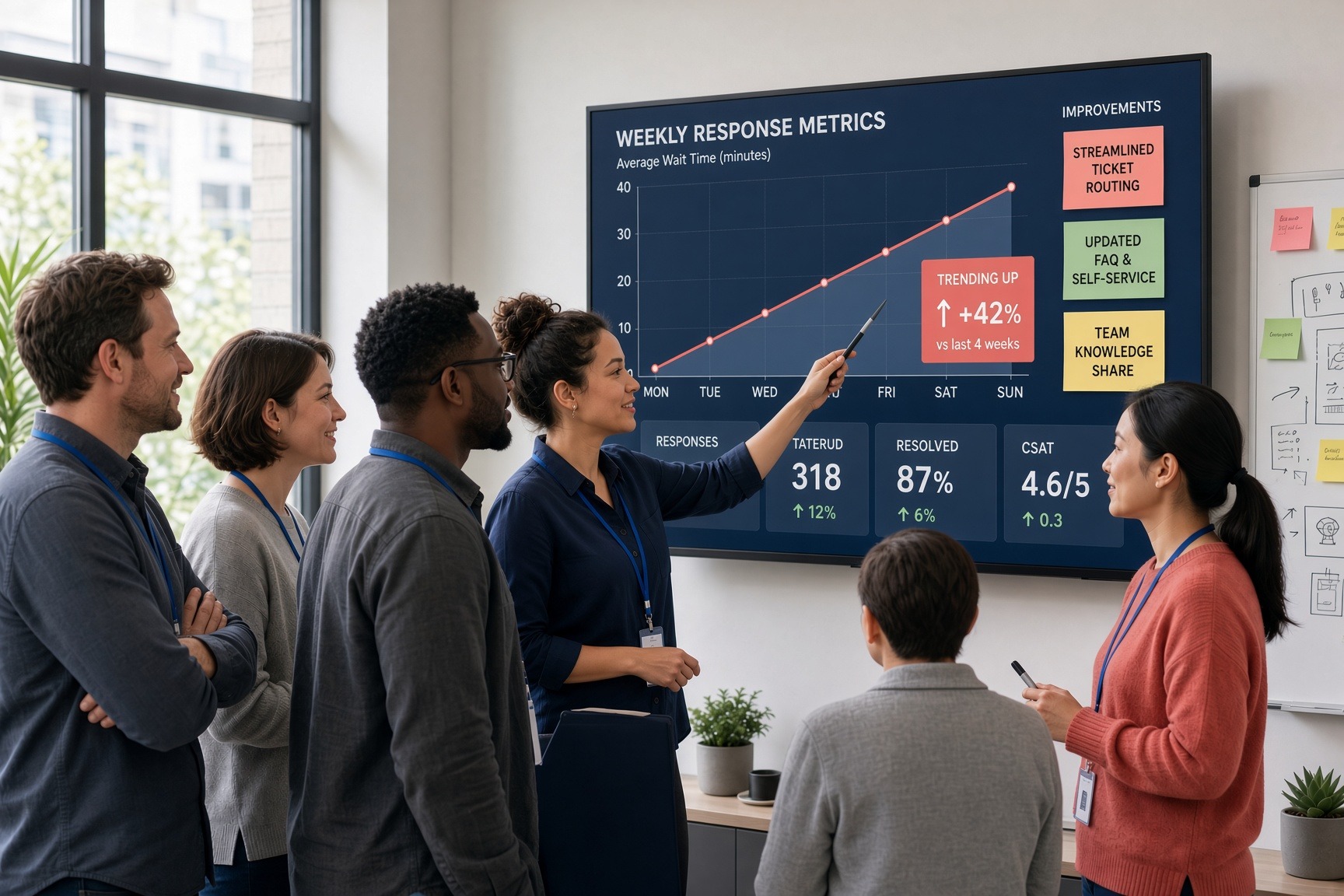
Staffing turns the IT helpdesk tooling into outcomes. Broadly skilled technicians resolve more on first contact, and continuous, deliberate training keeps the desk current as the toolchain changes underneath it, which it now does more or less constantly. The measurement loop closes the system: resolution times, first-contact rates, and satisfaction scores, read weekly rather than quarterly, tell managers exactly where the process leaks.
Building all of that in-house is a real program, which is why many organizations engage specialists instead. Providers like Nortec in the IT sector bring the integrated tooling, trained staff, and refined processes as a service, an arrangement that suits small and mid-sized companies that need a mature IT helpdesk without funding one from scratch.
The partnership route also scales in both directions. Growing companies add coverage as headcount rises, and hybrid organizations extend the same service quality to every location without opening an IT room in each one.
The build-or-partner choice bends on honesty about scale. A responsive IT helpdesk is a standing operation with coverage obligations, nights and weekends included, and half-funding one internally produces exactly the wait times the whole project was meant to end. The worst outcome is paying for a desk and getting a queue.
What the Urban Model Teaches
Dense markets run the hardest version of the IT helpdesk problem, and their solutions travel well. A New York City IT help desk operates against compressed expectations: diverse industries, high stakes per hour, and users who cannot wait for a next-day answer, conditions that force a service design the rest of the market can learn from.
The design has recognizable parts. On-site response handles what remote hands cannot: hardware failures and network drops get a technician at the office rather than a scheduled call. Proactive monitoring and patching prevent a share of tickets from ever existing.
Staffing carries the rest. Flexible models, on-call specialists layered over a core team, absorb demand spikes without carrying peak headcount all year, which is how urban desks stay responsive without staying expensive.
The transferable lesson is posture rather than geography. Urban desks succeed by treating responsiveness as the product itself, not a byproduct of adequate staffing, and any IT helpdesk, wherever it sits, can adopt the same stance: prevent what is preventable, respond in person when remote fails, and staff for variance instead of averages.
Suburban and remote-first companies apply the model with different tools and the same arithmetic. The demand spikes still come; only the commute changes.
Connected Teams Raise the Bar
Distributed work multiplies what the IT helpdesk has to cover. Teams split across cities and time zones need support that follows the sun, and the coordination challenges are the same ones the research on global teams documents: distance quietly sorts people into insiders and outsiders.
Support quality is one of the sorting mechanisms nobody names, and customers feel the sort secondhand. A region whose team waits longer for fixes is a region whose customers wait longer for answers, and the gap shows up in satisfaction data with no visible cause.
The remote employee's experience makes the point concretely. A headquarters worker with a dead laptop walks to the IT room; the remote worker files a ticket and waits, and if the waits differ enough, the company has built a two-tier workforce without deciding to.
Responsive, location-blind support keeps a distributed company serving customers at one standard. The IT helpdesk cannot fix distance, but it can refuse to pass it on to the people buying from every location.
Technology narrows the gap when the IT helpdesk deploys it deliberately. Remote monitoring resolves issues before users ever report them, AI-assisted triage answers the routine instantly and routes the complex to humans, and cloud-based support platforms let technicians serve any location from anywhere at all. Each tool exists to shorten the distance between a problem and a person who can fix it.
Tools close the distance but not the clock. A desk recruited from one metro still works that city's hours, so the queue that forms overnight waits for morning somewhere else. Sourcing through remote tech support jobs puts technicians in the hours where the tickets actually arrive.
A Culture That Keeps Getting Faster
Sustained IT helpdesk responsiveness is cultural before it is procedural, and the culture is buildable:
- Feedback that gets read. Post-ticket surveys and periodic user conversations surface where support actually frustrates, which is rarely where the metrics predicted.
- Knowledge that gets shared. Cross-training and documented solutions keep expertise from bottlenecking in one technician's head.
- Goals tied to growth. An IT helpdesk measured on outcomes the business sells by, uptime through launches, resolution speed for customer-facing teams, readiness in peak season, behaves like conversion infrastructure rather than a queue.
- Skills treated as an investment. Support work compounds when technicians grow, and the discipline of deliberate skill-building, the same logic that governs professional development anywhere, is what turns a ticket-taker into a problem-preventer.
The improvement loop is the point of all four. An IT helpdesk that studies its own performance monthly gets faster every quarter; a desk that only reports its performance stays exactly as fast as the day it was designed.
Emerging tools will keep raising the ceiling. Predictive maintenance that fixes issues before tickets exist, and remote guidance that walks a user through a hardware fix visually, both push support toward preventing the wait entirely, which is where every responsiveness program was always headed.
The Fastest Company Wins Twice
Every customer-facing promise a company makes is underwritten by how fast its own machinery recovers when something breaks. A fast, capable, location-blind IT helpdesk keeps the teams that face customers facing them; a slow one converts internal friction into external experience, twenty minutes at a time, at exactly the moments customers are watching.
The encouraging part is how buildable the fast version is. The stack is known, the staffing models are proven, the urban playbook is public, and the partners exist for organizations that would rather buy the maturity than grow it.
What remains is the decision to treat the IT helpdesk as the customer experience infrastructure it already is, and to fund it like the answer matters. To the customer waiting on the other side of a broken login, it does.


%2520(1).png)