Elton John brand partnerships work best when the collaborator has something credible to connect with: theatrical fashion, music technology, bold color, collectible merchandise, or philanthropy. Across the six examples below, the common thread is not celebrity reach alone. Each collaboration takes a recognizable part of Elton John's public identity and translates it into a product, experience, or cause.
Not every example is the same type of commercial relationship. Some are wardrobe and creative collaborations, some are consumer collections, and PEEX was an experience layered onto live performance. Treating all of them as generic “endorsements” would miss the useful distinction: the format changes, while the recognizable creative codes remain consistent.
That makes the portfolio useful for anyone studying celebrity brand partnerships. The strongest collaborations do more than place a famous face beside a logo. They align audience, product category, creative language, and purpose, which is why they also sit naturally inside a broader branding system rather than functioning as isolated promotions.
Why Elton John’s Brand Partnerships Feel Consistent
Elton John's stage identity has been built over decades through flamboyant tailoring, oversized eyewear, color, performance, and a willingness to turn visual excess into part of the show. A collaboration can borrow those signals, but it still needs its own reason to exist. The useful brand strategy lesson is to identify which parts of a personality are truly distinctive enough to transfer into another category.
- Recognizable creative codes: Sequins, saturated color, spectacle, and theatrical styling give partners a clear visual vocabulary.
- Category fit: Fashion, live music technology, beauty, socks, and home fragrance each provide a different way to express those codes.
- Purpose when relevant: The Charlotte Tilbury partnership shows how a commercial campaign can also connect to the Elton John AIDS Foundation without making every collaboration cause-led.
1. Richard James and Swarovski: Stage Wardrobe for The Million Dollar Piano
Richard James created special pieces for Elton John over many years, including Swarovski crystal-embellished tailcoats used during The Million Dollar Piano residency at Caesars Palace. The residency ran from 2011 to 2018, while Richard James later displayed and co-curated several Elton pieces with Swarovski. Richard James documents the wardrobe and exhibition, and Elton John's own site confirms the residency timeline. Elton John
That wording matters because the evidence supports a sustained wardrobe relationship and Swarovski-embellished pieces, but not a simple claim that Richard James and Swarovski were one formal seven-year licensing partnership. The stronger story is the creative continuity: the clothes were designed to work with the performance itself.
The collaboration works because the clothing is part of the show rather than a separate endorsement. Tailoring supplies craft and structure; crystals amplify the visual language audiences already associate with Elton. That alignment is a practical example of how visual identity can extend beyond logos into wardrobe, staging, and physical experience.

2. PEEX and Farewell Yellow Brick Road: Collaboration as Experience
Elton John's relationship with PEEX pushed the collaboration beyond merchandise. PEEX's live-audio system let concertgoers personalize elements of the sound mix through a wearable receiver and app. Wired tested the system on the Farewell Yellow Brick Road tour, while PEEX announced U.S. tour availability in 2019 after the Farewell era began in 2018.
The important fit was functional as well as promotional. The technology was attached to the reason people were already there: hearing a live Elton John performance. That is a stronger partnership role than adding an unrelated branded gadget to the merchandise table because the product can change the concert experience itself.
For artists, festivals, and other cultural properties, that kind of extension belongs within entertainment marketing because the brand value is created at the intersection of audience, content, venue, and technology.
View this post on Instagram
A post shared by Elton John (@eltonjohn)
3. Teddy Fresh x Elton John: Translating Glam Rock Into Streetwear
The 2022 Teddy Fresh x Elton John collection translated Elton's glam-rock references into Teddy Fresh's streetwear language. Sequins, patchwork, bright fabrics, and playful silhouettes gave the collaboration recognizable Elton cues without turning the garments into replicas of stage costumes. Teddy Fresh still includes Elton John in its official collaboration archive. Teddy Fresh
The archive is important to the idea. Elton's career gives a partner decades of imagery and fashion references to interpret, while Teddy Fresh has its own graphic and streetwear vocabulary. The collection therefore had source material on both sides instead of relying on a name printed across otherwise generic products.
This is a classic audience-overlap play. Teddy Fresh brings a younger streetwear audience, while Elton brings cultural history and a deep visual archive. The collaboration works because both sides retain something recognizable instead of flattening either identity into generic celebrity merchandise.

4. Charlotte Tilbury and The Rocket Fund: Connecting Commerce and Cause
In October 2023, Charlotte Tilbury announced Elton John as part of its holiday campaign and described the company as an Official Founding Beauty Partner of The Rocket Fund powered by the Elton John AIDS Foundation. The existing Step Into Beauty Magic campaign therefore connected holiday beauty marketing with a documented philanthropic partnership rather than simply using Elton as a campaign face.
That distinction changes the evaluation criteria. The collaboration is not useful because celebrity involvement supposedly guarantees sales; it is useful because the campaign, charitable relationship, holiday creative, and public mission reinforce one another. Readers can judge the fit without inventing conversion or donation results that the available sources do not establish.
Cause-related collaboration is strongest when the charitable relationship is real and clearly described. For organizations whose core work involves fundraising, advocacy, or donor communication, the relevant application is nonprofit marketing: purpose should be explained with the same clarity as the product or campaign.

5. Happy Socks: Making the Elton John Aesthetic Accessible
The Elton John x Happy Socks collection turned familiar career imagery into a lower-cost product category. Happy Socks describes designs inspired by songs such as “Rocket Man,” “Tiny Dancer,” and “The Bitch Is Back,” along with imagery from across Elton's career.
The appeal is accessibility. A customer does not need to buy couture or attend a major concert to participate in the visual world. Socks also work naturally as gifts and collectibles, giving the collaboration a different commercial role from the Richard James wardrobe or PEEX live-audio experience.
That makes the collection a useful B2C marketing example: price point, packaging, recognizability, and gifting all shape how a collaboration reaches beyond the core fan base.

6. Elton John x Slatkin + Co.: Turning Personal Memory Into Home Fragrance
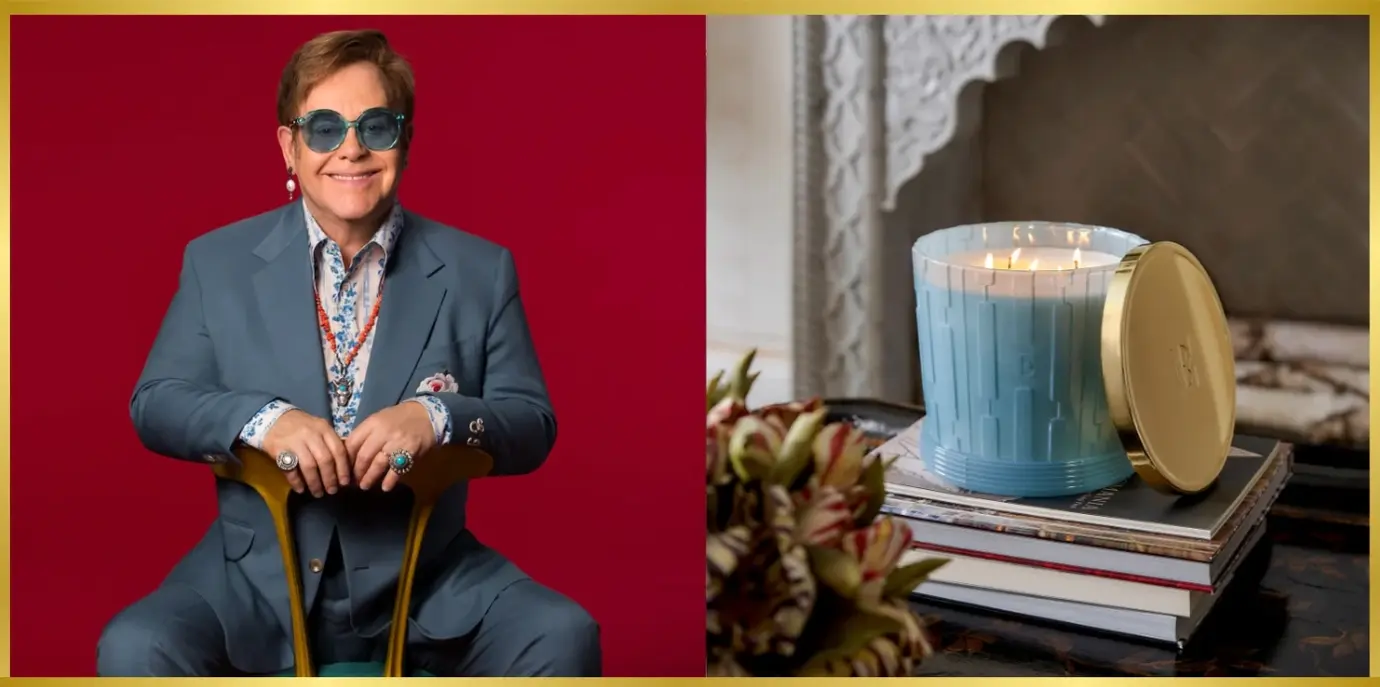
In November 2024, Elton John and Harry Slatkin launched a holiday home-fragrance collection inspired by John's Woodside estate and holiday traditions. The existing Elton John x Slatkin + Co. collection extended beyond two candles: contemporary coverage documented candles, reed diffusers, gift sets, and other home-fragrance formats. ABC News
The collection uses another part of Elton's story that is distinct from performance: home, memory, hospitality, and seasonal ritual. That makes fragrance a plausible category because scent can carry those associations in a way that a purely decorative logo treatment could not.
This partnership is less about stage spectacle and more about narrative translation. A private setting, recurring traditions, scent, and packaging become a consumer experience. That move only works when the source material is specific enough to feel personal rather than generic.

What Brands Can Learn From Elton John’s Collaborations
The strongest lesson is fit. Elton John's name creates attention, but the partnerships become more memorable when the product or experience connects to something audiences already understand about him. Before choosing a collaborator, brand research can test whether the audience overlap, category expectations, and cultural associations are strong enough to support the idea.
- Start with a specific brand code or audience behavior, not fame by itself.
- Give both partners a recognizable role in the final product or experience.
- Use cause marketing only when the charitable relationship is substantive and clearly explained.
- Match the collaboration format to the audience, from premium fashion to accessible merchandise or live experiences.
If your team is evaluating a partnership, entertainment campaign, or co-branded launch, Brand Vision can help organize the audience fit, positioning, and channel plan through a marketing consultation.