People often search for “Fortune 500 Canadian companies,” but there is an important distinction: the Fortune 500 is limited to U.S. corporations. Canadian companies are ranked on the Fortune Global 500, which compares the world’s largest companies by revenue. That means a Canadian business can be a major global corporation without ever appearing on the U.S.-only Fortune 500.
For the 2025 Fortune Global 500, six of the seven companies featured in this article made the list: Royal Bank of Canada, Toronto-Dominion Bank, Alimentation Couche-Tard, Magna International, Enbridge, and Suncor Energy. Manulife remains one of Canada’s largest financial-services companies, but Fortune’s current company history shows its most recent Global 500 appearance in 2022.
Fortune 500 vs. Fortune Global 500: The Key Difference
Fortune’s Global 500 ranks corporations from around the world by total revenue, while the Fortune 500 covers U.S. companies. For Canadian companies, the Global 500 is therefore the relevant list. The 2025 ranking uses company financials tied to the applicable fiscal reporting periods, and Fortune reports revenue in U.S. dollars so companies can be compared consistently.
This article preserves the original seven-company focus while correcting which businesses were actually represented in the 2025 Global 500. It also avoids mixing Canadian-dollar estimates with Fortune’s U.S.-dollar ranking data.
Canadian Companies on the 2025 Fortune Global 500
Royal Bank of Canada (RBC): No. 101
RBC ranked No. 101 on the 2025 Fortune Global 500 with approximately $98.7 billion in revenue. Its scale extends across personal and commercial banking, wealth management, capital markets, and insurance. For a bank serving customers through many digital journeys, service quality also becomes part of the competitive experience, which is why clear UI and UX design matters so much in modern financial services.

Toronto-Dominion Bank (TD): No. 132
TD ranked No. 132 in 2025 with approximately $88.3 billion in revenue. The bank’s operations span Canada and the United States, and its scale reflects personal and commercial banking, wealth, insurance, and U.S. banking businesses. Its cross-border footprint is a useful example of how a Canadian company can grow well beyond its domestic market while keeping a recognizable brand.

Alimentation Couche-Tard: No. 195
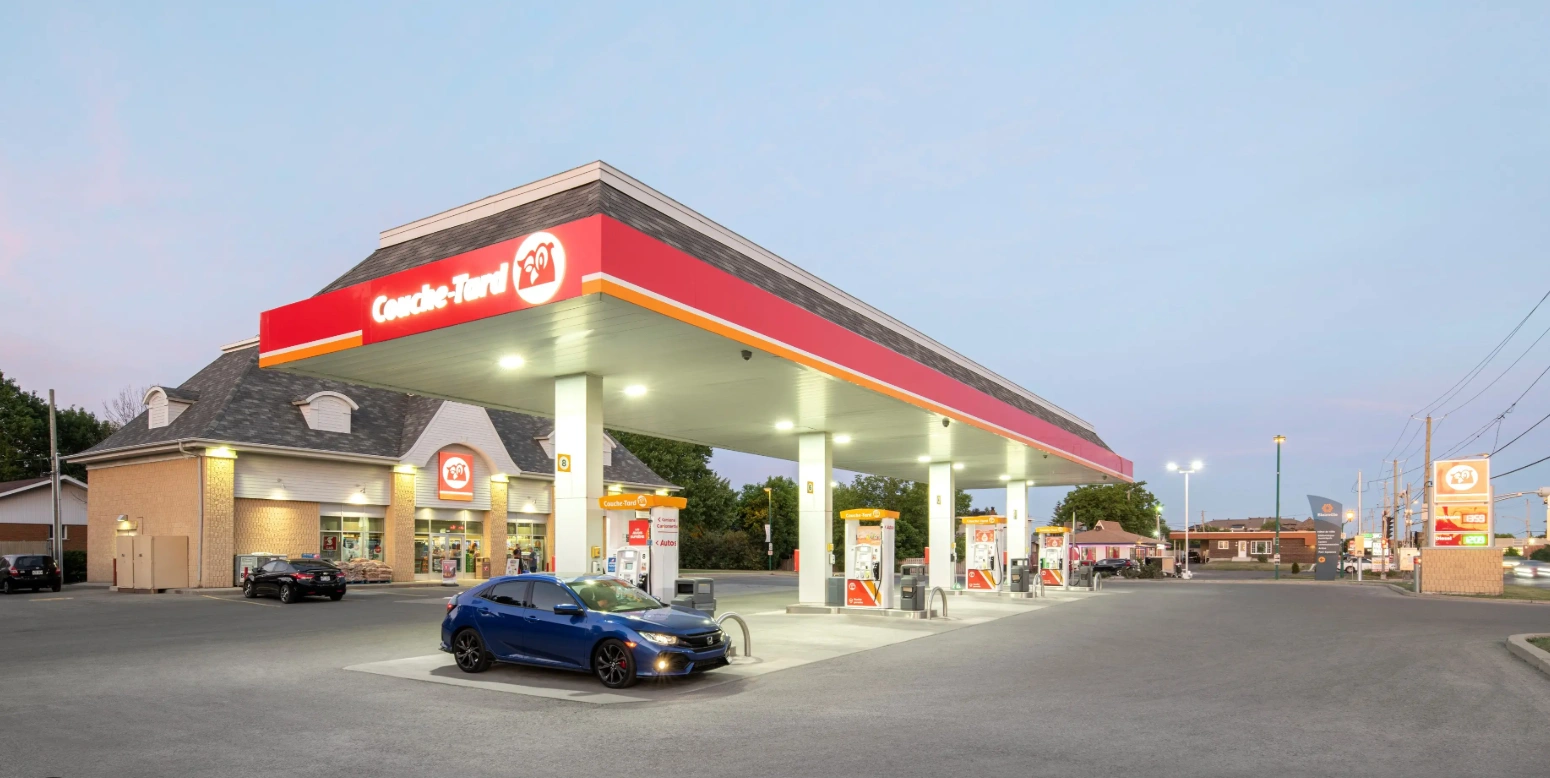
Alimentation Couche-Tard ranked No. 195 on the 2025 Global 500 with about $69.3 billion in revenue. The Laval-headquartered retailer built its international scale through acquisitions and the expansion of Circle K across multiple markets. Keeping an acquired network recognizable across countries is partly a brand strategy challenge: customers should recognize the promise even when the market, store format, and competitive context change.
For Quebec businesses taking a brand beyond the province, regional context still matters. A Montreal branding partner can help translate local positioning into a system built for expansion without pretending every new market behaves the same way.
Magna International: No. 360
Magna International ranked No. 360 in 2025 with about $42.8 billion in revenue. The Ontario-based automotive supplier works across body systems, seating, powertrain, electronics, and complete-vehicle manufacturing. Because companies like Magna sell complex capabilities to other businesses, effective B2B marketing needs to make technical value understandable to engineering, procurement, operations, and executive stakeholders at the same time.

Enbridge: No. 397
Calgary-based Enbridge ranked No. 397 on the 2025 Fortune Global 500 with approximately $39.0 billion in revenue. Its business spans pipelines, gas transmission, storage, utilities, and other energy infrastructure. The company’s place on the list reflects the scale of moving and storing energy across North America rather than a consumer-facing business model.
Suncor Energy: No. 425
Suncor ranked No. 425 on the 2025 Fortune Global 500 with approximately $37.3 billion in revenue. The Calgary-based company combines oil sands production, refining, logistics, and the Petro-Canada retail network. That vertical integration helps explain why Suncor remains one of Canada’s largest energy businesses even as commodity prices and capital spending shift from year to year.
Manulife Financial: A Major Canadian Company With Global 500 History
Manulife is a major insurance and wealth-management company with operations across Canada, the United States, and Asia. Fortune’s current company history shows Global 500 appearances through 2022, not a 2025 entry. It belongs in a discussion of major Canadian multinationals, but it should be distinguished from the companies above that actually made the 2025 list.

What These Canadian Corporate Giants Have in Common
The strongest lesson from these companies is not that Canada has its own version of the Fortune 500. It is that Canadian firms compete on the Fortune Global 500 through very different business models: banking, energy infrastructure, convenience retail, petroleum, and automotive manufacturing. Their scale comes from international reach, capital intensity, acquisitions, complex operations, and the ability to build trust across markets.
For Canadian organizations planning the same kind of cross-market growth, the strategic challenge is keeping the brand, website, and marketing aligned as the business expands. Brand Vision provides branding and digital marketing support across Canada for companies that need a clearer position and a more consistent customer experience as they grow.