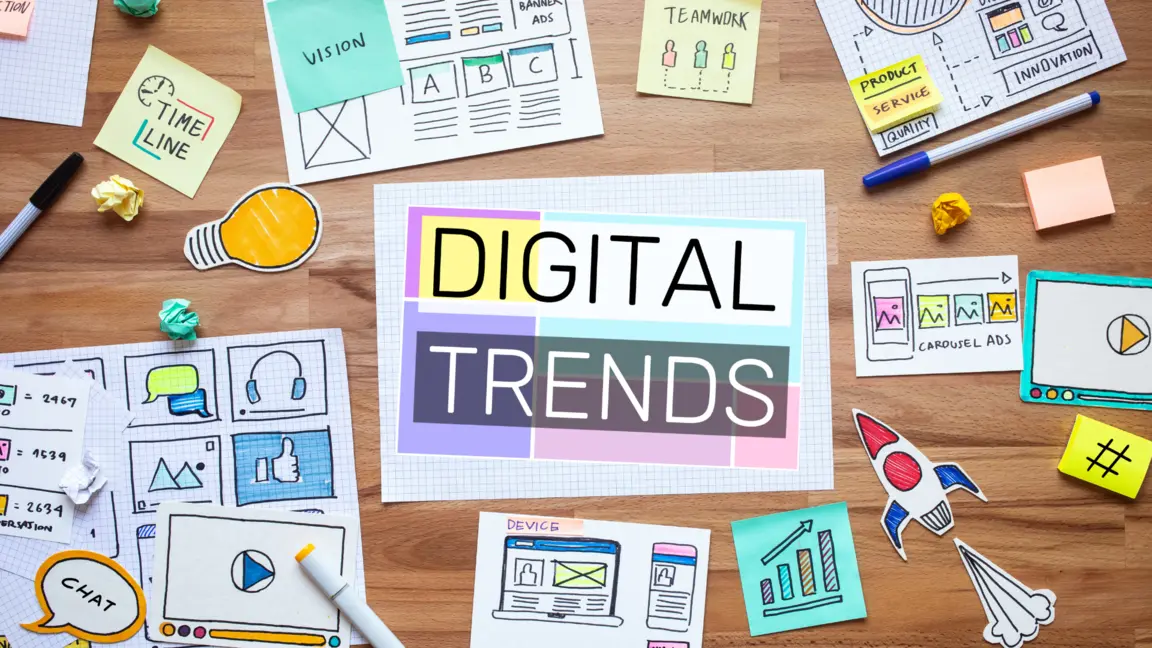

By the second half of 2026, the business conversation has moved beyond predicting change and toward deciding which shifts deserve real investment. AI is moving into everyday workflows, cybersecurity risk is rising with it, hybrid work has stabilized for many remote-capable roles, and sustainability is becoming more closely tied to resilience, capital allocation, and operating decisions.
The important question is not whether every company should chase every trend. Leaders need to distinguish broad structural changes from narrower experiments, then decide what matters to their customers, workforce, operations, and competitive position. That can include modernizing internal systems, improving customer-facing web design, or using brand and audience research to test whether a market shift is actually changing buyer expectations.
Some 2026 business trends are widespread and operational; others remain specialized and risk-sensitive. Decentralized finance, for example, continues to attract interest in capital markets (Oliver Wyman) but should not be treated as a universal business priority. The seven trends below are most useful when viewed through that practical lens.
Sustainability Moves From Commitments to Execution
Sustainability remains important in 2026, but the emphasis has shifted from broad promises toward measurable business decisions. The World Economic Forum's September 2026 Chief Sustainability Officers' Outlook found that 63% of surveyed sustainability leaders expected global progress to hold steady or accelerate over the next year, while policy uncertainty and short-term business pressure were making execution more uneven.
That makes sustainability increasingly relevant to supply chains, resource efficiency, climate resilience, product design, and capital planning. The strongest initiatives are tied to operational risk or economic value rather than vague claims. For customer-facing companies, credible branding services can help translate substantiated sustainability work into clear communications without overstating what the business has actually achieved.
- Focus on measurable operational changes, not generic sustainability language.
- Connect environmental priorities to resilience, efficiency, and customer relevance where the evidence supports it.

Hybrid Work Settles Into a Durable Model
Hybrid work is no longer a temporary response for many remote-capable roles. Gallup's 2026 Hybrid Work indicator reports that 52% of U.S. employees in remote-capable jobs work in a hybrid arrangement, with another 26% fully remote. Gallup also reports that six in 10 remote-capable employees prefer hybrid work. Earlier research summarized by Sloan Review likewise emphasizes the importance of designing purposeful in-person time rather than simply mandating attendance.
For employers, the practical challenge is coordination. Teams need clear norms for meetings, documentation, decision-making, and on-site collaboration. Distributed work also makes consistency across sales, marketing, and customer-facing teams more important, which is where shared brand positioning and messaging can give people a common reference point even when they are not in the same room.
- Hybrid policies work better when they define how teams collaborate, not only where they sit.
- Documentation and clear decision ownership reduce friction across locations and time zones.

AI, Cloud, and Connected Systems Move Into Core Operations
Cloud computing and connected devices still matter, but the bigger 2026 shift is how they support AI-enabled workflows. IBM's current hybrid cloud roadmap describes cloud platforms increasingly supporting AI systems, governance, observability, and distributed operations. The operational question is therefore moving from whether a business uses cloud tools to whether its data, infrastructure, and controls can support reliable automation at scale.
IoT remains valuable where real-time device data can improve maintenance, logistics, inventory, or customer experience. AI can make that data more actionable, while cloud infrastructure connects systems and workloads. Technology companies selling these capabilities also face a communication challenge: strong marketing for technology businesses needs to explain the operational outcome, not bury buyers in technical features.
- Prioritize use cases with a clear operational benefit before scaling automation.
- Data quality, governance, security, and integration matter as much as the AI model itself.
Freelancing Expands as Skills and Work Models Shift
The freelance economy continues to evolve alongside AI. Upwork's Future Workforce Index 2026, based on a survey of 2,400 U.S. skilled knowledge workers plus marketplace data, reported that the share of skilled knowledge workers freelancing rose from 28% in 2025 to 38% in 2026. That should not be treated as a measure of the entire labor market, but it does show how quickly skilled work can reorganize around changing demand.
For businesses, flexible talent can make it easier to access specialized capabilities for defined projects, from graphic design to technical implementation. The trade-off is management complexity: organizations still need clear briefs, ownership, quality standards, security controls, and onboarding processes so external specialists can work effectively with internal teams.
- Use freelance talent for specific skills or capacity gaps rather than as a substitute for workforce planning.
- Give contractors clear access, approval, and quality-control processes from the start.
Cybersecurity Becomes a Business Resilience Issue
Cybersecurity is one of the clearest business trends of 2026 because digital risk now reaches far beyond the IT department. The World Economic Forum's Global Cybersecurity Outlook 2026 says AI is expected to be the most significant driver of cybersecurity change, while organizations are increasing scrutiny of the AI tools entering their environments.
That pushes security into procurement, employee training, vendor management, product development, and leadership oversight. Businesses that depend on cloud services and AI also need plans for access control, incident response, business continuity, and third-party risk. Security is not only about preventing a breach; it is about limiting operational disruption and protecting trust when something goes wrong.
- Assess the security implications of AI tools before they become embedded in workflows.
- Treat cyber resilience as an operating and leadership responsibility, not only an IT task.

DeFi Remains an Emerging, Regulated Experiment
Decentralized finance still belongs in a 2026 trends discussion, but it should be framed more cautiously than a mainstream replacement for conventional finance. The Bank for International Settlements' Project Atlas describes cryptoassets and DeFi as part of an emerging global financial ecosystem while noting persistent transparency and financial-stability challenges.
Businesses exploring blockchain-based payments, tokenized assets, or DeFi infrastructure therefore need to weigh potential efficiency against regulatory, counterparty, liquidity, compliance, and technology risk. Earlier analysis from Oliver Wyman also examined how decentralized finance could reshape capital markets. The practical 2026 lesson is not that every company should adopt DeFi, but that finance teams should understand where digital-asset infrastructure intersects with their industry and jurisdiction.
- Separate useful blockchain infrastructure from speculative adoption pressure.
- Evaluate regulation, custody, compliance, and operational risk before pursuing financial experiments.
Employee Wellbeing Stays Closely Tied to Performance
Employee wellbeing remains a management issue because engagement and mental health affect how consistently teams can perform. Gallup's State of the Global Workplace 2026 reported that global employee engagement fell to 20% in 2025, while the World Health Organization notes that workplace conditions can influence mental health and productivity. Existing workplace commentary has also argued for making wellbeing part of business design (Forbes).
Wellbeing programs are most credible when they address working conditions rather than relying only on perks. Workload, management quality, flexibility, psychological safety, role clarity, and access to support can all matter. For providers in this sector, clear and responsible health and wellness marketing also matters because claims about outcomes need to be precise and appropriately supported.
- Design wellbeing around working conditions and management practices, not only benefits.
- Track engagement and workforce signals rather than assuming a program is working.

What Business Leaders Should Take From These 2026 Trends
The common thread across these trends is operational discipline. AI, hybrid work, cybersecurity, sustainability, workforce flexibility, and digital finance all create opportunities, but each comes with trade-offs. Leaders should start with the customer or business problem, verify what has actually changed, and invest where the evidence supports a meaningful outcome.
If your team is deciding which shifts should affect positioning, channels, website priorities, or growth planning, Brand Vision's marketing consultation can help organize the decisions around research and business priorities rather than trend-chasing.