AI-powered tools for small businesses are reshaping how teams operate, produce content, and manage campaigns. The capabilities are real. Automation is accelerating, content generation has become more accessible, and data analysis no longer requires a dedicated analytics team. For small business owners operating with lean resources, these tools represent a meaningful productivity advantage.
But efficiency is not strategy. And this is the distinction that separates businesses that grow from businesses that stay busy.
AI-powered tools for small businesses can handle volume, accelerate drafts, surface patterns, and help teams explore ideas. They can also assist with positioning exercises and brand-voice development when the right research and constraints are supplied. What they do not provide on their own is accountable strategic judgment: deciding which market position to commit to, which trade-offs to accept, and how brand, website, search, and campaigns should work together as one growth system.
This article maps both sides of that equation: where AI-powered tools for small businesses create genuine leverage, where human strategy and specialist execution matter most, and how small teams can combine internal expertise, AI, and outside support without treating any one of them as a universal replacement for the others.
What AI-Powered Tools for Small Businesses Do Well
The strongest AI-powered tools for small businesses are built for speed and scale at the execution layer. These are the areas where they consistently perform:
Content Generation at Volume
Tools like ChatGPT, Jasper, and Copy.ai can help small teams produce first drafts, email sequences, research summaries, and social concepts faster. McKinsey’s 2026 survey found that 80 percent of respondents said AI improved their individual productivity, while organization-wide financial impact remained more uneven. For lean teams, the practical lesson is to use AI where it saves time, then measure whether those gains improve business outcomes.
Keyword Research and SEO Auditing
AI-assisted platforms such as Semrush and Ahrefs have transformed the accessibility of keyword intelligence. AI-powered tools for small businesses can now surface search volume data, content gaps, and competitor rankings without requiring deep technical expertise. This lowers the barrier to informed SEO decision-making.
Visual Asset Creation
Canva's AI suite, Adobe Firefly, and similar platforms allow small businesses to produce on-brand visual content at scale. This reduces a significant barrier for teams without in-house designers, particularly for social media and email marketing. These tools perform well within an established visual identity system.
Workflow Automation
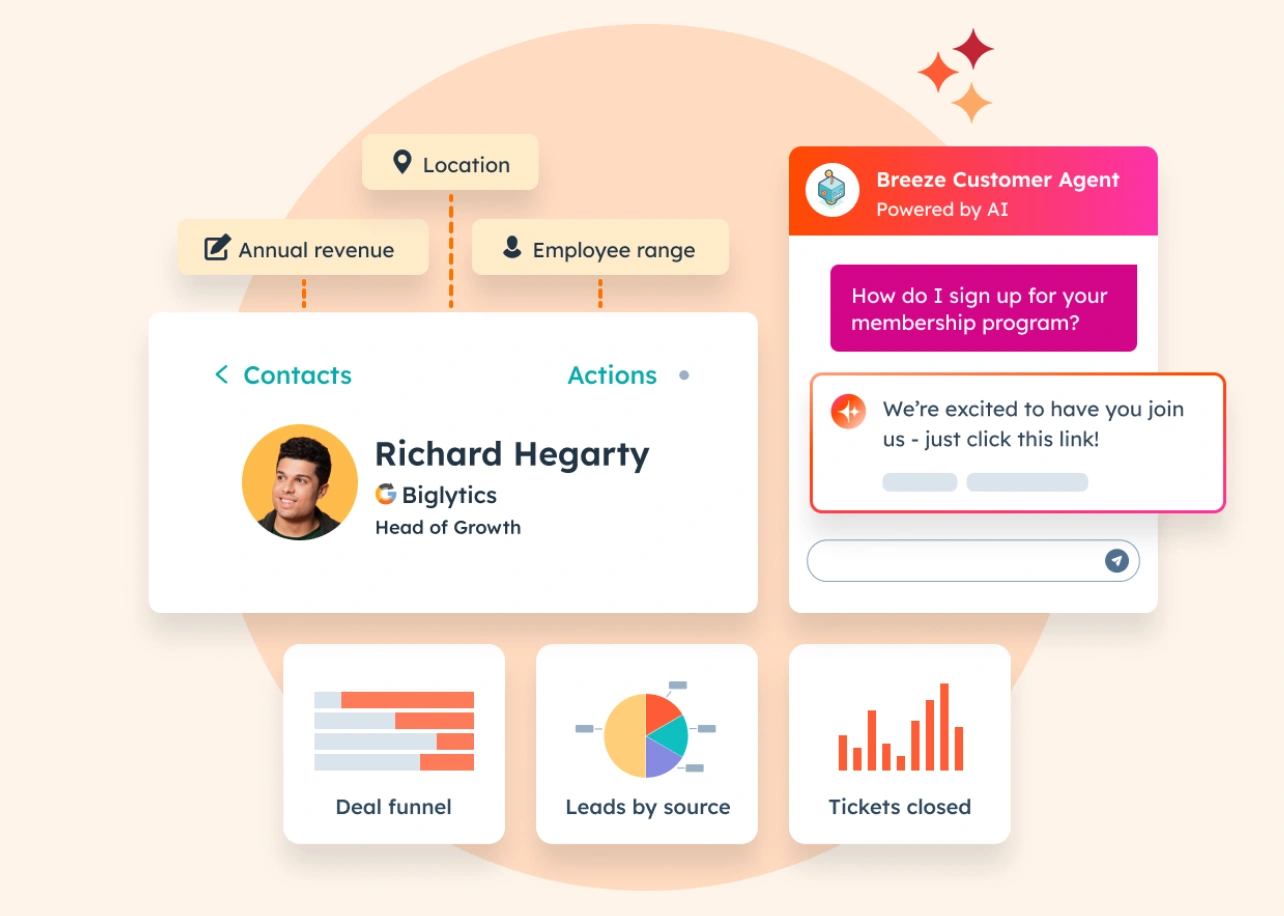
Platforms like Zapier and HubSpot’s automation layer reduce manual work across email nurturing, CRM updates, reporting, and campaign triggers. HubSpot reports that 47 percent of marketers use automation to make marketing processes more efficient. The value is strongest when the workflow has clear triggers, useful customer data, and someone accountable for what happens when the automation fails or a lead needs human attention.
Performance Reporting
AI tools embedded within Google Analytics 4 and similar platforms distill complex datasets into faster-to-read summaries. Small business owners gain clearer access to performance signals without needing to interpret raw data manually. This is valuable when the data interpretation is supported by a strategic framework.
These capabilities are real and worth deploying. They strengthen efficiency and reduce friction in repeatable execution tasks.
Where AI-Powered Tools for Small Businesses Fall Short
Efficiency gains at the execution layer do not remove the need for strategic foundations. AI-powered tools for small businesses are most reliable when the business already knows what it is trying to achieve, has usable source material, and has a person or team reviewing outputs against real customer and commercial context.
- Positioning still needs a decision-maker. AI can summarize competitors and generate positioning options, but the final choice depends on evidence, business constraints, differentiation, and the market position the company is willing to defend.
- Brand coherence depends on a defined system. AI can follow a documented brand voice and messaging framework, but vague prompts and inconsistent inputs produce inconsistent outputs. The stronger the source guidelines, the more useful the automation becomes.
- Website generation still needs technical and UX review. AI website tools can accelerate layouts, copy, and prototyping, while high-stakes sites still require deliberate information architecture, accessibility, technical SEO, responsive behavior, analytics, and conversion-path decisions.
- SEO quality depends on originality and usefulness. AI can support research and drafting, but publishing large volumes of undifferentiated material is not a search strategy. Google's own helpful content guidance emphasizes original, reliable, people-first content and warns against automation used primarily to manipulate rankings.
- Data still needs prioritization. AI can summarize patterns and suggest hypotheses. A business leader, analyst, or strategic partner still has to decide which signals matter, what trade-offs they imply, and what the company should change next.
The Strategic Layer AI Cannot Replace
From Brand Vision’s agency perspective, the highest-value work is usually not the production of a single draft or asset. It is connecting research, positioning, customer experience, channel decisions, measurement, and execution into one system. AI can contribute inside each of those activities, while accountability for the direction and final quality still sits with people.
Brand Strategy and Positioning
A scalable business requires a positioning framework that is defensible and differentiated. Brand strategy defines how a business is perceived relative to its competitors, establishes the language buyers use to understand value, and aligns messaging across every channel.
AI-powered tools for small businesses can generate taglines, summarize interviews, and help organize competitor findings. They can make brand research faster to synthesize, but the evidence still needs to be validated and translated into a positioning choice, messaging hierarchy, and set of brand rules that the organization can actually use.
Web Design and User Experience
A high-performance website is more than a template with updated copy. It is a structured experience based on what target buyers need at each stage and how the business wants them to move from intent to action. AI can assist with wireframes, copy variants, and prototypes, while UI/UX design for complex journeys still benefits from research, information architecture, accessibility review, and iterative testing.
Fast, accessible, mobile-optimized websites with clear conversion pathways require technical QA and deliberate choices. AI builders can be appropriate for simple sites, while businesses with complex funnels, integrations, regulatory constraints, or distinctive brand systems may need custom web design and development expertise.
SEO and Organic Search Performance
Ranking for competitive keywords requires more than publishing AI-generated content. A structured SEO agency approach can combine technical optimization, internal linking, authority development, search-intent research, and editorial priorities. AI can accelerate research and production inside that system, but the system itself still needs goals, governance, measurement, and ongoing judgment.
Visual Identity and Brand Cohesion
Typography, color systems, logo architecture, and layout principles form the visual language that communicates brand quality before a word is read. A structured branding program and visual identity give AI design tools stronger constraints to work within. Generators can extend or adapt assets, while the core system, usage rules, and final quality control still need intentional creative direction.

The Right Workflow: AI Tools Working Within an Agency Framework
The most effective use of AI-powered tools for small businesses is usually structured rather than standalone. The strategy can be owned by an internal marketing lead, a specialist, or a marketing agency; the important point is that automation operates inside clear goals, guardrails, and review.
Here is how that workflow operates in practice:
- Strategic foundation first. Positioning, audience priorities, channel roles, and measurement are defined before execution is scaled. For companies with longer buying cycles, the B2B marketing system also has to account for multiple stakeholders, proof requirements, and sales handoffs.
- AI accelerates execution within defined systems. Content creation, keyword research, email drafts, and visual asset production benefit from AI-powered tools for small businesses when they operate inside a defined brand and messaging framework.
- Human review maintains quality and cohesion. An internal team or outside partner reviews important outputs, checks claims, protects the brand system, and decides when AI-generated work needs deeper research or specialist execution.
- Measurement informs iteration. AI analytics platforms surface performance data. A strategic team interprets that data and adjusts positioning, content, and channel investment accordingly. This loop compounds over time.
This is not an either/or decision. AI can handle repeatable execution at scale, while people define the rules, review the work, and stay accountable for what the business publishes, builds, and invests in.
How to Evaluate What Your Small Business Actually Needs
Before investing in AI-powered tools for small businesses or an agency engagement, two questions clarify the right starting point.
Is Your Strategic Foundation Solid?
If your positioning is unclear, your brand system is inconsistent, or your website does not support the customer journey, adding more automation can simply scale unclear inputs. The foundation may need strategic work before execution is expanded. For early-stage teams, a structured startup marketing plan can help separate foundational decisions from tasks that are ready to automate.
Is Your Execution Infrastructure Optimized?
If your strategy is defined, your brand is cohesive, and your channels are structured for performance, AI-powered tools for small businesses can meaningfully compress timelines and reduce repetitive work. A marketing consultation and audit can identify where the constraint actually sits before more software or outside support is added. Canadian teams weighing internal capacity, AI tools, and external execution can also review marketing support in Canada in that context.

Frequently Asked Questions About AI-Powered Tools for Small Businesses
Can AI-powered tools for small businesses replace a marketing agency?
Sometimes, at the task level. AI-powered tools can reduce or replace portions of drafting, scheduling, reporting, research, and production. A business may still need an internal marketing lead, freelancers, specialists, or an agency when it needs accountable positioning, integrated campaigns, custom design, technical implementation, or ongoing cross-channel management.
What are the most effective AI-powered tools for small businesses in 2026?
Useful options depend on the job: Semrush and Ahrefs support SEO research, ChatGPT and Jasper can accelerate drafting and analysis, Canva can speed up visual production, and HubSpot can support CRM and automation. For a broader look at AI content tools, compare each tool’s strengths with the review, brand, and workflow requirements around the task rather than choosing by feature count alone.
How do I know when to hire a marketing agency versus using AI tools?
Consider outside strategic help when the business lacks a defined brand strategy, has a website or customer journey that needs redesign, or has multiple channels operating without a shared plan. If those foundations are already strong, AI tools can often accelerate execution without adding a full agency engagement. A brand and marketing audit is one way to diagnose which layer needs attention first.
Do AI-generated websites perform as well as custom-designed sites?
AI website builders can produce functional sites quickly and may be sufficient for simple use cases. Custom web design becomes more valuable when the site needs distinctive brand expression, complex conversion flows, integrations, accessibility work, technical SEO, or ongoing experimentation. The choice depends on the business requirements rather than whether AI was involved in the build. The broader need for judgment as AI changes management and decision-making is also explored by MIT Sloan Management Review.
The Foundation Still Determines the Outcome
AI-powered tools for small businesses are not a strategic shortcut. They are execution accelerators that perform at their highest level when they operate within a structured, strategically designed system.
The businesses gaining the most from AI are not necessarily the ones replacing people with automation. They are the ones giving AI clear source material, defined goals, useful workflows, and review standards, then measuring whether the time saved translates into better customer and business outcomes.
Brand Vision’s role is to help build the strategic and digital systems around the tools: from brand strategy and visual identity to web design, SEO, and UI/UX. If the right starting point is unclear, a marketing consultation can help separate strategy gaps from execution tasks that are ready for AI-assisted scaling.