

Brand voice is the consistent personality a company expresses through its words. It influences vocabulary, sentence structure, level of formality, point of view, pacing, humor, and the way a brand communicates with its audience.
A strong brand voice should remain recognizable across websites, emails, advertising, social media, product interfaces, sales materials, and customer support. That does not mean every message should sound identical. The underlying personality stays consistent while the tone adjusts to the audience, channel, and situation.
Creating a distinctive voice takes more than choosing a few adjectives. You need to connect the voice to your positioning, understand how your audience communicates, define clear writing rules, and provide examples other people can apply consistently.
This guide explains what brand voice is, why it matters, how to create yours step by step, and how to turn it into a practical system your team can use.
Brand Voice: Quick Answer
Brand voice is the consistent verbal personality behind a company’s communication.
To create a brand voice:
- Clarify your positioning, values, and audience.
- Audit how your brand currently communicates.
- Study the language your customers and competitors use.
- Choose three to five credible voice attributes.
- Define what each attribute means and does not mean.
- Translate the attributes into specific writing rules and examples.
- Test the voice across different channels and document the final system.
A brand voice is not simply a list of adjectives. It is a repeatable set of communication choices that determines how your company sounds wherever customers encounter it.
What Is Brand Voice?
Brand voice is the consistent personality and communication style a brand uses in written and spoken language.
It shapes decisions such as:
- Which words the brand uses
- Which words the brand avoids
- How long or short its sentences are
- How formal or conversational it sounds
- Whether it uses humor
- How it explains complex information
- How directly it addresses the audience
- How it supports claims with evidence
- How it handles mistakes, uncertainty, or sensitive situations
- Whether it speaks as “we,” refers to the company by name, or uses another point of view
Brand voice is one part of a company’s verbal identity. The wider verbal identity may also include messaging, naming, vocabulary, taglines, tone guidance, and editorial standards.
An authentic brand voice does not mean the company must sound casual, personal, or unfiltered. It means the communication is credible and aligned with the organization’s actual positioning, values, behavior, and audience.
Why Brand Voice Matters
Customers rarely experience a brand through one message.
A prospective customer might read a social post, visit the website, receive a sales email, review a proposal, use the product, and contact customer support. Those interactions should feel like they came from the same organization.
A defined brand voice helps with:
Recognition
Consistent language gives customers another way to recognize a company beyond its logo, colors, or visual identity.
Differentiation
Many businesses use similar claims, services, and marketing language. A distinctive point of view and communication style can make familiar ideas feel more specific to the brand.
Clarity
Voice guidelines help teams make repeatable decisions about language, structure, vocabulary, and tone.
Consistency
Writers, marketers, sales teams, customer support staff, agencies, and AI-assisted workflows can all work from the same communication standards.
Efficiency
Clear rules reduce time spent debating whether something “sounds right.”
Credibility
When the website, sales materials, product experience, and customer support all sound connected, the company feels more deliberate and dependable.
Brand voice should therefore be built from the same strategic foundation as positioning and messaging. Use Brand Vision’s brand strategy framework before defining the voice if the company’s position, audience, or competitive difference is still unclear.

Brand Voice vs. Tone of Voice
Brand voice and tone of voice are connected, but they have different jobs.
Brand voice is the consistent personality behind the communication.
Tone of voice is how that personality adjusts to a particular situation.
For example, a brand may define its voice as clear, confident, and helpful.
During a product launch, the tone may become energetic.
During a customer complaint, the tone may become calm and empathetic.
During a contract discussion, the tone may become more formal and precise.
The emotional delivery changes, but the same underlying personality remains recognizable.
For the full distinction and situational examples, read Brand Vision’s guide to brand voice vs. tone of voice.
How to Create a Brand Voice in 7 Steps
Step 1: Anchor the Voice to Brand Strategy
Do not begin by choosing adjectives that sound appealing.
Start with the strategic decisions the voice needs to express.
Clarify:
- Who the brand is for
- What problem it solves
- How it is positioned
- What makes it different
- What it believes
- What it can credibly prove
- How customers should perceive it
- What it should never sound like
A premium legal firm, a youth entertainment platform, and a technical software company may all want to sound “confident,” but confidence should look different for each one.
The voice must fit the brand’s actual market position.
Use Brand Vision’s brand strategy framework if these foundational decisions have not been documented.
Step 2: Audit Your Current Communication
Before inventing a new voice, identify what already works.
Collect examples from:
- Homepage copy
- Product or service pages
- Blog posts
- Sales emails
- Marketing emails
- Social media
- Advertisements
- Proposals
- Customer support replies
- Product notifications
- Error messages
- Internal presentations
Review the examples and ask:
- Which pieces already sound recognizable?
- Which phrases feel specific to the company?
- Where does the communication become generic?
- Which channels sound disconnected from the others?
- Which examples feel clear and credible?
- Which examples feel exaggerated, stiff, or overly casual?
- What language do team members consistently disagree about?
Keep the strongest existing patterns when they support the strategy.
Do not discard useful brand equity simply because the company is formalizing its voice for the first time.
Step 3: Research Your Audience and Category Language
A brand voice should be distinctive, but it should also be understandable and credible to the intended audience.
Use evidence from:
- Customer interviews
- Sales calls
- Support conversations
- Customer reviews
- Surveys
- Search queries
- Social comments
- Community discussions
- Competitor websites
- Category publications
- Existing customer emails
Look for:
- Words customers naturally use
- Problems they describe repeatedly
- Technical terms they understand
- Technical terms that create confusion
- Emotional concerns behind their decisions
- Claims they trust
- Claims they question
- Phrases every competitor repeats
Do not imitate every phrase, trend, or piece of slang the audience uses.
The goal is to understand the audience well enough to communicate naturally, not to impersonate them.
If internal evidence is limited, Brand Vision’s audience and competitor research can supply the interviews, category analysis, and customer language this step depends on.
Step 4: Choose Three to Five Brand Voice Attributes
Choose a small number of characteristics that describe how the brand should communicate consistently.
Possible attributes include:
- Clear
- Confident
- Helpful
- Direct
- Warm
- Practical
- Optimistic
- Sophisticated
- Curious
- Bold
- Empathetic
- Precise
- Playful
- Educational
Three to five attributes are practical for most teams. A longer list becomes difficult to remember and may contain characteristics that conflict.
Each attribute should be:
Strategically Relevant
It should support the brand’s positioning and customer expectations.
Credible
The company should be able to communicate this way naturally.
Distinctive
The combination should create a personality that does not sound interchangeable with every competitor.
Usable
Writers should be able to translate the attribute into observable language choices.
Compatible
The attributes should work together as one personality.
Avoid relying on broad words such as:
- Professional
- Authentic
- Innovative
- Modern
- Friendly
These words are not necessarily wrong, but they are incomplete without specific definitions and rules.
Step 5: Add “We Are, but We Are Not” Guardrails
Every voice attribute needs a boundary.
Guardrails prevent teams from exaggerating a characteristic until it becomes a different personality.
For example:
- We are confident, but not arrogant.
- We are warm, but not overly familiar.
- We are expert, but not jargon-heavy.
- We are direct, but not abrupt.
- We are playful, but not careless.
- We are sophisticated, but not pretentious.
- We are optimistic, but not unrealistic.
For each voice attribute, document:
- What the attribute means
- What the attribute does not mean
- How it affects writing
- Where it should be dialed back
- An on-brand example
- An off-brand example
These boundaries make abstract personality characteristics easier to apply.
Step 6: Translate Attributes Into Writing Rules
A usable brand voice needs rules, not only descriptions.
For example:
Voice attribute: Clear
Change the abstract direction, write clearly, into specific rules:
- Lead with the answer or most important information.
- Use everyday words when they are as accurate as technical terms.
- Define necessary technical language.
- Keep each sentence focused on one main idea.
- Replace vague claims with specific information.
- Make the next action obvious.
- Remove introductory language that delays the point.
Another example:
Voice attribute: Confident
Translate it into rules such as:
- State the recommendation directly.
- Support important claims with evidence.
- Avoid unnecessary qualifiers.
- Acknowledge uncertainty when it genuinely exists.
- Do not use superiority claims the company cannot prove.
- Do not insult competitors or pressure the reader.
Another example:
Voice attribute: Human
Translate it into rules such as:
- Use natural sentence structures.
- Use contractions when appropriate.
- Address the reader directly when it improves clarity.
- Avoid corporate filler and scripted enthusiasm.
- Explain what happens next.
- Do not force jokes into serious situations.
Every attribute should produce a repeatable set of writing decisions.
Step 7: Test and Document the Voice
Test the proposed voice before finalizing it.
Apply the voice to several different content types:
- Homepage headline
- Service description
- Sales email
- Social post
- Product announcement
- Customer complaint response
- Payment reminder
- Error message
- Policy explanation
The voice should remain recognizable across all of them.
If one characteristic only works in advertising or social media, it may be a tone choice rather than a core voice attribute.
Once the system works across contexts, document it.
The complete documentation and governance process should live in Brand Vision’s brand voice playbook and brand guidelines guide.
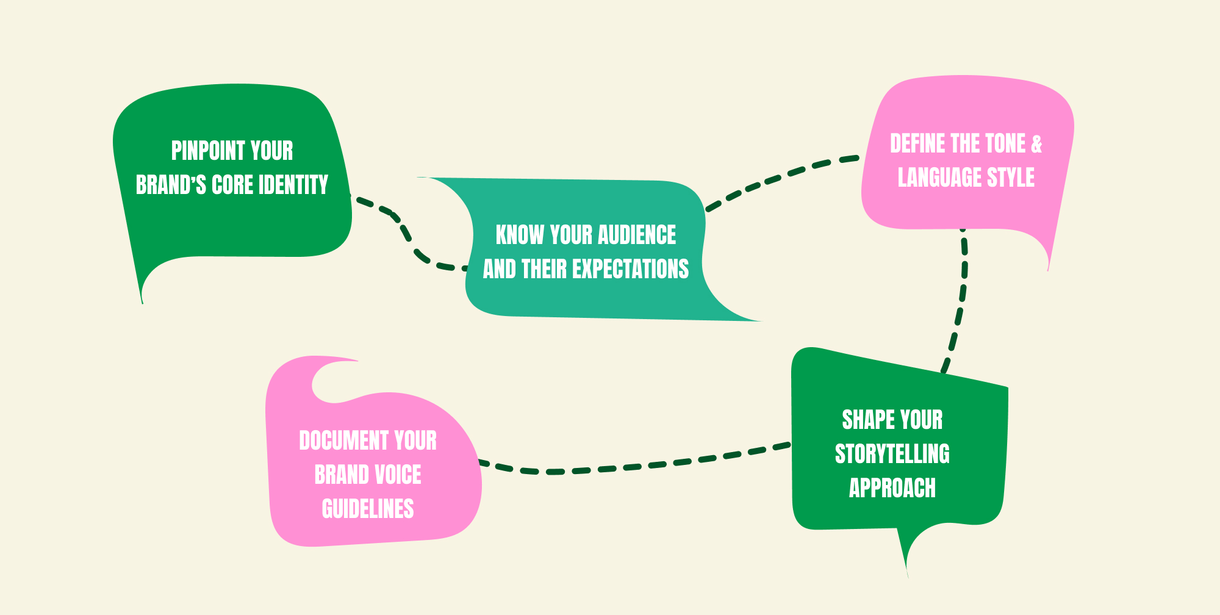
Brand Voice Worksheet
Use these prompts to create the first version of your brand voice.
Strategic Foundation
Complete these statements:
- Our brand exists to:
- Our primary audience is:
- Our audience is trying to:
- Our audience is concerned about:
- Customers choose us because:
- We want to be known for:
- We never want to be perceived as:
- Our strongest proof is:
- Our point of view is:
Audience Language
Document:
- Words customers use to describe the problem:
- Words customers use to describe the desired outcome:
- Terms customers understand:
- Terms that need explanation:
- Common objections:
- Claims customers respond to:
- Claims customers distrust:
- Competitor phrases that have become generic:
Voice Attributes
Complete the following for your first voice attribute:
- We are:
- This means:
- This does not mean:
- We do:
- We do not:
- On-brand example:
- Off-brand example:
Repeat the same exercise for each additional voice attribute.
Vocabulary Rules
Document:
- Preferred words:
- Words to avoid:
- Industry terms we use:
- Industry terms we explain:
- Acronyms we allow:
- Phrases that sound too corporate:
- Phrases that sound too casual:
- Product and service naming conventions:
Writing Mechanics
Decide:
- Do we use contractions?
- Do we use first person or third person?
- Do we address the reader as “you”?
- How long are our typical sentences?
- Do we use humor?
- Do we use emojis?
- How do we format headlines?
- How do we handle numbers and statistics?
- How do we communicate uncertainty?
- How do we make calls to action?
Tone by Situation
Document how the voice should adjust during:
- Announcements
- Educational content
- Sales communication
- Product launches
- Customer support
- Complaints
- Service interruptions
- Billing issues
- Policies
- Apologies
- Celebrations
The finished worksheet should produce a usable first draft, not a collection of disconnected adjectives.
How to Choose Strong Brand Voice Attributes
The best brand voice characteristics create meaningful communication choices.
Use these tests before approving an attribute.
Can It Be Defined?
A writer should be able to explain what the attribute means in one or two sentences.
Can It Be Observed?
The characteristic should affect vocabulary, sentence structure, formality, rhythm, or another visible part of the writing.
Can It Be Distinguished From Its Opposite?
If “confident” and “not confident” produce the same copy, the attribute has not been defined clearly enough.
Does It Fit the Audience?
The voice should help the audience understand and trust the brand.
Does It Fit the Category?
The characteristic should make sense within the expectations and risks of the industry.
Is the Combination Distinctive?
One attribute may be common. The combination should create a more specific personality.
For example, clear + confident + practical creates a different communication style from clear + warm + curious or clear + bold + irreverent.
Do not choose characteristics independently. Evaluate how they work together.
Brand Voice Examples: Before and After
Assume a fictional software company has defined its voice as clear, confident, practical, and helpful.
Homepage Example
Change this generic copy:
Our innovative, cutting-edge platform empowers modern organizations to unlock next-level productivity and transform the way they work.
To this on-brand copy:
Plan the work, assign owners, and see what is blocked before deadlines slip.
Why it works: the second version explains the product in specific language and removes unsupported promotional claims.
Call-to-Action Example
Change this:
Unlock Your Potential
To this:
Create Your First Project
Why it works: the revised call to action tells the reader exactly what will happen next.
Customer Support Example
Change this:
Oops! Something went wrong. Please try again later.
To this:
We couldn’t save your changes. Try again in a moment. Your previous version is still available.
Why it works: the revised message explains what happened, gives a next step, and reduces uncertainty.
Sales Example
Change this:
We would be delighted to schedule some time to explore how our world-class solution could potentially support your organization.
To this:
Book a 30-minute call to review your current process and see whether the platform fits your team.
Why it works: the revised message is direct, specific, and clear about what the conversation will cover.
Social Media Example
Change this:
We are beyond thrilled and incredibly excited to announce the launch of our amazing new feature!
To this:
Project templates are live. Save your best workflow once, then reuse it with every new project.
Why it works: the second version leads with the change and explains its practical benefit.
Brand Voice Examples From Public Style Guides
Microsoft: Simple, Human, and Helpful
Microsoft’s official brand voice guidance defines three primary voice principles:
- Warm and relaxed
- Crisp and clear
- Ready to lend a hand
The guide turns those characteristics into practical writing decisions, such as getting to the point quickly, using natural language, reducing jargon, and making choices and next steps obvious.
What to learn from Microsoft: do not stop at personality adjectives. Explain how each characteristic changes the writing.
Mailchimp: Plainspoken With Controlled Humor
Mailchimp’s public Voice and Tone guide describes its voice through practical characteristics such as being plainspoken, genuine, helpful at translating complexity, and capable of dry humor.
The guide also establishes an important boundary. Clarity is more important than entertainment, and humor should depend on the reader’s situation.
What to learn from Mailchimp: a distinctive brand can use humor without forcing jokes into every message. Define where personality belongs and where clarity must come first.
Atlassian: Bold, Optimistic, and Practical
Atlassian’s public voice and tone guidance defines its personality as:
- Bold
- Optimistic
- Practical, with a wink
Its guidance then explains how those characteristics should be adjusted according to what the user is doing and feeling.
What to learn from Atlassian: a strong voice can stay recognizable while the intensity of individual traits changes according to context.
How to Test Your Brand Voice
Before approving the voice, test it against six standards.
Recognition Test
Remove the logo and company name from several examples.
Ask whether the language still feels connected and recognizable.
Relevance Test
Ask whether the voice fits the company’s positioning, audience, industry, and level of customer risk.
Distinction Test
Compare the writing with several direct competitors.
Look for language, claims, and sentence patterns that feel interchangeable.
Repeatability Test
Give the guidelines to two writers.
Ask them to write the same type of message independently.
If the outputs feel like completely different brands, the rules need more detail.
Flexibility Test
Apply the voice to:
- A celebration
- A sales page
- A complaint
- An error
- A policy
- An educational article
The personality should remain recognizable without making every message emotionally identical.
Credibility Test
Read the copy aloud and ask:
- Does this sound natural?
- Would the company actually speak this way?
- Can the claims be supported?
- Is the personality appropriate for the audience?
- Does any part feel forced or performative?
A distinctive voice should still feel credible.
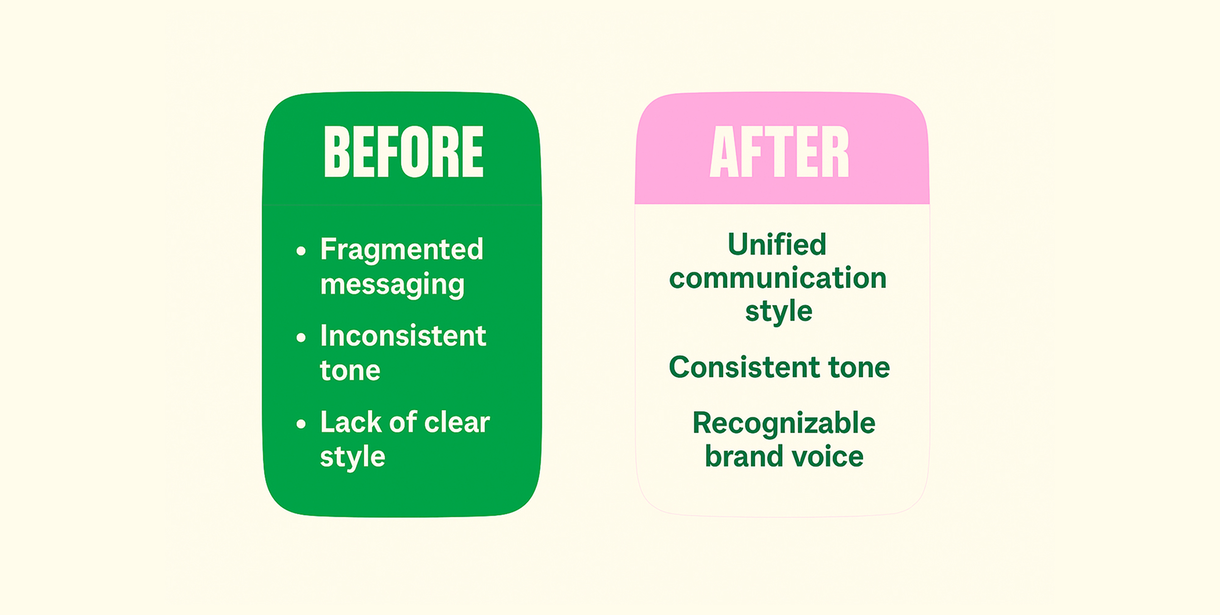
What to Include in Brand Voice Guidelines
Once the voice has been defined, document it in a practical reference.
Include:
Brand Voice Summary
A short explanation of the personality and the strategic reason behind it.
Audience Summary
Who the brand is speaking to, what the audience needs, and what language it understands.
Voice Attributes
Three to five characteristics with clear definitions.
Guardrails
A “we are, but we are not” statement for every attribute.
Writing Principles
Specific rules for vocabulary, structure, claims, formality, point of view, and clarity.
Preferred and Avoided Language
Approved terms, terminology rules, generic phrases to remove, and words that conflict with the voice.
Tone Guidance
Instructions for adapting the voice during common situations such as sales, support, complaints, billing, announcements, and errors.
On-Brand and Off-Brand Examples
Examples from the company’s actual communication, not only invented sentences.
Channel Guidance
Any meaningful differences between the website, social media, email, product, sales, and support.
Ownership
Who maintains the guidelines, approves exceptions, and decides when the system needs to change.
For documentation, governance, training, audits, templates, and scaling, use Brand Vision’s brand voice playbook.
How to Keep Brand Voice Consistent
A brand voice becomes valuable when different people can apply it without recreating the personality every time.
Create One Source of Truth
Keep the current guidelines, examples, vocabulary, and templates in one location.
Do not allow multiple outdated versions to circulate.
Use Real Examples
Save strong examples from:
- Website pages
- Emails
- Social posts
- Sales communication
- Product copy
- Customer support
Real examples make the system easier to understand than abstract descriptions alone.
Train Everyone Who Communicates Externally
Voice training should include more than writers.
It may also involve:
- Marketing
- Sales
- Customer support
- Product teams
- Executives
- Freelancers
- Agencies
Build Voice Rules Into Templates
Add voice guidance to:
- Content briefs
- Email templates
- Sales scripts
- Support macros
- CMS instructions
- AI prompts
- Design systems
- Approval workflows
Review Samples Regularly
Review a selection of communication across major channels.
Look for repeated drift rather than editing every sentence individually.
Change the Voice Deliberately
A brand voice can evolve when the positioning, audience, market, or company changes.
Do not change the voice every time a new trend, platform, or campaign appears.
For the operational system behind consistency, use Brand Vision’s brand voice playbook.
How to Use Brand Voice With AI
Do not ask an AI writing tool to “sound confident, authentic, and professional” and expect consistent results.
Provide a structured voice brief containing:
- The audience
- The communication goal
- The approved voice attributes
- A definition of each attribute
- “We are, but we are not” guardrails
- Preferred vocabulary
- Prohibited or overused phrases
- Approved examples
- Off-brand examples
- The tone required for the specific situation
- Factual and legal constraints
- The desired format and length
For example:
Voice: Clear, confident, practical, and helpful.
Clear means: Lead with the answer, use everyday language, and explain necessary technical terms.
Confident does not mean: Arrogant, absolute, or dismissive of uncertainty.
Avoid: “Revolutionary,” “game-changing,” “seamless,” “unlock your potential,” and unsupported superiority claims.
Situation: A customer is reporting a failed payment.
Required tone: Calm, direct, and nonjudgmental.
Output requirement: Explain what happened, what remains secure, and the next action.
AI-assisted content should still be reviewed for accuracy, context, originality, and alignment with the approved voice.
Common Brand Voice Mistakes
Mistake 1: Choosing a Voice Before Defining the Brand
A voice built without positioning usually becomes a list of generic adjectives.
Change the approach: Define the audience, position, difference, and point of view first.
Mistake 2: Copying a Famous Brand
A playful social voice may work for another company because of its audience, category, product, and existing reputation.
Change the approach: Study examples for structure, not imitation.
Mistake 3: Treating “Authentic” as a Complete Direction
Authenticity does not tell writers which words, structures, or claims to use.
Change the approach: Define observable rules that align the language with the company’s real identity and behavior.
Mistake 4: Using Generic Attributes Without Definitions
“Professional,” “friendly,” and “innovative” can mean almost anything.
Change the approach: Define every attribute with rules, guardrails, and examples.
Mistake 5: Confusing Voice With Tone
This can make the brand rigid or inconsistent.
Change the approach: Keep the personality stable and adjust the emotional delivery according to context.
Mistake 6: Mimicking Customer Slang
Audience research should improve understanding, not lead to forced imitation.
Change the approach: Use language customers understand while preserving the brand’s own identity.
Mistake 7: Creating Guidelines Without Off-Brand Examples
Writers need to understand the boundaries, not only the ideal.
Change the approach: Show both on-brand and off-brand executions.
Mistake 8: Applying the Voice Only to Marketing
Customers also experience the brand through sales, product, billing, policies, and support.
Change the approach: Test the voice across the entire customer journey.
Mistake 9: Using the Same Tone Everywhere
A product celebration and a serious customer complaint require different emotional delivery.
Change the approach: Create situational tone guidance.
Mistake 10: Giving AI Vague Personality Prompts
Three adjectives do not provide enough operational direction.
Change the approach: Include definitions, rules, examples, prohibited language, and contextual tone.
Frequently Asked Questions About Brand Voice
What is brand voice?
Brand voice is the consistent personality a company expresses through written and spoken communication.
It influences vocabulary, sentence structure, formality, point of view, humor, pacing, and the way the brand relates to its audience.
How do I find my brand voice?
Start with your positioning, values, audience, and competitive difference.
Then audit your current communication, research the language your customers use, choose three to five credible voice attributes, and translate those attributes into rules and examples.
How do I create a brand voice?
Use this process:
- Define the strategic foundation.
- Audit existing communication.
- Research the audience and category.
- Choose three to five attributes.
- Add guardrails.
- Create writing rules and examples.
- Test and document the system.
How many brand voice attributes should I choose?
Three to five is practical for most teams.
Use enough characteristics to create a specific personality without making the system difficult to remember or apply.
What is the difference between brand voice and tone of voice?
Brand voice is the consistent personality behind the communication.
Tone of voice is how that personality adjusts according to the audience, channel, situation, or emotional context.
Read the complete guide to brand voice vs. tone of voice.
What are some brand voice examples?
Microsoft, Mailchimp, and Atlassian publish public guidance showing how they define their communication styles.
Microsoft emphasizes simplicity and helpfulness. Mailchimp combines plain language with controlled humor. Atlassian defines a bold, optimistic, and practical personality that adjusts according to the user’s situation.
What should a brand voice guide include?
Include:
- Voice summary
- Audience
- Voice attributes
- Guardrails
- Writing rules
- Vocabulary
- Tone guidance
- Channel guidance
- On-brand examples
- Off-brand examples
- Ownership and review process
Can a brand voice change?
Yes, but the change should be deliberate.
Review the voice when the company changes its positioning, audience, product portfolio, market, or overall identity.
Do not change the core voice for every campaign or social trend.
How do I keep brand voice consistent across a team?
Create clear guidelines, use real examples, train contributors, build the rules into templates and workflows, and review samples across channels.
Use Brand Vision’s brand voice playbook for the complete governance process.
How can I make AI follow my brand voice?
Provide more than personality adjectives.
Give the AI definitions, guardrails, preferred vocabulary, prohibited phrases, approved examples, off-brand examples, the audience, the task, the required tone, and factual constraints.
Review the output before publication.
Build a Voice People Recognize
A strong brand voice is not necessarily the loudest, funniest, or most informal.
It is the voice that accurately expresses the company’s position, makes clear communication choices, and remains recognizable across every customer interaction.
Start with strategy.
Listen to the language your audience uses.
Choose a small number of credible characteristics.
Turn those characteristics into rules, boundaries, and examples.
Then test the voice across marketing, sales, product, and customer support before documenting the final system.
For the operational next step, use Brand Vision’s brand voice playbook to document, govern, and scale the voice across a team.
If your company needs to define or rebuild its positioning, messaging, verbal identity, and wider brand system, Brand Vision’s branding agency can lead the process from research and strategy through guidelines and rollout.



%2520(1).png)






