Wendy’s social media voice became famous because it did not sound like standard corporate fast-food copy. On Twitter, now X, the brand built a recognizable style around competitor banter, memes, short replies, and an intentionally sharp sense of humor. Its Wendy’s account on X is only one part of that history, but it became the clearest public showcase for the brand’s roast-heavy voice. Wendy’s later turned that style into a recurring event: its own National Roast Day, which the company says it created in 2018.
The examples below are best read as a snapshot of that voice rather than a current performance ranking. They span different years, formats, and campaigns, and public engagement counts can change or become difficult to verify over time. The screenshots also capture posts as they appeared at specific moments, so the analysis focuses on the creative idea rather than claiming a permanent view or share count. What lasts is the pattern: Wendy’s repeatedly uses a defined brand voice to make ordinary product messages, competitor exchanges, and pop-culture references feel recognizable.
How Wendy’s Built a Roast-Heavy Social Media Voice
Wendy’s roast culture works because the jokes are connected to a clear point of view. The brand often presents itself as the fast-food challenger that is willing to say what a more formal account would avoid. Wendy’s own National Roast Day posts show that the company deliberately institutionalized the format, inviting fans and other brands to ask for roasts rather than treating the tone as a series of accidental one-offs.
That does not mean the voice is simply “be rude online.” A strong brand personality needs boundaries, repeatable language, and enough flexibility to respond to culture without becoming unrecognizable. Wendy’s humor usually points back to familiar brand themes such as freshness, product launches, competitor comparisons, or the red-haired Wendy character. That connection between voice and business context is what makes the account useful as a marketing case study.
There is also a difference between a one-time stunt and a repeatable operating style. A stunt can earn attention once. A voice has to work when the brand is launching breakfast, replying to a customer, promoting a limited-time collaboration, or making a joke with no product link at all. Wendy’s examples are useful because the same personality appears across all of those situations, even when the format changes from text reply to meme to campaign creative.
10 of Wendy’s Funniest Tweets and Social Moments
1. “Pookie Looking Absolutely Fire”
In January 2024, Wendy’s posted a photo of a McDonald’s Golden Arches sign on fire with the caption “Pookie looking absolutely fire.” The joke is simple: the slang compliment also describes the image literally. It is a clean example of Wendy’s competitor-banter formula because the brand does not need a long setup or a product pitch to make its point.
Pookie looking absolutely fire pic.twitter.com/zx9zjINi7m
— Wendy’s (@Wendys) January 30, 2024
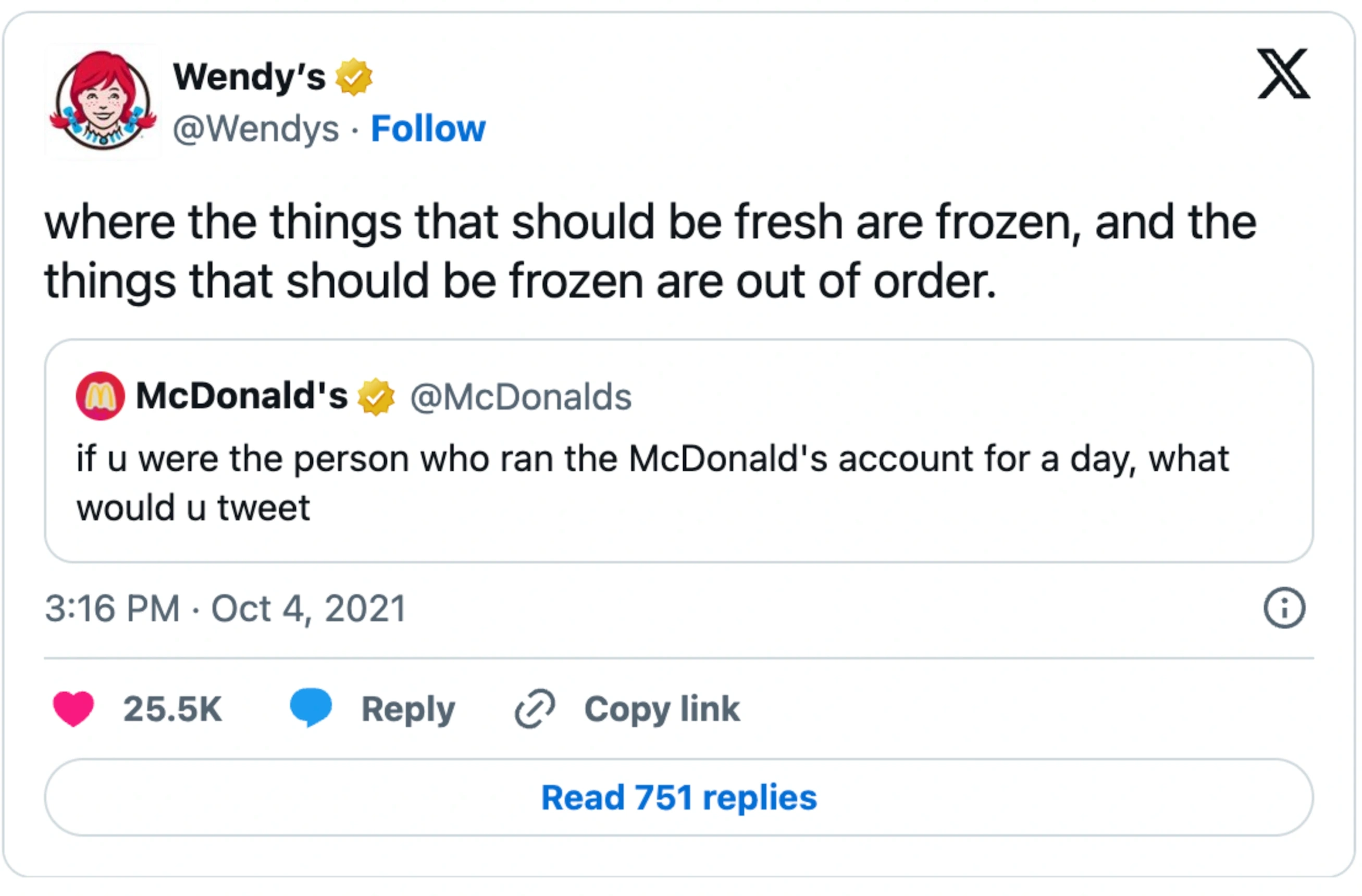
2. The Frozen-Beef and Ice-Cream-Machine Roast
This example combines two familiar fast-food talking points in one line: Wendy’s long-running fresh-beef positioning and the internet joke about McDonald’s ice-cream machines. The structure is important. Instead of explaining why its own product is different, Wendy’s uses a competitor joke to reinforce the distinction indirectly.
3. Burger King’s Promposal Gets a Wendy’s Reply
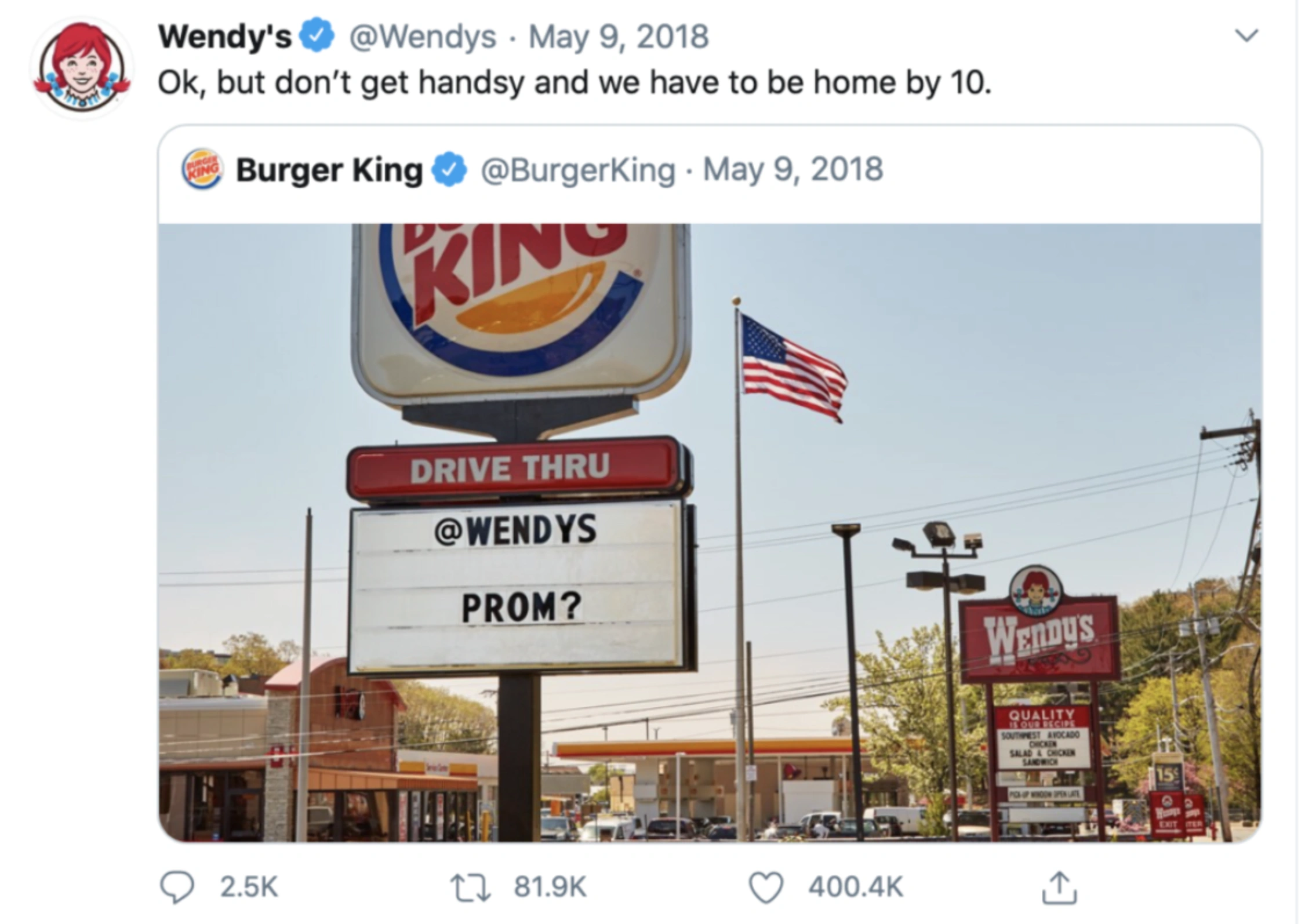
When Burger King played with the idea of asking Wendy’s to prom, Wendy’s replied in character rather than treating the exchange as a formal brand collaboration. The humor comes from personifying both restaurant brands and making the conversation read like awkward teenage banter. For food and beverage marketing, the broader lesson is that category rivalry can become entertainment when the voice is already familiar to the audience.
4. Wendy’s Meets Gordon Ramsay
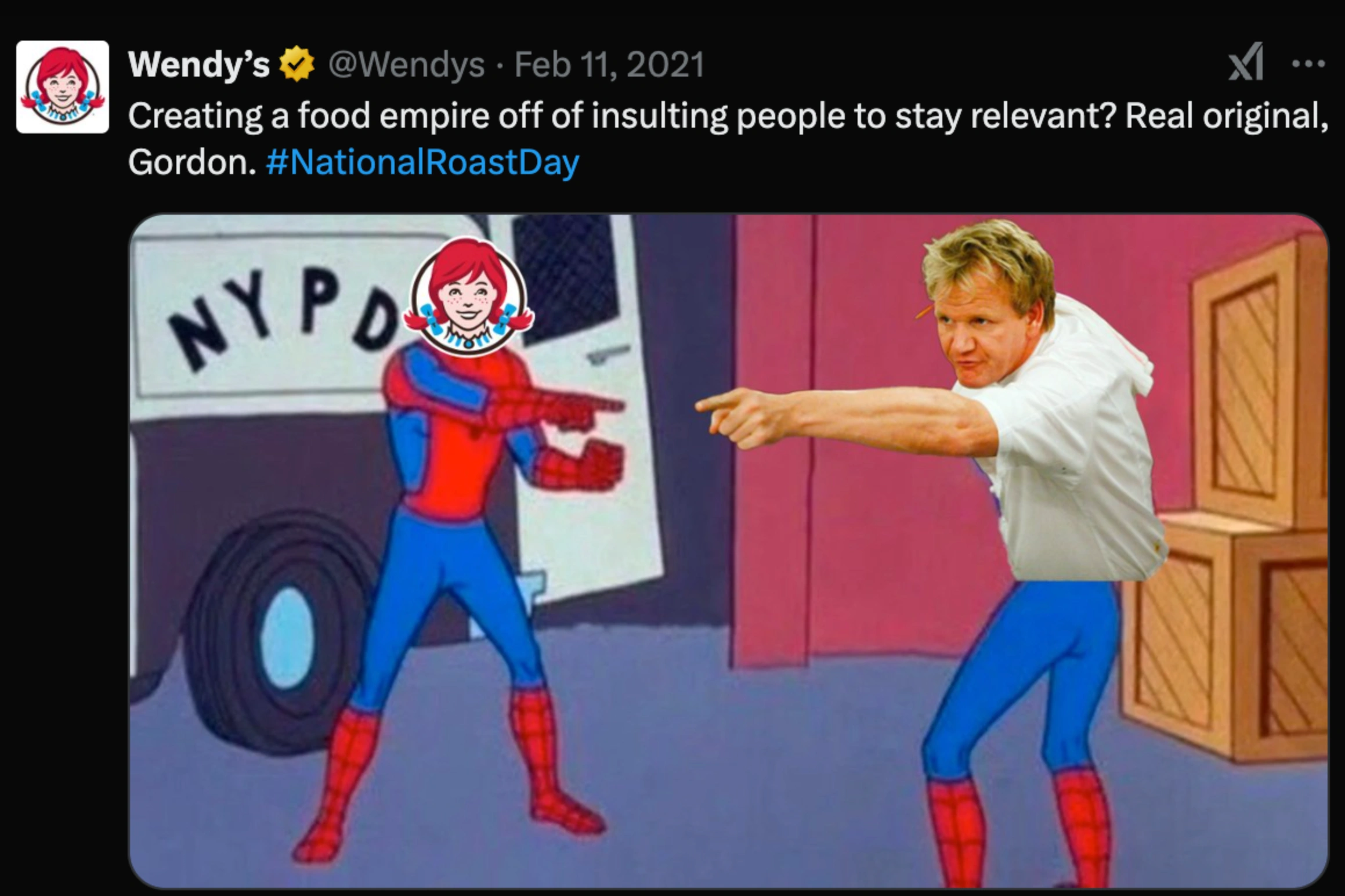
The Spider-Man pointing meme works because both Wendy’s and Gordon Ramsay were already associated with public roasting. Wendy’s uses the meme to make itself the subject of the joke as well as the author of it. That self-awareness matters: a brand that only attacks competitors can feel defensive, while a brand willing to joke about its own reputation can make the persona feel more deliberate. The format is also instantly legible, so the audience understands the comparison before reading much copy.
5. The Krabby Patty Kollab
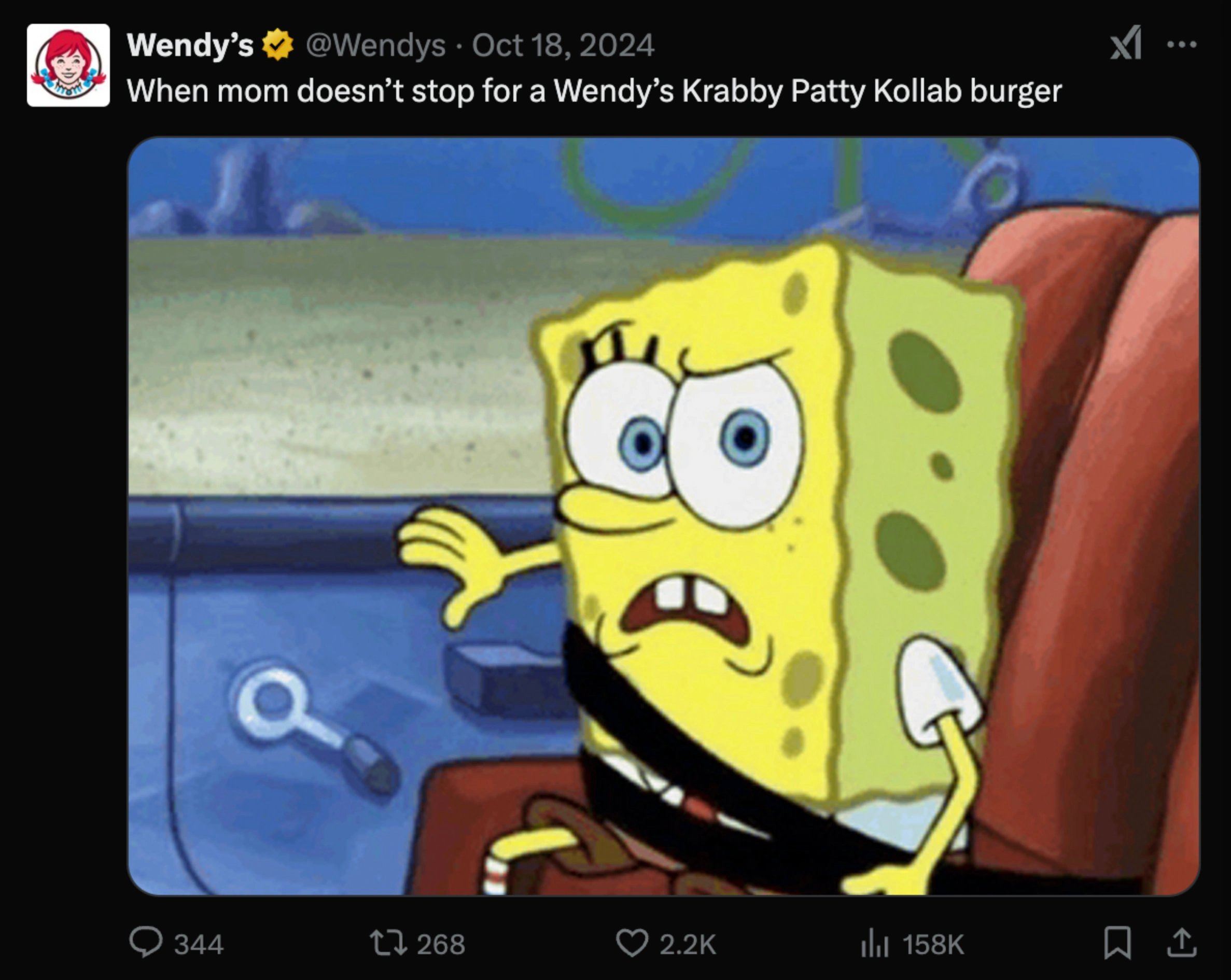
This SpongeBob moment was tied to a real limited-time product collaboration rather than a standalone meme. Wendy’s and Paramount announced the Krabby Patty Kollab in October 2024, including a Krabby Patty Kollab Burger and Pineapple Under the Sea Frosty in the U.S., Canada, and Guam. The social joke therefore did two jobs at once: it used nostalgia to entertain existing followers while supporting an actual menu launch. Wendy’s official announcement also described the campaign as including custom creative and social content.
6. The McDonald’s Truck Reply
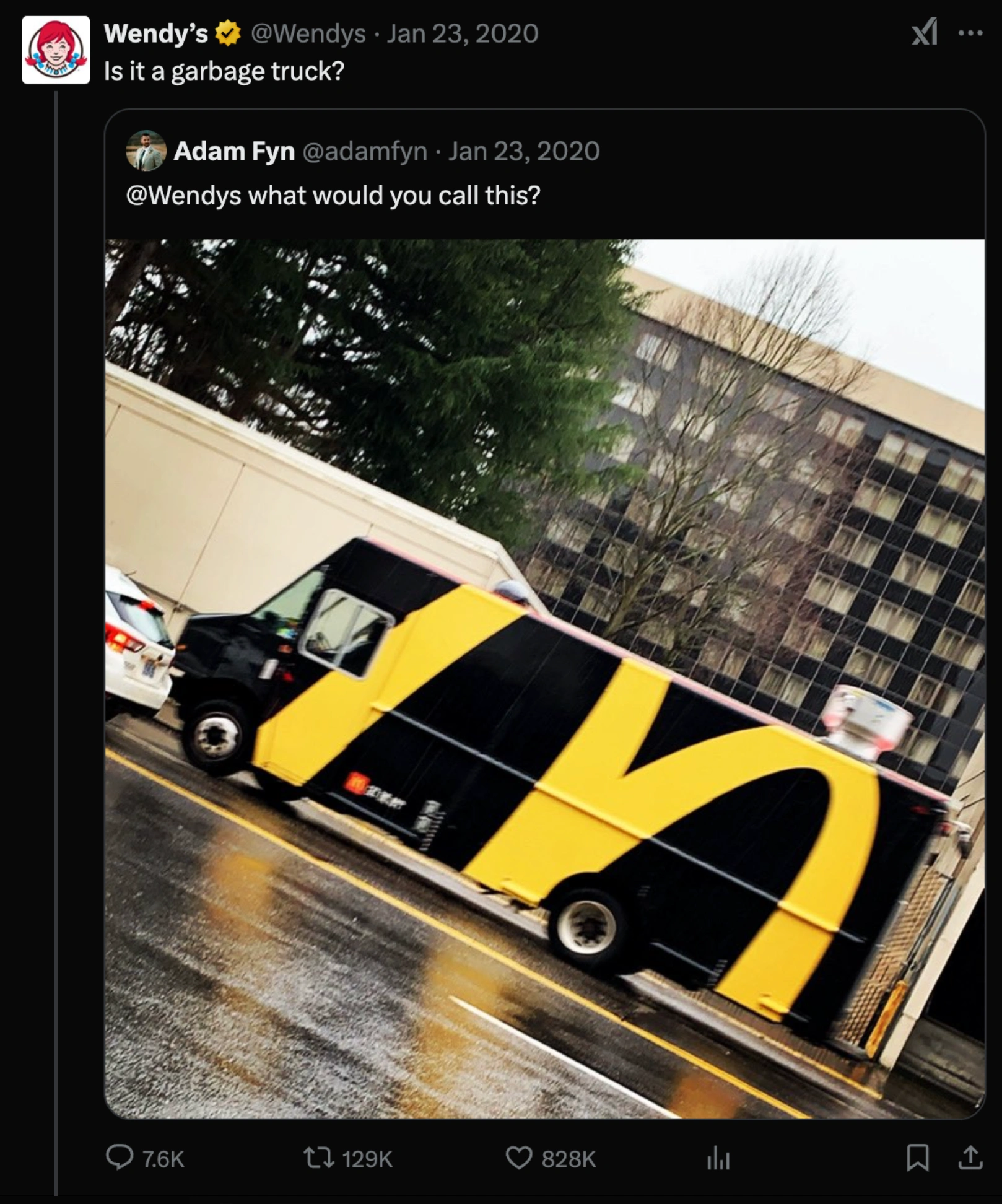
A user asked what Wendy’s would call a McDonald’s-branded truck, and Wendy’s answered with the obvious insult: a garbage truck. The appeal is the speed and economy of the punchline. There is no elaborate campaign mechanic, which shows why a defined voice can matter in everyday community management as much as in large launches.
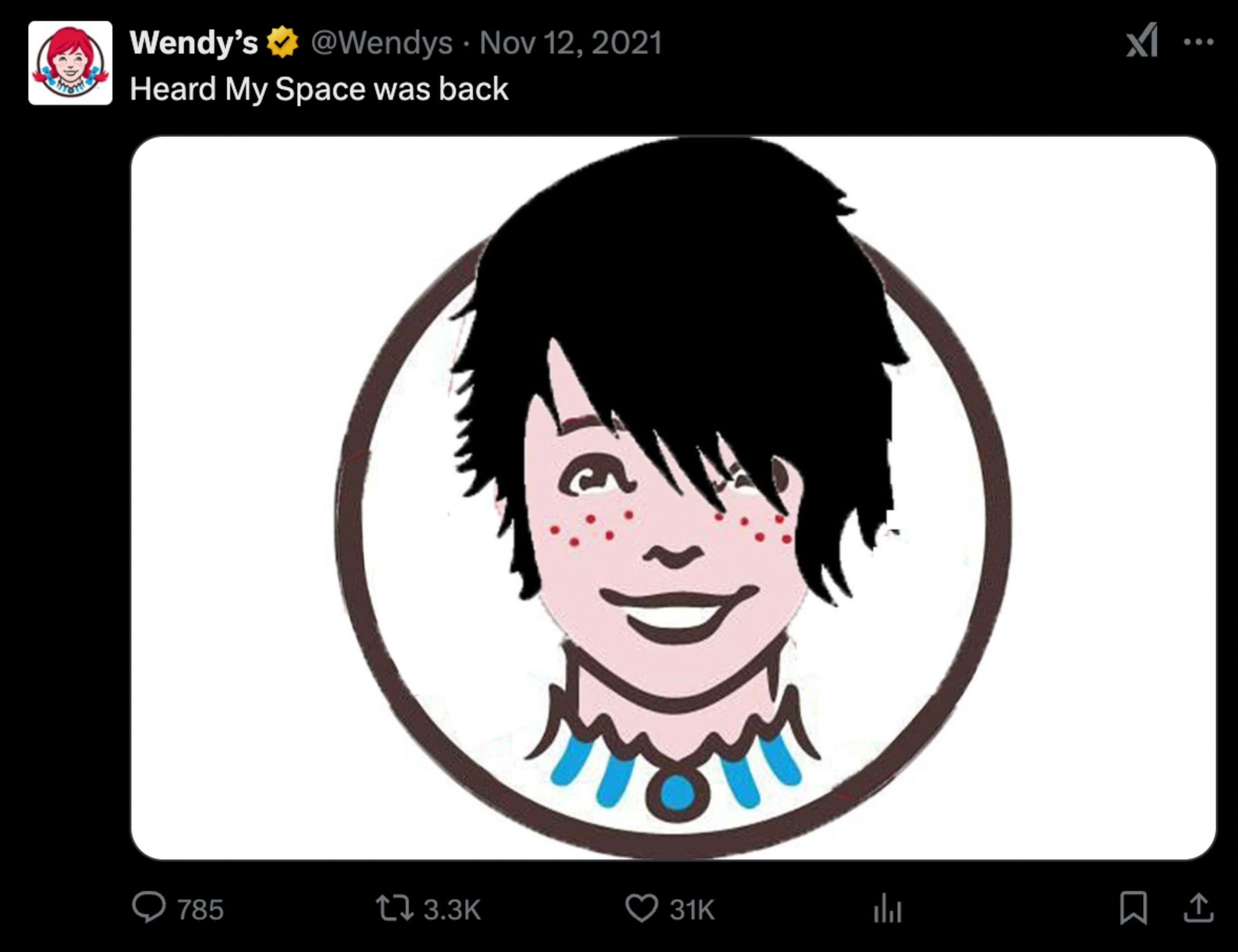
7. The Dunkin’ Roast Exchange
The Dunkin’ exchange shows how Wendy’s extends a single joke through replies. The brand answers a jab about spicy nuggets with another category-specific insult, then keeps escalating the bit. That kind of improvisation works only when the social team knows what the voice can and cannot say. Without those guardrails, “being edgy” can become inconsistent or needlessly hostile. The exchange also shows why community management can become creative work in its own right: the reply has to feel immediate while still sounding like the same brand.
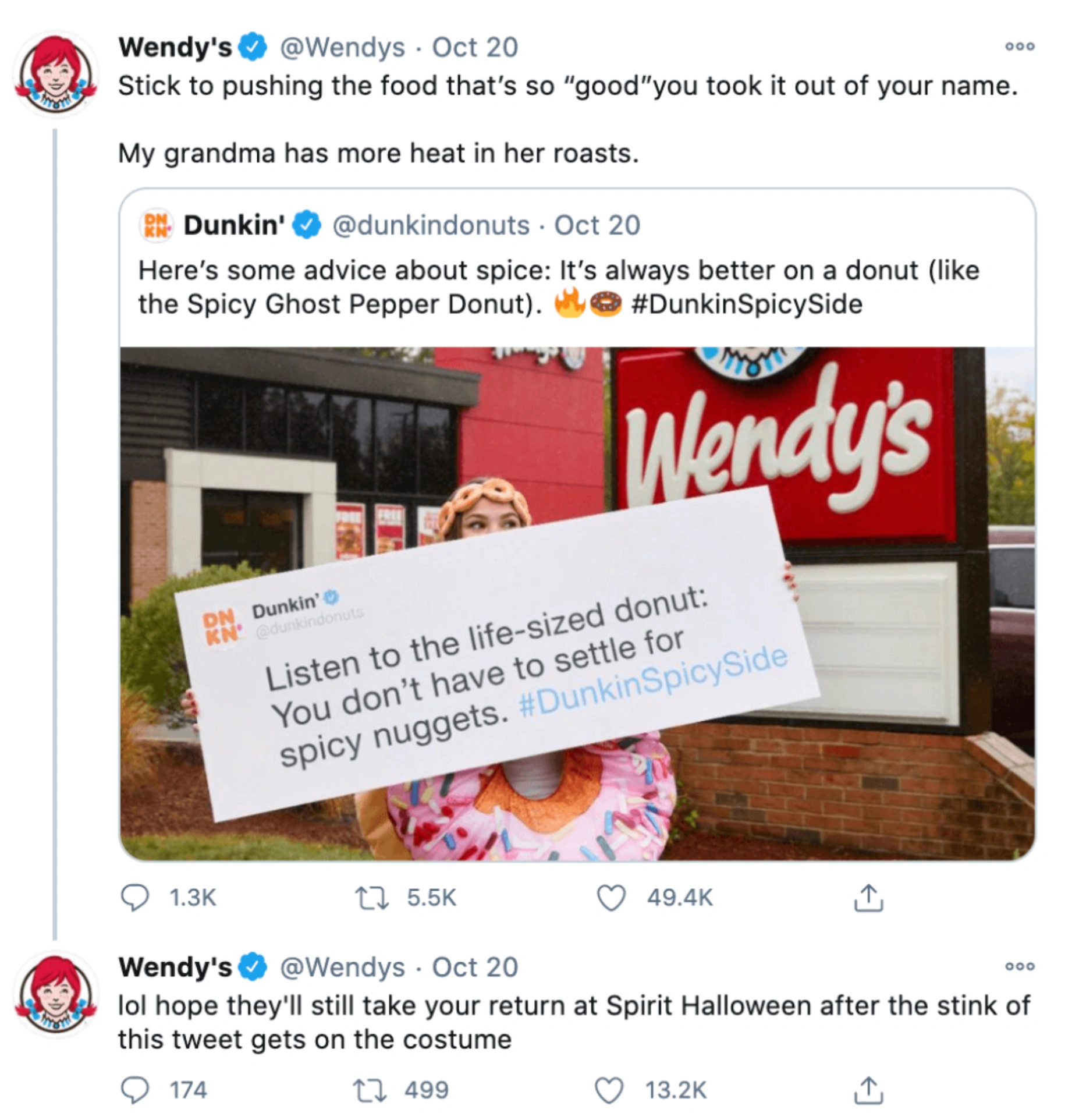
8. The Egg McMuffin Gravestone
Wendy’s breakfast-era joke turned a competitive comparison into a mock funeral, complete with a gravestone and the line “Here lies mediocrity.” The exaggerated visual is doing most of the work, while the copy stays brief. It is a useful example of how the Wendy’s persona travels from replies into campaign creative without needing a different tone. The brand can support a product push without abandoning the humor followers already associate with the account.
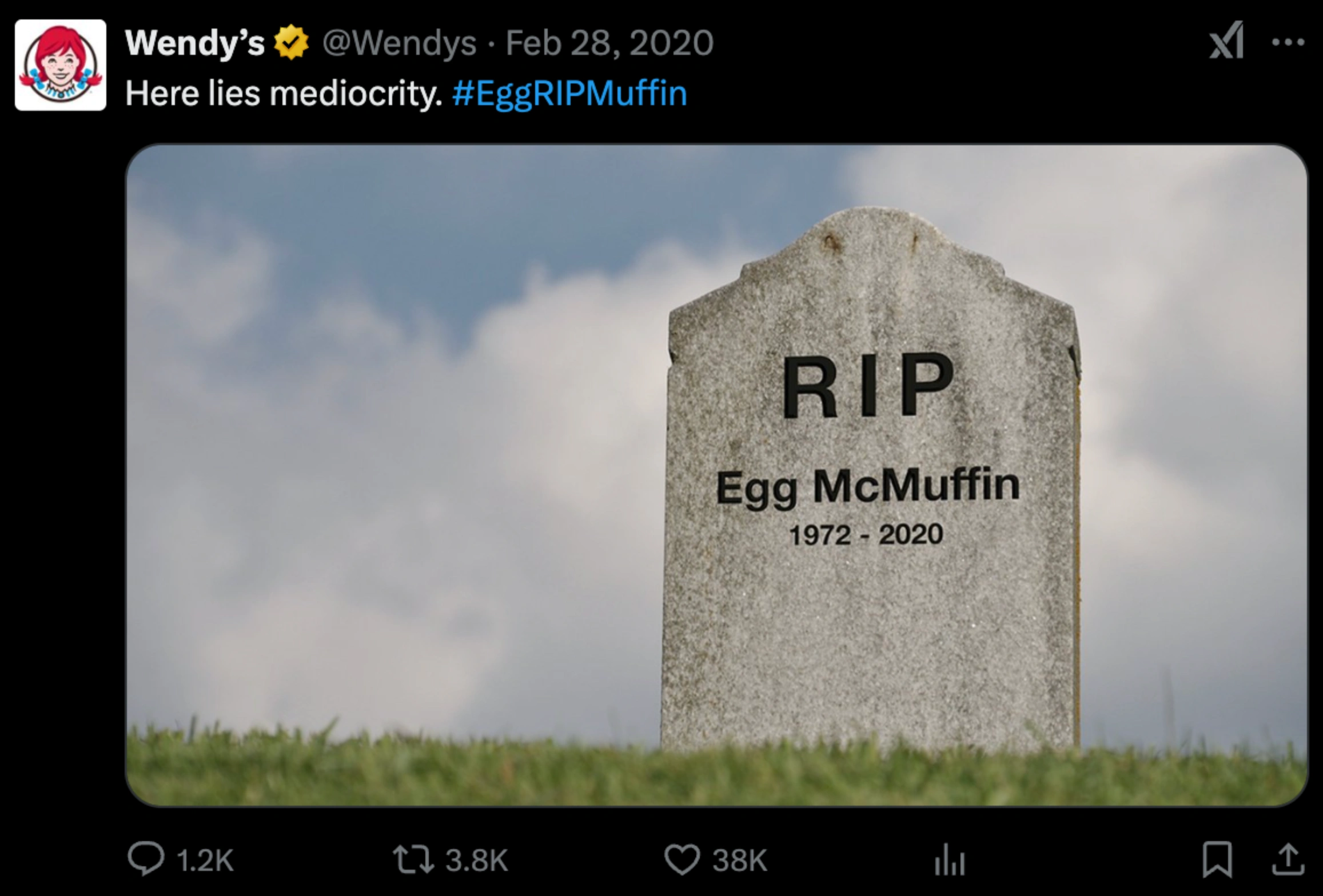
9. Cosmic Wendy
In this meme, Wendy’s is turned into an exaggerated cosmic figure looking down on the fast-food category. The joke combines recurring competitor language with a surreal visual format. It is less about a specific product than maintaining the account’s ongoing character, which is why it fits the same voice even though the creative format changes.
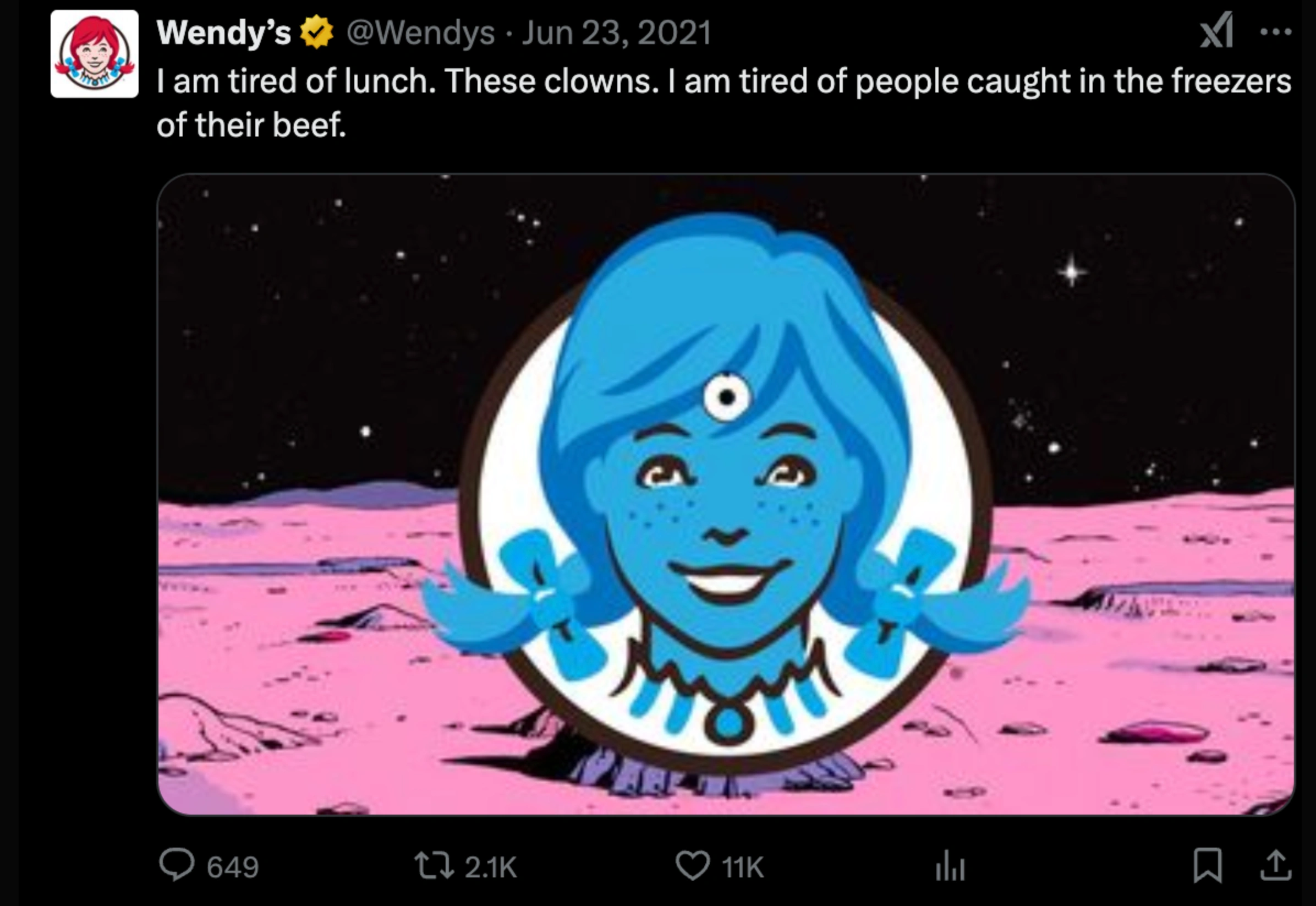
10. Wendy’s Goes Emo for a MySpace Joke
Wendy’s altered its familiar red-haired logo into a 2000s emo look and paired it with a MySpace reference. The post leans on nostalgia rather than competitor rivalry, but the mechanism is similar: start with something the audience already recognizes, then filter it through Wendy’s visual identity and dry delivery. It also shows that a recognizable brand asset can be temporarily remixed without making the underlying identity hard to recognize.
Why the Wendy’s Brand Voice Works
Wendy’s is often described as a challenger even though it is a major global restaurant brand. On social media, that posture gives the account permission to behave more like a quick-witted participant than a distant corporate announcer. The key is consistency. Competitor jokes, product claims, character-based memes, and fan replies repeatedly return to the same recognizable personality rather than changing tone with every trend.
The brand also creates recurring formats. Wendy’s says National Roast Day has been an annual tradition since 2018, and its own recaps show fans and brands actively volunteering to be roasted. Recurrence turns a tone of voice into an expectation. It gives the audience a reason to return while giving the social team a structure that can be refreshed each year.
That structure is useful beyond Wendy’s. A strong social program needs a defined role for the channel, editorial guardrails, response principles, and a way to connect entertainment back to the brand. Teams also need escalation rules for sensitive replies, legal or customer-service issues, and moments when the brand should not join a trend. A broader social media marketing strategy can coordinate those decisions with campaigns, paid distribution, and other channels rather than treating individual posts as isolated wins.
The creative standard is not “make every post viral.” It is to make the account recognizable enough that a good post feels native to the brand and useful enough that the channel supports a larger objective. That may mean awareness, product launches, community participation, or simply maintaining salience between campaigns.
What Brands Can Learn From Wendy’s Funniest Tweets
The lesson is not that every company should roast competitors. Wendy’s tone works because it fits a brand personality the audience has seen repeatedly, and because the company has invested in the format over years. A professional-services firm, nonprofit, luxury brand, or regulated company may need a completely different voice. The transferable principle is to define the personality first, document how it should sound, and then adapt trends to that system instead of copying another account’s jokes. That voice should also connect with the wider branding system, so social content does not feel like a separate personality from the website, packaging, advertising, or customer experience.
Social platforms also change quickly. Looking at the broader history of social media makes that clear: formats, algorithms, and platform names evolve, but recognizable brands carry more continuity than any individual feature. For restaurant operators and food brands competing for attention in South Florida, a marketing agency in Miami can help translate that principle into local audience strategy without forcing Wendy’s tone onto a different business.
If your team needs help defining a voice, building the content system around it, or connecting social media with a broader brand and campaign plan, talk with Brand Vision about the scope.