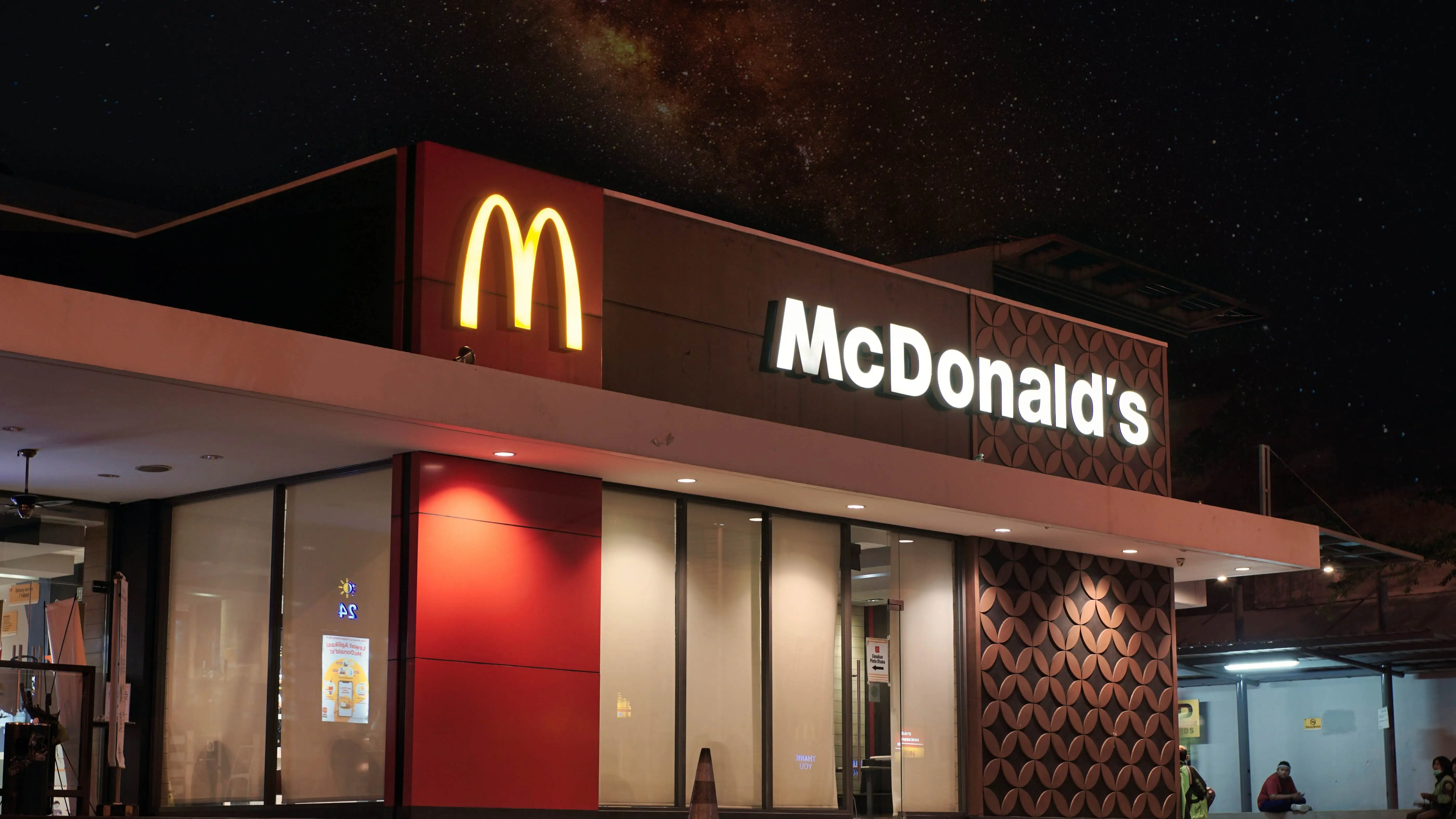

McDonald’s introduced “I’m Lovin’ It” as its first global advertising platform in 2003. Since its launch in 2003, the slogan and five-note “ba-da-ba-ba-ba” mnemonic have become durable parts of the company’s brand identity system. The important marketing lesson is not simply that the sound is catchy. It is that McDonald’s has repeated a compact verbal and sonic cue across campaigns, markets, and media for more than two decades.
- Easy for audiences to hum, even without lyrics
- Gave global campaigns a recurring audio cue despite language differences
Why a Jingle Matters More Than You’d Think
A sonic cue can give a brand another route to recognition when a logo is not visible. “I’m Lovin’ It” paired a short phrase with an equally short mnemonic, making the asset easy to repeat across television, radio, digital video, and other audio environments. The jingle is only one part of the wider McDonald’s marketing strategy, but it shows how a distinctive asset can reinforce a broader system instead of carrying the entire brand by itself.
- Pairs the product message with an emotional tone rather than only a sales claim
- Creates a repeatable audio cue that can strengthen brand association and positioning
@a1234music We all know the McDonald’s jingle, but do you know the weird history behind it? #mcdonalds #imlovinit #justintimberlake #pharrell #pushat #grimace ♬ original sound - A1234
Unifying a Global Brand
McDonald’s operates in diverse markets, different cultures, languages, and tastes. A recurring sonic mnemonic gives those markets a recognizable cue even when the menu, language, creative execution, or local promotion changes. That is useful global-brand architecture: preserve a small set of distinctive assets while allowing local teams enough flexibility to stay relevant.
- Provides a consistent cue across markets
- Supports familiarity while local creative and menus vary
Moving Beyond Words
The five-note mnemonic also carries meaning without requiring a long sentence. The words still need localization and cultural judgment, but the sonic pattern can remain recognizable even when the surrounding advertising changes. The useful principle is to make a brand asset simple enough to travel without pretending that every market interprets the message identically.
- Reduces dependence on long copy for the core audio cue
- Still requires careful localization of language and cultural context
Reinforcing Emotional Connections
Think about it: when that tune plays, it’s not just about food. It’s about shared childhood memories, late-night snack runs, or midday breaks from a busy schedule. Each time someone hears the jingle, it taps into those feelings. That’s more powerful than static words on a billboard. It’s the sound of comfort food meeting warm nostalgia.
- Links brand to personal experiences and small joys
- Evokes reassurance and lightheartedness rather than formality
Creating Instant Brand Recall
Distinctive assets are valuable because they give audiences shortcuts to recognition. With McDonald’s, the combination of phrase, rhythm, Golden Arches, product imagery, and restaurant experience reinforces the same brand over time. The jingle matters most as part of that repeated system, not as proof that audio alone caused a particular level of recall.
- Adds a nonvisual recognition cue alongside McDonald’s visual assets
- Supports recognition without requiring a long explanation
Consistency and Flexibility Combined
One reason “I’m Lovin’ It” has endured is that the mnemonic can sit beside many different products and campaign ideas without becoming the entire message. McDonald’s said in 2014 that the platform was entering its 11th year and continued to give the brand a consistent voice worldwide. That kind of longevity comes from protecting a recognizable strategic core while allowing the creative around it to change. McDonald’s Corporation
- Adapts to evolving product lines and marketing angles
- Prevents the brand from feeling stale while maintaining familiarity
A Positive Spin During Tough Moments
A familiar jingle cannot solve criticism about nutrition, sustainability, labor, pricing, or service. Those issues require operational and communications responses of their own. What a stable sonic asset can do is keep the brand recognizable while the company addresses harder questions through policy, products, service, and evidence.
- Maintains a recognizable tone while harder reputation issues are handled elsewhere
- Keeps creative continuity without treating the jingle as a solution to operational problems
View this post on Instagram
A post shared by McDonald’s (@mcdonalds)
Adaptation Across Different Media
Originally, “I’m Lovin’ It” hit the airwaves, but it’s not stuck in a TV-only world. The slogan and sound show up everywhere: social media ads, smartphone apps, digital streaming platforms, even gaming integrations. No matter where consumers encounter the brand, that tune knits the experience together, making it all feel cohesive.
- Maintains unified branding across multiple digital channels
- Keeps pace with changing media habits without losing identity
What Other Brands Can Learn
The transferable lesson is not that every company needs a jingle. Brands need a small set of distinctive cues that fit their positioning and can be repeated without becoming monotonous. Audio may be one of those cues, but color, typography, packaging, motion, language, product form, or customer experience can perform the same memory-building role.
- Shows that sonic cues are one option for a distinctive brand asset
- Highlights the value of simple, repeatable signals across campaigns
Continuous Tweaks for Freshness
McDonald’s has changed creative styles, spokespeople, products, and media formats while retaining recognizable elements of “I’m Lovin’ It.” Looking across the broader history of McDonald’s advertisements shows why consistency does not require repeating one execution forever. The asset can remain stable while the story around it changes.
- Fine-tunes the presentation without losing the familiar anchor
- Ensures the brand remains relevant, not just a relic of old campaigns
View this post on Instagram
A post shared by McDonald’s (@mcdonalds)
Cultural Adaptations that Preserve Identity
McDonald’s local marketing can vary in language, menu focus, partnerships, and cultural references while recognizable global assets provide continuity. The useful principle is not to force identical advertising everywhere. It is to define which elements should stay stable and which should adapt to the local market.
- Balances local relevance with universal consistency
- Maintains brand coherence while embracing regional differences
Encouraging User-Generated Content
Short, recognizable brand cues are easy to quote, imitate, parody, and remix in social content. That can extend cultural visibility, but brands should distinguish organic participation from measurable commercial impact. User-generated content is useful evidence that an asset is being reused; it is not automatically proof of incremental sales.
- Makes the asset easy for audiences to quote, imitate, or remix
- Creates additional cultural touchpoints when audiences reuse it
View this post on Instagram
A post shared by McDonald’s (@mcdonalds)
Why Sonic Branding Extends Beyond Visual Media
A sonic asset gives a brand a cue that can work when the audience is listening rather than looking. That matters across radio, podcasts, streaming video, connected devices, in-store audio, and other environments where a visual logo may be secondary. McDonald’s demonstrates the durability of the format, but the sound still has to connect to a larger brand system to remain meaningful.
- Gives the brand a cue that can work in audio-led environments
- Extends recognition beyond situations where a visual logo is prominent
Linking Past and Present
For long-time customers, “I’m Lovin’ It” can carry associations from earlier advertising; for newer customers, it may simply register as part of the current brand system. That continuity helps connect different eras of communication without forcing every campaign to look or sound the same.
- Connects different eras of communication with one recurring cue
- Provides familiarity while campaigns and channels change
View this post on Instagram
A post shared by McDonald’s (@mcdonalds)
Reinforcing Brand Personality
Words can feel cold or corporate. A catchy melody feels more human. “I’m Lovin’ It” injects personality into a multinational chain. It suggests McDonald’s is approachable, laid-back, and all about everyday enjoyment. That personality element makes the chain less of a faceless corporation and more like a friendly companion.
- Humanizes the brand, making it approachable rather than distant
- Encourages consumers to perceive McDonald’s as part of their daily rhythm
A Tool for Storytelling
When weaving narratives about family dinners or local community events, McDonald’s can lean on the jingle. It frames stories in a familiar context. Maybe a TV spot shows a group of friends laughing over fries, cutting to that iconic sound at the end. The audience instantly grasps the mood, warm, uplifting, inclusive, without a wordy explanation.
- Simplifies storytelling, letting sound convey warmth and unity
- Makes complex marketing messages feel straightforward and inviting
- People captioning "I'm Lovin' It" under their Mcdonald's posts and shares
View this post on Instagram
A post shared by Samantha Angilletta (@putaforkinit_)
Looking Ahead
Consumer preferences, channels, menus, and competitive conditions keep changing. The value of a long-running brand asset is that it can provide continuity while those surrounding decisions evolve. The asset should remain only as long as it continues to fit the strategy; longevity is useful when it reinforces meaning, not simply because it is familiar.
- Shows how a long-term brand asset can support consistency without freezing the creative system
- Adjusts naturally to changing cultural and consumer landscapes
Why the Campaign Endured
“I’m Lovin’ It” has lasted because McDonald’s treated it as a repeatable platform rather than a one-season line. The phrase, mnemonic, visual identity, advertising, restaurant experience, and menu communications repeatedly reinforce one another. That does not make every campaign equally effective, but it helps explain why the asset has remained usable across different creative eras.
- Shows how sound can become one part of a long-running brand system
- Remains a useful case study in protecting a distinctive asset over time
How Business Owners Can Apply This in 2026
The practical lesson for smaller businesses is to treat recognition as a system of repeatable cues, not a one-time creative idea. Define what the brand should mean, decide which verbal, visual, or sonic assets will carry that meaning, and use them consistently enough to become familiar. For restaurant and café operators, Brand Vision’s restaurant branding and marketing guide covers the wider customer experience around those cues. Food and beverage companies can also connect the lesson to food and beverage marketing, while Canadian operators coordinating a consistent system across markets can work with a Canada marketing partner when regional support is useful.
- Build a clear foundation with brand strategy so your tagline, tone, and creative choices all point to the same promise.
- Lock in recognizable cues through visual identity so your brand is instantly “yours” in any format.
- Validate what people actually associate with you using brand research, especially if your brand has grown or shifted since your last refresh.
- Make your customer journey feel seamless by pairing messaging with UX, from ads to landing pages, using a UI UX design agency approach.
- If you’re updating pages or launching campaigns, involve a web design agency early enough that the campaign message and customer journey are designed together.
- Use outside review when you need help prioritizing gaps across brand, web, UX, search, and campaigns.
- If discoverability is part of the plan, build a long game around organic growth so your brand shows up consistently where people search.
The McDonald’s lesson is not to copy the five notes. It is to choose a small set of brand signals, connect them to a clear promise, and repeat them with enough discipline that customers can recognize the system across channels. Brand Vision can help connect that strategy to identity, web, UX, search, and campaign priorities through a marketing consultation.