Starbucks has built some of its most memorable advertising around rituals people already recognize: the first Pumpkin Spice Latte of the season, the return of holiday cups, a coffeehouse meetup, or a drink tied to a cultural moment. The best Starbucks ads and campaigns are effective because they connect products to behaviors, seasons, and communities rather than relying only on product claims.
That approach is especially useful in food and beverage marketing, where packaging, store experience, social content, limited releases, and repeat purchase can all reinforce the same idea. The nine examples below show how Starbucks has used humor, participation, gifting, cause marketing, and pop culture while maintaining recognizable brand storytelling.
1. Starbucks Doubleshot “Glen” (2004)
“Glen” turned an ordinary workday into a musical performance. In the spot, an office worker named Glen is followed around by the band Survivor, who belt out a custom version of the classic rock anthem. The joke is that Glen’s momentum is powered by Starbucks Doubleshot Espresso.
The ad works because the product benefit is dramatized rather than explained. Starbucks takes a familiar office routine and exaggerates it into something energetic and memorable. The product remains part of the premise, while the humor gives the audience a reason to keep watching even before the sales message lands. The spot is also a useful reminder that a functional benefit can be communicated through character and rhythm instead of a direct product demonstration. That gives the campaign entertainment value without disconnecting the joke from what the drink is meant to represent.
2. Pumpkin Spice Latte Campaigns (2003 to Present)
The Pumpkin Spice Latte is less a single advertisement than a recurring seasonal platform. Starbucks introduced the drink in 2003, then built its return into a recognizable autumn ritual. By the drink’s 10th anniversary, the campaign had contributed to over 200 million drinks sold, a figure Starbucks also included in its 20th-anniversary PSL timeline. That longevity matters because the campaign does not rely on a one-time surprise. Starbucks can refresh the surrounding creative while leaving the core seasonal cue intact, which makes anticipation part of the marketing itself.
Part of the strength comes from treating the product like an event. Social teasers, limited availability, and the @TheRealPSL Twitter account gave the drink a voice beyond the menu board. The campaign shows how a repeatable seasonal moment can become a brand asset when the timing, product, and communication style stay recognizable year after year.

3. Holiday Red Cups and #RedCupContest (2014 to 2015)
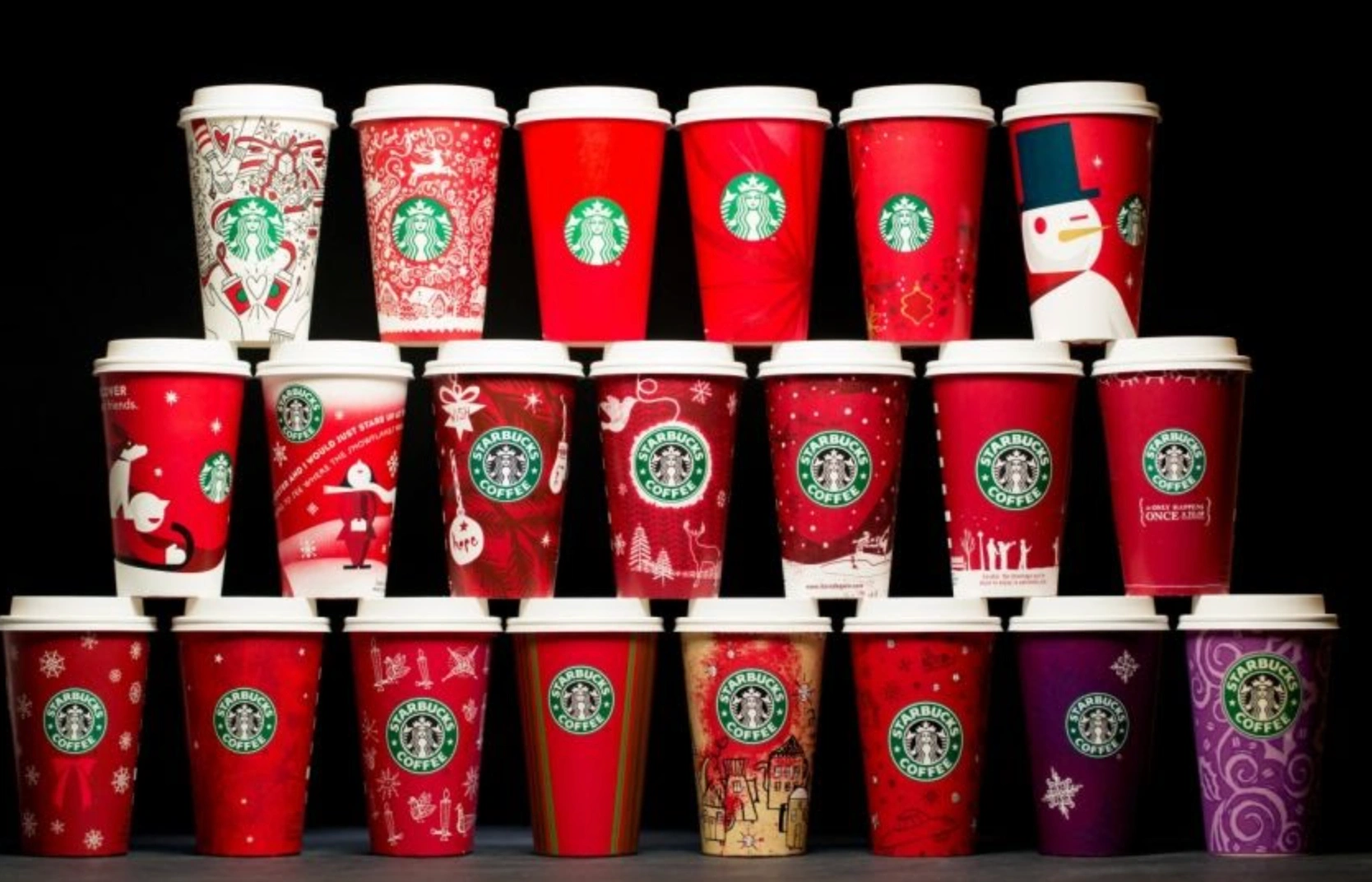
Starbucks’ holiday cups were already a seasonal cue, but the #RedCupContest on Instagram in 2014, gave customers a reason to participate directly. People photographed the red cups in holiday settings and shared their own interpretations of the seasonal design.
The useful marketing lesson is the shift from audience to participant. Rather than only receiving brand messages, customers created images that carried the Starbucks identity into their own feeds. This kind of participation works best when the visual system is already recognizable, which is why strong visual identity can make user-generated content feel connected even when the individual posts are different. The cup acts as the common visual anchor, while customers supply the variation. That balance gives a campaign consistency without requiring the brand to produce every piece of creative itself.
4. Starbucks Love Project (2009)
The Starbucks Love Project connected a global sing-along with the company’s involvement in (RED). Coverage of the event described The Beatles’ “All You Need Is Love,” broadcasting real-time performances across over 150 countries. Starbucks also used the campaign to support (RED)’s mission against AIDS in Africa.
The campaign is useful as an example of cause-related marketing built around participation rather than a simple donation message. The activity gave people something to do together, while the charitable connection provided the reason for the event. For brands, the important distinction is that the cause and the activation need to make sense together rather than being attached only for visibility. The Love Project gave the audience a shared action, a recognizable song, and a charitable context that could be understood quickly. Cause-related work is stronger when each of those pieces supports the same idea instead of competing for attention.
5. “Meet Me at Starbucks” (2014)
“Meet Me at Starbucks” focused on the coffeehouse as a place where people connect. The production followed real interactions, and coverage described how Film crews captured genuine interactions over one day in Starbucks cafes across 28 countries, then assembled those moments into a documentary-style film.
The campaign fits Starbucks’ broader idea of the coffeehouse as a gathering place. Instead of making the beverage the only subject, the creative made the environment and customer behavior part of the brand story. It is a reminder that customer and brand research can help marketers identify which real behaviors are worth elevating into a campaign rather than inventing a story that customers do not recognize. The coffeehouse itself becomes evidence for the positioning: people are already meeting, working, talking, and reconnecting there, so the campaign can document that behavior instead of manufacturing a separate brand personality.
6. Tweet-a-Coffee (2013)
Tweet-a-Coffee linked social conversation directly to a small digital purchase. The concept was straightforward: if you wanted to buy someone a $5 Starbucks gift card, you could do so just by tweeting “@tweetacoffee” plus the recipient’s handle.
What made the idea notable was the connection between public social behavior and a real gift. The transaction itself became part of the message because the act of giving could also be visible to others. For marketers, the broader lesson is that digital campaigns become more useful when the interaction and the business action are designed together rather than treated as separate layers. Tweet-a-Coffee reduced the distance between seeing the idea, participating in it, and creating a transaction. That connection made the social mechanic relevant to the business rather than simply adding engagement around the edges.
7. Unicorn Frappuccino (2017)
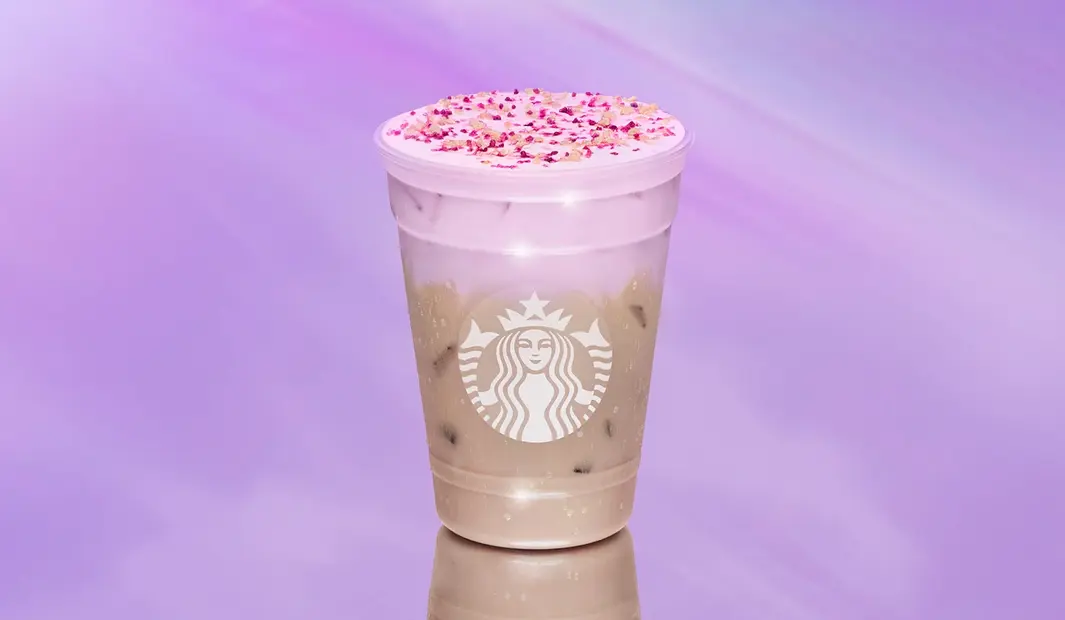
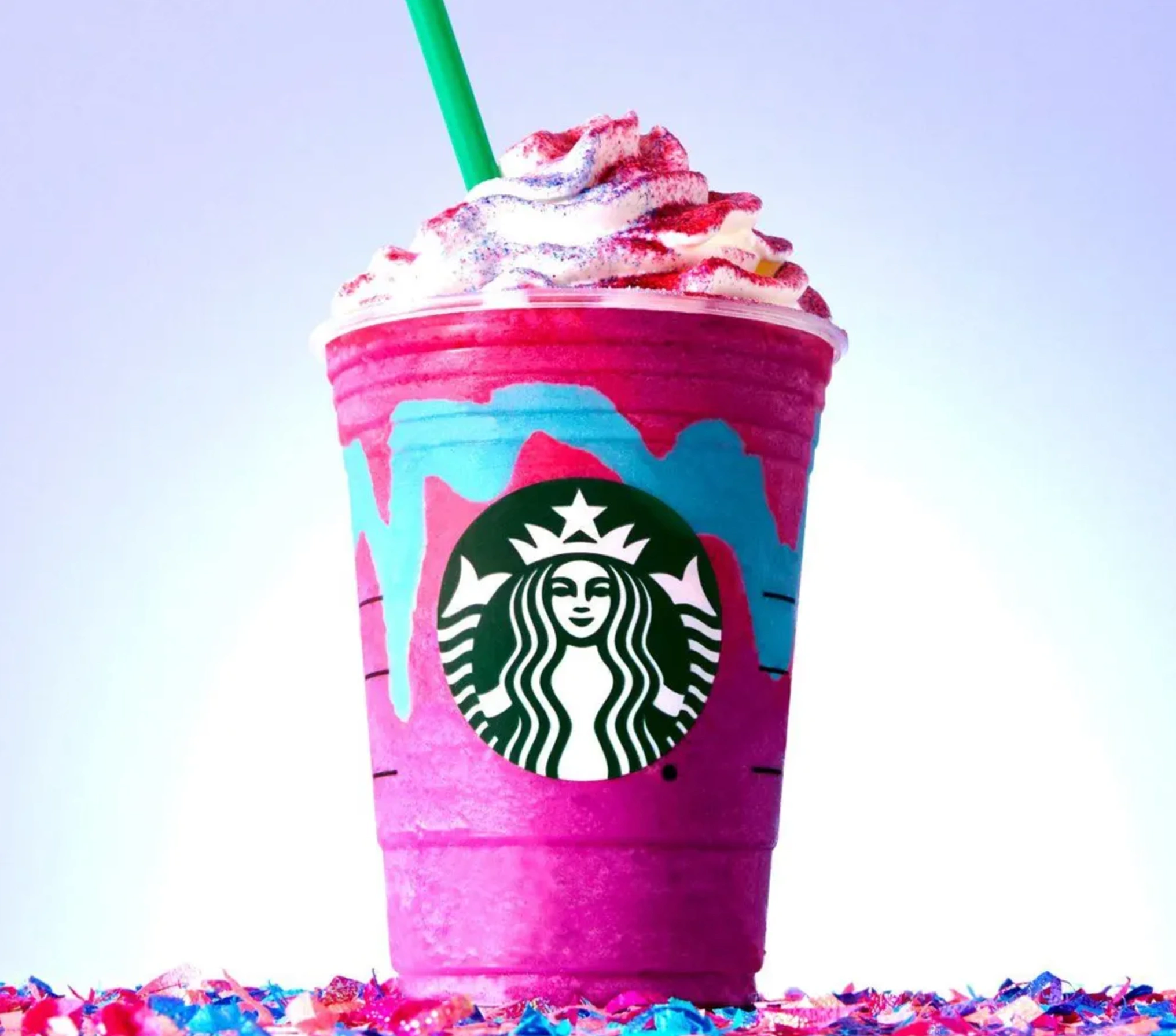
The Unicorn Frappuccino was a limited-edition drink designed around a highly visual color change. Its appearance made it easy to photograph and share, while the short availability window created urgency. Coverage at the time noted that People flocked to Starbucks for the “unicorn” experience, making the drink as much a social object as a beverage.
The campaign shows how product design itself can become media. The bright colors and limited window gave customers a clear reason to post without Starbucks needing to script every piece of content. The idea remained recognizable enough that Starbucks brought a new Unicorn Frappuccino interpretation to selected Asia-Pacific markets in 2026. That return reinforces how visually distinctive limited products can become reusable campaign assets. The exact recipe or market can change, while the name, color-driven experience, and sense of novelty still give customers something familiar to recognize and share.
8. White Cup Art Contest (2014)
Starbucks noticed customers drawing on its white cups and turned that behavior into a formal contest. Inspired, the company launched the White Cup Art Contest, inviting patrons to sketch on Starbucks cups, photograph them, and submit their artwork. The winning design was later used on a reusable cup.
This campaign worked because it started with something customers were already doing. Instead of asking people to learn a new behavior, Starbucks gave an existing behavior a larger stage. Starbucks’ 2015 Global Responsibility Report later referenced the White Cup Contest as one of the promotions that temporarily increased interest in reusable cups, showing that the activation had a measurable connection to customer behavior even if the long-term effect was limited. That is a useful measurement lesson: participation can spike during a campaign without permanently changing behavior, so marketers should separate short-term response from longer-term habit formation.
9. “Taylor’s Latte” with Taylor Swift (2021)
Starbucks partnered with Taylor Swift around the release of “Red (Taylor’s Version).” Coverage described how Dubbed “Taylor’s Latte,” Starbucks offered Swift’s favorite drink—a Grande Caramel Nonfat Latte—alongside themed social content.
The collaboration worked because the connection was easy for fans to understand and participate in. The campaign did not require Starbucks to invent a new core product; it turned an existing order into a cultural reference. That gave the partnership a natural relationship with Starbucks’ existing brand identity and seasonal red-cup environment. Starbucks later confirmed the collaboration as part of its history with Swift, which makes the campaign a useful example of a partnership built around an existing customer order rather than a completely invented endorsement product.

What Starbucks’ Best Campaigns Have in Common
Across these examples, Starbucks repeatedly turns familiar assets into participatory formats. A cup becomes a canvas, a seasonal beverage becomes a countdown, a coffee order becomes a celebrity collaboration, and a store becomes the setting for customer stories. The strongest campaigns make the product or coffeehouse experience part of the activity rather than treating it as a logo placed beside an unrelated idea.
From Brand Vision’s agency perspective, the useful lesson is to decide which brand assets customers already recognize before building the campaign. Strong distinctive brand storytelling. works best when it grows from those recognizable assets and gives people a clear way to participate.
How Businesses Can Apply the Lessons
First, identify repeatable moments. Seasonal launches, packaging, loyalty milestones, limited editions, gifting, and community events can all become campaign platforms when customers understand them quickly. Second, give the audience an action that fits the idea, whether that means creating, sharing, gifting, collecting, or attending.
Third, keep the regional context genuine. A food, beverage, or retail business choosing a marketing agency in Miami, for example, may need local market perspective, but that regional support should complement broader brand strategy rather than replace it. Related campaign examples such as McDonald’s advertising show the same principle from a different restaurant brand.
The best Starbucks ads show that familiarity and novelty can work together. A recognizable brand system gives customers something stable, while the campaign adds a new reason to pay attention. If you are deciding which brand assets or campaign ideas are worth building around, you can discuss your campaign direction with Brand Vision before choosing the channels and creative format.