
Canada’s Economy: A Comprehensive Report
Canada stands among the world’s foremost economies, with diversified industries and policies that promote resilience, innovation, and inclusivity. Below is a condensed yet detailed overview of the Canadian economy and how it operates.
Economic Overview of Canada
Canada consistently positions itself as a top global economy, exhibiting robust growth, controlled inflation, and strong employment rates. This resilience stems from its mixed economic model, adaptive fiscal frameworks, and strategic global engagements.
- Gross Domestic Product & Ranking
- Nominal GDP: $2.36 trillion CAD (2024), 9th largest globally.
- GDP (PPP): 16th worldwide, reflecting elevated per capita output.
- Recent Trends
Key Economic Sectors in Canada
Canada’s prosperity rests on a blend of natural resources, modern technologies, and a broad agricultural-manufacturing base. This diversity safeguards the economy from single-sector downturns and propels cross-industry synergy.
- Natural Resources
- Technology
- AI Hubs: Montreal, Toronto, Vancouver drive AI R&D.
- Tech Sector: 6% GDP ($141B CAD).
- Clean Energy: $20B CAD federal support; ~0.5% GDP ($13B CAD), fast-growing.
- Agriculture & Manufacturing
- Agriculture: 2% GDP ($49B CAD), major wheat/canola exporter.
- Manufacturing: 8.5% GDP (~$200B CAD), anchored by automotive, aerospace.
Trade and International Relations in Canada
A hallmark of Canada’s economy is its open stance on trade. Strategic agreements and global engagement help sustain growth, foster competitiveness, and attract investors seeking reliable, rules-based markets.
Major Trading Partners
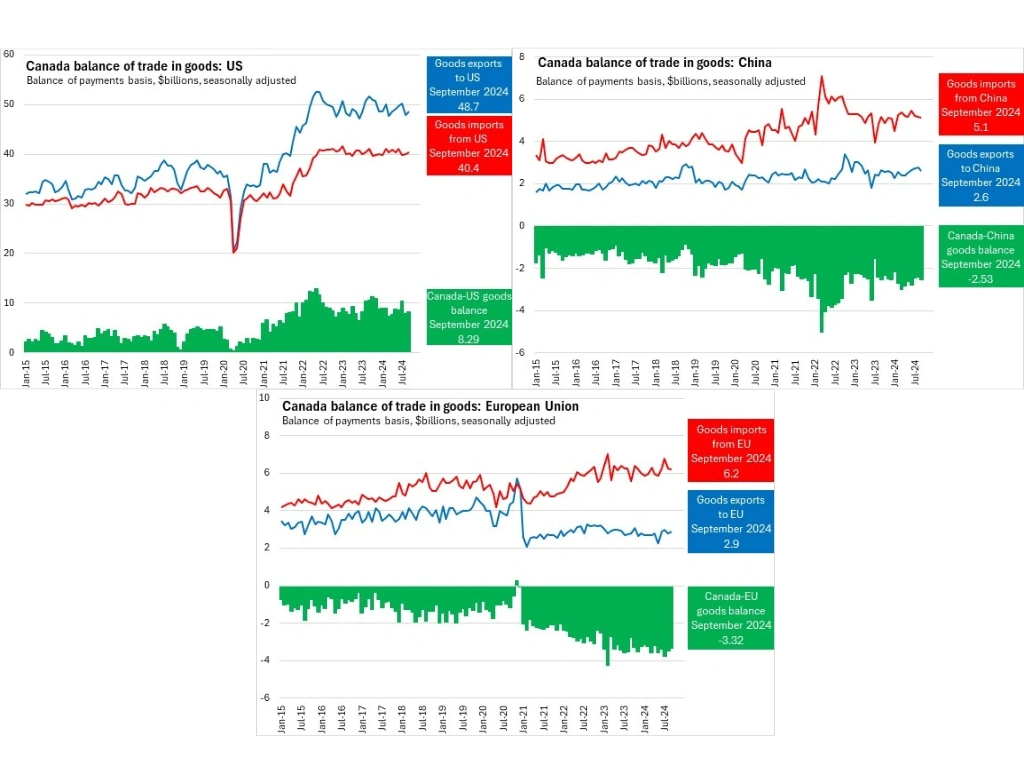
- United States: 73% of exports, 51% of imports; strong ties in automotive and energy.
- China: 4.5% exports, 12% imports; focuses on agriculture, metals, forestry.
- European Union: 8.5% exports, 10.1% imports; key goods include gold, energy, aerospace.
Trade Agreements
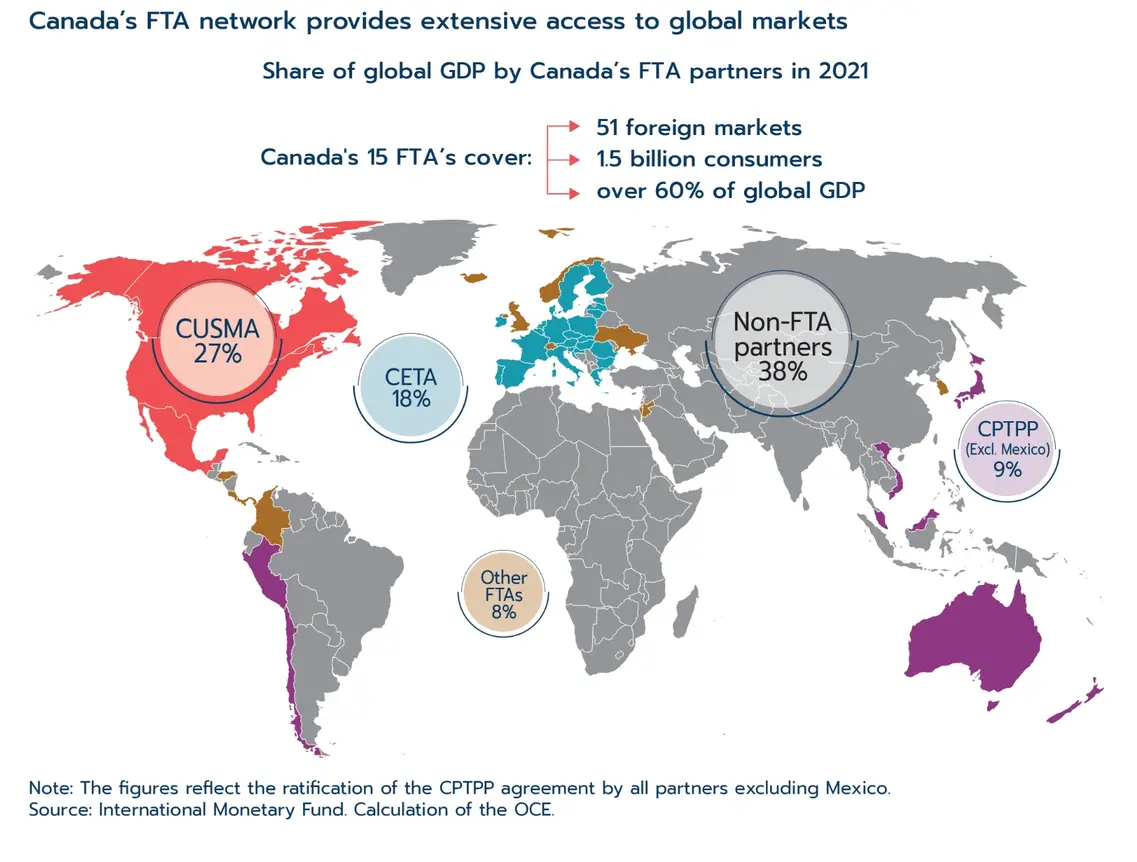
- USMCA: Replaced NAFTA, covering $1.5T+ CAD in North American trade.
- CETA: Boosted Canada-EU trade by 12%, eliminating tariffs on 98% of goods.
- CPTPP: Access to 11 Pacific Rim nations (13.5% of global GDP).
Export-Import Landscape
- Exports: Crude oil, natural gas, vehicles, machinery, agriculture.
- Imports: Machinery, electronics, vehicles, pharmaceuticals.
Economic Policies and Government Role
Canada’s fiscal and monetary frameworks aim to balance growth, control inflation, and address evolving social needs. Federal and provincial programs reinforce healthcare, education, and tech innovation while maintaining budget discipline.
- Fiscal Policies
- In the 2023–2024 fiscal year, Canada reported total revenues of 498 billion CAD, reflecting a 8% increase compared to the previous year. Total expenditures were $538 billion CAD, resulting in a budget deficit of $40 billion CAD.
- Debt Charges: Up 35% in 2024 due to higher rates.
- Monetary Policy
- The Bank successfully reduced annual inflation to 2.7% in 2024, aligning it with the mid-point of its 1-3% target range.
- Core inflation measures showed steady improvement due to declines in energy prices and eased supply chain disruptions.
- Federal & Provincial Programs
- $20B CAD for clean energy, 30% refundable tax credit on green tech.
- Healthcare, AI, biotech investments bolster innovation and social welfare.
Employment and Workforce in Canada
Canada’s strong labor market reflects steady job creation, low unemployment, and targeted immigration policies that address skills gaps. Industries like healthcare, tech, and resources remain key employers.
- Unemployment & Participation
- 5.4% unemployment (2024), among G7’s lowest. 1.1M jobs added post-pandemic.
- Job-Driving Sectors
- Healthcare: 13% of total employment, aided by federal healthcare funds.
- Technology: High-skill jobs in AI, software dev, biotech.
- Natural Resources: Over 200K workers in oil, gas, mining, forestry.
- Immigration’s Role
- 430K+ new permanent residents (2024), boosting healthcare, IT, skilled trades.
- Immigrants form 23.8% of workforce.
.webp)
Sustainability and Green Economy in Canada
A resolute shift towards renewable energy and emission reductions positions Canada as a leader in climate-aligned policies. Government funding, regulatory caps, and tax incentives pave the way for a more sustainable future.
- Renewable Targets & Carbon Cuts
- 90% non-emitting electricity by 2030; net-zero by 2050.
- Oil & gas sector emissions cap, aiming 40–45% reduction by 2030 vs. 2005.
- Green Policies & Tech
- $20B CAD for clean energy.
- Carbon price: $65/ton, rising to $170/ton by 2030.
- Industry Adjustments
- Oil & gas firms adopt carbon capture (CCUS).
- Renewables see job expansion via government support, spurring energy diversification.
Current Trends and Projections
Post-2025, Canada’s economy is set for steady, moderate growth amidst evolving global conditions. Tech expansion, climate investments, and stable consumer spending anchor these forecasts.
- Post-Pandemic Growth
- 1.9–2.0% annual GDP rise (2025–2029).
- Global factors (geopolitics, climate) shape Canada’s trajectory.
- Future Outlook
- GDP: Sustained by AI, renewables, advanced manufacturing.
- Inflation: Targeted 2% by 2025, aided by better supply chain conditions.
- Consumer & Business Shifts: Tech adoption, environmental awareness surge.
Final Observations
Canada stands at an economic crossroads where tradition meets transformation. Natural resources and manufacturing continue to anchor GDP, yet AI hubs, climate tech ventures, and sophisticated trade partnerships accelerate modern growth. Government policies, ranging from moderate series funding for emerging startups to tax incentives for green adoption, signify the country’s pragmatic approach to balancing expansion with social well-being.
Key Takeaways
- Diversified Economy: Resource sectors remain vital, while technology and clean energy gain momentum.
- Steady Growth & Low Unemployment: Stable job creation, strong labor participation, and a 5.4% unemployment rate highlight resilience.
- Green Commitment: Emission caps, carbon pricing, and massive renewables investments move Canada toward net-zero targets.
- Trade & Openness: USMCA, CETA, and CPTPP grants broad market access, reinforcing Canada’s export-driven framework.
Looking forward, Canada’s 1.9–2.0% annual GDP expansion suggests measured but reliable progress. AI, advanced manufacturing, and renewables will steer innovation, while robust public policies continue to refine social welfare and environmental stewardship. Positioned as both an attractive investment hub and a champion of inclusive growth, Canada’s economy appears well-poised to thrive in an evolving global landscape.

%2520(1).png)
.png)