
Video sits at the center of most marketing plans now, and the plans keep asking for more of it. Product launches, paid campaigns, social calendars, customer stories, webinars, and sales enablement each want their own footage, in their own formats, on their own schedules.
The hard part was never making one video. It is making the twelve variations of it that a real campaign needs, the long-form version, the vertical cutdowns, the ad-length edits, the testimonial pulls, and the regional or segment variants, each with its own captions, sizing, and brand checks.
The agentic video editor is the tooling response to that variation problem. Where earlier automation handled single tasks, an agentic system takes an instruction, works through the connected editing steps behind it, and returns an editable result, following the same trajectory as the rest of AI-assisted content creation, from features that help with a step toward systems that carry a workflow.
What follows examines the shift the way a marketing operations lead would: the variation math that breaks manual production, what an agentic video editor actually does differently, the compliance line testimonial content has to respect, how brand consistency survives volume, and where the team's time actually goes once the repetitive layer is absorbed.
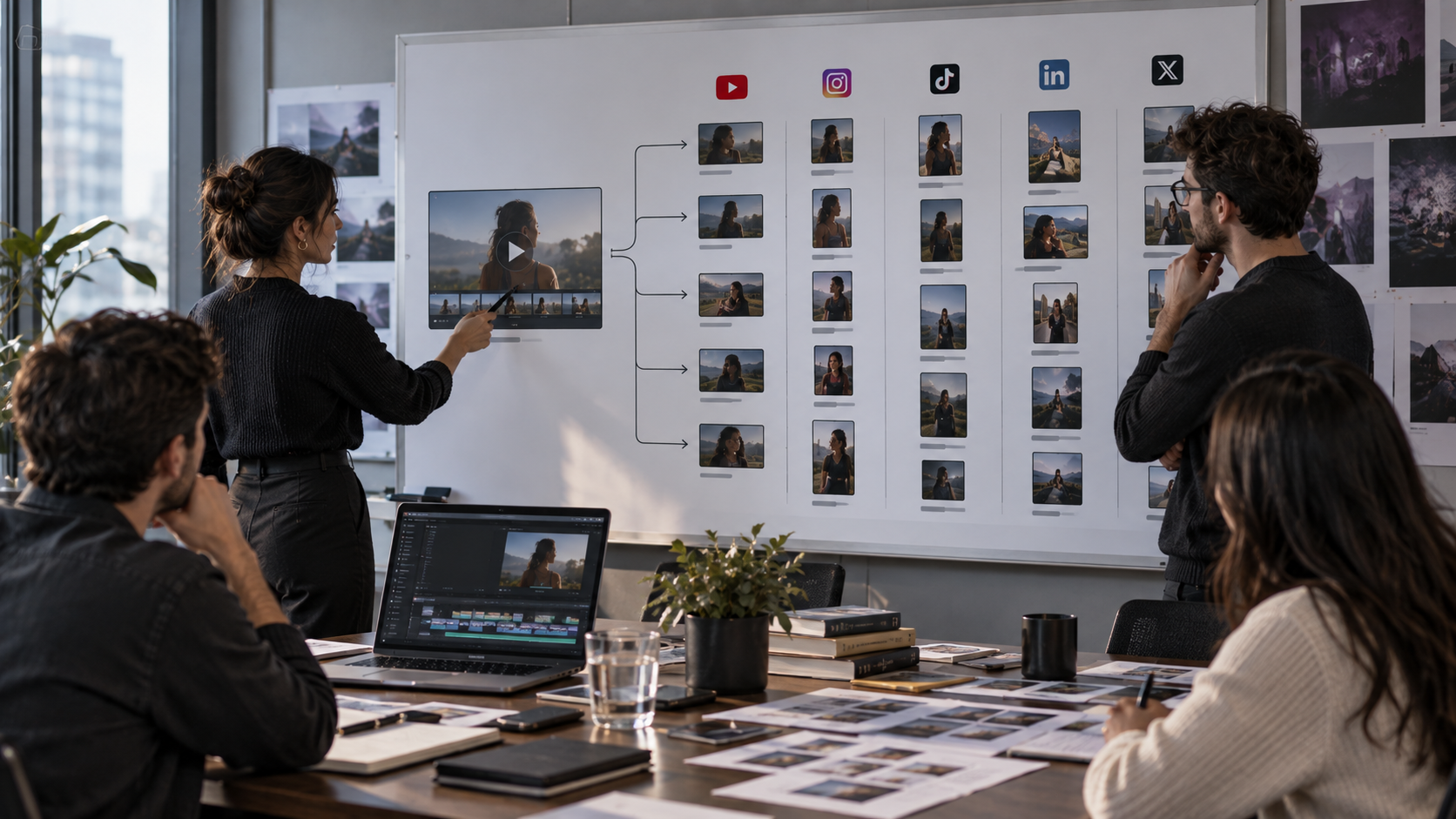
Campaign Math Is Variation Math
A modern campaign is a matrix, not a video. Channels multiply against formats, formats against audience segments, and segments against test variants, so a single launch can legitimately require dozens of finished assets from one shoot.
The audience side drives the matrix. People split their attention across several platforms at once, with most of the online public on social platforms habitually, and each platform rewards different lengths, shapes, and opening styles, which turns every campaign message into a family of versions rather than a file.
Segments deepen it further. The version that speaks to an existing customer differs from the one aimed at a cold audience, paid placements need lengths organic posts do not, and sales teams want cuts neither channel uses, all from the same underlying footage.
Manual production pays for that matrix in hours. Each variant needs review, cutting, resizing, captioning, and a brand pass, and the work repeats with small differences across every cell of the grid.
The repetition is deceptive because no two cells are quite identical. A vertical ad variant differs from the square social variant in framing, opening, and caption placement, so the work cannot be batch-exported, and yet the differences are patterned enough that redoing them by hand feels like waste because it is.
Campaign timelines make the cost concrete. When a launch date is fixed and the variant grid is large, the editing stage becomes the critical path, and marketing teams end up trimming the plan to fit the calendar rather than the audience.
The result is a familiar ceiling. Marketing teams do not run out of campaign ideas, they run out of production capacity, and the campaigns that ship are shaped by what the editing calendar could absorb rather than what the strategy called for.
That ceiling is what the agentic video editor exists to raise. The variation grid does not get smaller, but the cost of filling each cell drops enough that the full plan becomes producible.
What an Agentic Video Editor Does Differently
An agentic video editor moves from assisting with steps to carrying sequences. Given an instruction, it can analyze the footage, organize the timeline, make the connected edits, and prepare the requested versions, returning a draft the team reviews and adjusts rather than a suggestion the team still has to execute.
The distinction from earlier AI features is practical. A caption generator saves minutes on one task, while an agentic video editor can take a goal, build a first cut from raw campaign footage, switch multicam angles, trim to platform lengths, and hand back an editable project, which saves the hours between tasks where campaign production actually stalls.
A worked example makes the shape clear. A team hands over webinar footage with an instruction to pull the strongest product moments, build a highlight cut, and prepare short versions for two platforms, and the agentic video editor returns drafts of all three, timeline open, ready for the human pass that decides what actually ships.
Editability is the control mechanism. Every action the agent takes stays visible and reversible on the timeline, so the marketer directs, the system executes, and the final asset remains the team's own work.
That visibility is what separates an agentic video editor from a black-box generator. A tool that produced finished files no one could open would move the bottleneck to revision, while an open timeline means the fastest path and the controlled path are the same path.
The fit for campaign production is direct. Variation work is precisely the kind of patterned, repeatable execution an agentic video editor handles well, and it is also the work least deserving of a senior editor's afternoon.
The supported task list reads like the campaign checklist itself. Finding key moments in long recordings, selecting strong talking points, building first drafts, creating aspect-ratio versions, adding subtitles and chapter markers, removing pauses and filler words, and preparing short-form cuts cover most of what stands between a shoot and a shippable asset family.
Testimonials Have Rules, Not Just Edits
Customer stories are among the most persuasive assets a campaign can carry, and they are also the most regulated. Cutting a testimonial is never only an editing decision, because the finished clip has to stay truthful to what the customer actually said and experienced.
Campaigns lean on these assets precisely because audiences trust them more than brand claims. That borrowed trust is the value, and it is also why the editing of testimonial footage deserves more care than any other cut the agentic video editor touches.
The standard is public and specific. Regulators expect endorsements to reflect honest opinions and typical experiences, with material connections disclosed, as the FTC's endorsement guidance lays out, and an edit that reshapes a customer's meaning to sharpen the pitch crosses a real line.
Speed makes the review layer more important, not less. When an agentic video editor can produce testimonial cutdowns in minutes, the volume of clips rises, and each one still needs a human pass confirming the cut preserves context and the claims match the customer's actual words.
The risk pattern is subtle rather than dramatic. A trim that drops a qualifier, a reordering that implies a stronger result, or a caption that paraphrases past what was said can each happen innocently at speed, and the review pass exists to catch exactly those small drifts before they publish.
Marketing teams that build the check into the workflow get both benefits. The production speed of automation, and testimonial assets that hold up to the scrutiny persuasive content invites.
The practical checklist is short. Keep the customer's meaning intact across every cutdown, keep any required disclosures visible in every format the agentic video editor produces, and keep the source recording archived so any published claim can be traced back to what was actually said.
Brand Consistency Is a System Property
A campaign's credibility depends on its assets feeling like one voice. Dozens of videos across platforms have to share the same look, tone, caption style, and pacing, and consistency at that volume cannot depend on each editor's memory.
The durable answer is a defined system. A coordinated visual identity specifies the colors, type, treatments, and usage rules once, and every campaign asset inherits the standard instead of approximating it.
Without that definition, volume amplifies drift. Ten videos made under deadline pressure by different hands wander in caption style and tone, and audiences register the inconsistency as carelessness long before they could name it.
An agentic video editor operationalizes that system at production speed. Repeated editing patterns, caption styles, visual treatments, and color matching get applied the same way across every variant, which is exactly where manual production drifts when deadlines compress.
Consistency enforced this way also survives team changes. When the standard lives in the system rather than in one editor's habits, a new hire's first variant looks like the veteran's fiftieth, and the campaign never shows the seam.
Color work shows the division of labor cleanly. The system can match color between clips and hold visual consistency across a batch, while the judgment about what the campaign should look and feel like stays a creative decision made once and enforced everywhere.
The payoff compounds across campaigns. Assets built on the same system stack into a recognizable brand presence, and the audience's tenth touchpoint reinforces the first instead of diluting it.
Recognition is a measurable marketing asset in its own right. Campaigns launched into an audience that already knows the brand's look start warmer, and that head start was built by every consistent variant that came before.
Where the Team's Time Actually Goes
The hours an agentic video editor absorbs were never the valuable ones. Reviewing footage for the fourth time, rebuilding captions per format, and resizing the same cut for another placement are the fragmented, repetitive load that analysis of the modern workday shows quietly consuming teams.
What the reclaimed time buys is the actual marketing. Message and audience decisions, creative concepts worth testing, and the campaign strategy that determines whether any of the assets matter are the work that was getting squeezed by production mechanics.
The agility gain is just as valuable as the volume gain. Messaging updates, regional versions, and trend responses used to mean reopening every affected asset, and with an agentic video editor those changes become instructions against existing projects rather than new production cycles.
The working model settles into a clear sequence. Marketers define the objective and the variant plan, the agentic video editor organizes and prepares the content, editors refine the creative decisions, and the team ships more versions faster without anyone approving work they have not seen.
The sequence holds at any team size. A two-person marketing team runs it with lighter review, an enterprise team adds approval layers, and in both cases the agentic video editor sits in the execution seat while the accountability stays with named people.
Iteration speed becomes the quiet advantage. Campaigns rarely survive contact with performance data unchanged, and a team whose agentic video editor can produce revised variants in hours responds to results while the campaign is still live rather than in the retrospective.
Testing programs benefit the same way. Creative tests need enough variants to learn from, producing those variants was the historical blocker, and a production line that fills a test matrix cheaply makes disciplined experimentation the default rather than the exception.
The capacity ceiling moves accordingly. The constraint on campaign ambition stops being the editing calendar and becomes the quality of the ideas, which is where a marketing team wants its constraint to live.
Budgets feel the shift too. Production spend that used to buy variant volume now buys concept quality and testing breadth, and the same footage investment yields a larger, better-measured asset family than the manual workflow ever returned.
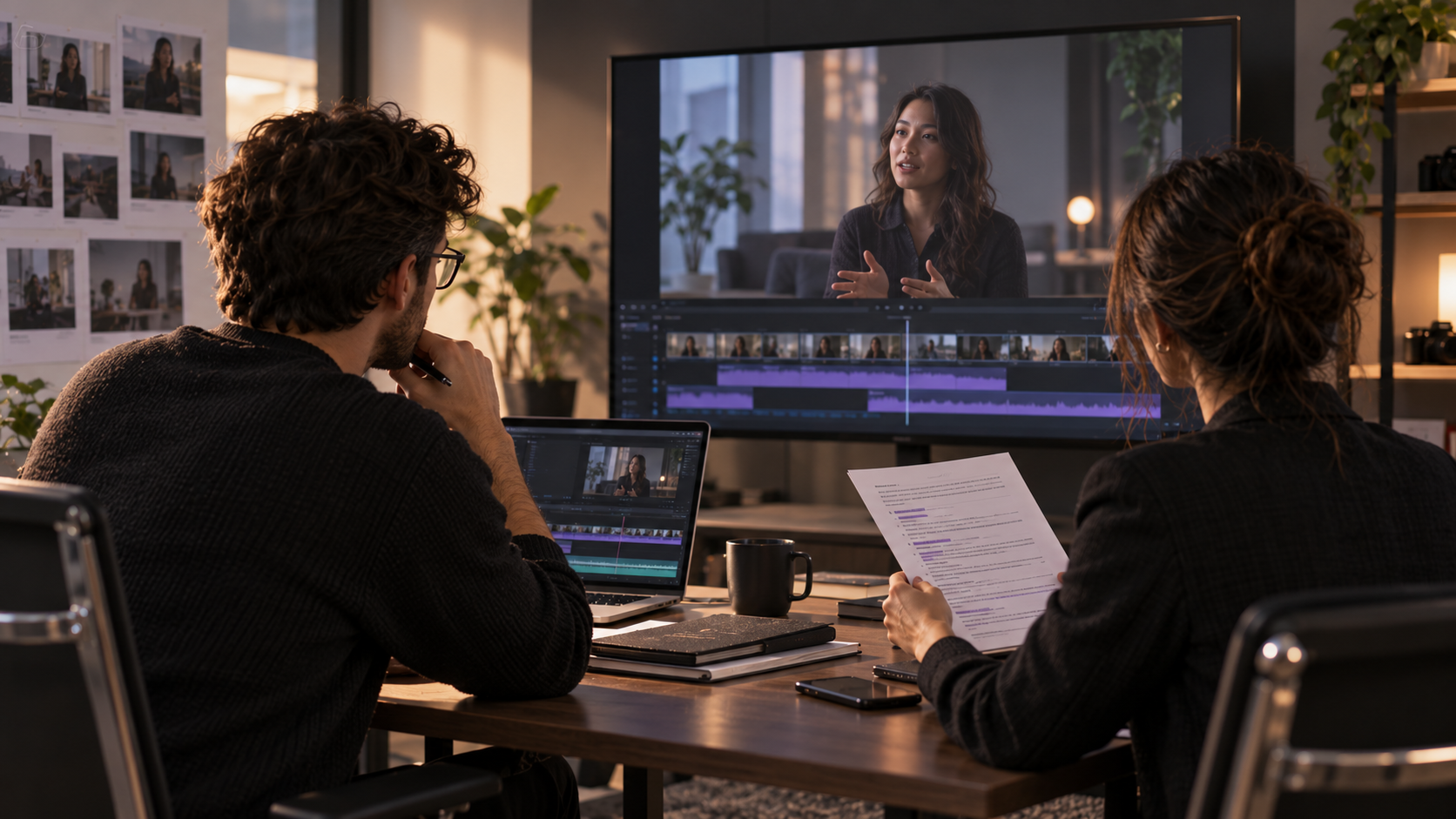
The Campaign System Beats the Campaign Sprint
Marketing video production is heading from sprints toward systems. The teams treating every campaign as a fresh editing mountain will keep rationing their own ideas, while the teams that pair a variant plan, a defined brand system, and an agentic video editor turn one shoot into a full asset family on a repeatable line.
The control question has a settled answer in that model. The system executes and the people decide, every draft stays editable, testimonials keep their honesty checks, and the brand's standards ride along on every variant the agentic video editor produces.
What changes is the ambition the production line can support. More campaigns, more tested variants, and faster response to live results all become normal operating speed, and the marketing teams building that capability now are the ones the next planning cycle will not catch undersupplied.


%2520(1).png)