
For a home-service company, the first site visit is rarely the first real interaction with a customer. Long before a contractor, technician, delivery driver, estimator, or project manager arrives, the customer has usually reviewed a website, checked a service area, scanned reviews, compared a few providers, and tried to determine whether the business appears organized enough to trust with a home, schedule, and budget.
That means a home-service website is doing more than generating leads. It is helping a prospective customer settle a series of practical questions: whether the company serves the neighborhood, what will happen next, where the limits and responsibilities sit, whether the business knows the local market, and who the customer would be dealing with before any contact information changes hands.
For companies serving Chicago and its surrounding communities, those questions carry extra weight because the market is fragmented. A provider may serve the city, the North Shore, selected suburbs, parts of Northern Illinois, or nearby Wisconsin communities, and in home-service categories that operational footprint is exactly what local search visibility is won or lost on.
The strongest home-service trust signals are therefore not decorative; they are informational. Good design matters, but clarity about geography, process, pricing structure, scheduling, reviews, and customer responsibilities often does more to build confidence than another polished hero image. What follows is the home-service marketing playbook for earning that confidence before anyone rings a doorbell.
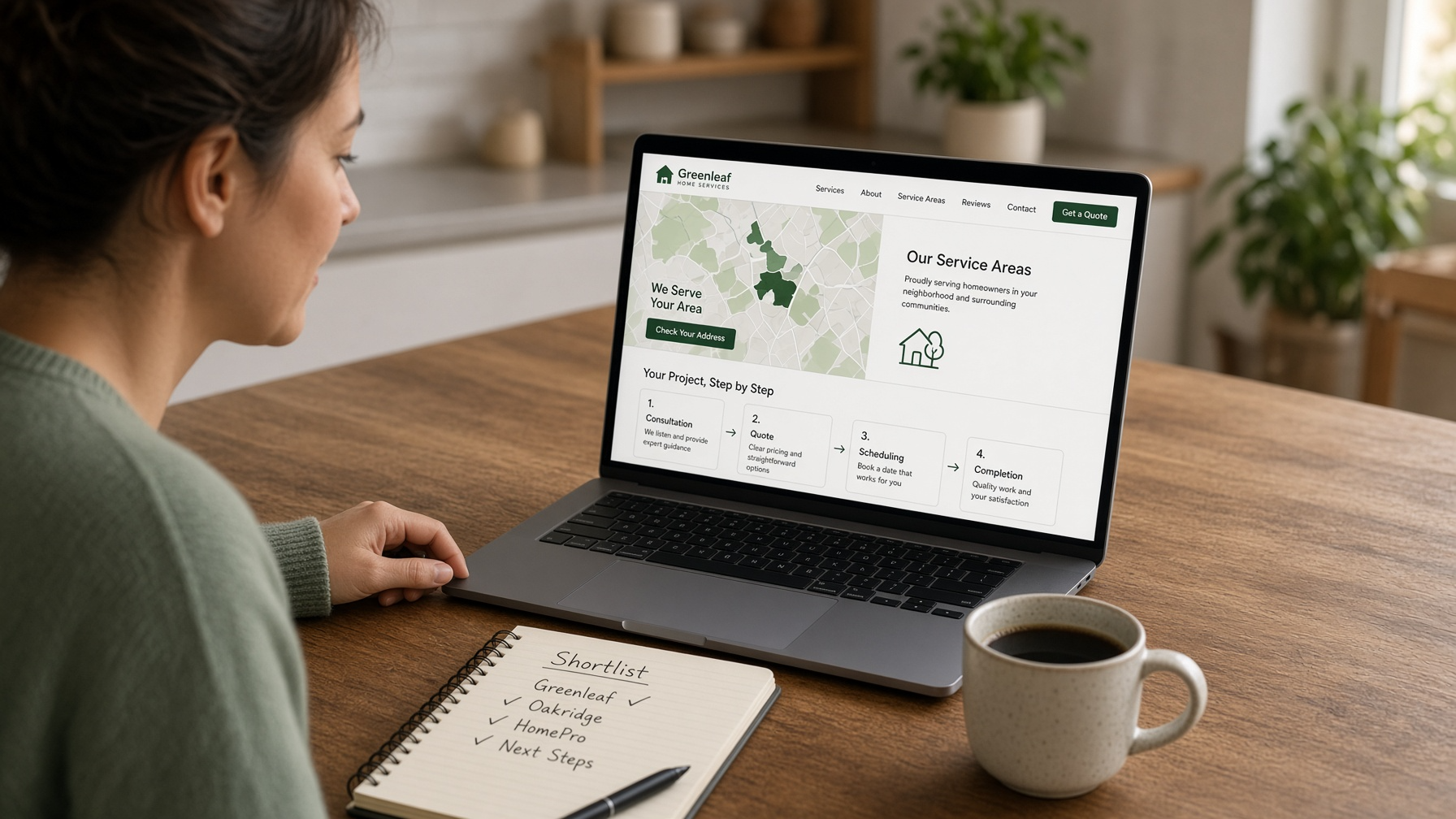
Trust Starts With Specificity, Not Slogans
Many home-service websites rely on the same vocabulary: reliable, professional, experienced, local, quality, trusted. Those words are not necessarily wrong, but they are difficult for a customer to verify.
Verification is the operative problem, because visitors form their credibility judgment fast. Usability research has long shown that people read trustworthiness from what a site demonstrates, not what it declares, and slogans demonstrate nothing.
A stronger website translates broad claims into details a visitor can evaluate. Instead of saying service is fast, it can explain typical scheduling windows and what affects them. Instead of calling estimates transparent, it can state what is included and what may create an additional charge.
The pattern repeats across every claim. Instead of describing the company as local, the site can identify the communities, counties, or neighborhoods actually served, and each substitution trades a slogan for something checkable.
This kind of specificity works because it reduces the interpretation the customer has to perform. The visitor does not have to guess what local means or whether full service covers the job at hand; the website answers directly, and in home-service marketing the direct answer is the trust signal.
Geography Is the First Trust Test
Geographic clarity is one of the most useful home-service trust signals, because these are companies that travel to customers. Google Business Profile guidance for service-area businesses emphasizes that service areas should be specific and accurate, and a company's own website should be at least as clear as its profile.
A visitor should not have to dig through a footer, a generic Chicago reference, or a list of dozens of locations that may or may not reflect real operations.
The fixes are all plain statements. If the company serves only certain parts of the metro area, the site should say so; if service crosses a state line, that belongs in visible text; if certain locations involve different scheduling, the website can explain that too.
The dedicated service-area page is the working home-service pattern. EcoBox Dumpsters, for example, uses one to identify the communities and broader areas it serves, which lets a prospective customer confirm geographic fit before requesting service instead of discovering the mismatch after.
The page pays operationally as well. When people can tell whether they sit inside the operating footprint, the business fields fewer leads that were never viable, and the website starts functioning as both a marketing asset and an operational filter.
Local credibility follows the same rule as service area: specificity over name-dropping. A contractor explaining the housing stock of older North Shore communities, or a landscaper discussing seasonal timing in Northern Illinois, is demonstrating that location changes how the work is performed, which persuades in a way that repeating city names never will.
Explain the Service, Publish the Expectations
Home-service buyers often arrive with less category knowledge than the company assumes. A homeowner may know a roof needs attention or debris must be removed, without knowing the professional terminology or the decisions that precede the work.
Effective service pages bridge that gap. The strong ones explain what the service is, who it is for, what common variations exist, and what information the customer should have ready, without turning the page into a technical manual.
The same clarity should extend to the project itself. Uncertainty is the largest friction in home-service work: arrival times, property access, cleanup, payment, and change orders all breed hesitation when left unaddressed.
Publishing the framework in advance answers the questions customers hesitate to ask. What happens after the form is submitted, whether someone calls before arriving, what the customer should prepare, when payment is due, and what could change the original quote all belong on the page, not in the customer's imagination.
Publishing those answers does two jobs at once. The company appears organized because its process is visible, and the customer gains a basis for judging fit before anyone spends an appointment finding out, which makes operational transparency a form of home-service marketing in itself.
Practical details carry the message further. Noting whether permits may be required, how much notice is typical, or whether another trade must finish first tells the visitor the business understands the real sequence of a project, not just the sale.
Reviews as Evidence, Contact as Process
Reviews are an important home-service trust signal, but they work best supporting a website that is already clear. The Federal Trade Commission guidance on online reviews stresses that reviews should reflect genuine experiences and not be manipulated or selectively solicited, which points review strategy toward credibility over raw volume.
Specific reviews tell home-service customers more than generic five-star statements. Feedback that mentions communication, punctuality, property care, or how an unexpected issue was handled connects directly to the operational promises the site makes elsewhere, and linking to established review platforms with a representative range reads as confidence rather than curation.
The contact form is where home-service trust converts or evaporates. Collecting only what moves the conversation forward, and explaining why each field matters, keeps the form from feeling intrusive: an address or ZIP confirms service area, project type routes the request, preferred timing helps scheduling, and photos get labeled optional or necessary rather than left ambiguous.
The step after the form deserves a sentence of its own. A short statement that the request will be reviewed and followed by a call, text, or estimate turns the submission into the start of a defined workflow instead of a message disappearing into a general inbox.
Show the Operation, Align the Claims
Trust grows when the digital experience is visibly connected to a real operating business. Clear contact information, consistent hours, recognizable staff roles, actual project photography, and an explanation of how crews identify themselves all signal that people, processes, and accountability sit behind the website.
The stakes are highest where the work is most personal. For companies whose employees enter driveways, basements, and yards, the customer is admitting a business into private space, and the website should read like it understands that.
The claims also have to match the operation behind them. A site promising same-day service should state the limited circumstances honestly; transparent pricing that still requires a site-specific quote can say why; a company that serves all of Chicagoland but routinely declines distant suburbs should narrow the language.
The reason is measurable, not moral. Customers now expect the experience to match the promise across every interaction, and the gap between claim and operation is exactly where trust leaks first.
Alignment pays inside the home-service company as much as outside. When the website is treated as an operating document rather than pure promotion, sales conversations start from accurate expectations, and dispatchers, estimators, and field staff spend less time correcting assumptions the marketing created.
The discipline is unglamorous and cumulative, which is exactly why it differentiates. Most competitors will keep publishing slogans; the home-service marketing that wins is the kind the rest of the organization can actually honor.
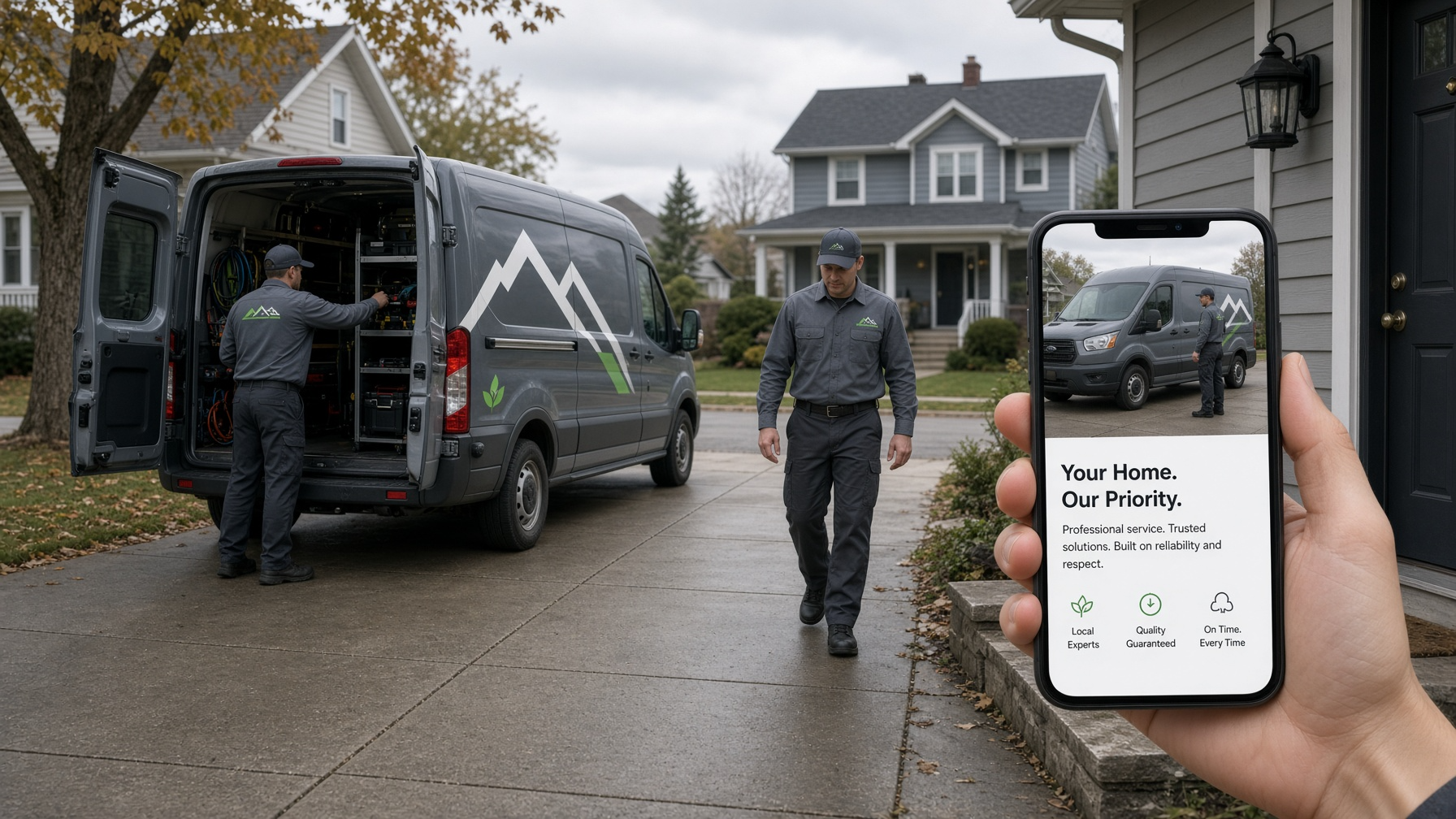
The First Visit Should Confirm Trust, Not Create It
For Chicago-area home-service companies, the website has a job to finish before anyone reaches the property: make the business easy to understand, define where and how it operates, show how projects are handled, and give the customer enough information to decide the next step is worth taking.
None of that requires aggressive promotion. The most persuasive home-service marketing is usually the version that removes the most uncertainty, specific service areas, published expectations, genuine local knowledge, credible reviews, and a predictable contact process, so that by the time the first visit happens, the customer already understands the relationship and the visit merely confirms what the website communicated.


%2520(1).png)






