Formalwear is one of the few categories where a brand gets judged in a single glance across a crowded room. A prom gown, a pageant dress or an evening piece either reads as its maker's work or it reads as inventory, and the difference between those two outcomes is design identity, held consistently enough that shoppers recognize it before they check the label.
The category rewards that consistency unusually hard. Occasionwear purchases are infrequent, emotional and heavily researched, so the brands that win are rarely the ones with the widest assortment. They are the ones a shopper can describe in a sentence, the dramatic silhouettes, the hand-beaded finish, the clean line at a fair price.
The commercial machinery behind that recognition is worth studying well beyond fashion. Design identity, range architecture, distribution and a seasonal calendar form a system any consumer brand can learn from, and formalwear simply runs the system at its most visible.
What follows walks through that system as a marketing discipline, how a design identity gets defined, how the product range serves it, where distribution multiplies it and how the season turns it into demand.
Design Identity Is the First Filter
A design identity is a set of repeatable choices, not a logo. Silhouette families, embellishment language, fabric behavior and color range add up to a look that survives from one collection to the next, and the repetition is what converts a dress on a rack into a recognizable brand asset.
The working parts of a design identity fit in four lines.
- A silhouette family the house returns to season after season
- An embellishment and fabric language consistent enough to recognize at a glance
- A color range that behaves like a palette rather than an inventory
- A price territory the label defends in every channel
The strategic work sits underneath the sketches. A documented brand positioning names the shopper the label serves, the occasions it owns and the price territory it defends, and every collection decision afterward either reinforces that position or erodes it.
Naming the design identity makes it enforceable. A short internal phrase, the architectural drape, the crystal-heavy statement, gives merchandisers, photographers and partners one test to apply, and a design identity that exists only as taste disappears with the person who had it.
Focus beats breadth at the identity stage. A label known for statement embellishment cannot also be the quiet minimal option without blurring both stories, so the strongest occasionwear houses choose a lane and let the rest of the market keep the other lanes.
The identity also has to survive translation across contexts. The same design language has to read on a runway, in a boutique mirror, on a phone screen and in a prom photo posted at midnight, and choices that only work in one of those settings get filtered out by the discipline itself.
Heritage becomes part of the identity where it is real. A house built on decades of dressmaking technique carries that story as a durable differentiator, while a young label can own a modern claim instead, and both strategies work precisely because neither pretends to be the other.
Range Architecture Serves the Signature
The product range is where design identity meets commercial reality. A collection has to cover enough silhouettes, sizes and price points to serve its audience, while every added style risks diluting the look the brand is known for, and managing that tension is the real work of range planning.
Size range is a strategic decision wearing a technical costume. Labels that cut their designs across a genuinely wide size run serve shoppers the category historically ignored, and the loyalty that earns shows up in reviews, referrals and repeat occasions long after the first purchase.
Price tiering works the same way inside one identity. An entry line, a core collection and a showpiece tier let different budgets buy the same design story at different depths, and the tiers hold together only while they visibly share the signature.
The rules that keep a range coherent belong in writing. A brand identity system that records the approved silhouettes, finishes, color stories and styling rules gives designers and merchandisers one reference, and it keeps a fast-moving collection calendar from drifting style by style.
Collaboration tests the design identity from the outside. Capsule lines, licensed collections and stylist partnerships each borrow the signature for a season, and the ones worth signing are the ones the house could have plausibly designed itself.
Occasion breadth is the quiet growth lever. A house that dresses prom can usually dress homecoming, pageants and formal evenings with the same language, and each adjacent occasion amortizes the design investment across more selling moments without demanding a new identity.
Returns data reads as design feedback in this category. A style with high returns against its size chart is reporting a cut problem, and fixing the pattern beats discounting the inventory every time the two options compete.
Discipline shows at the edit as much as the launch. Styles that sell without fitting the signature are the dangerous ones, because each repeat order buys revenue with recognition, and the strongest ranges retire those pieces deliberately rather than letting the bestseller list redraw the brand.
Distribution Decides Who Meets the Brand
Occasionwear still sells through a mix of owned channels, boutiques and multi-brand retail, and each channel does different brand work. The boutique delivers fittings and advice, the owned site controls the full story, and the multi-brand environment delivers the comparison shopper the brand would never reach alone.
Multi-brand retail deserves more strategic respect than it usually gets. A shopper browsing a retailer such as Couture Candy, where collections from many designers sit side by side, meets each label in direct comparison, and a strong design identity turns that comparison into free advertising, since the recognizable label stands out on exactly the shelf where standing out matters.
The economics of the channel mix follow the occasion. A once-in-a-lifetime purchase justifies the shopper's travel to a boutique, while the research phase happens online weeks earlier, so the digital shelf effectively decides which dresses make the shortlist that the fitting room later judges.
Retail data keeps the channel strategy honest. The retail trade figures the Census Bureau publishes track how spending moves between online and physical channels, and occasionwear sits in both worlds at once, researched on screens and confirmed in mirrors.
Retail presentation extends the same control. The photography standard, the product copy voice and the swatch accuracy a label supplies to its retail partners decide how the design identity survives on shelves the brand does not run.
Channel conflict yields to the same identity logic. Styles exclusive to boutiques, parallel lines for multi-brand partners and a consistent price floor protect each partner's reason to carry the label, and the design identity stays the constant that every channel sells.
Availability itself is a brand signal in this category. A dress that can actually be found, in the size needed, inside the event timeline, beats a slightly preferred dress that cannot, so inventory depth on core styles is marketing spend by another name.
The Season Writes the Marketing Calendar
Formalwear demand arrives in waves the calendar announces years in advance. Prom season, homecoming, pageant circuits and holiday formals each bring a predictable surge, and the marketing calendar works backward from those dates rather than forward from campaign ideas.
The research phase starts on social feeds long before any store visit. Pew Research Center's work on teens and social platforms reports that around nine-in-ten US teens use YouTube and roughly six-in-ten use TikTok and Instagram, with nearly half describing themselves as online almost constantly, which is a precise description of where a prom shortlist actually gets built.
Content for that audience behaves differently than campaign imagery. Try-on footage, silhouette comparisons and real fittings travel further than polished lookbooks, and the design identity has to be legible in a nine-second clip shot in a fitting room, which is a test worth designing for on purpose.
Paid support follows the seasonal curve rather than fighting it. Teams running paid media campaigns against occasion terms concentrate budget in the research windows, retarget the shortlist weeks and go quiet in the dead months, because in this category the calendar moves the demand and the spend merely captures it.
Launch cadence can manufacture mid-season attention. A small drop released at the season's peak, a new colorway or a limited finish, gives the audience a reason to look twice in the same buying window without redrawing the design identity to do it.
Timing errors are the expensive ones. A collection that lands after the season's first buying wave sells into the leftovers, and a campaign still running after the events have happened entertains nobody but the finance team, so the calendar discipline outranks creative perfection.
Event timing also varies by region, which the calendar has to respect. Prom dates spread across months between states and countries, so campaigns and inventory move region by region rather than on one national switch, and the label's social feeds carry different dates to different audiences without confusing either.
The off-season has its own quiet job. Archive content, alteration guidance and early previews keep the brand present while nobody is buying, and the label that stayed visible in October is the one remembered when the search begins in January.
Craft Claims Need Evidence on the Label
Quality language saturates this category, and shoppers have learned to discount it. Hand-beading, couture technique and premium fabric are checkable claims, and the brands that let the garment prove them, through close-up photography, construction detail and honest fabric content, convert the skepticism their rivals created.
Fiber content is the one claim with a statute behind it. Textile products in the United States carry labeling obligations under the Textile Fiber Products Identification Act, so the fabric story told in marketing copy has to match the label sewn into the seam, and the match is checkable by anyone with the dress in hand.
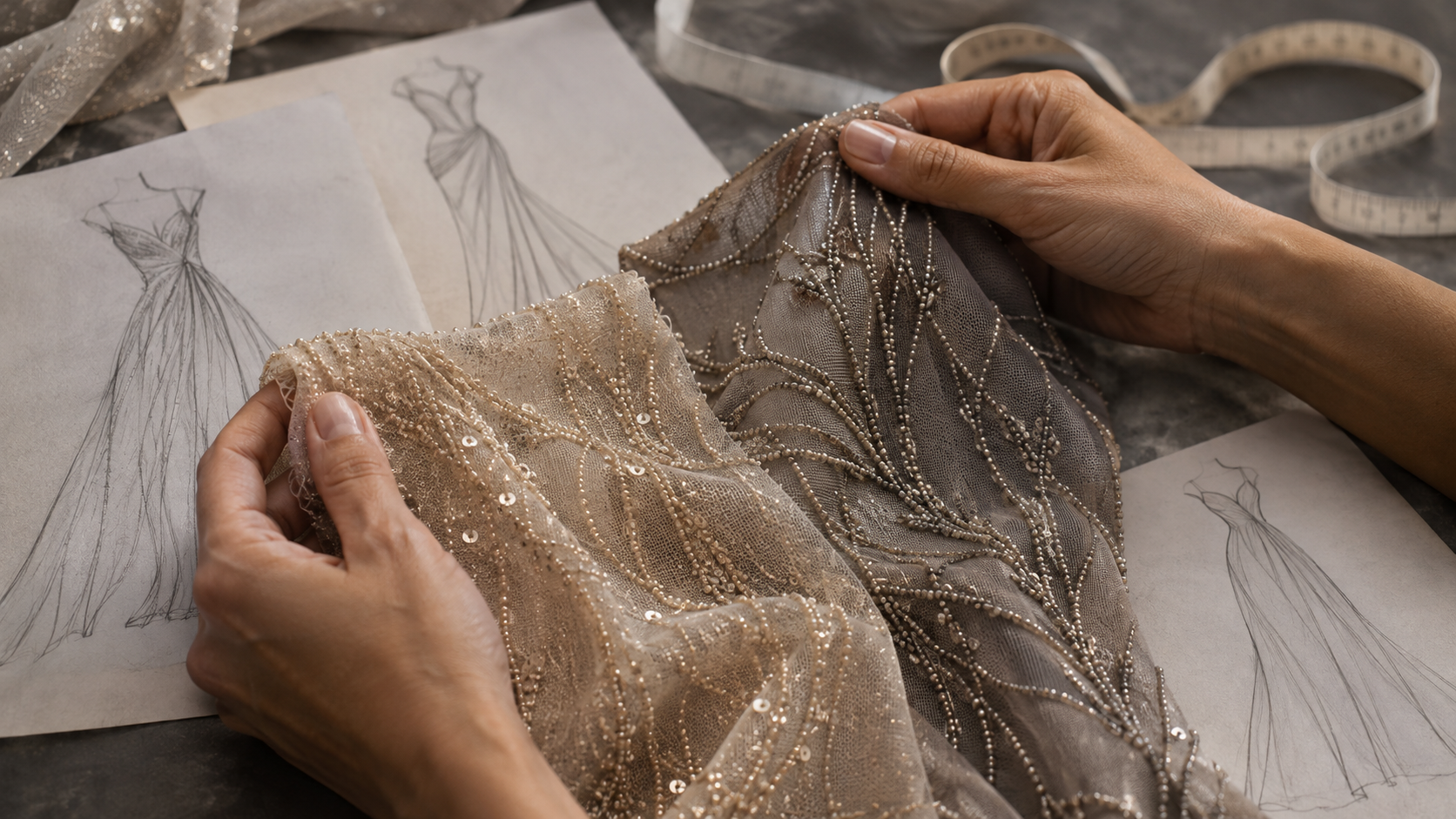
Construction detail earns its photography budget. The inside of a bodice, the density of beadwork and the behavior of a hem in motion are the proof points a considered shopper actually zooms in on, and showing them unprompted reads as confidence in a category full of borrowed stock imagery.
Pricing honesty rounds out the craft story. A gown priced well above its construction eventually gets found out at the alterations table, and a fair ratio between the price and the make is the quietest quality claim a label can offer.
Fit language deserves the same honesty. Size charts that match the actual cut, fabric stretch described plainly and alteration guidance offered upfront reduce returns and build the trust that a once-per-occasion category cannot earn through frequency, since there is no second purchase next month to repair the first.
Care and durability information belongs in the same evidence file. A gown that survives the night, the photographs and the cleaning afterward protects the design identity in the retelling, and the care card inside the box is the last marketing asset the shopper reads.
Reviews close the evidence loop shopper to shopper. The photographs customers post from real events are the most persuasive asset the brand does not control, and labels that make sharing easy, and ask permission to feature the results, compound their proof with every season.
What Marketers Can Borrow From the Category
The formalwear playbook generalizes because its constraints are extreme versions of everyone's constraints. Infrequent purchase, high emotion, heavy comparison and seasonal demand describe mattresses, engagement rings and tax software as much as gowns, and the answers transfer.
The first lesson is the sentence test. A brand a shopper can describe in one sentence survives comparison shelves, and teams that run integrated marketing programs use that sentence as the filter for every campaign, partnership and product decision, exactly the way a dress house protects its silhouette language.
The sentence test has a measurable form. Asking recent customers to describe the brand in their own words, then counting how many answers match the intended design identity, turns brand clarity from a feeling into a tracked number.
The second is designing for the comparison context rather than the brand's own stage. Every category has its multi-brand shelf, a marketplace page, a review site, a retail aisle, and the identity that stays recognizable there is the one doing commercial work.
Consumer brands apply the third lesson at the calendar level. Teams working on direct-to-consumer marketing map their own demand waves, the gift seasons, the renewal cycles and the life events, and then shift budget from always-on habit to concentrated presence in the windows where their shoppers actually decide.
The last lesson is the discipline of the edit. Every brand accumulates products, campaigns and messages that sell a little while blurring the story, and the formalwear houses that endure are simply the ones that keep cutting what no longer matches, year after year, until the identity is the strategy.
Design Identity Outlasts the Season
Occasionwear brands succeed by being recognizable at a glance, available where the comparison happens and honest about the craft behind the price. The design identity carries all of it, filtering the range, anchoring the distribution and giving each season's marketing something durable to spend.
Any brand selling an infrequent, emotional purchase is in the same business whether it knows it or not. The ones that define their design identity, protect it from their own bestseller lists and show up precisely when the calendar says the shopper is looking tend to find that demand, like a well-cut gown, holds its shape.