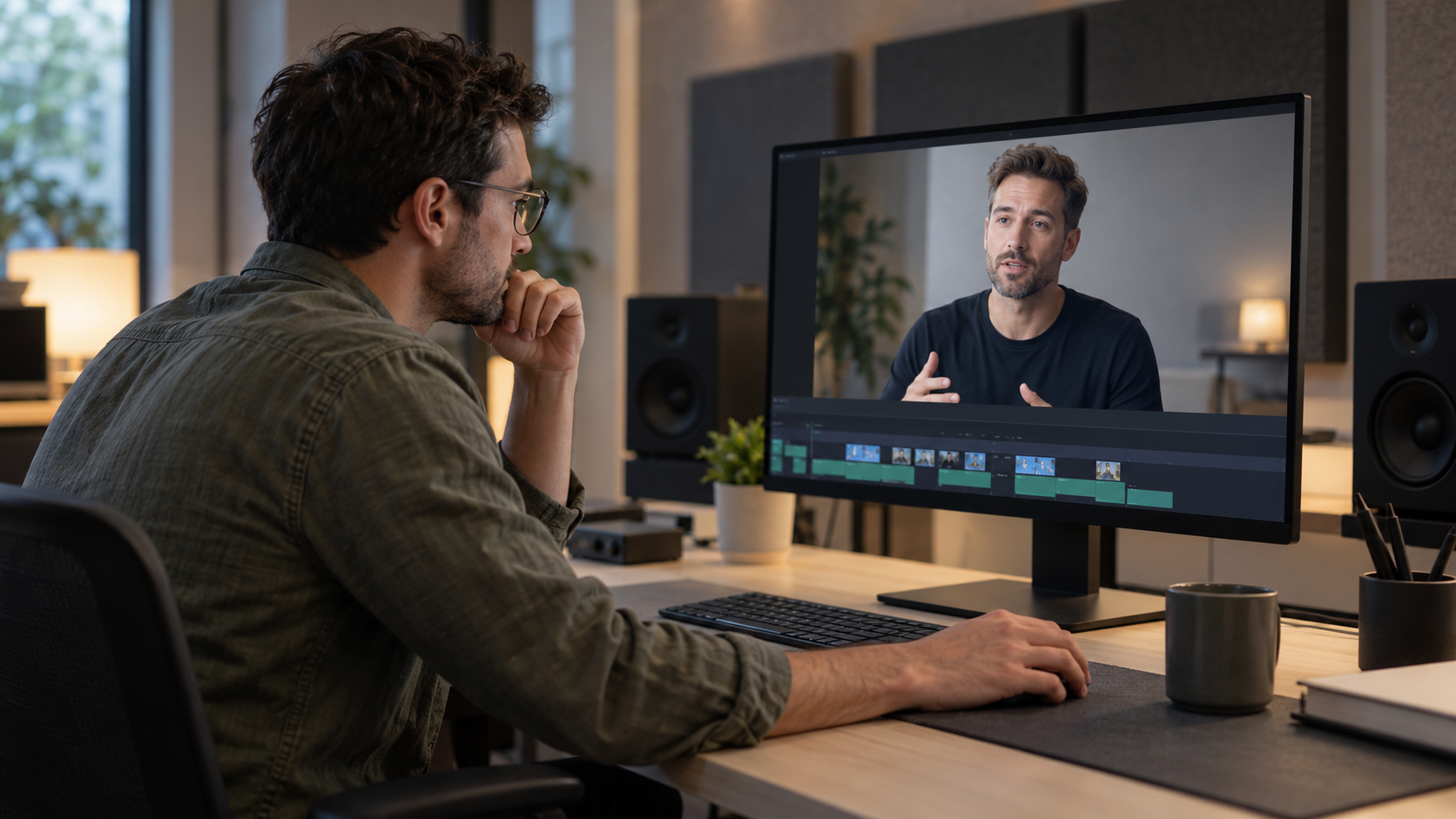
The person explaining a product in a polished video may not be a person. A synthetic digital human, generated or animated by artificial intelligence, can now deliver scripted content on camera without a studio, a crew or a performer, and viewers routinely meet one before they ever think to ask what it is.
The tells are mundane rather than cinematic, which is the point. The financial explainer available in twelve languages by Tuesday, the course module whose instructor never ages, and the support walkthrough refreshed weekly without a reshoot are increasingly made this way.
For creators and marketing teams, the interesting question has moved past whether the technology works. The AI presenter is now an ordinary production tool, and the practical questions are the ones that attach to any tool, how it works, where it fits in the pipeline, what it costs in quality and compliance, and when a human on camera still wins.
This piece answers those questions in production order. It covers the two technical approaches behind the current AI presenter generation, the formats teams actually deploy, the production economics that explain the adoption, the disclosure rules now attached to commercial use, and the workflow questions that decide whether the tool saves time or scatters it.
None of it requires a machine learning background. A production budget worth protecting is qualification enough.
Two Technologies Behind One Label
The avatar label covers two distinct technical approaches, and knowing the difference calibrates expectations before any budget moves. Vendors rarely volunteer which engine sits underneath, so the question belongs on every evaluation call.
Template-based animation drives a pre-built character model with lip-sync matched to audio, phoneme by phoneme, and it powered the first usable generation of AI presenter tools. The motion stays within what the template allows, and the output arrives fast, consistent and predictable across generations.
Diffusion-based generation is the newer approach, and it is taking over the category. The same model family behind modern image and video generators learns to reverse a gradual noising process, and applied to presenters it produces body language, micro-expressions and spontaneous-feeling movement no template can match.
The trade-offs are higher computing cost and less predictable output. The same input can yield somewhat different results across runs, which production schedules have to plan around.
The split matters commercially because it maps to use cases. High-volume routine content suits the fast, repeatable template approach, while flagship content that needs a convincing AI presenter justifies the heavier generation cost.
Teams that match the technology to the job avoid paying premium rates for throwaway clips and avoid fronting stiff animation where credibility counts. A content calendar usually needs both, which is why platform choice matters more than model loyalty.
Voice sits inside the same architecture conversation. The audio track drives the animation in both approaches, so script quality and voice generation decide how natural an AI presenter reads before the visuals get a vote. Teams that invest in the voice layer first get more from whichever visual engine they pick.
Realism research keeps narrowing the gap either way. The uncanny valley problem that once defined the category now appears mainly in low-cost generators, and a published study of synthetic instructor videos found AI-generated teaching videos matched traditionally produced ones on learning outcomes. Evidence of that kind moved the tools from novelty to inventory, and procurement followed the evidence.
The AI Presenter Formats Teams Actually Deploy
Production teams choose between three working formats, and each answers a different brief.
- Photorealistic digital humans, built on three-dimensional scanning references and micro-expression modeling, carrying the credibility work in news-style delivery and brand ambassador roles
- Stylized avatars, deliberately non-photorealistic characters built from a visual identity, common as brand figures and always-available support personas
- Custom digital twins, replicating a specific real person from reference recordings, extending an executive's presence across markets without further recording sessions
The stylized route rewards brands with a developed visual identity, since a synthetic character built from the same system as the rest of the brand reads as an extension rather than a gimmick. A mascot-style AI presenter inherits recognition the brand already paid for, and keeps earning on it in every clip.
Format choice is an audience decision before it becomes a technical one. A photorealistic AI presenter raises expectations it must then meet, while a stylized character sets its own bar and clears it consistently, which is why support content and community channels often run stylized while flagship launches go photorealistic.
The twin format deserves its own caution. Matching a real person's appearance and voice makes it the format where governance matters more than anywhere else, since consent and likeness rights sit at its center, and the reference recordings themselves need documented permission before anything generates. A twin without paperwork is a liability wearing a familiar face.
The use cases now span the content economy. Marketing teams run an AI presenter through product demonstrations, promotional spots and campaigns personalized by segment. Training teams produce onboarding and internal communications without scheduling a single shoot, educators turn written lessons into presenter-led modules localized by language, and support teams publish walkthroughs and tutorial libraries that stay current because updating them costs a script edit.
Creators occupy a growing and visible share of the category. Presenter-led and faceless formats for video platforms benefit from a consistent synthetic host, and localization multiplies a working video into many languages with matched lip-sync. The channel keeps one face while the production calendar stops depending on one person's availability, and a faceless creator gains a face without stepping in front of a camera.

Production Economics Explain the Adoption
The money case is the simple one. A video that once required a studio, a crew and an on-camera employee now starts from a script, updates when the material changes, and localizes without a reshoot. The AI presenter turns recording from an event into an edit.
Content that was a special occasion becomes a routine format. Teams that produced a handful of videos a year find themselves maintaining libraries, and the library changes what the team plans for.
Localization is where the economics compound for marketing teams. A multilingual campaign that once meant separate shoots or subtitled compromises becomes one AI presenter delivering adjusted scripts with matched lip-sync per market, at a marginal cost closer to translation than to production.
Campaigns of that shape, coordinated across formats and languages, are the territory of integrated marketing agency planning, and the AI presenter removes one of their classic production bottlenecks. Localization stopped being the expensive afterthought of the campaign plan.
Budget math still deserves honesty about where the savings land. The AI presenter removes shoot costs rather than production judgment, and script, review and brand oversight stay fully human expenses. Teams that cut the editorial layer along with the camera crew ship more content and worse content at the same time.
Consistency is the quieter and more durable economic win of the format. A library whose presenter never changes jobs, ages or renegotiates appearance fees stays visually coherent across years of content, and updates splice into old material without visible seams. Brand teams price that continuity highly once they have lived without it, usually right after a spokesperson change orphans two years of perfectly good video.
The entertainment and creator side of the category runs on the same math at different scale. Content businesses measured in output volume, the audience economy covered under entertainment marketing, adopt the AI presenter precisely because publishing cadence is the product, and a presenter who is never unavailable protects the cadence.
Volume businesses feel the economics first. The rest of the market follows them down the cost curve, as it did with every earlier production technology.
Disclosure Became a Legal Requirement
Regulation caught up with the category while many teams were still piloting it. Synthetic media that reads as real now sits inside formal disclosure regimes, and the rules bind commercial users first.
The compliance picture changed faster than production workflows did. Multiple jurisdictions now require labeling synthetic media in commercial contexts, and the EU AI Act's transparency provisions set explicit obligations for AI-generated commercial content, with more regulation arriving as synthetic media risks stay in public view. Commercial use sits squarely in the first wave of enforcement.
The statutory layer is only half the obligation, because distribution runs through platforms with rules of their own.
Platforms imposed a second and often stricter layer above the law. YouTube's rules on disclosing altered or synthetic content require creators to flag realistic synthetic media at upload, which pulls the disclosure question into the ordinary publishing checklist for every channel using an AI presenter. Platform enforcement arrives faster than legal enforcement, and a strike lands harder than a fine for the typical channel.
The practical implication is structural rather than legal in tone. Disclosure belongs inside the production workflow, applied at creation, rather than retrofitted when a regulator or platform asks. Teams that treat the label as metadata attached to every synthetic asset ship compliant content without a review bottleneck, and the habit costs nothing once it exists.
Disclosure wording is its own small craft, worth settling once and reusing. A plain line identifying the presenter as synthetic, placed where the audience actually looks, satisfies both regulators and viewers, while buried fine print satisfies neither. The brands handling this well treat the label as part of the content's voice rather than a legal appendix.
Trust runs ahead of regulation in any case. Audiences penalize discovered deception far more than disclosed synthesis. The brands building long-term AI presenter programs disclose by default, because the program's value depends on the audience still believing the channel next year.
Quality and Workflow Decide the Real Return
Quality below the premium tier remains the honest caveat. Unnatural movement, occasional anatomical errors and expressions that read slightly wrong still appear, and the gap between a platform's demo reel and what its entry plan produces can be wide.
A pilot run on real material, rather than the vendor's curated examples, is the only reliable evaluation an AI presenter tool gets. The demo shows the model on its lucky day, and the pilot shows it on an ordinary one.
Workflow integration is the second deciding question, and it separates tools faster than raw output quality does. Avatar generation that sits beside the team's video, voiceover, image and music tooling, under licensing that covers commercial use in one agreement, keeps a project inside one environment from script to cleared deliverable.
Generation that lives in a separate application with its own rights terms adds a seam to every production, and each seam carries handoff time that rarely appears in the vendor comparison spreadsheet. The seams cost more on the tenth project than on the first, which is when teams start consolidating.
Platform strategies in the category reflect that reality. Some vendors build one proprietary engine, while aggregation platforms such as Artlist AI avatars curate multiple generation models inside a broader creative stack, matching different engines to full-body motion, expressive single-speaker delivery or high-volume output speed.
For production teams evaluating the category, the architecture question is less about any single model and more about how much of the pipeline stays under one roof and one license. Models will keep leapfrogging each other, and the pipeline is what the team actually lives in.
Pilots also reveal the operational fit that spec sheets and sales demos reliably hide. Render times against the team's real deadlines, revision behavior when a script changes mid-cycle, and how gracefully the tool handles the brand's actual fonts, colors and framing all surface in a week of genuine use.
Rights hygiene completes the full workflow picture for any serious, ongoing AI presenter program inside a brand. Commercial licensing for every generated asset, documented consent for any digital twin, and clear records of which model produced what are the unglamorous disciplines that keep a synthetic content library an asset rather than a liability.
A Tool Now, Not a Forecast
The AI presenter conversation has left the future tense. The AI presenter is current production equipment across marketing, training, education and the creator economy, and the teams getting value from them treat the choice like any other equipment decision, matched to the job, piloted on real material, disclosed by default and licensed cleanly. The hype cycle moved on, and the tool stayed.
The starting point for any team is smaller than the category's hype suggests. One pilot on one real script, run through the formats above, shows where the AI presenter earns its place in the pipeline and where the human stays on camera. The result usually surprises in both directions.
The teams that run that pilot now are building the production habit their next three years of content will quietly depend on.