Adidas is one of the few global sportswear brands that can move between performance, lifestyle, and fashion without splitting its identity. In 2026, the Adidas marketing strategy works as a system: product franchises create meaning, brand campaigns create memory, partnerships create proof, and distribution captures demand. The advantage comes from those parts reinforcing each other rather than competing for attention.
This analysis uses the same brand and growth lens we apply at Brand Vision, where strategy matters only when it can be executed across creative, digital experience, and measurable performance. Adidas offers a useful model for building relevance that can last beyond a single campaign cycle.
Product and Innovation as the Engine of Adidas Marketing
Adidas marketing starts with product, then translates that product into a story customers can repeat. That discipline lets Adidas refresh demand without constantly reinventing the brand. It also creates a natural runway for campaigns because the product itself provides the narrative, whether the theme is speed, comfort, heritage, or identity.
Adidas's own reporting explains product creation and marketing as connected layers that link brand storytelling to commercial conversion (Adidas Group Annual Report). That alignment is a foundational reason the Adidas marketing strategy scales so well.
- Build franchises that can evolve over multiple seasons
- Reduce product storytelling to one clear customer benefit
The Adidas Marketing Strategy in 2026 Runs on Category Clarity
The Adidas marketing strategy does not try to speak to everyone in one voice. It uses category precision. Performance categories such as running, training, and football build credibility, while lifestyle and Originals maintain cultural fluency. Each category has its own proof points, but the brand's visual identity and broader world stay consistent.
This is why Adidas can change campaigns by market without chasing a new identity every quarter. It is building different entry points into the same brand.
- Category clarity prevents dilution as reach expands
- One brand world can support multiple audience doorways
Brand Positioning That Earns Cultural Permission
Adidas brand positioning is built on sport credibility first, then cultural permission. That order matters. When performance legitimacy is real, lifestyle storytelling feels earned rather than manufactured. It is also why Adidas can move between sport and culture without looking like it is borrowing relevance.
Adidas reporting makes the post-Yeezy transition measurable. The company disclosed the completion of remaining Yeezy inventory sales in 2024 and detailed how that affected operating profit and comparability (Adidas income statement). The strategic lesson is durable: no partnership should become the entire brand identity.
- Credibility comes from what the brand consistently proves
- Partnerships should amplify the brand, not replace it

Financial Momentum That Marketing Has to Support
Adidas's 2024 annual report and North America segment remain useful historical baselines for the post-Yeezy recovery. Corporate updates through 2025 also documented the brand's improving revenue and profit outlook (Adidas press release).
The completed 2025 results show net sales of €24.8 billion and operating profit of €2.06 billion, up from €23.7 billion and €1.34 billion in 2024 (Adidas Annual Report 2025). In the first half of 2026, currency-neutral revenue rose 14%, net sales reached €13.3 billion, direct-to-consumer revenue grew 23%, and operating profit reached €1.28 billion. Adidas also raised its full-year currency-neutral revenue growth outlook to 9% to 10% (Adidas Q2 and H1 2026 results).
- Connect campaign KPIs to franchise growth and repeat purchase
- Use financial signals to test whether brand momentum is translating into demand
The Brand Campaign Layer: How Adidas Builds Emotion at Scale
Adidas marketing does not rely only on product drops. It also invests in a global brand narrative that can stretch across sports and markets. The “You Got This” platform is a recent example of Adidas choosing a broad emotional territory around encouragement and pressure relief, then building creative that can live in multiple categories.
Adidas's behind-the-scenes documentation explains the intent and structure of the 2025 campaign chapter (Adidas Group Magazine). The company also tied marketing and point-of-sale spending to continued investment in the global campaign and partner portfolio (Adidas Group press release).
- A platform becomes more useful when it can fuel category work
- A consistent narrative gives product and partner stories a shared frame
Social and Creator Strategy: How Adidas Keeps the Brand Current
In 2026, Adidas has to win where culture forms in real time: short-form video, creator ecosystems, and community-first platforms. The strongest social strategy is not constant posting. It is consistent creative language paired with culturally relevant moments and product storytelling that is easy to share.
A practical way to read Adidas's approach is through how brand campaigns are built to travel. “You Got This” is designed to be modular, showing different stories and contexts while keeping the same emotional promise (Adidas Group Magazine). That structure gives creators and communities room to adapt the idea without losing the brand.
- Creator strategy works best when the brand language is easy to adapt
- Social should support product narrative, not compete with it
World Cup 2026: Football as Adidas's Global Proof Engine
The 2026 FIFA World Cup gave Adidas a global proof cycle rather than simply an upcoming campaign window. Football remains one of the brand's strongest credibility engines because product, athletes, federations, retail, and fan culture can all reinforce the same story at once.
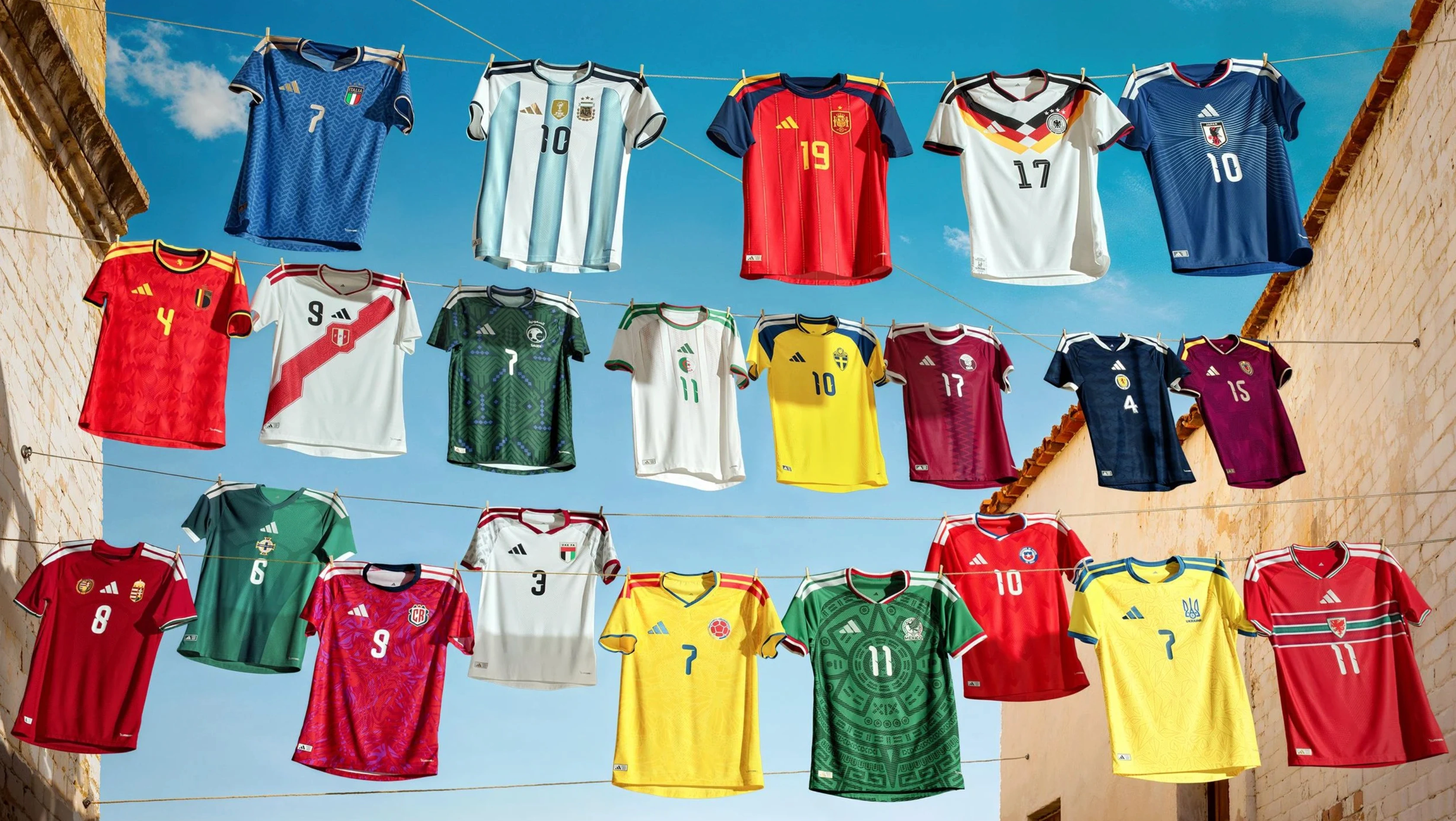
Before and during the tournament, Adidas released an official World Cup film featuring major football figures (Adidas Newsroom), unveiled its largest collection of home kits for partner federations (Adidas Newsroom), and introduced the Trionda match ball through events in New York, Toronto, and Mexico City (Adidas Newsroom). For the closing rounds, it released Trionda Final for the semifinals, third-place match, and final (Adidas Newsroom).
- Major tournament cycles can create brand proof that outlives the event window
- Product, storytelling, retail, and partner timing need to be coordinated well in advance
Membership and Apps: The Retention Layer Behind Adidas Marketing
Adidas marketing in 2026 is not only about acquiring new buyers. It is also about keeping customers inside the ecosystem. adiClub spans the Adidas app, Confirmed, and Adidas Running (adiClub). Adidas also connects the membership program to running and training apps in its official terms, reinforcing that this is an ecosystem strategy rather than a simple points program (adiClub terms).
For brands learning from Adidas, the important idea is that retention lowers dependence on constant new-customer acquisition and gives the company more ways to connect product launches with existing behavior.
- Loyalty should reward behavior and identity, not only transactions
- Membership ecosystems work when they connect to real habits
Direct to Consumer and Distribution Consistency
A marketing strategy weakens when distribution undermines the brand promise. Adidas has emphasized consumer experience and brand consistency across channels in its growth strategy communications (Adidas Group). In 2026, digital storefronts are part of the brand experience, not just catalogs. That makes web design a commercial consideration as well as a visual one.
Execution becomes the difference between demand and revenue when campaigns create traffic. A slow, confusing, or inconsistent site experience can add friction at the exact moment a customer is ready to act.
- Treat ecommerce as a flagship store experience
- Align merchandising, storytelling, and availability across channels
Competitive Context: Adidas, Nike, and Puma in 2026
Adidas does not compete in a vacuum, but the useful lesson is not to rank three brands. Nike's marketing strategy provides one comparison point because its scale creates different pressures around product heat, distribution, and efficiency. Nike's fiscal 2025 results (Nike Investor Relations), fiscal 2026 second-quarter update (Nike Investor Relations), and 2025 Form 10-K (Nike 2025 10-K) show how quickly priorities can shift at that scale.
Puma provides a different comparison point. Its 2024 annual report describes a “brand elevation strategy” focused on brand DNA, performance credibility, sportstyle relevance, and distribution quality (Puma Annual Report 2024). Adidas's own position is shaped by the combination of global football credibility, lifestyle franchises, product breadth, and a retention ecosystem that connects those categories to its direct channels.

What You Can Apply to Your Own Brand
Adidas shows that durable marketing is a repeatable system, not a string of isolated campaigns.
- Pick one category you can win first, then expand with discipline
- Build one offer into a recognizable franchise customers return to
- Treat partnerships as positioning decisions, not calendar filler
- Invest in retention loops that lower acquisition dependency
- Make your digital experience feel like a flagship store, not a brochure
- Measure outcomes that compound, including repeat purchase, retention, and conversion
Check Out Marketing Strategies of Other Companies
- Red Bull
- Fenty Beauty
- Louis Vuitton
- Alo
- Zara
- Victoria's Secret
- Aritzia
- Tesla
- BMW
- Mercedes-Benz
- Porsche
- Sony
- Duolingo
- McDonald's
How Business Owners Can Apply Adidas's Playbook in 2026
The most transferable lesson is coherence. Product innovation, community, cultural relevance, distribution, and retention work better when they reinforce the same position. For founders and marketing teams, a connected marketing strategy is more durable than a series of disconnected campaign spikes.
If your team is translating these principles into its own growth plan, Brand Vision can help clarify the priorities and execution path through a focused marketing consultation.


.avif)







.webp)