Apple’s advertising has delivered campaigns that sit at the center of modern marketing history. The best Apple ads of all time are memorable because they usually commit to one clear idea, support it with disciplined storytelling, and repeat a recognizable visual language across formats.
Across the nine campaigns below, Apple repeatedly turns product features into simple human or cultural stories. The creative changes by era, but the underlying pattern is consistent: make the idea easy to understand, give the product a clear role, and remove anything that competes with the message.
1. “1984” (1984, TV Commercial)
Apple’s “1984” commercial aired nationally during Super Bowl XVIII and was directed by Ridley Scott. Its Orwellian world presents a crowd watching an authoritarian figure until a lone runner breaks the scene by throwing a hammer through the screen. The closing line announces the Macintosh and promises that “1984 won’t be like ‘1984.’”
The campaign works because the product is introduced through a high-concept position rather than a feature list. Apple is framed as the challenger to conformity, while the cinematic execution makes a product launch feel like a cultural event. The idea is easy to retell, which is one reason the ad remains a reference point in advertising history.
2. “Think Different” (1997, Integrated Campaign)
Released as Apple was rebuilding its position in the market, Think Different paired black-and-white portraits of figures such as Albert Einstein, Pablo Picasso, and Mahatma Gandhi with sparse copy and the line “Think different.” The campaign shifted attention away from hardware specifications and toward the people Apple wanted to represent.
That makes it a useful example of brand repositioning. The campaign signaled values before features, gave Apple a distinct cultural role, and used a short line that could stretch across products and media without losing meaning.
3. iPod “Silhouettes” (2003–2005, TV and Outdoor)
The iPod silhouette campaign used bright color fields, black figures in motion, and unmistakable white earbuds. The result made iPods visible without relying on detailed product demonstrations.
Its strength came from the system rather than a single execution. The same visual formula could be repeated across television, posters, and outdoor placements while staying instantly recognizable. Instead of selling storage capacity, the ads sold the feeling of carrying music with you. The product itself occupied only a small part of each composition, yet the white earbuds and device silhouette were distinctive enough to carry the message. That balance between simplification and recognizability is a useful lesson for any brand building a campaign across multiple placements.
4. “Get a Mac” (2006–2009, TV Commercial Series)
The “Get a Mac” series reduced the Mac-versus-PC debate to two people in a white studio: an easygoing Mac, played by Justin Long, and a more formal PC, played by John Hodgman. Individual spots turned technical topics such as compatibility, security, and software into short conversations.
The format made comparative advertising easier to follow because the audience did not need to understand every technical detail. It also gave Apple a repeatable structure that could support many messages without changing the basic setup. Humor carried the argument while the format reinforced the same personality contrast from one commercial to the next. Just as importantly, the campaign did not try to resolve the entire Mac-versus-PC debate in one spot. Each commercial handled one objection or benefit, which made the series easier to extend and gave audiences a familiar frame for each new comparison.
5. “Shot on iPhone” (2015–Present, Digital and Outdoor)
“Shot on iPhone” turned customer and creator output into the advertising itself. A global showcase of images and videos demonstrated what people could make with the device, while Apple’s own Shot on iPhone challenges extended the idea through curated community participation. Apple has continued using iPhone-shot creative in major projects through 2026.
The campaign makes the product claim visible instead of explaining it. The work also demonstrates Apple’s design approach: reduce visual noise, give the output space, and let the viewer judge the result. Because the source of new creative can keep changing, the format has remained adaptable across products and platforms. It also gives Apple a flexible way to connect camera improvements with real output without rebuilding the campaign idea from scratch for every device generation.
6. “Welcome, IBM. Seriously.” (1981, Print Ad)
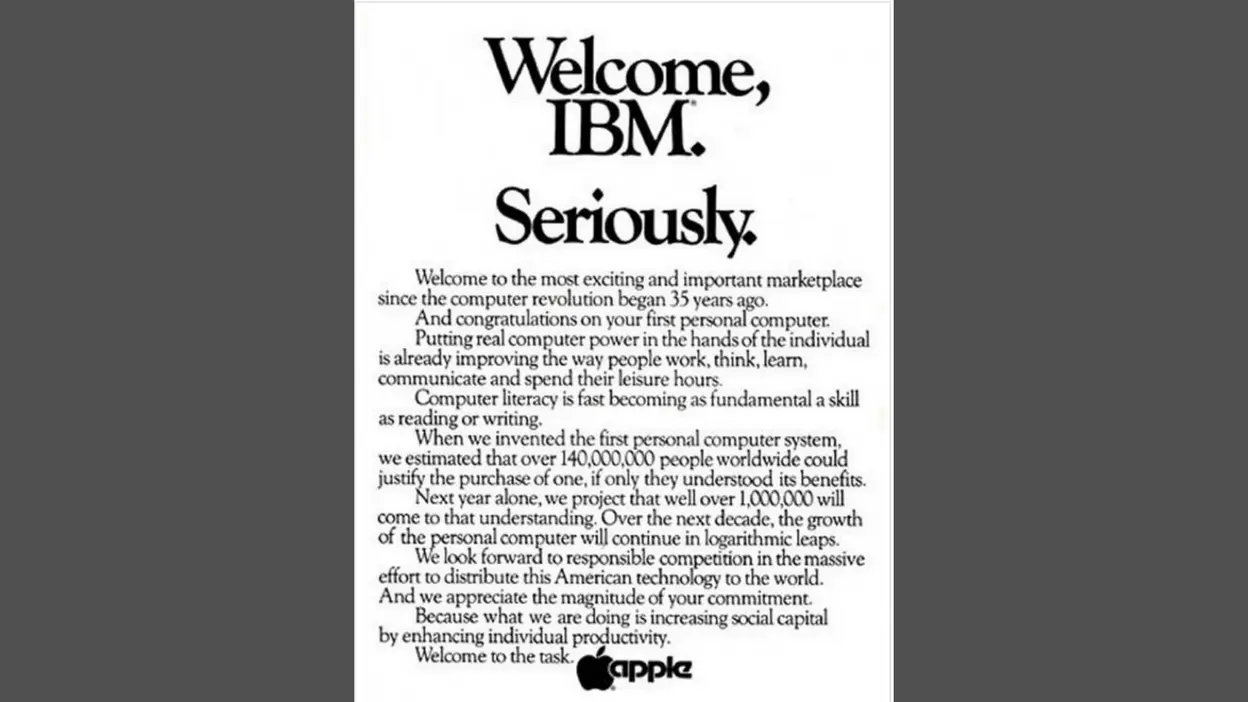
Apple placed a full-page newspaper ad from Apple welcoming IBM into the personal-computer market when IBM launched its first PC. The message congratulated a much larger competitor while positioning Apple as an established participant in the category.
The tone made the placement memorable. Instead of sounding threatened, Apple used IBM’s entrance as a moment to reinforce its own challenger identity. It is an early example of competitive positioning that can be direct without becoming hostile.
7. “There’s an App for That” (2009, TV Commercial Series)
A run of simple TV spots showed iPhone owners using apps to solve everyday problems, then closed with the line “There’s an app for that.” The campaign helped make the App Store understandable through use cases instead of platform architecture.
The line worked because it could be repeated across almost any scenario. Each example explained what the phone made possible, while the tagline tied those separate situations into one product promise. It is a strong example of category education made memorable through repetition.
8. “Misunderstood” (2013, TV Commercial)
Apple’s holiday ad for the iPhone 5s follows a teenager who appears disengaged from a family gathering. The reveal shows that he has been recording and editing a family video, changing the audience’s interpretation of his behavior.
The ad uses a familiar tension around phones and attention, then resolves it by showing the device as a tool for creating and sharing something meaningful. The product remains central, but the story gives viewers an emotional reason to care about the capability rather than listing specifications.
9. Apple Watch “Dear Apple” (2017, Online Video Campaign)
“Dear Apple” used video testimonials built around letters written to Apple. Participants described ways the Apple Watch had affected their health, safety, activity, or daily routines, shifting the focus from a product demonstration to personal experience.
The campaign works because the proof comes through individual stories rather than broad claims. It expands the meaning of the product while keeping the tone quiet and specific. The audience is asked to understand the device through another user’s experience, not through a feature comparison.
Why These Apple Ads Stand Out
From “1984” to “Shot on iPhone,” Apple’s strongest marketing work follows a few consistent principles. The campaigns simplify without becoming generic, attach products to a clear identity or behavior, and use repeatable creative systems that can stretch across many executions.
- One primary idea gives the audience something easy to remember.
- Product benefits are often shown through people, behaviors, or outcomes instead of a feature list.
- Campaign formats are designed to repeat without losing their visual or verbal signature.
- Restraint in copy and art direction keeps attention on the central message.
That consistency is why these campaigns continue to influence advertising, brand storytelling, and long-term creative systems. They also show that brand consistency does not require every ad to look identical. “1984,” “Get a Mac,” and “Shot on iPhone” are visually very different, but each is built around a clear role for the product and a disciplined relationship between message and execution. The consistency comes from how Apple frames the value, not from repeating one aesthetic forever.
Related Campaign Breakdowns
- Top 10 March Madness Ads of All Time: Iconic Campaigns That Scored Big
- History of Tobacco Marketing: From Early Ads to Modern Laws
- The Best Starbucks Ads of All Time
- The Best McDonald’s Advertisements of All Time
How Business Owners Can Apply Apple’s Advertising Discipline
From Brand Vision’s agency perspective, the most transferable part of Apple’s playbook is not budget. It is the discipline behind the work. A clear positioning idea, a recognizable creative system, and a specific next step can make a campaign easier to understand and easier to repeat. This matters for smaller brands because the same discipline can reduce wasted production: teams can decide what must stay consistent, what can change by platform, and which proof points deserve the most attention before they start producing assets.
Build One Sharp Message
Start by deciding what the audience should remember after a few seconds. If the message changes from channel to channel, the campaign may need stronger branding services around positioning, voice, and identity before more creative is produced.
Turn Product Features Into Buyer-Facing Proof
Apple repeatedly shows what a product enables instead of stopping at technical language. The same principle matters in technology marketing, where a feature is more persuasive when the audience can see the task, outcome, or experience it changes.
Create a Format You Can Repeat
Silhouettes, “Get a Mac,” and “Shot on iPhone” are systems as much as individual ads. A business can apply the same thinking by defining a repeatable opening, visual structure, proof point, and closing device. Adapting that system across the right video marketing formats can extend the idea without making every placement feel identical.
Use Real Proof
“Shot on iPhone” works because the output is visible. “Dear Apple” works because the story is attributed to real people. Businesses can use customer stories, real product demonstrations, behind-the-scenes craft, or documented results, provided the context is clear and the claims are supportable.
Keep the Regional Context Natural
Businesses do not need to imitate Apple’s scale to apply its discipline. A technology company choosing a marketing agency in Miami, for example, still benefits from the same fundamentals: a clear message, a recognizable visual system, and campaign execution suited to the audience and market.
Compete With Clarity
“Welcome, IBM. Seriously.” shows that competitive positioning can be direct without becoming bitter. Define what is different in plain language, then support that difference consistently through product, creative, and customer experience.
Apple’s marketing history shows what happens when strategy and creative execution reinforce each other over time. The strongest examples are memorable not because they use one formula, but because the creative choices are tightly connected to the message and product role. If you are refining a campaign or broader brand direction, you can discuss your brand direction with Brand Vision and identify where the message, identity, or campaign system needs the most work.