Launching a new product line should create momentum, not isolation. Yet many teams find that every new name makes their brand story a little harder to tell, their website a little harder to navigate, and their sales deck a little harder to follow.
Product-launch failure estimates vary widely depending on how studies define a “new product” and a “failure.” Existing business coverage summarizes several common reasons launches struggle, including weak differentiation, poor market fit, and unclear positioning (business.com). Naming is only one part of that picture, but a confusing portfolio can make an already difficult launch harder to explain.
For leadership teams, the better question is not simply “do we like this name?” It is “what role should this name play in the portfolio, and will customers understand the relationship?” This guide lays out a practical product line naming strategy for 2026, from architecture and testing to web, UX, search, and governance.
Why Product Line Naming Matters in 2026
Product launches are expensive and noisy. Even strong products can struggle if customers cannot see where they fit in the portfolio. Confusing line names slow down buying decisions, weaken cross-sell, and make it harder for teams to keep stories straight.
Several forces make naming more critical now:
- Crowded portfolios. Most mature brands already have multiple tiers, bundles, and regional variants. Each new name competes for attention inside that system.
- Search and digital discovery. Product names appear in search results, app listings, navigation, site search, sales tools, and increasingly in AI-assisted research. Clear naming does not create rankings by itself, but it reduces ambiguity across the places where customers and systems encounter the portfolio.
- Cost of inconsistency. Existing industry surveys have associated weak brand control with meaningful commercial losses, although self-reported estimates vary widely and should not be treated as a universal benchmark (Astute Review).
Strong product line names tend to:
- Make the role of the product clear in one line of copy
- Signal how the line relates to the master brand
- Scale cleanly as more lines and variants are added
- Support navigation, search, and UX, not work against them
Treating naming as a strategic discipline rather than a last-minute creative task is one of the simplest ways to protect brand equity while you grow.

Brand dilution: what actually goes wrong when names drift
Brand dilution happens when new products weaken what your brand stands for and make it harder for people to recognize and recall you. Shopify defines brand dilution as the weakening of a company’s brand identity and value, often caused by off-strategy extensions, inconsistent use of visual and verbal elements, or poor quality experiences.
When names drift, several problems show up:
- Blurry positioning. Customers cannot quickly explain what your brand is “for” anymore. Each new line muddies the associations you worked to build.
- Cannibalization risk. Closely related extensions can shift demand within the portfolio rather than add incremental demand. Naming can make that overlap harder or easier to understand, but the name alone does not determine whether cannibalization occurs.
- Choice overload. Behavioral science has repeatedly found that too many similar options can lead to decision fatigue, slower choices, and lower satisfaction (The Decision Lab).
Operational friction. Sales teams mislabel products. Finance teams struggle to track performance by line. Web teams improvise category names to patch gaps in the naming system.
Most of this traces back to one root cause: new names are created without a clear view of the brand architecture and without explicit guardrails on what the core brand should and should not stretch to cover.
Clarify your brand architecture before you name anything
Before any brainstorming session, you need to understand the structure your new line will live in.
Branded House, House of Brands, and Hybrid Models
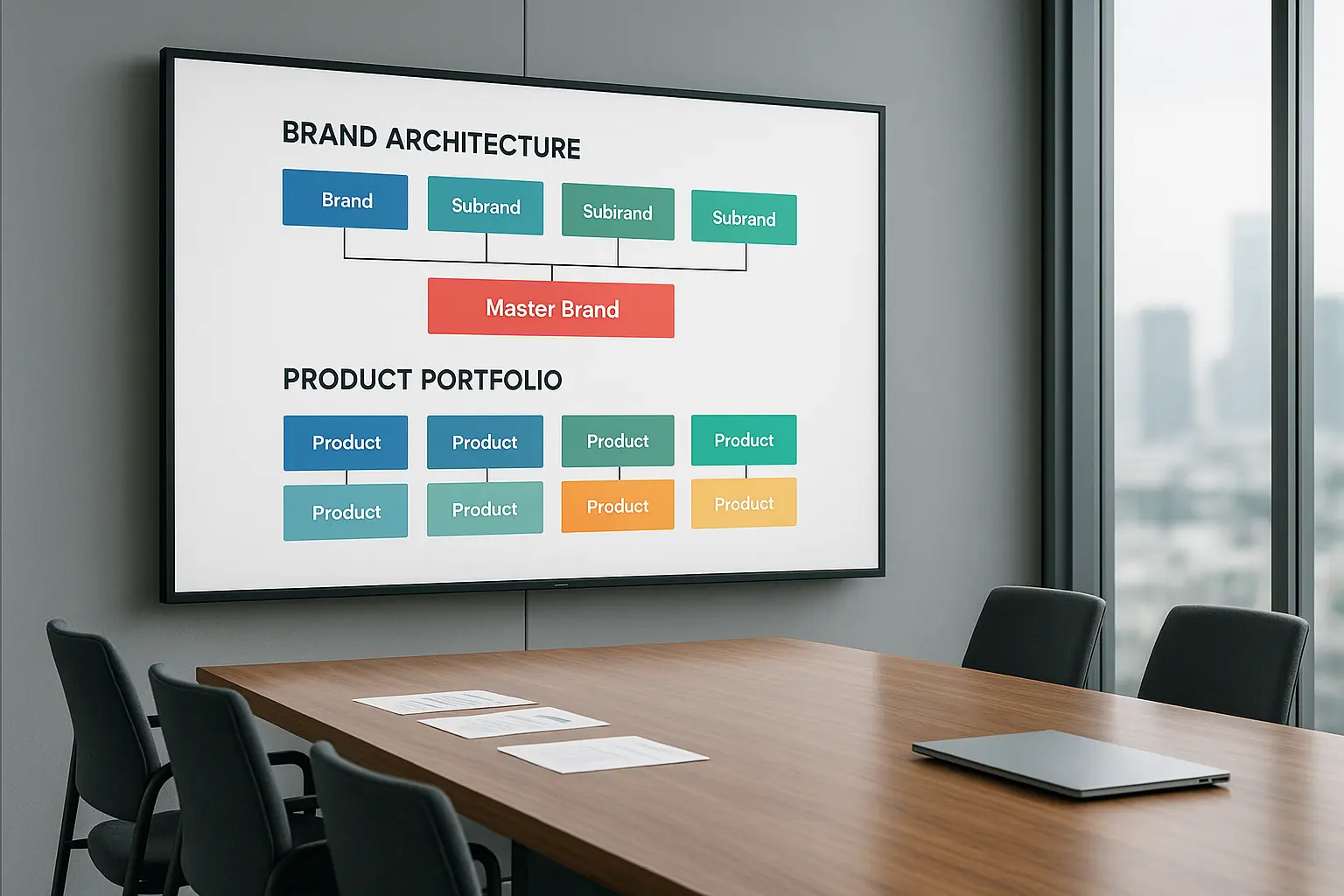
Brand architecture describes how your brands and product lines relate to each other. The classic models are:
- Branded house. One master brand spans multiple products and services. For example, a single name applied across logistics services, digital tools, and sub-lines. The master name is prominent, line names act as descriptors.
- House of brands. The parent company is mostly invisible to customers. Each product line has its own primary brand, often aimed at different segments.
- Hybrid or endorsed. Some product lines carry the master brand alongside distinct line brands, balancing shared equity with targeted positioning.
Each model implies different expectations about how visible the core brand should be in product line names. In a branded house, the default is “the core brand leads.” In a house of brands, the default is “the line brand leads, the parent is quiet.” Hybrid systems sit in the middle.
Brand Vision’s analysis of the PepsiCo corporate rebrand shows the same architecture question at enterprise scale: a parent identity has to create coherence without flattening the identities that customers already know.
Where Your New Product Line Actually Sits
Now place your new line in that structure. A simple lens is a two-by-two grid:
- Same vs new category
- Same vs new primary audience
This gives four broad situations:
- Same category, same audience. Often a line extension. Incremental variants, bundles, formats, or tiers.
- Same category, new audience. Often a sub-brand. New price point, segment, or use case that still fits the core promise but speaks differently.
- New category, same audience. Often a brand extension. You are asking customers to trust you in a new space. Naming must signal both fit and difference.
- New category, new audience. Sometimes, a candidate for a new brand entirely, especially if the risk of failure or misfit is high.
Writing this down before you discuss names aligns executives on what job the new line is supposed to do for the portfolio.
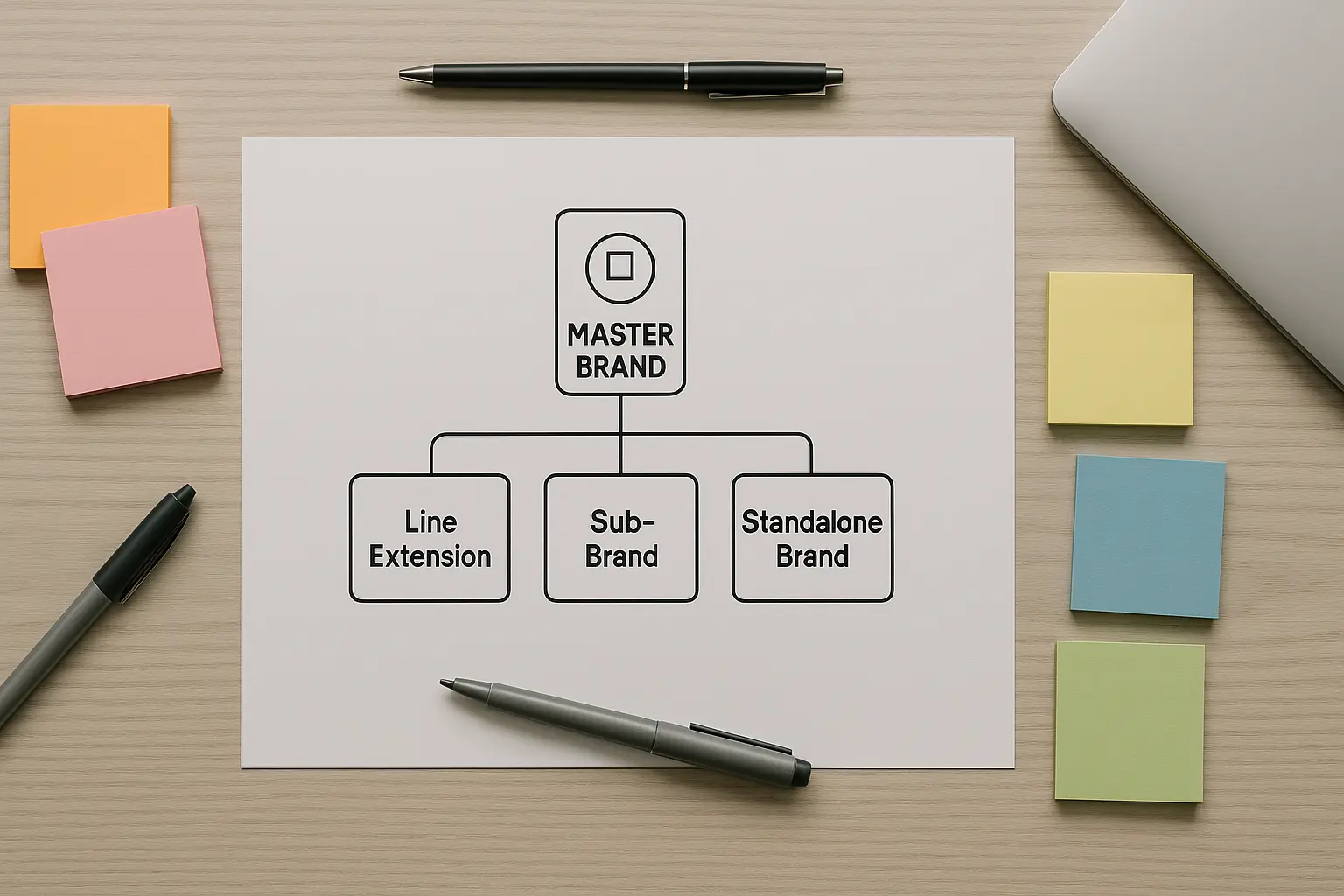
Decide the role of the new line: extension, sub-brand, or standalone
Once you know where the line sits, you can decide how tightly its name should lean on the master brand.
Line extensions work best when:
- The product delivers the same core promise as your flagship
- The main goal is variety or choice within an existing category
- You want to keep risk and complexity low
Names often follow the pattern “Master Brand + Modifier,” such as flavor, format, or level. They borrow trust almost entirely from the parent.
Sub-brands are useful when:
- You want to serve a distinct segment (for example, enterprise vs starter)
- You need more storytelling room than a simple descriptor
- You expect to build multiple offers under the sub-brand in time
Sub-brands can combine a unique name with clear endorsement from the parent when the strategy calls for both separation and visible connection. Other portfolios may choose a looser relationship, so the endorsement pattern should follow the architecture rather than become a default rule.
Standalone brands may make sense when:
- The new offer sits far from the parent in category or audience
- Failure could materially damage the core brand if directly tied
- You are willing to invest separately in awareness and distribution
Harvard Business Review’s work on product-line extensions cautions that overusing the master brand to stretch into unrelated spaces can erode margins and make it harder for consumers to know what you stand for.
If a proposed line does not clearly reinforce your positioning or help tell a joined-up story on your website and in your decks, consider whether it really needs the master brand at all.
A product line naming framework that protects your core brand
With architecture and role clarified, you can move into the naming process itself. Treat this as a repeatable framework, not a one-off exercise.
Step 1: Clarify non‑negotiables
Start with your brand strategy. Capture in one place:
- The brand promise and personality
- Priority associations you want to reinforce
- The audiences for the new line and the existing ones
If this is not documented, it is a signal to revisit your brand strategy and positioning before naming.
Step 2: Define the naming job
Decide what kind of name will best serve the line:
- Descriptive (clearly states function)
- Evocative (suggests benefit or feeling)
- Hybrid (one descriptive element, one evocative)
Be explicit about whether the new line is a sub-brand, a descriptor, or both. This keeps discussions focused on function rather than taste.
Step 3: Set system rules
Write simple rules such as:
- Which elements of the master brand are fixed in every line name
- Which elements can change (modifiers, numerical tiers, thematic families)
- How many levels deep the system is allowed to go
This is where you align naming with your information architecture. Navigation labels, product cards, and URLs should use the same logical system. Google’s current Search documentation says site relationships are understood largely through links between pages, while descriptive URLs and anchor text help people and search engines interpret those relationships (Google Search Central). A consistent naming system also makes it easier to maintain a coherent website with the support of a web design agency that understands brand architecture. For search-specific measurement, see Brand Vision’s guide to branded search.
Step 4: Generate options in batches
Brainstorm names within those rules. Work in small, thematic batches rather than trying to cover every angle at once. You are designing a family, not just a hero.
Step 5: Screen for risk and confusion
Eliminate options with:
- Obvious legal conflicts or close competitors
- Confusing similarity to existing line names
- Undesired meanings in key languages or regions
At this stage, bring in legal counsel for proper clearance and, if relevant, a brand research and insights services partner to stress-test perception. WIPO recommends searching its Global Brand Database and relevant national or regional trademark registers before filing, while noting that database searches are a starting point rather than a guarantee of availability (WIPO).
Step 6: Test with real users and internal teams
Shortlist a small set of viable options and test them with:
- Prospects and customers
- Sales and success teams
- Regional or channel partners
You are not looking for a popularity contest. You are looking for clarity: can people tell, in a sentence, what the line is, who it is for, and how it relates to what you already sell?
Scoring fit: a simple matrix for comparing name options
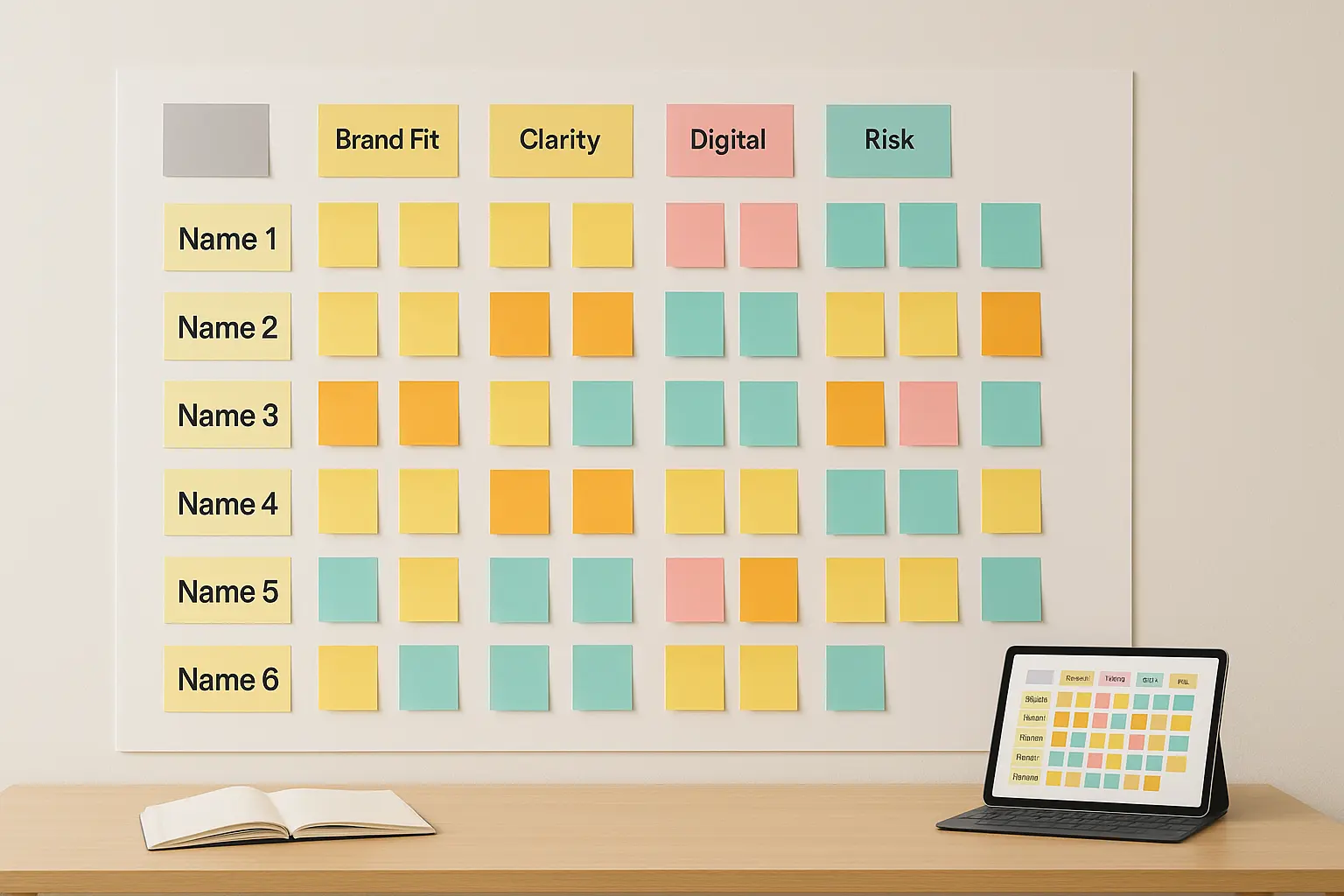
To move from opinion to structured judgment, use a simple scoring matrix. List name options on one axis and criteria on the other. Score each name from 1 to 5 on each criterion.
Useful criteria include:
- Brand fit. Does the name feel aligned with your brand promise and tone?
- Portfolio clarity. Does it make the overall lineup easier to understand?
- Distinctiveness. Is it meaningfully different from alternatives and competitors?
- Future extension potential. Can you extend this line name to new variants?
- Linguistic ease. Is it easy to pronounce and recall in key markets?
- Digital performance. Is it workable for domains, search, and app store listings?
You can give some criteria more weight than others. For example, a master brand in a sensitive category may prioritize brand fit and risk over distinctiveness.
Classic line-extension research warns that portfolio expansion can cannibalize existing demand, complicate positioning, and add cost when extensions are not meaningfully differentiated (Harvard Business Review). Similar names can contribute to confusion, but they are only one factor alongside product, price, audience, and distribution. If a name scores high on brand fit but low on portfolio clarity, investigate whether the similarity is helping recognition or masking a weak distinction.
Document the scores and rationale. This helps future teams understand why a name was chosen and avoid re-litigating the same decision every few years.
Guardrails for naming within a branded house
If you operate a branded house, naming guardrails are essential. The master brand does most of the heavy lifting, but each new line can still destabilize the structure if unmanaged.
Consider guardrails like:
- One fixed element. Keep a fixed brand stem in every line name, and limit how many free-form words can appear alongside it.
- Clear tiers, not endless variations. For recurring offers (plans, bundles, seats), standardize tier names rather than inventing new ones every year. Brand Vision’s WHOOP marketing analysis shows how One, Peak, and Life use names to signal increasing scope without turning every plan into a technical specification.
- Limits on “special” names. Decide how many whimsical or highly creative sub-brand names the system can handle before it becomes a patchwork.
This is also where naming and UX meet. Product line names should match:
- Navigation categories in your main menu
- Filters and tags in product catalogs
- Labels on pricing tables and plan pickers
Working with a UI UX design agency that understands your brand architecture can ensure that naming, layouts, and microcopy all support the same mental model for users.
When customers move from an ad to a landing page to a pricing page, they should see one clear, consistent set of names, not three slightly different ones.
When to create a sub-brand and how to signal the parent brand
Sub-brands are powerful tools when used sparingly. They allow you to speak to a distinct audience or use case while still borrowing equity from the core.
Common triggers for sub-brands include:
- New segment or use case. A line aimed at a different level of sophistication, price point, or industry.
- Distinct experience or model. A subscription line within a historically one-off purchase brand, or a digital line within a physical heritage brand.
- Reputation management. You want some distance in case the line does not perform, but you still want customers to recognize the connection.
One option is an endorsed-brand structure, where the line name leads and the parent appears as a secondary mark or phrase such as “[Line] by [Master Brand].” This can provide:
- Enough separation to protect the core if something goes wrong
- Enough connection for trust and cross-sell to flow both ways
Sub-brand naming should be developed alongside visual identity design. Typography, color, and lockups need to show clearly which elements belong to the parent and which belong to the line, on packaging, websites, and interfaces.
When sub-brands proliferate without a clear rationale, they can quickly create the same confusion they were meant to solve. Build a simple rule: if a proposed sub-brand does not have a multi-year roadmap of products and a distinct value proposition, it probably does not deserve a separate name.
Key takeaways for your next launch
When you are under pressure to name a new product line, it can be tempting to rush the decision. A few core principles help keep the brand safe while you move quickly.
- Start with architecture, not names. Decide whether the new line is a line extension, sub-brand, or standalone before you brainstorm.
- Write simple rules for your system. Clarify what is fixed and what can change in line names so future launches do not have to start from zero.
- Use a scoring matrix to compare options. Treat names as strategic options you can weigh against criteria, not just creative ideas you like.
- Design for UX and search. Ensure naming, navigation, URLs, and UI copy all reinforce the same structure, with support from a web design agency and UI UX design agency that understands brand systems.
- Invest in governance. A small naming council and lightweight testing can prevent inconsistent decisions that accumulate into dilution.
If your portfolio already feels tangled, you do not necessarily need an immediate full rebrand. Start by mapping the current architecture, defining naming principles, and applying them to the next launches. Migration can then happen deliberately across web, sales, packaging, and product interfaces.
FAQ: Product Line Naming and Brand Dilution
1. How similar can a new product line name be to my flagship?
Similarity is useful for borrowing equity but risky for cannibalization. If customers cannot easily explain the difference between lines in one sentence, the names are probably too close. Studies of product-line extensions show that highly similar variants often shift demand around rather than growing it.
2. Does product line naming really affect SEO and AI search?
Clear naming can support SEO indirectly by making page purpose, navigation, internal links, and URLs easier to understand. Google says logical site structure and descriptive internal links help it understand relationships between pages, but the product name itself is not a ranking switch. The same caution applies to AI search: use consistent names because they reduce ambiguity, not because a naming pattern guarantees inclusion in an AI answer. See Brand Vision’s branded search guide for the search-side implementation.
3. When should we create a sub-brand instead of a simple line extension?
Create a sub-brand when the line has a distinct value proposition, will host multiple offers, or targets a new segment where tone and messaging need to shift. If you cannot describe why this audience needs a different story, a carefully named line extension may be enough.
4. Can we fix a messy naming system without a full rebrand?
Often yes. Many brands first define a future-state architecture and then migrate existing lines toward it over time, starting with digital and sales materials. A structured branding agency engagement or marketing audit can prioritise which changes to make first.
5. How do we know if we are already suffering from brand dilution?
Warning signs can include customer confusion between lines, inconsistent naming across regions or channels, sales teams using different labels for the same offer, or weak differentiation between adjacent products. Those signals justify research, but they do not prove that naming alone caused a commercial decline.
Build a Naming System That Can Scale
A careful product line naming strategy should make growth easier to understand, not add another layer of complexity. If you are planning several launches or cleaning up an existing portfolio, Brand Vision, a branding agency, can help connect naming, brand strategy, and digital experience. Talk with Brand Vision if you want to map the architecture before the next launch.