The Netflix tarot marketing campaign turns a slate reveal into an experience audiences can enter, complete, and share. For decision-makers, that matters because modern launches compete with feeds, recommendations, and other entertainment moments rather than sitting alone on a release calendar.
Netflix's Discover Your Future campaign turns the “what’s next?” question into participation. The Netflix tarot experience gives audiences a personalised path into the 2026 lineup, while a physical activation gives the campaign a public layer beyond the screen. For entertainment marketing teams, the useful lesson is how one campaign idea can connect discovery, interaction, owned media, and an event.
The Pitch
The purpose is simple: make upcoming titles feel personally relevant before the trailer season begins. The What Next Netflix 2026 campaign treats discovery as the core product, not as a byproduct of promotion. That is the strategic move behind the Netflix tarot marketing campaign.
For leaders reading this, the lesson is not tarot. The lesson is the system: an interactive campaign that turns curiosity into a sequence of deliberate choices, clear progression, and a re-entry path back into owned pages.
The helpfully uncomfortable conflict
Streaming discovery has a choice problem. Audiences face crowded release calendars, overlapping recommendations, and a constant stream of entertainment news. Netflix slate reveal marketing also competes with announcements from other platforms and franchises.
Netflix's Discover Your Future campaign responds to that conflict by replacing broad messaging with guided selection. The Netflix tarot experience makes discovery feel like a decision, not a scroll. The experiential marketing activation then makes the campaign feel real, not purely digital.
Primary impact
The campaign is designed to make the slate reveal something people can move through rather than simply watch. A campaign landing page experience becomes the centre of gravity, with a beginning, a result, and a shareable output instead of a single announcement asset.
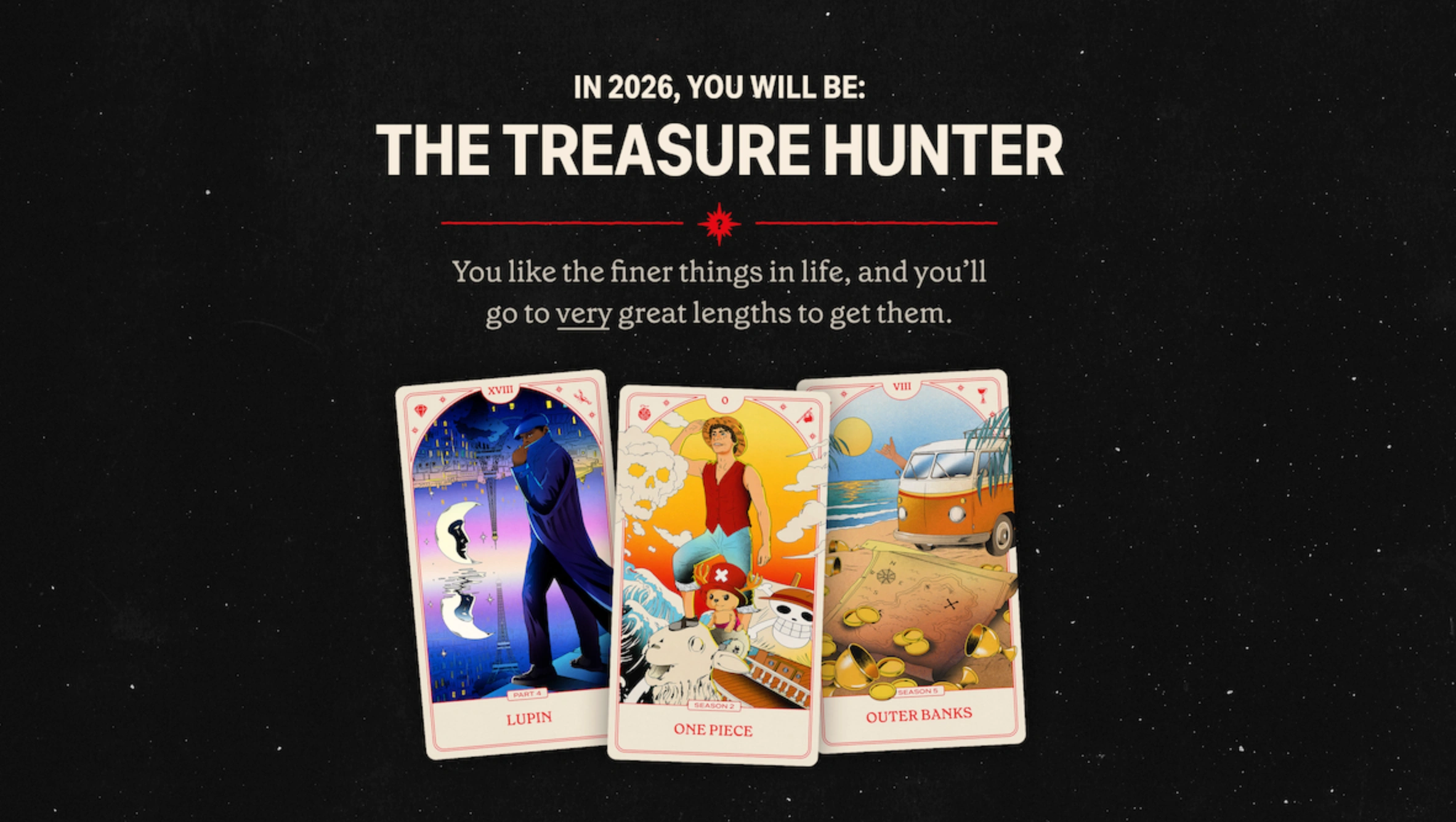
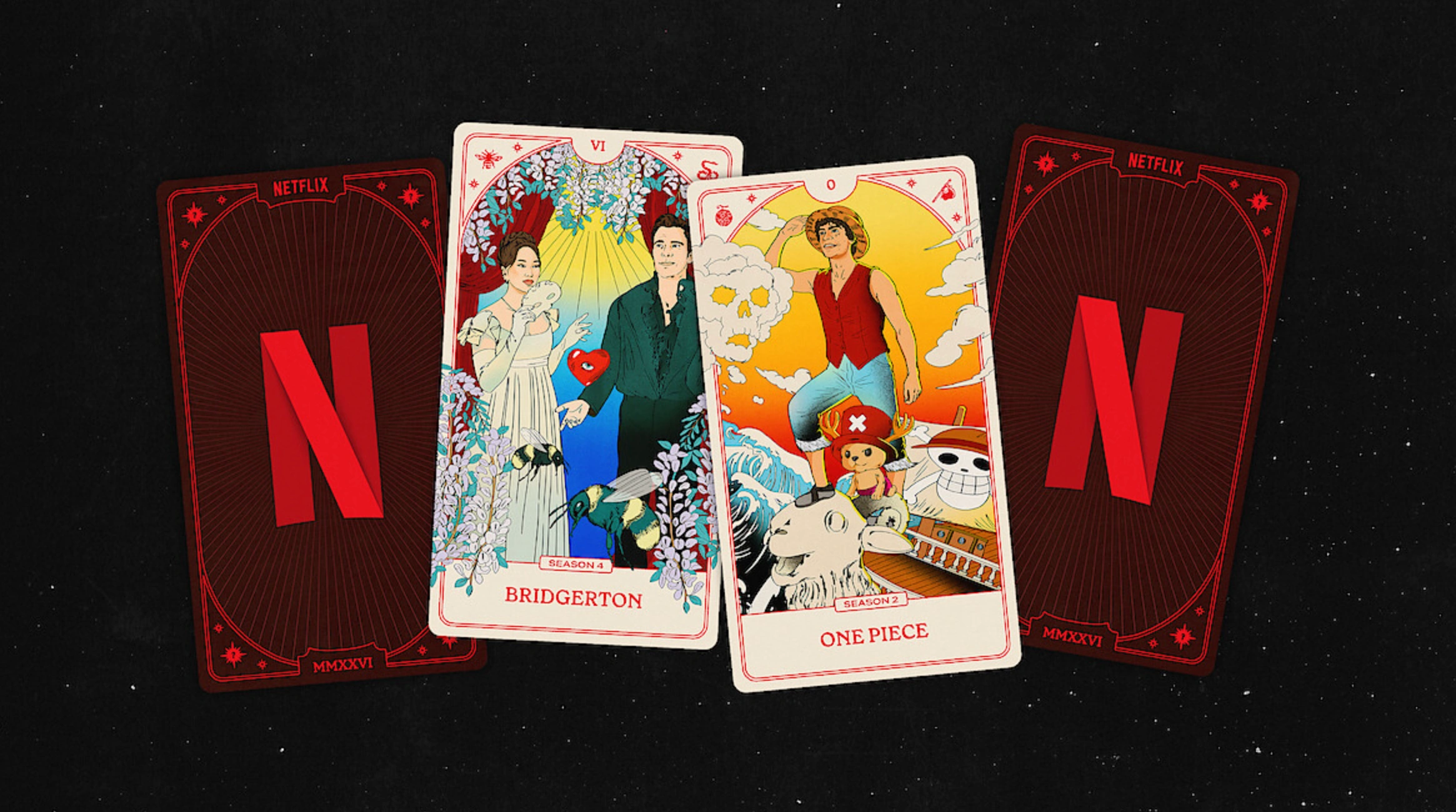
Netflix describes the Netflix tarot experience as part of the Discover Your Future campaign tied to previewing 2026 movies and series, delivered through a personalised reading. (Netflix Tudum coverage)
What Netflix Actually Launched With Discover Your Future
The Netflix tarot marketing campaign is not one asset. It is a set of connected touchpoints designed to move audiences from curiosity into a self-selected viewing path. That is the core reason it functions as a repeatable interactive marketing campaign example.
Netflix launched the broader Discover Your Future slate campaign on January 7, 2026, alongside its What Next announcement. The campaign includes a digital reading experience, while official newsroom messaging anchors the tarot mechanic to Netflix’s 2026 films, series, and games rather than leaving it as a standalone novelty. (Netflix newsroom announcement)
The Netflix tarot experience flow
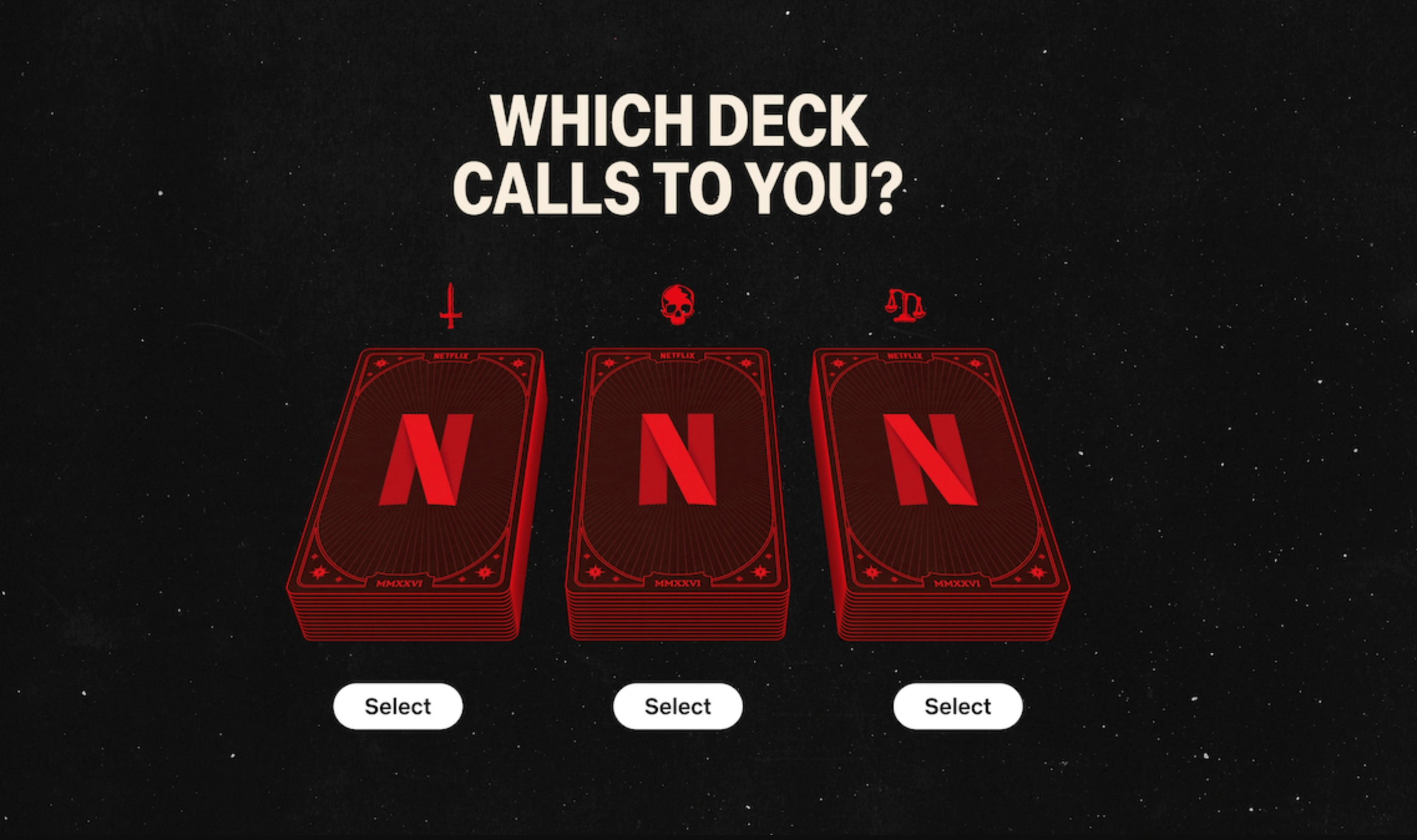
The Netflix tarot experience uses a short guided flow. It asks a limited set of questions and returns a personalised result without requiring a long form or deep personal profile. That makes the interaction easy to understand as a campaign landing page experience.
Key elements in the Netflix tarot experience:
- A guided reading structure tied to upcoming titles and the 2026 slate, framed as what’s next.
- A controlled sequence of prompts that reduces drop-off and keeps the pacing consistent.
- A result that is shareable and legible, so the experience travels beyond the initial session.
Netflix frames this as a personalised reading that offers a glimpse of what’s coming in 2026. (Netflix's Tudum explanation of the experience)
The real-world layer in Grand Central
The experiential marketing activation matters because it changes the campaign’s media profile. It creates a helpfully concrete story for press and creators, and it supplies real footage that looks different from typical brand content. This is how an experiential marketing activation supports a digital campaign landing page experience.
Time Out’s event coverage places the public activation at Grand Central Terminal’s Vanderbilt Hall from January 12 through January 14, 2026, with free public access during listed daytime hours. (Time Out listing for Discover Your Future at Grand Central) For teams adapting a comparable launch across major US markets, a US branding agency can help keep the campaign system consistent while local production, media, and venue details change.
This is also where Netflix slate reveal marketing creates conditions for earned coverage. A physical touchpoint gives press and creators a concrete event to document, while the digital experience gives audiences somewhere to continue the interaction after seeing the activation.
Why Tarot Works for Netflix Slate Reveal Marketing
Tarot is not the strategy. Tarot is the interface. It gives Netflix a structured way to translate a large slate into a personal narrative. That is why the Netflix tarot marketing campaign is a strong interactive marketing campaign example.
Netflix's slate reveal marketing traditionally tries to impress with volume. The Netflix tarot experience instead tries to guide. That shift changes the user’s role from spectator to participant, which is precisely what a modern campaign landing page experience needs to earn time and attention.
Identity framing beats recommendation framing
Tarot outputs are meaning-based rather than framed as a conventional recommendation engine. In this campaign, that lets Netflix package title discovery as a reflection or prompt instead of a list of “because you watched” suggestions.
The transferable principle is to make the outcome feel relevant to the user’s stated mood, need, or intent. Netflix's Discover Your Future campaign uses identity language to make the What Next Netflix 2026 campaign feel more personal without requiring a hard sell.
Cultural familiarity without deep context
Tarot is a familiar cultural format for many audiences, so the campaign can communicate its basic mechanic quickly: choose, reveal, interpret, and share. That familiarity reduces the amount of instruction the landing page needs.
For a campaign landing page experience, familiar mechanics can lower the explanation burden. Content Marketing Institute has discussed quizzes, games, and polls as formats that invite active participation and can create measurable engagement signals. (Content Marketing Institute)
Origins and Evolution: From Slate Reel to Interactive System
The Netflix tarot marketing campaign fits a broader shift in how campaigns need to perform in 2026. Decision makers are not just funding assets. They are funding systems that sustain attention across weeks, not hours. Netflix's Discover Your Future campaign is designed as a loop.
The What Next Netflix 2026 campaign uses participation to refresh the slate reveal format. Netflix slate reveal marketing becomes less dependent on a single announcement day and more reliant on repeatable sharing and re-entry behaviour.
What changed in the 2026 audience behaviour
Digital audiences are accustomed to interfaces that respond to choices and provide a clear next step. The Netflix tarot experience applies that product pattern to entertainment discovery by giving users a guided path rather than a passive slate reel.
Interactive formats create behaviours teams can measure, such as starts, completions, step drop-off, result views, shares, and downstream clicks. Those signals can be useful for campaign learning when privacy, consent, and analytics are designed correctly.
The pivot from announcement to participation
The strategic pivot is that Netflix did not just tell audiences what is coming. Netflix asked audiences to choose a path into what is coming. That is the difference between marketing as distribution and marketing as design.
In the Netflix Discover Your Future campaign, participation is the core mechanic. The experiential marketing activation then gives that mechanic a public stage, while the campaign landing page experience gives it a scalable home.
The Marketing Framework: 4 Ps, SWOT, and a Clear Positioning Move
Frameworks matter because they help leaders translate this into their own context. The Netflix tarot marketing campaign is often discussed as creative. It is more useful to see it as a strategy executed through design choices, channel choices, and measurement choices.
Here is a concise 4 Ps and SWOT read on Netflix's Discover Your Future campaign, framed as an interactive marketing campaign example rather than a one-off stunt.
4 Ps snapshot
Product: The product is discovery itself. The Netflix tarot experience packages discovery as a personalised ritual tied to the 2026 slate. That makes Netflix slate reveal marketing feel like a service, not a broadcast.
Price: The experience is free. The cost is attention and participation, which is the core currency of modern launches.
Place: The primary place is owned digitally, through the campaign landing page experience. The physical place is the experiential marketing activation in a high-foot-traffic environment.
Promotion: Promotion is built into the experience. The result is designed to be shareable, which makes the experience itself a distribution channel.
SWOT snapshot
Strengths:
- Clear differentiation versus typical slate reveal marketing.
- High share potential driven by personalised outputs.
- Strong alignment with the Netflix brand as a discovery engine.
Weaknesses:
- Requires careful UX polish or it risks feeling like a generic branded quiz marketing play.
- Symbolic themes can be misread if tone is not controlled.
Opportunities:
- Extend the Netflix tarot experience into ongoing discovery moments.
- Use the mechanic to drive deeper engagement with specific franchises.
Threats:
- Cultural fatigue if too many brands copy the same mechanic.
- Accessibility risks if the campaign landing page experience is not inclusive on mobile and assistive tech.
Positioning map
On a simple positioning map, most slate reveals sit at high volume, low participation. The Netflix tarot marketing campaign moves toward high participation and high narrative meaning. That creates a distinct lane for the What Next Netflix 2026 campaign.
This is also why it serves as an interactive marketing campaign example. It is not just content. It is a guided experience that produces an outcome and a next step.
Audience Segmentation and Jobs to Be Done
Netflix has a broad audience, so the Netflix tarot marketing campaign cannot be built for a narrow demographic. The segmentation strategy is behavioural. It is based on what people want from entertainment in a given moment. That is a practical lesson for any campaign landing page experience.
Netflix’s Discover Your Future campaign supports multiple entry points. The Netflix tarot experience is flexible enough to serve different moods, while the experiential marketing activation gives the campaign a public narrative for people who value event moments.
Core segments Netflix is speaking to
Segment one: The curiosity-led browser.
They want something quick that helps them decide what to watch.
Segment two: The cultural participant.
They want something shareable that signals taste and identity.
Segment three: The planning-oriented viewer.
They want a sense of what is coming in 2026 so they can anticipate and follow.
The What Next Netflix 2026 campaign uses one interface to serve all three. That is a key reason Netflix's slate reveal marketing here scales beyond a niche.
Jobs to be done the campaign solves
Jobs to be done is a strong lens for branded quiz marketing and interactive marketing campaign example design. The Netflix tarot experience solves a clear set of jobs:
- Help me choose what to watch without feeling overwhelmed.
- Give me a reason to talk about Netflix with others.
- Make the 2026 slate feel relevant to my preferences.
- Let me engage with the brand without committing to a full trailer or long video.
Campaigns and Creative Execution: The Two Big Bets
The Netflix tarot marketing campaign has two big bets. First, it treats the slate reveal as a story. Second, it treats the audience as an active participant. Together, those bets turn the Netflix Discover Your Future campaign into a durable interactive marketing campaign example.
Creative execution matters because it controls the perception of quality. If the Netflix tarot experience looked cheap or felt slow, the metaphor would collapse. The campaign relies on craft to protect the premise.
Big bet one, the hero story engine
A hero film gives the campaign a high-level narrative entry point. It sets the tone, introduces the tarot device, and makes the What Next Netflix 2026 campaign feel cohesive rather than fragmented.
Creative trade coverage of the spot positions it as part of a wider Discover Your Future campaign that includes both the online experience and the Grand Central activation. (Lürzer’s Archive)
Big bet two, the personalised reading
The Netflix tarot experience is the second big bet, and arguably the more important one. It converts passive interest into active engagement. It also creates an output that can travel on social without requiring people to watch a full trailer.
In practical terms, this is a campaign landing page experience designed for completion, meaning a user can start, finish, and leave with something tangible. That is why it works as branded quiz marketing without feeling like a typical quiz.
Content pillars that keep it coherent
The campaign stays coherent because it rotates around a few simple pillars:
- Future, as a narrative frame for the 2026 slate.
- Personal relevance, delivered through the Netflix tarot experience.
- Participation, reinforced by shareable outputs.
- Physical presence is delivered through the experiential marketing activation.
This is the kind of clarity teams should aim for when building an interactive marketing campaign example. Without pillars, the parts do not reinforce each other.
Collaborations and Distribution: Paid, Earned, Owned in One Motion
Netflix Discover Your Future campaign is designed to travel. The campaign does not rely on one channel to do all the work. It combines earned, owned, and supportive paid distribution to carry the What Next Netflix 2026 campaign across different audience behaviours.
Netflix slate reveal marketing becomes easier to connect across channels when the campaign landing page experience gives earned, owned, and paid attention a common destination.
Earned media design
The experiential marketing activation is an earned media generator. It creates visuals. It creates a reason to attend. It creates a public story. Event coverage supports that the activation was positioned as a free, public, visible experience. (Time Out)
The result itself can also support earned distribution because it is designed to be shared. That gives participants an optional artifact to post without assuming that every completed reading becomes organic reach.
Owned experience and re-entry points
Owned media is where Netflix controls the full narrative. The campaign landing page experience is the hub where the interaction happens. Netflix also anchors the slate context through official communications, which gives clarity and legitimacy. (Netflix newsroom)
For organisations outside entertainment, the equivalent is a strong owned landing page tied to a measurable next step. A campaign cannot depend solely on social distribution. The destination must carry the intent. For another entertainment-led example, the Emily in Paris Season 5 collaborations show how product, event, and digital touchpoints can support one release moment in a different format.
Paid support without breaking the spell
Paid media in a campaign like this can function as routing rather than doing all of the persuasion itself. Ads can introduce the premise and send interested audiences into the Netflix tarot experience, where the interaction carries more of the explanatory work.
For other brands, this is where a clean campaign landing page experience matters. If paid media sets one expectation and the page delivers something thinner or harder to use, teams should measure where people leave the flow rather than assuming the problem is the ad alone.
The Technical Stack and Metrics: How to Measure an Interactive Launch
An interactive campaign needs a measurement plan before the creative is final. Otherwise, teams can end up with a polished experience and no agreement on what a useful outcome looks like. A marketing consultation and audit can help define the objective, conversion event, instrumentation, and decision rules before production scope expands.
This section matters for leaders because interactive campaigns can be expensive. A Netflix scale build is not the benchmark. The benchmark is whether the system ties engagement to next actions and whether the web experience is fast, accessible, and maintainable.
Funnel flow from awareness to conversion
Awareness:
- People see the What Next Netflix 2026 campaign through social, press, and public activation.
- They click through to the campaign landing page experience.
Consideration:
- The Netflix tarot experience provides guided discovery.
- Users spend time, make choices, and receive a personalised output.
Conversion:
- Conversion for Netflix is not a purchase. It is a deeper behaviour, such as following titles, returning to browse, or starting a watch session.
- For other brands, conversion could be a demo request, trial start, qualified lead, or sales conversation.
This is the core reason Netflix's slate reveal marketing here is valuable. It builds a clear pathway from awareness into measurable participation.
KPI stack by touchpoint
For a campaign like Netflix’s Discover Your Future campaign, KPIs should map to each layer:
Campaign landing page experience KPIs:
- Completion rate of the Netflix tarot experience.
- Time on experience and step drop-off rate.
- Share rate for results.
- Return rate within seven days.
Experiential marketing activation KPIs:
- Earned media pickups and total reach.
- UGC volume and sentiment.
- QR scans or direct sessions to the Netflix tarot experience.
Slate marketing KPIs:
- Lift in visits to title pages or slate hub pages.
- Lift in watchlist adds where available.
- Organic search lift for key 2026 titles after the campaign window.
For another perspective on interactive formats, Content Marketing Institute summarizes Mediafly engagement data comparing interactive and static content, including engagement and time-spent measures. (CMI summary of interactive engagement data)
Governance, performance, accessibility
A campaign landing page experience should be managed like a product: it needs ownership, performance checks, accessibility review, and a plan for post-launch changes. Teams should test speed and mobile usability rather than assume the experience is frictionless.
For most organisations, this is where teams lose value. Campaign pages are launched quickly, then abandoned. A high-performing interactive marketing campaign example should include:
- Clear ownership for updates and fixes.
- Analytics hygiene and naming conventions.
- Performance budgets for mobile.
- Accessibility checks for keyboard navigation and screen readers.
This is where interaction design becomes practical. A maintainable interactive campaign is easier to govern when the design system, content model, component states, and analytics plan are defined before the build expands.
For teams building comparable experiences, start with the fundamentals: web design agency support for the landing page build, UI UX design agency support for flow and interaction, and an analytics plan tied to your SEO agency measurement stack.
A Practical Playbook: How to Build Your Own Interactive Marketing Campaign Example
The Netflix tarot marketing campaign is a useful reference because it is easy to adapt. Most brands do not need tarot, celebrity talent, or a major venue. They need a clear mechanic, a structured outcome, and a destination that holds attention.
This playbook is designed to help leaders translate the Netflix Discover Your Future campaign into a repeatable method for their own campaign landing page experience.
A minimum viable version
A minimum viable interactive marketing campaign example can be built in weeks, not months. The goal is participation and clarity, not spectacle.
Minimum viable blueprint:
- One question that matters to your audience right now.
- Three to five choices that feel meaningful.
- One output that is easy to share and easy to understand.
- One next step that respects the user’s intent.
Use cases that mirror the Netflix tarot experience mechanic:
- A solution finder that maps needs to a recommended path.
- A maturity assessment that outputs a simple score and next step.
- A product match flow that produces a short personalised summary.
This is branded quiz marketing done with restraint. The output must be useful, not promotional. That is the key difference between a novelty quiz and a campaign landing page experience.
A premium version that stays maintainable
A premium version does not mean heavier animation. It means better craft and clearer measurement. The Netflix tarot experience is premium because it feels intentional and cohesive.
Premium version upgrades:
- A visual system that supports the narrative, consistent typography, and controlled motion.
- Share assets that are legible on mobile and recognisable in feeds.
- Segmented outputs that align to different audience jobs to be done.
- A content model that makes updates possible without rebuilding the whole experience.
This is where branding services matter. When the identity system and interaction design are aligned, the experience can feel like a coherent product rather than a disconnected campaign page.
A campaign landing page experience checklist
Before you launch a campaign, your landing page experience needs a short checklist. This is the operational side of an interactive marketing campaign, and it is where many teams underperform.
Checklist:
- Does the experience load fast on a mid-range phone?
- Can a keyboard-only user complete the flow?
- Is the outcome shareable in one tap?
- Are there clear analytics events for each step?
- Does each output have a defined next step?
- Is there a content owner for post-launch fixes?
- Is the CTA aligned to user intent, not internal targets?
Netflix slate reveal marketing works here because the experience itself is the destination. Netflix's Discover Your Future campaign did not treat the landing page as a supporting asset. It treated it as the product.
For a broader view of how Brand Vision approaches experiences that convert, visit Brand Vision.
Critique, Risks, and What Comes Next
The Netflix tarot marketing campaign is strong, but it is not universally safe. Any interactive marketing campaign example that uses symbolism needs careful tone control. Any experiential marketing activation needs strong logistics and risk planning.
The What Next Netflix 2026 campaign also benefits from Netflix’s category authority. Smaller brands must earn trust more directly through clarity, utility, and accessibility in the campaign landing page experience.
Where this strategy can misfire
Common failure points when brands copy the Netflix tarot experience pattern:
- The interaction is long, but the output is thin.
- The theme is clever, but the decision path is confusing.
- The share asset is unreadable or generic.
- The experience is not accessible, creating brand risk.
- Measurement is vague, so outcomes are debated internally.
Branded quiz marketing can also backfire if it feels like data collection. The Netflix Discover Your Future campaign limits the visible interaction to entertainment choices, which keeps the user-facing mechanic focused on discovery rather than a long lead form.
The next 24 months
Interactive formats are becoming more common, so novelty alone is unlikely to remain a durable advantage. Performance, accessibility, clear outcomes, and maintainability become more important as audiences see more campaign experiences built around quizzes, selectors, and guided flows.
A useful interactive campaign in 2026 behaves more like a product than a static asset: fast enough to use, clear about its purpose, measurable, accessible, and easy to update. The Netflix tarot marketing campaign is a useful marker of that shift without being a template every brand should copy.
Start a Conversation With Brand Vision
Netflix Discover Your Future campaign is a reminder that modern marketing is design. The Netflix tarot experience works because it is a considered system, not a single creative asset. The experiential marketing activation supports the system, but the campaign landing page experience carries it.
If you want to build an interactive marketing campaign example that is measurable, accessible, and maintainable, start with the fundamentals. Build the destination first, then build the distribution plan around it.
If you are planning a comparable experience, contact Brand Vision or start with our web design agency and UI UX design agency practice, with measurement support from our SEO agency.