

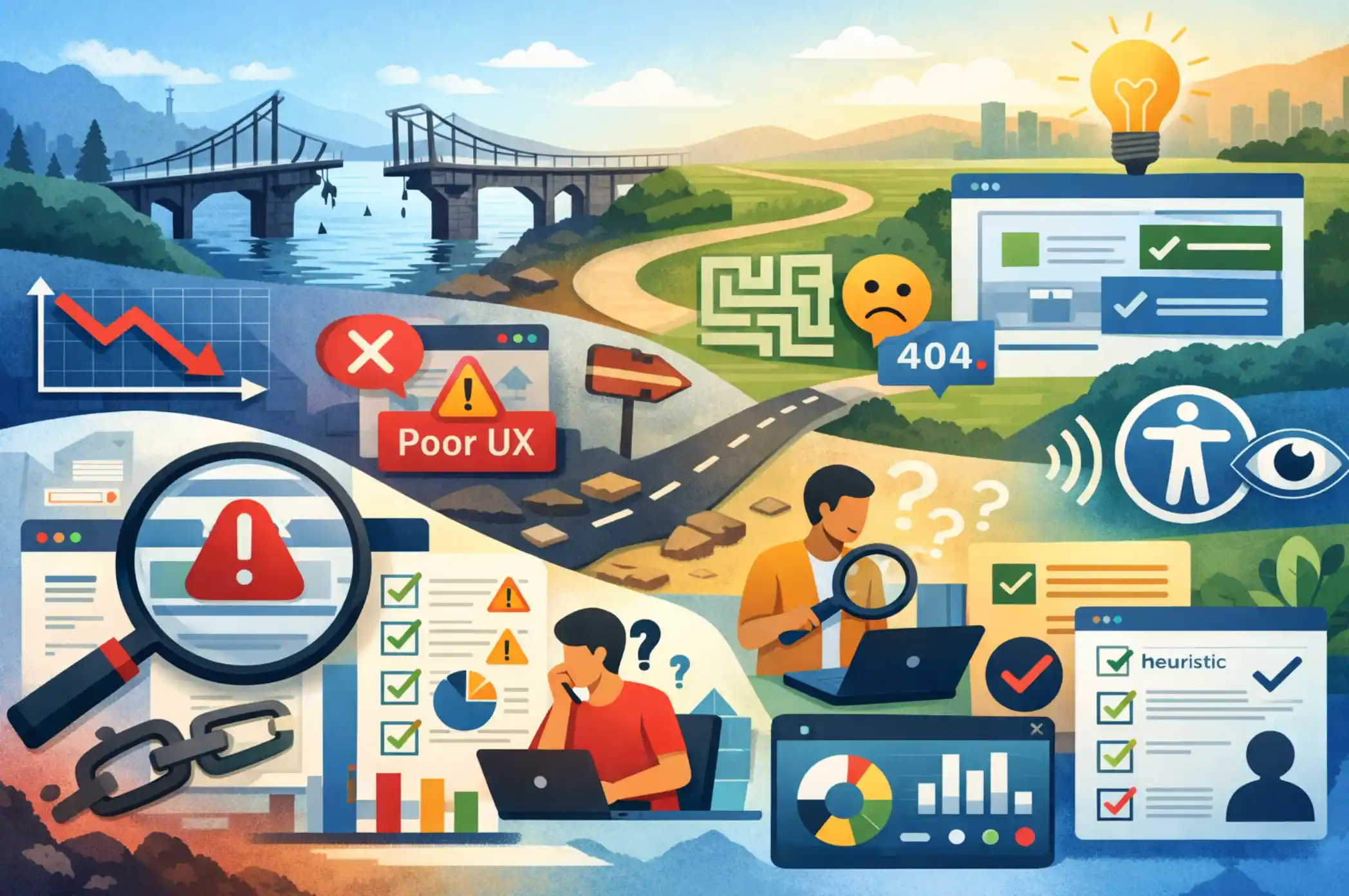
Your website is your highest-performing sales and marketing asset, or at least it should be. When users struggle to navigate a page, abandon a checkout flow, or leave without converting, those are not random events. They are structural signals that a professional UX audit can identify, diagnose, and resolve with precision.
A UX audit is a structured evaluation of your website's user experience against established usability principles, business objectives, and real user behavior data. It reveals friction points, accessibility gaps, and design inconsistencies that suppress performance. For ambitious teams operating in competitive markets, a UX audit is not a discretionary exercise. It is a strategic investment in measurable, defensible growth.
This guide covers everything decision-makers need to understand about the UX audit process: what it includes, how it is structured, what it costs, and what deliverables a rigorous engagement should produce.
.webp)
What Is a UX Audit?
A UX audit is a comprehensive review of a digital product's user experience. It evaluates how effectively your website or application supports the goals of both the business and its users. A well-executed UX audit combines qualitative analysis, heuristic evaluation, analytics review, and accessibility testing to produce a complete, evidence-backed picture of your site's current state.
The term "UX audit" is sometimes used interchangeably with usability audit or user experience audit, though scope can vary by methodology. At its core, every UX audit answers one question: where is your digital product failing users, and why?
UX audits are grounded in recognized industry frameworks. Jakob Nielsen's 10 usability heuristics, maintained by the Nielsen Norman Group, remain one of the most widely applied benchmarks for evaluating interface quality. A heuristic evaluation against these principles reveals navigation failures, inconsistent design patterns, and system feedback gaps that erode user confidence.
Usability problems that go unaddressed compound over time, particularly as product complexity increases. A UX audit surfaces these issues systematically, before they become structural liabilities that require expensive remediation.
Why Your Website Needs a UX Audit
Most websites are not built from a blank slate with perfect UX strategy in place. They evolve over time: new pages are added, content is restructured, products change, and stakeholder requests layer on top of each other. Without periodic review, this accumulation creates inconsistency, confusion, and measurable friction.
A website UX audit is particularly valuable in the following situations:
- Conversion rates are below industry benchmarks
- Bounce rates have increased without a clear technical explanation
- Users are abandoning forms, checkouts, or key conversion flows
- The website was built without formal UX research or user testing
- A redesign is being planned and the team needs a clear, defensible baseline
- Accessibility compliance has never been formally evaluated
- Analytics data reveals consistent drop-off but does not explain the cause
According to the Baymard Institute, which conducts large-scale UX research on digital experiences, the average cart abandonment rate sits at approximately 70%. A significant portion of that abandonment is attributable to friction in the user experience, not pricing or intent. A UX audit identifies exactly where that friction lives and provides the evidence needed to resolve it.
For B2B organizations, the stakes are compounded. Decision-makers visit websites to evaluate credibility, strategic clarity, and capability. If your information architecture is disorganized or your navigation requires significant effort to parse, prospects disengage before you have the opportunity to demonstrate value. A UX audit ensures your website operates at the standard your audience expects and your business requires.
What Does a UX Audit Scope Cover?
The scope of a UX audit varies based on the size and complexity of the website, the goals of the engagement, and the depth of research involved. A structured UX audit typically covers the following areas:
Heuristic Evaluation
A systematic review of the interface against established usability principles. This evaluates navigation clarity, error handling, consistency of design patterns, system feedback, and cognitive load across key pages and user flows. Heuristic evaluation is the analytical foundation of most UX audits.
Information Architecture Review
An assessment of how content and navigation are structured. This examines whether users can efficiently locate what they need, whether menu systems are logical, and whether the hierarchy of information supports the intended user journey. Strong information architecture is a foundational requirement for any high-performance digital experience.
Accessibility Audit
An evaluation of the website against WCAG 2.1 guidelines, maintained by the W3C Web Accessibility Initiative. This covers keyboard navigation, color contrast ratios, screen reader compatibility, alt text implementation, and form field labeling. Accessibility is both a compliance requirement and a measurable usability standard.
Analytics and Behavior Data Review
A data-driven analysis of user behavior using platforms such as Google Analytics, heatmaps, session recordings, and funnel analysis. This layer of the UX audit connects qualitative findings with quantitative behavioral patterns, allowing the team to prioritize recommendations by documented impact.
Core Web Vitals and Performance Assessment
Page performance directly affects user experience. A UX audit evaluates load times, interaction responsiveness, and visual stability using Google's Core Web Vitals framework. Poor performance scores correlate consistently with elevated bounce rates and reduced conversion. Understanding your site's performance baseline is integral to any comprehensive UX audit.
Conversion Flow Analysis
A focused review of key conversion paths: lead forms, product pages, checkout flows, or booking systems. This component of the UX audit identifies where users are dropping off and which design or content decisions may be contributing to that attrition.
Content Clarity and Readability
An evaluation of whether messaging is clear, scannable, and aligned with user intent at each stage of the funnel. Content structure, heading hierarchy, and call-to-action placement are all assessed as part of a well-scoped UX audit.
The UX Audit Process: Step by Step
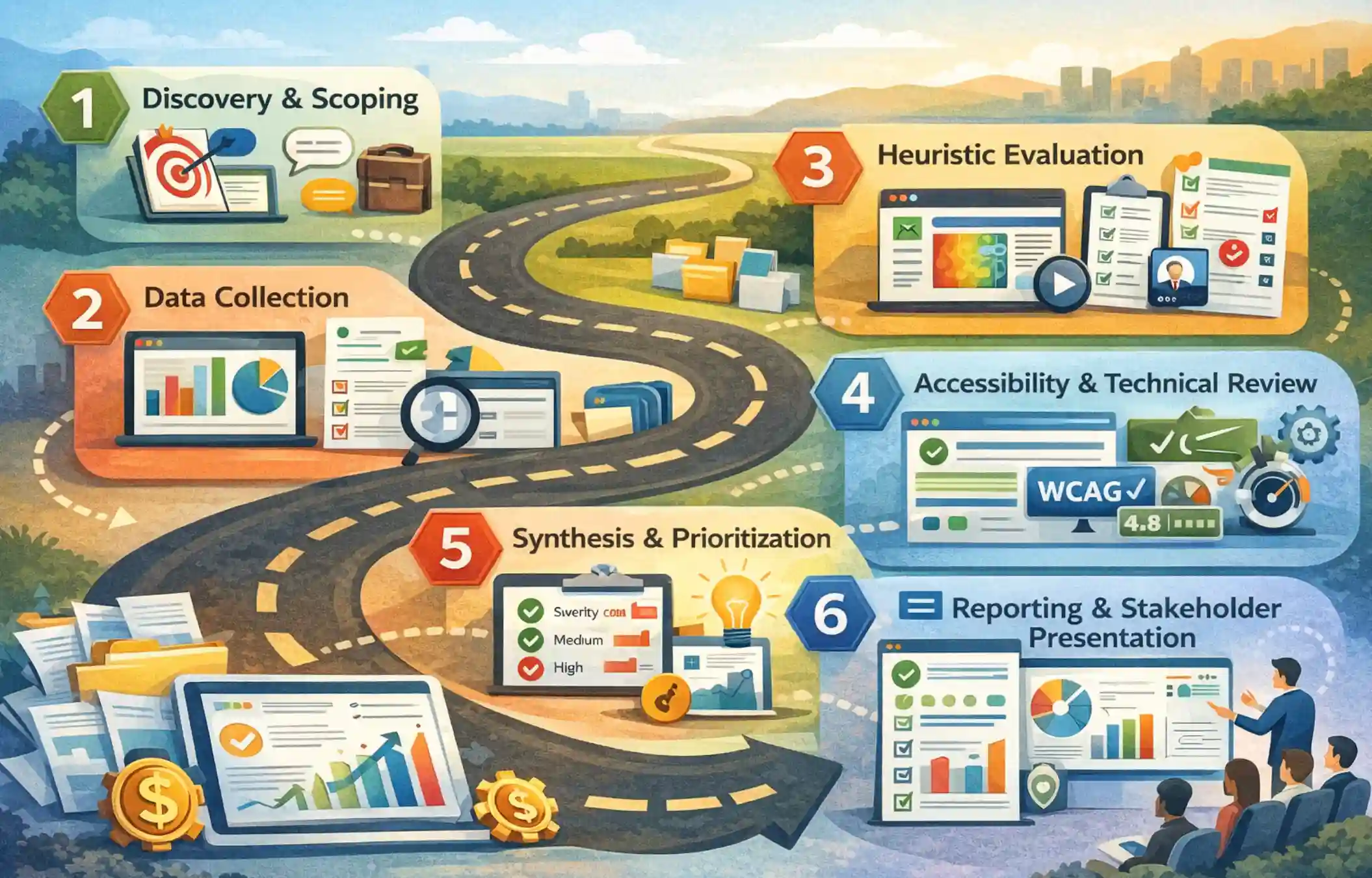
A rigorous UX audit follows a structured, repeatable process. Here is how a professionally governed engagement typically unfolds:
1. Discovery and Scoping The engagement begins with a thorough briefing. The audit team gathers business objectives, target audience profiles, existing analytics access, and key performance benchmarks. This alignment ensures the UX audit produces findings connected to commercial goals, not just theoretical usability best practices.
2. Data Collection The team collects quantitative data from analytics platforms, heatmaps, and session recordings. Qualitative data may be gathered through user interviews, surveys, or usability testing sessions. The combination of both data types produces findings that are measurable and contextually grounded.
3. Heuristic Evaluation Experienced UX specialists evaluate the interface systematically against established frameworks. Each issue is documented, categorized by severity, and mapped to a specific location within the product.
4. Accessibility and Technical Review The site is evaluated for WCAG compliance and Core Web Vitals performance. This layer ensures the UX audit addresses both experiential and technical barriers simultaneously.
5. Synthesis and Prioritization Findings are organized by severity and business impact. The team identifies quick wins alongside longer-term structural recommendations, ensuring the UX audit report is actionable and strategically sequenced for implementation.
6. Reporting and Stakeholder Presentation The final UX audit deliverable is presented to stakeholders with clear explanations, annotated screenshots, and prioritized recommendations tied to measurable business outcomes.
UX audit cost should always be evaluated in the context of what it protects and what it unlocks. Forrester's Total Economic Impact model found that mature design thinking practices can generate an ROI of 85% or greater, with returns varying based on project scope, organizational maturity, and application. A UX audit is the diagnostic foundation that makes design and UX investment precise rather than speculative. It ensures that every subsequent development resource is directed at documented, prioritized problems rather than assumed ones.
UX Audit Deliverables: What You Should Expect
A professional UX audit produces a structured set of deliverables that your team can act on immediately. Depending on the scope of the engagement, standard UX audit deliverables include:
- A comprehensive UX audit report with annotated findings and severity ratings
- A prioritization matrix organizing issues by impact and implementation effort
- Heuristic evaluation documentation with specific interface references
- Accessibility audit findings mapped to WCAG 2.1 success criteria
- Core Web Vitals assessment with benchmark comparisons
- User flow diagrams illustrating identified friction points and drop-off stages
- A strategic recommendation roadmap organized by business impact
- An executive summary formatted for leadership and stakeholder review
The quality of the UX audit report is where the value of the engagement is realized. A rigorous report does not simply catalogue problems. It provides the strategic rationale behind each recommendation and builds the business case for prioritizing resolution. That distinction separates a diagnostic document from a genuine growth instrument.
How Much Does a UX Audit Cost?
UX audit cost varies significantly based on the scope of the engagement, the size and complexity of the website, the depth of research conducted, and the experience of the team involved. The following ranges reflect typical market scope tiers and are provided as general orientation, not published benchmarks. Every engagement should be scoped individually against specific objectives.
Foundational UX Audit (Small to Mid-Size Websites) Covers heuristic evaluation, basic analytics review, and accessibility assessment. Typically suited to websites of 10 to 30 pages with a focused conversion objective. Typical range: $2,500 to $7,500.
Comprehensive UX Audit (Mid-Size to Enterprise Websites) Includes the full scope outlined above: heuristic evaluation, information architecture review, accessibility audit, analytics analysis, Core Web Vitals assessment, and conversion flow analysis. Suited to websites with multiple user types, complex navigation, or significant commercial conversion objectives. Typical range: $7,500 to $25,000.
Enterprise or Platform UX Audit Involves extended research phases, user testing sessions, multiple stakeholder interviews, and cross-platform evaluation. Suitable for SaaS platforms, large e-commerce environments, or organizations with complex digital ecosystems. Typical range: $25,000 and above.
UX audit cost should always be evaluated in the context of what it protects and what it unlocks. A single structural improvement to a high-traffic conversion page, identified through a rigorous UX audit, can produce returns that exceed the cost of the entire engagement. The UX audit eliminates guesswork from that investment by providing documented, prioritized evidence before a single development resource is committed.
When Should You Commission a UX Audit?
Timing matters. A UX audit is most valuable when it can directly inform a meaningful decision or intervention. The following scenarios represent optimal moments to commission one:
- Before a website redesign. A UX audit establishes a clear baseline and ensures the redesign addresses documented problems rather than assumed ones. This prevents costly rework post-launch.
- After a traffic or conversion decline. When analytics signal a performance drop, a UX audit determines whether the cause is experiential rather than purely technical or algorithmic.
- Before a product launch or major feature release. A UX audit at this stage prevents the launch of interfaces that embed friction from the outset, protecting the user's first impression.
- As part of an annual digital governance cycle. High-performing organizations treat the UX audit as a scheduled diagnostic, not a reactive measure deployed only during a crisis.
- When accessibility compliance is a priority. A UX audit ensures the site meets current WCAG standards, reducing legal and reputational exposure.
If your organization is planning a comprehensive marketing consultation and audit of your full digital ecosystem, a UX audit is a core, non-negotiable component of that process. It ensures every subsequent marketing investment is built on a website experience capable of converting the traffic you generate.
UX Audit vs. Usability Testing: Key Differences
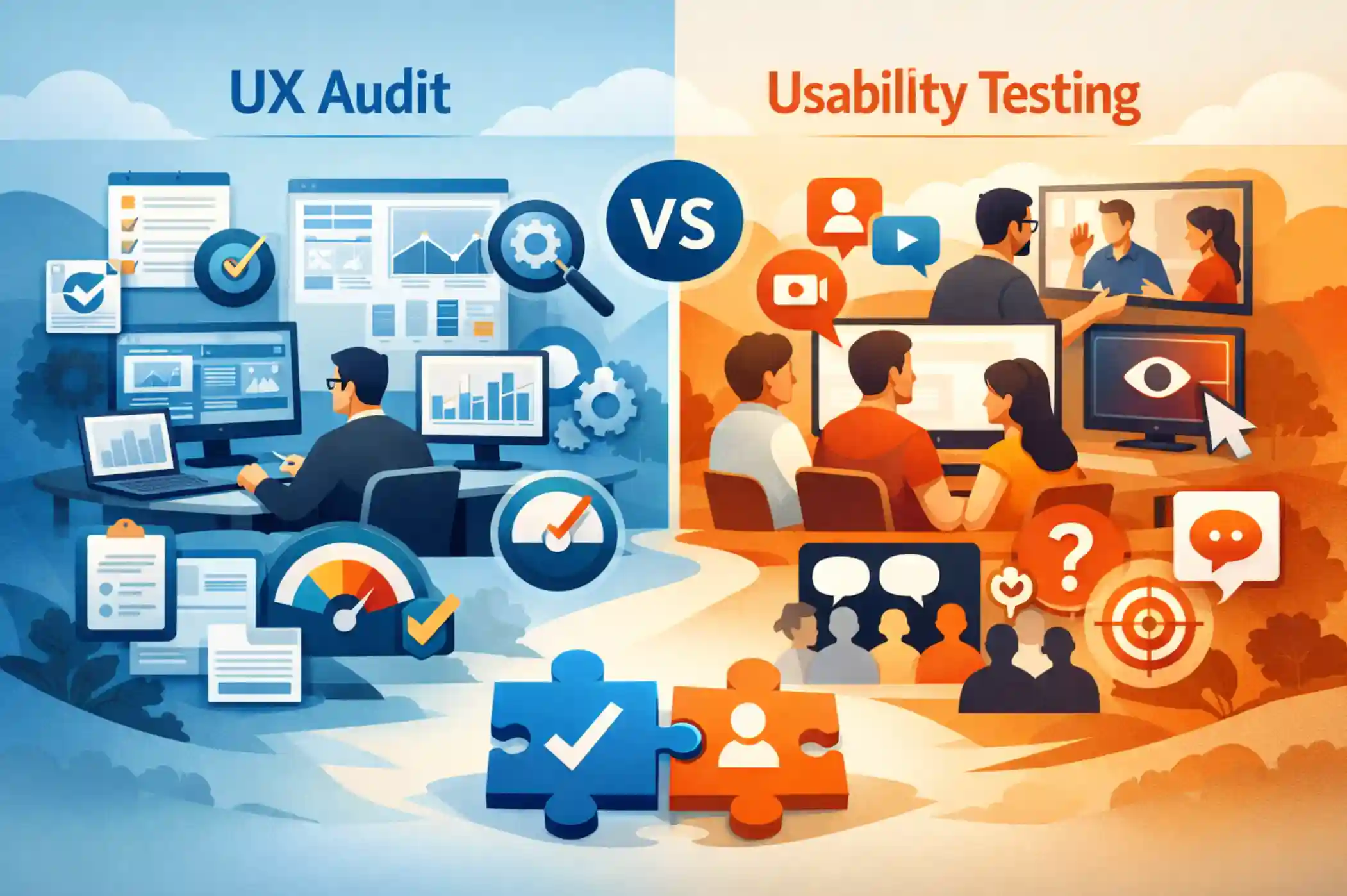
These two terms are frequently conflated, but they represent distinct activities with different methodologies and outputs.
A UX audit is an expert-led evaluation. At Brand Vision we have trained specialists that review the interface systematically using established frameworks, analytics data, and documented best practices. It does not require the direct involvement of end users during the evaluation itself. It is faster to execute and provides immediate, structured insight.
Usability testing, by contrast, involves observing real users as they attempt to complete tasks within the interface. It produces behavioral data and direct insight into how your actual audience experiences the product in context.
Both are valuable and often complementary. A UX audit is more cost-effective as a diagnostic starting point. Usability testing adds depth and validation, particularly when the UX audit surfaces issues that require behavioral confirmation before committing to a resolution. Many mature digital programs deploy both in sequence: the UX audit identifies what to investigate, and usability testing validates the severity and nature of those issues at scale.
How to Choose the Right Partner for Your UX Audit
The quality of a UX audit is directly proportional to the rigor and experience of the team conducting it. When evaluating partners, consider the following criteria:
Methodology transparency. Does the agency articulate a clear, documented UX audit process with defined deliverables? Vague scope and undefined outputs are indicators of a low-caliber engagement.
Cross-disciplinary capability. A UX audit is most valuable when the team connects UX findings to SEO performance, conversion strategy, and brand clarity. Isolated UX expertise without commercial context produces incomplete recommendations that lack implementation priority.
Accessibility expertise. WCAG compliance requires specialized, current knowledge. Confirm that accessibility evaluation is a formal, structured component of the UX audit scope, not a checkbox afterthought. The W3C Web Accessibility Initiative provides the authoritative standard against which all accessibility work should be measured.
Actionable deliverables. The UX audit report should be structured for implementation, not just analysis. Prioritized recommendations tied to business impact, organized by effort and return, are the standard of a professional engagement.
Platform fluency. Whether your site is built on WordPress, Webflow, or a custom stack, your UX audit partner should understand the technical constraints and opportunities of your specific environment. Platform knowledge shapes the feasibility and precision of every recommendation.
Brand Vision integrates UX audit methodology with brand strategy, web design and development, and search engine optimization to produce recommendations that are commercially grounded, sequenced for implementation, and measurable against real business outcomes.
.webp)
Strengthen Your Website With a Structured UX Audit
A UX audit is one of the most precise investments available to a digital team. It replaces assumption with evidence and converts analytics data into structured, prioritized action. For organizations that operate their websites as commercial assets, the UX audit is not a luxury. It is a governance standard.
Whether you are planning a redesign, investigating a performance decline, or building toward a higher standard of digital execution, a UX audit provides the diagnostic clarity that makes the next phase of work defensible, measurable, and strategically aligned.
Our UI/UX design agency structures UX audits to align with your business objectives, your audience's documented behavioral patterns, and your team's capacity for structured implementation. The outcome is not a report that sits in a folder. It is a strategic roadmap that elevates your digital performance from the ground up.
To explore how a UX audit can strengthen your website's performance, connect with our team to begin an initial consultation.



%2520(1).png)