
Most corporate training portals fail at the single thing their creators built them to do: hold attention long enough for learning to actually happen. Employees routinely complete training modules at far lower rates than they finish entertainment content on streaming platforms, and the gap is not accidental.
The interfaces are different, the content structure is different, and the assumptions about how people choose to spend their time are different. Against a corporate e-learning industry now measured in hundreds of billions of dollars, the cost of building portals employees avoid has become a genuine business problem rather than a minor L&D inefficiency.
Streaming platforms operate on a simple observation about modern attention: if the first three seconds of a piece of content do not compel, the viewer leaves. L&D teams have been slow to internalize this reality.
A training portal built on the assumption that learners are captive, because they are required to complete the course, produces the same measurable outcome as any other captive experience. Minimum viable engagement, poor retention, and a quiet collective resentment of the system itself.
The portals that actually succeed borrow specific design patterns from consumer streaming. Those patterns, applied to UX design for learning, are what separate training that changes behavior from training that simply runs to completion.
The Structural Problem Behind Most Learning Platforms
Legacy training portal design typically follows one organizing logic: compliance. Every required module is listed, categories are built around regulatory mandates rather than learning goals, and the visual hierarchy treats all content as equally important. The learner opens the portal and sees a wall of obligation.
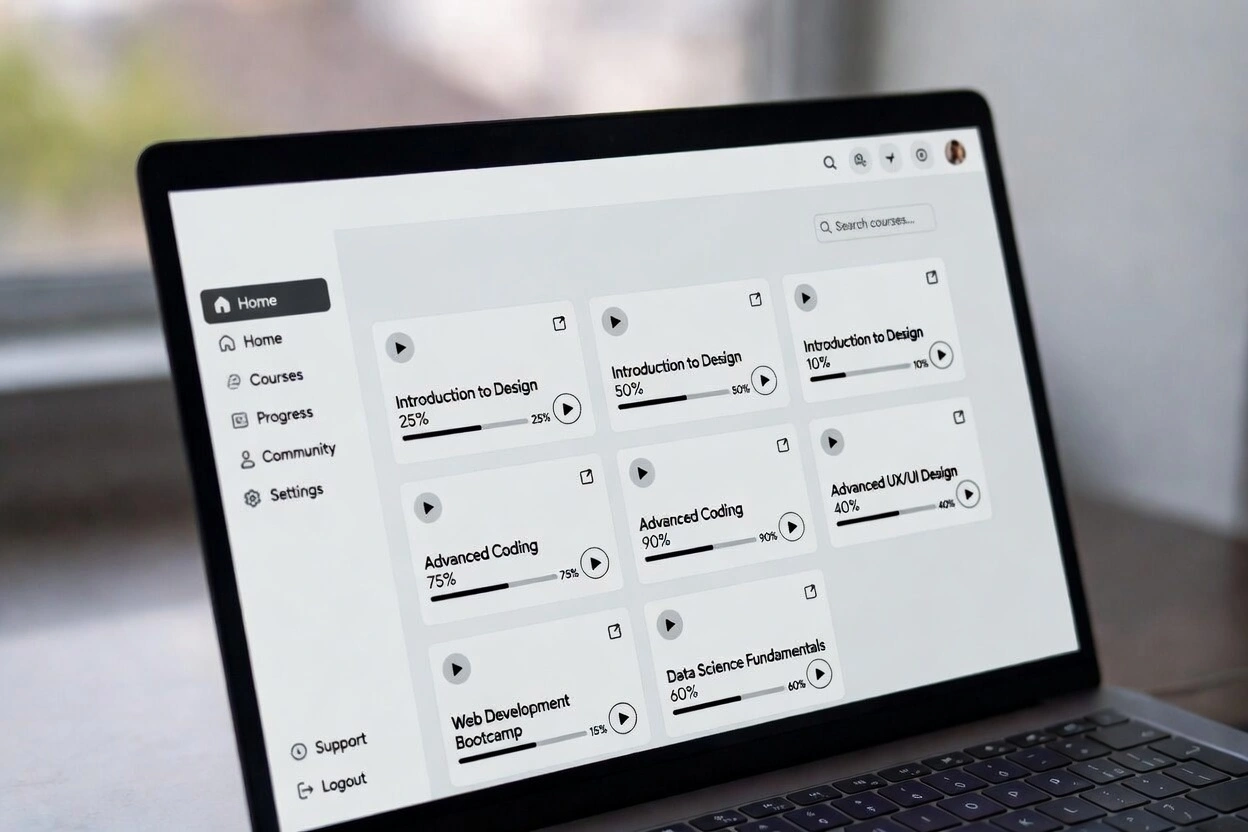
Streaming platforms use the opposite logic. The visual hierarchy is curatorial, the defaults surface high-engagement content first, and the structure makes exploration feel natural rather than assigned.
A learner browsing a well-designed training portal should encounter content the way a viewer encounters a streaming homepage: with strong visual anchors, clear category logic, and an obvious starting point.
The architectural fix is not cosmetic. It is a decision to treat training content as a product that must earn attention, rather than a regulatory artifact that assumes it.
That shift changes everything downstream. Curation replaces comprehensiveness. Visual design replaces boilerplate. And the training portal starts to function as a learning environment rather than a filing cabinet.
Content Structure That Respects How Adults Actually Learn
The second structural shift is duration. Long-form training modules, once the default, perform poorly against modern attention patterns. Research on learning and development in the future of work emphasizes that weaving development into everyday workflows outperforms separate, lengthy training sessions, and that workflow-embedded learning requires shorter, more modular content to be viable.
Microlearning is not a trend. It is an acknowledgment that adult learners complete what fits into the gaps in their day, and abandon what does not.
Effective learning platforms build around this reality. Modules run 3 to 10 minutes, each with a single learning objective, a defined outcome, and a clear relationship to the next module in the sequence.
The structural discipline required to build content this way is significant. Most training content is written to cover topics comprehensively, not to produce specific learner outcomes at specific durations. Rebuilding a portal around microlearning means rewriting content, not just re-chunking it.
Video Is the Format That Earns the Attention
In practice, video tends to outperform text, slides, and audio alone for employee onboarding and compliance learning. The reason is straightforward: video compresses information density in a way that respects attention.
A two-minute video can deliver what a ten-minute reading requires, and do it in a format the learner is already conditioned to consume outside of work.
The production quality of video content inside a training portal now sets the tone for how seriously the learner takes the training itself. Poorly lit screen recordings with monotone narration communicate that the organization does not take learning seriously.
The learner responds accordingly. Working with a specialist partner like Motifmotion corporate training video production is the difference between content that learners watch and content they mentally tune out within the first thirty seconds.
The investment case is clearer than it looks. A training portal anchored by a small library of well-produced videos, supported by text and interactive elements, consistently outperforms a larger library of unwatched content in completion, retention, and application on the job. The cost of producing fewer, better assets is almost always lower than the cost of producing more assets that no one finishes.
Personalization That Goes Beyond Cosmetic Tagging
The word "personalization" has been overused in L&D software marketing to describe features that amount to little more than renaming dashboards. Real personalization inside a training portal means the system adapts what content is surfaced based on role, tenure, prior assessment performance, and the specific skill gaps the organization is trying to close.
A new engineering hire and a ten-year sales veteran should not see the same training portal homepage.
The technical infrastructure to do this properly exists. Role-based content gating, adaptive learning paths, and assessment-driven recommendations are now standard in modern LMS platforms.
The failure, when it happens, is almost always at the content design layer rather than the software layer. Building a training portal that can personalize requires content assets tagged with the metadata that enables personalization, and that tagging discipline is usually missing.
Organizations that get this right treat the training portal as a product managed by a team with content, design, and analytics responsibilities, rather than a project owned by HR alone. The product model is what separates the training portal that stays useful over years from the one that decays within months of launch.
For B2B organizations specifically, where role complexity compounds, the case for structured personalization is even stronger. Sophisticated B2B marketing and operational environments generate exactly the role diversity that generic training fails to address.
Gamification, Used With Discipline
Gamification carries real risk when applied without judgment. Leaderboards and badges applied to mandatory compliance training often produce the opposite of the intended effect, while the same mechanics applied to discretionary skills development can substantially lift engagement.
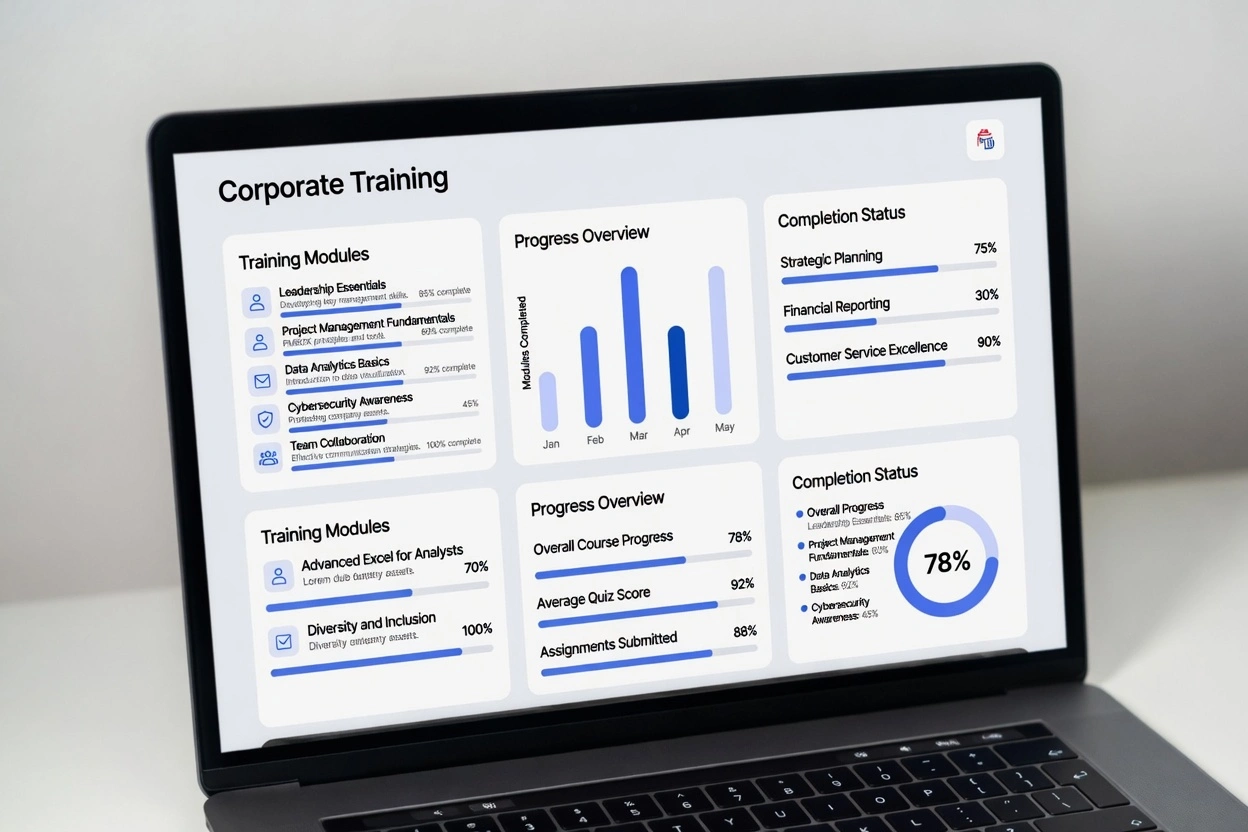
Research on gamification in workforce engagement shows that gamified simulations and interactive quizzes can reduce time to competency for new and seasonal staff, particularly when progress-tracking elements give learners visibility into their own development.
The design principle that matters: gamification aligns well with content learners have chosen to engage with, and tends to backfire on content they are required to complete. A training portal that deploys gamification selectively, matching it to voluntary skill development rather than mandatory modules, produces measurably different outcomes than one that applies the same mechanics universally.
Analytics That Inform the Next Iteration
A training portal produces extensive behavioral data. The question is whether anyone uses it. Completion rates alone are a weak signal. They tell the organization that content ran, not whether it worked.
The metrics that matter measure knowledge retention over time, behavior change on the job, and the specific drop-off points within modules where attention fails.
Drop-off analysis, specifically, is the analytic practice most closely copied from streaming platforms. When a video has a consistent abandonment point at the three-minute mark, that is a production signal. When a module has a consistent abandonment point at the second quiz, that is a content signal.
The training portal that treats these signals as product feedback, and rewrites content accordingly, compounds its value over time. The one that treats them as reporting artifacts gets less useful every quarter.
The analytic infrastructure for this analysis ships with most modern LMS platforms. The practice of actually using it is rarer, and it is often the single differentiator between learning platforms that evolve and ones that decay.
What Learning Experience Design Borrows From Streaming, and What It Does Not
The streaming-platform comparison has limits. Training is not entertainment, the learner is not a viewer, and a training portal that tries too hard to mimic consumer UX produces its own failure mode: a learning environment that feels unserious.
The principles that transfer cleanly are structural. Short-form content. Visual hierarchy built around engagement. Personalization driven by data. Iterative improvement based on behavioral analytics.
The cultural dimension of this shift, as argued in a case for creativity in corporate learning, emphasizes that creativity and playfulness in training design are actively undervalued in most corporate L&D functions. The training portals that take this seriously produce measurable lifts in voluntary engagement and self-directed learning, which are the two signals most strongly correlated with actual skill development.
What does not transfer is the content itself. A training portal is not competing for attention with Netflix. It is competing for the scarce attention employees have left after their primary work is done, and that competition is won on respect for their time, clarity of purpose, and quality of content. The streaming aesthetic is useful only in service of that outcome.
For organizations evaluating this as a broader operational question, a structured marketing and digital strategy consultation often surfaces the same pattern: the platforms that underperform are almost always the ones treated as projects rather than products, with no owner accountable for ongoing iteration.
Where Portals Earn Their Audience
The training portals that will outperform their peers over the next five years share a consistent profile: built as products rather than projects, prioritizing content quality over content volume, personalizing with actual data rather than cosmetic tagging, and treating analytics as a continuous feedback loop rather than a reporting function.
Organizations that adopt this posture will produce measurably better outcomes across onboarding, compliance, and professional development.
The technical tools to build a training portal like this are no longer a barrier. The design discipline, the content investment, and the organizational willingness to treat learning as a product are what separate the portals that learners complete from the ones they endure. That shift is available to any organization serious enough to make it.











.webp)