
The Godiva rebrand matters for a simple reason. It shows what it takes to modernize a legacy brand without trading away trust. For decision-makers, that is the real constraint in 2025. Your buyers are comparing everything. Not just products, but cues, experience, and credibility.
Godiva is approaching its 100th anniversary in 2026, and it is using that milestone as a deadline for a full brand reset. The shift spans identity, packaging, product architecture, and a global campaign. It also includes a commerce move that signals deeper operational change, not just creative refresh. Godiva’s parent company, pladis, lays out the reset as a multi-surface rollout across packaging, retail stores, and digital experience. You can read the announcement here: GODIVA unveils new identity ahead of 100th anniversary.
At Brand Vision, we pay attention to rebrands like this because they reveal a practical playbook. Not the press-release version. The operating version: what gets updated, how it gets governed, and what a leadership team should measure to decide whether the change worked.
The Godiva Rebrand In 60 Seconds (What Changed, What Didn’t)
At A Glance: The Five Moves Behind The Brand Reset
If you only remember five things about the Godiva brand reset, start here.
- Identity reset: a refined logo and refreshed Lady Godiva symbol integrated more cleanly into the mark.
- Packaging and design language: a system meant to hold across shelves, gifting moments, and digital touchpoints.
- Core product reinvention: refreshed Gold and Truffle collections, plus a spotlight on Masterpiece as a modern “entry” line.
- Campaign relaunch: “Lady Godiva Returns: A Modern Masterpiece is Born,” led by Leighton Meester across CTV, OOH, digital, social, and influencers.
- Experience shift: digital commerce upgrades and new partnership moves that point to broader reach and relevance.
pladis describes the rebrand as “over a year in the making,” rolling out across packaging, retail stores, and digital experience as Godiva heads into its centennial year. (Pladis Global)
What Stayed Consistent: The Heritage Cues Godiva Kept
Good rebrands are edits, not replacements. Godiva kept the equity assets that already mean something.
- The Lady Godiva symbol remains central, not minimized.
- Gold as a signature cue still carries the premium promise.
- Craft and gifting still frame the product story, even as the brand broadens access.
This is the first lesson worth copying. A rebrand that breaks recognition forces you to buy it back with paid media. A rebrand that tightens recognition compounds faster.
View this post on Instagram
A post shared by Leighton Meester (@itsmeleighton)
Why Rebrand Now: Centennial Timing + Modern Trust + Premium Dynamics
Centennial As A Strategic Deadline
Anniversaries create permission. They also create urgency.
Godiva’s centennial is not just a narrative device. It is an operational forcing function. It gives the organization a date to coordinate packaging transitions, retail updates, photography, digital templates, and campaign assets. pladis positions the reset as a lead-in to 2026, with the brand reset debuting globally in October 2025. (Pladis Global)
For leadership teams, this timing logic is useful. Large rebrands fail most often when the launch is treated as a single event. The stronger model is a staged system change, anchored to a deadline everyone respects.
Trust And Cultural Relevance Are Now Linked
Brand trust is no longer built only on product performance. It is built on relevance, clarity, and consistency in how a brand shows up.
Edelman’s 2025 Trust Barometer special report on brand trust captures the shift in blunt terms. In their global data, 73 percent of respondents say a brand that authentically reflects today’s culture would be more effective at increasing trust than a brand that ignores culture and focuses solely on its products. The same report shows that “I trust it” is tied at 88 percent among top purchase considerations, alongside value and quality. (Edelman)
This is the quiet logic behind many 2025 rebrands. The work is not only to look modern. It is to feel current in a way that does not read as opportunistic.
Premium Is Being Re-Defined In Everyday Channels
Premium brands are under pressure from two directions.
- Down-market pressure: consumers are value-conscious and skeptical of empty signals.
- Up-market pressure: premium is now expected to include experience, convenience, and digital polish.
Godiva’s rebrand leans into this reality by modernizing the premium cues while expanding the ways people can buy and gift the product. The Masterpiece push is a strong signal here. It brings the brand into more everyday purchase moments while keeping a premium story.

Godiva’s Brand Equity, Briefly: From Brussels (1926) to Global Premium Gifting
The Equity Assets: Symbol, Gold, Gifting, Craft
Godiva’s history matters because it explains what the brand can change safely. pladis anchors the origin in Brussels in 1926 and frames the legacy around craftsmanship and indulgence. (Pladis Global)
Over time, three equity cues became dominant:
- A recognizable symbol in Lady Godiva.
- A premium color and material language built around gold and gifting.
- A consumption context that is less “snack” and more “occasion.”
Those cues are a moat. They are also a constraint. They limit how far a brand can stretch without confusing the buyer.
The Constraint: Heritage Can Become Repetition
Heritage brands often repeat themselves into irrelevance. The risk is not that the heritage is wrong. The risk is that it becomes predictable.
A modern rebrand is often a correction to that pattern. It clarifies the brand promise in a format that travels better across screens, retailers, and modern media.
The Strategic Bet: Heritage Craft Packaged as Modern, Cross-Channel Culture
Positioning: Chocolate As Art, Not Just Indulgence
pladis frames the shift as “redefining chocolate as fine art,” anchored by a refreshed portrayal of Lady Godiva and an elevated design system. (Pladis Global)
This is more than copy. It is a positioning move with practical implications:
- Art framing supports premium pricing without relying only on tradition.
- Art framing travels well in social media because it is visual and collectible.
- Art framing makes collaborations feel coherent because art culture is built on editions, drops, and creative partnerships.
If you are building your own reset, this is where brand strategy becomes the center of gravity. Design follows strategy. Otherwise, a new look becomes a temporary event.
Audience Expansion Without Premium Dilution
Godiva is aiming at two groups at once.
- Loyal buyers who already associate the brand with gifting and premium cues.
- New buyers who want premium taste in a format that fits everyday purchase behavior.
The rebrand solves this through system design. It updates the symbol and packaging so the premium codes stay intact, while the product architecture creates an accessible ladder.
This is also where many rebrands break. When the ladder is built, but the cues are not consistent, the premium tier gets dragged down by the entry tier. Godiva is signaling an attempt to avoid that by making the identity system carry across all tiers.
Visual Identity Teardown: The Lady Godiva Mark, Logo System, and Design Rollout
Symbol Hierarchy And Logo Lockups
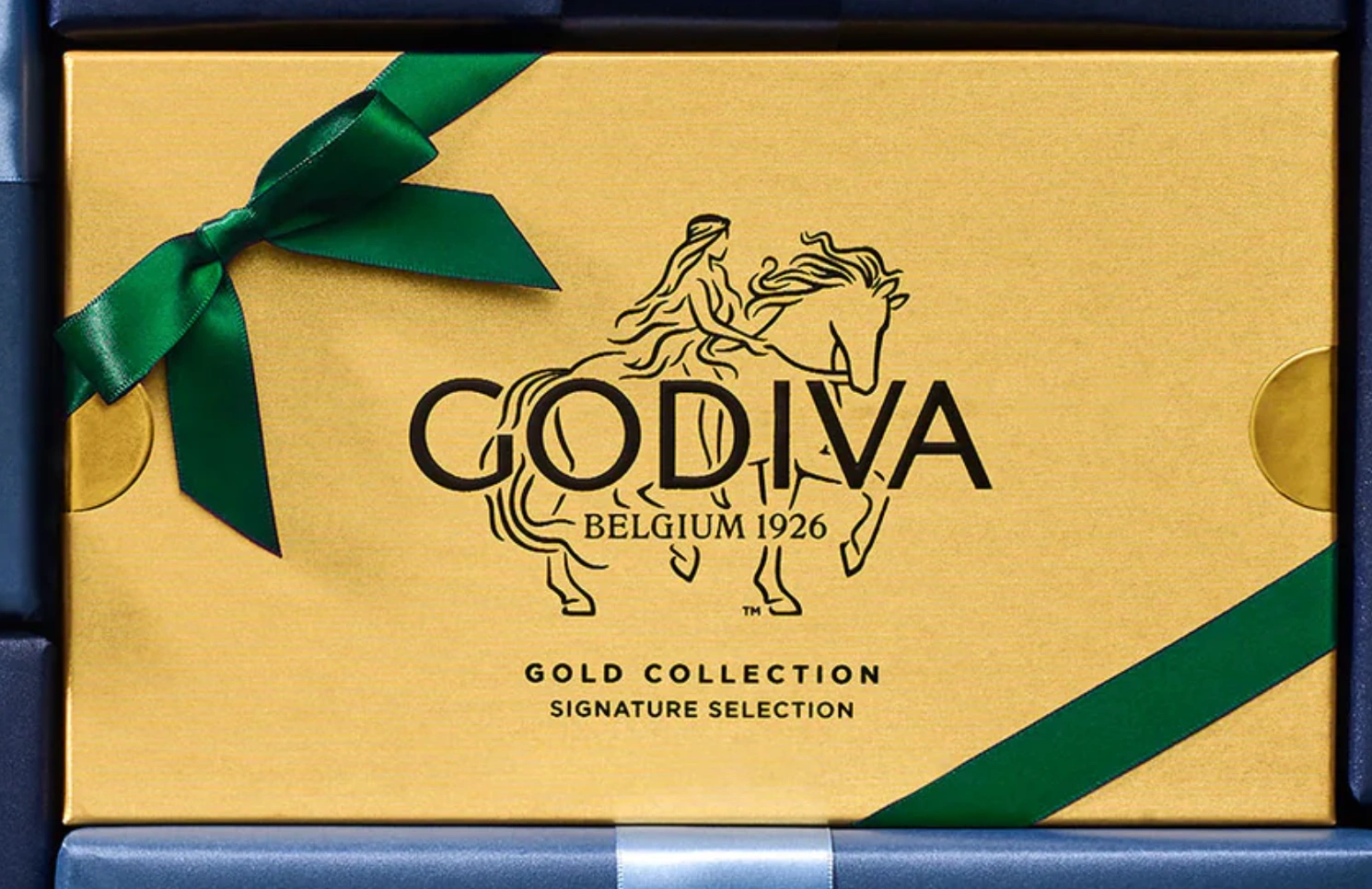
Marketing Dive describes a new logo that integrates the Lady Godiva icon more cleanly into the mark. It also notes that the reset is the first time in at least 15 years that Godiva has undertaken a brand reset. (Marketing Dive)
From a visual identity perspective, this choice is disciplined. It treats the icon as an equity asset, not decorative nostalgia. That matters because the symbol is doing three jobs at once:
- Recognition on shelf and in search results.
- Premium signaling through craft detail and restraint.
- Story anchor for the “Lady Godiva Returns” campaign narrative.
For brands considering a reset, this is a useful checkpoint: if your symbol is still valuable, bring it closer to the core mark. Do not let it float as a secondary element that disappears in small formats.
If you need a reference point for how to document and scale this kind of system, a formal visual identity guide and brand book is the practical deliverable, not a logo file.
-1.webp)
Packaging Hierarchy And Shelf Readability
Packaging is often the highest-ROI surface in a rebrand. It shows up where conversion happens. It also has to work in hard conditions: fluorescent lighting, partial visibility, competitor clutter, and time pressure.
Godiva’s packaging refresh appears designed to do two things:
- Improve hierarchy: make the brand and product line readable at a glance.
- Keep premium cues: preserve gold, craft detail, and gifting posture.
This is where many teams over-index on aesthetic novelty. The more important question is operational: can the buyer identify the line, flavor, format, and occasion in under two seconds?
A practical packaging hierarchy test you can copy:
- At six feet away, can you read the brand and line?
- At two feet away, can you identify the variant and format?
- In a thumbnail, can you recognize it as yours without color accuracy?
If the answer is no, the rebrand is not finished.
Digital Constraints: Small Screens, Accessibility, Performance
A 2025 identity system needs to survive digital constraints. That includes:
- Small sizes: mobile ads, email tiles, site headers, retailer thumbnails.
- Accessibility: color contrast, legible type, predictable hierarchy for screen readers.
- Performance: lightweight assets that do not slow conversion paths.
This is where brand teams often need partnership between design and engineering. A modern brand system should include a small set of reusable components:
- Logo lockups with clear spacing rules
- Type scale for web and email
- Color tokens with contrast guidance
- Photography rules that work on product pages and in paid social
When this system is executed well, it reduces production load and improves consistency. That is why rebrands increasingly connect to web design agency and experience work, not only packaging and campaigns.
Product Architecture: Gold + Truffles + Masterpiece (And Why Portfolio Design Matters)
Gold And Truffles As The Heritage Anchors
pladis is explicit about what sits at the center of the reset: the Gold collection and the Truffle collection, refreshed with new designs, flavors, and recipes while holding onto craftsmanship and storytelling. (Pladis Global)
This is a classic rebrand move for legacy premium brands. You protect the core first. It anchors trust during the transition and gives loyal buyers a reason to re-engage.
For other brands, the equivalent move is identifying two or three products that are “equity carriers,” then prioritizing them in the rollout:
- Update those SKUs first.
- Give them the cleanest storytelling.
- Use them in campaign creative.
Masterpiece As The Accessibility Ladder
The Masterpiece line is positioned as a more everyday format that still carries premium cues. Marketing Dive notes that the campaign spotlights the Masterpiece Collection, aligning it with the new Lady Godiva narrative. (Marketing Dive)
From a portfolio-design standpoint, Masterpiece functions as an “entry rung.” It helps Godiva expand reach without forcing the full gift-box purchase behavior every time.
The business logic behind an entry rung is measurable:
- Higher trial volume
- Higher frequency of purchase
- More distribution opportunities
- Stronger branded search and retailer discovery
All of that can support the premium tier, if the identity system keeps the ladder coherent.
Channel Strategy: Grocery, Drug, Department, Club
Channel strategy is where rebrands become real. Distribution determines who sees the new brand, how often, and in what purchase context.
Allrecipes’ reporting on the Masterpiece rollout illustrates the ladder clearly through pack sizes and suggested price points, spanning grocery and drug retailers, department stores, and club formats. Godiva is unveiling a new Masterpiece Collection
Even if you ignore the specific numbers, the design lesson holds. Portfolio architecture is not only about products. It is about matching the format and price to the channel and the buyer’s moment.
Go-To-Market: “Lady Godiva Returns” and the Channel Mix Logic
The Campaign Story
“Lady Godiva Returns: A Modern Masterpiece is Born” puts Leighton Meester in the role of Lady Godiva, using a cinematic, culture-facing storyline to relaunch the icon. The campaign is positioned as a global push tied to the broader brand reset ahead of the 2026 centennial. (Godiva Chocolates)
The campaign’s job is not only awareness. It is permission. It tells the market that the icon can be modern without becoming ironic.
Media Mix: CTV, OOH, Social, Influencer
Marketing Dive notes that the campaign spans connected TV, out-of-home, billboards, digital, social, and influencer activations. (Marketing Dive)
This channel mix makes sense for a rebrand because it does two things at once:
- It creates broad mental availability through reach channels.
- It creates repeated proof points through short-form and influencer content.
A practical takeaway for marketing leaders: a rebrand campaign should be planned as an asset system. One hero spot is not enough. You need consistent cutdowns that preserve the cues, especially the updated logo, packaging, and product shots.
Retail And Ecommerce Integration
Rebrand campaigns fail when the product page and retail shelf do not match the ads.
The operational requirement is simple:
- The packaging on shelf should match the creative.
- The product pages should show the updated design system.
- The conversion path should reduce friction, especially for gifting.
This is where user experience work becomes revenue work. Gift flows benefit from clear bundles, reliable shipping timelines, and predictable navigation. A UI UX design agency lens helps teams translate brand cues into flows that convert.
.webp)
Collaborations as Distribution + Culture: What Godiva’s Newest Partnerships Signal
Celebrity As Brand Muse
A celebrity-led campaign is not new. The more interesting point is how Godiva uses celebrity to reframe a symbol.
Leighton Meester is positioned as the first person to portray Lady Godiva for the brand, turning an icon into a character in a modern story.
For brand leaders, the lesson is about role clarity. Celebrity can do three jobs:
- Borrow attention.
- Borrow meaning.
- Borrow legitimacy in a new audience segment.
The risk is dilution. If the celebrity becomes the brand, the equity does not compound. Godiva appears to avoid that by keeping Lady Godiva, not Meester, as the primary narrative anchor.
Pop-Culture Limited Editions
Godiva’s newest collaborations also show a second play: limited-edition products that connect the brand to collector culture.
One current example is the GODIVA x LABUBU collection, presented as a limited-edition series across chocolates and keepsake tins. This is a collaboration that blends premium gifting behavior with collectible design. GODIVA x LABUBU collection
For leadership teams, collaborations are best treated as a disciplined tool, not a trend. Use a scorecard before you say yes:
- Does this partner expand distribution or audience reach?
- Does it reinforce our premium cues or contradict them?
- Can the identity system hold across packaging, content, and commerce?
- What is the measurement plan: awareness, conversion, repeat, or PR value?
Shopify Partnership And Commerce UX
Not all partnerships are cultural. Some are operational.
Godiva announced a partnership with Shopify on December 17, 2025, framing it as a move that brings together brands focused on crafted experiences. Shop GODIVA on Shopify
This matters because a rebrand is judged in conversion, not only in sentiment. If a brand refresh increases attention but the site experience creates friction, the work underperforms.
Commerce upgrades typically target measurable outcomes:
- Higher conversion rate
- Higher average order value through bundling
- Lower support burden through clearer shipping and gifting details
- Faster iteration and better governance across campaigns
This is also where search engine optimization becomes part of brand stewardship. A refreshed identity often drives a temporary lift in branded search. The site needs to capture that demand with fast pages, clean information architecture, and consistent product taxonomy.
.webp)
Rollout and Governance: How to Rebrand Across Packaging, Retail, and Digital Without Drift
The Minimum Viable Brand System
A brand reset is a system launch. Governance is what keeps it from splintering.
A minimum viable brand system for a rebrand of this scale includes:
- Brand architecture map: lines, sub-lines, naming conventions, and which cues signal tier.
- Asset library: approved logos, lockups, and packaging files with version control.
- Component set: reusable templates for web, email, social, and retail signage.
- QA process: someone owns consistency checks across all channels.
- Training: sales, customer support, and retail partners understand what changed and why.
This is where a branding agency often provides the documentation layer that internal teams do not have time to build while running the business.
Packaging Transition Plan For SKU Complexity
Packaging transitions are usually the hardest part of a rebrand. They involve lead times, inventory, retailer coordination, and compliance constraints.
A practical transition plan looks like this:
- Define “hero SKUs” that switch first to establish recognition.
- Set cutover rules for old packaging sell-through versus new packaging shipping.
- Align retail photography and listings so thumbnails match what people see in-store.
- Create a SKU naming and tagging standard to prevent catalog clutter.
- Prepare customer support macros for “Is this new packaging real?” questions.
If you skip this, you create confusion that looks like counterfeit risk. That erodes trust quickly, even when the product is unchanged.
Digital Governance: Templates, Tokens, QA
Digital drift is subtle. It starts with one off-brand landing page and becomes a fragmented experience.
The fix is not endless review cycles. The fix is a system:
- Design tokens for color, spacing, and type scale.
- Reusable page templates for product lines and campaigns.
- Performance guardrails so design updates do not slow the site.
- Accessibility checks as a standard step, not a last-minute fix.
Done well, digital governance reduces production friction and protects the rebrand’s compounding value.
If your team is rebuilding the digital layer as part of a rebrand, it helps to align brand, UX, and engineering early. That is where website design and development services become part of brand consistency, not a separate project.

The Brand Reset Scorecard: What to Measure in the First 90 Days (and Through 2026)
First 30 Days: Leading Indicators
The first month is about signal, not revenue certainty. Track whether the market is noticing and whether channels are aligned.
Core indicators to watch:
- Branded search lift for “Godiva rebrand,” “Godiva new logo,” and “Godiva new packaging” style queries
- Share of search versus key competitors, if you track it
- Creative recall proxies such as video completion rates and engagement quality
- Retail readiness: are the right SKUs and shelf assets live where the campaign is running?
This is also when internal teams should audit drift. If your paid creative shows new packaging but your product pages show old imagery, you are paying for confusion.
Days 31-90: Conversion And Retention
In the second and third month, measurement should shift toward conversion and repeat behavior.
Track:
- Conversion rate on key product pages and gift bundles
- Average order value and bundle attach rates
- Repeat purchase rate for entry-rung products
- Email performance on launches, especially click-through and unsubscribes
- Customer support themes that signal confusion or friction
A calm benchmark worth keeping in view is trust itself. Edelman’s report shows “I trust it” at 88 percent among top purchase considerations, tied with value and quality. If your rebrand creates uncertainty, conversion will reflect it. (Edelman)
Through 2026: Brand Equity And Distribution
A centennial rebrand is not a quarter-long play. The durable outcomes should show through 2026.
Look for:
- Distribution expansion into channels that match the new portfolio ladder
- Sustained premium mix without margin erosion
- Higher gifting frequency across more occasions, not only holidays
- Improved ecommerce efficiency: faster iteration, better content governance, lower operational drag
This is where the Shopify move becomes relevant as an operational signal. If you upgrade the platform but do not upgrade taxonomy, content operations, and performance governance, the benefit is limited. Shop GODIVA on Shopify
A Simple Reporting Cadence
A rebrand scorecard should be boring. That is a compliment. It should make it easy for a leadership team to decide what is working.
A simple cadence:
- Weekly (first 6 weeks): branded search, conversion, creative performance, retail execution checks
- Monthly (months 2–6): repeat rate, AOV, channel ROI, distribution milestones, sentiment themes
- Quarterly (through 2026): brand equity proxies, share of search, product mix, platform health
If you are rebuilding brand, site, and growth systems at the same time, it helps to keep measurement and governance aligned from the start. More case studies and breakdowns like this live in Brand Vision Insights.
If you want a practical assessment of where your brand system is drifting, or what a rebrand would require across packaging, web, and growth, start with a marketing consultation. Speak with our team.



%2520(1).png)