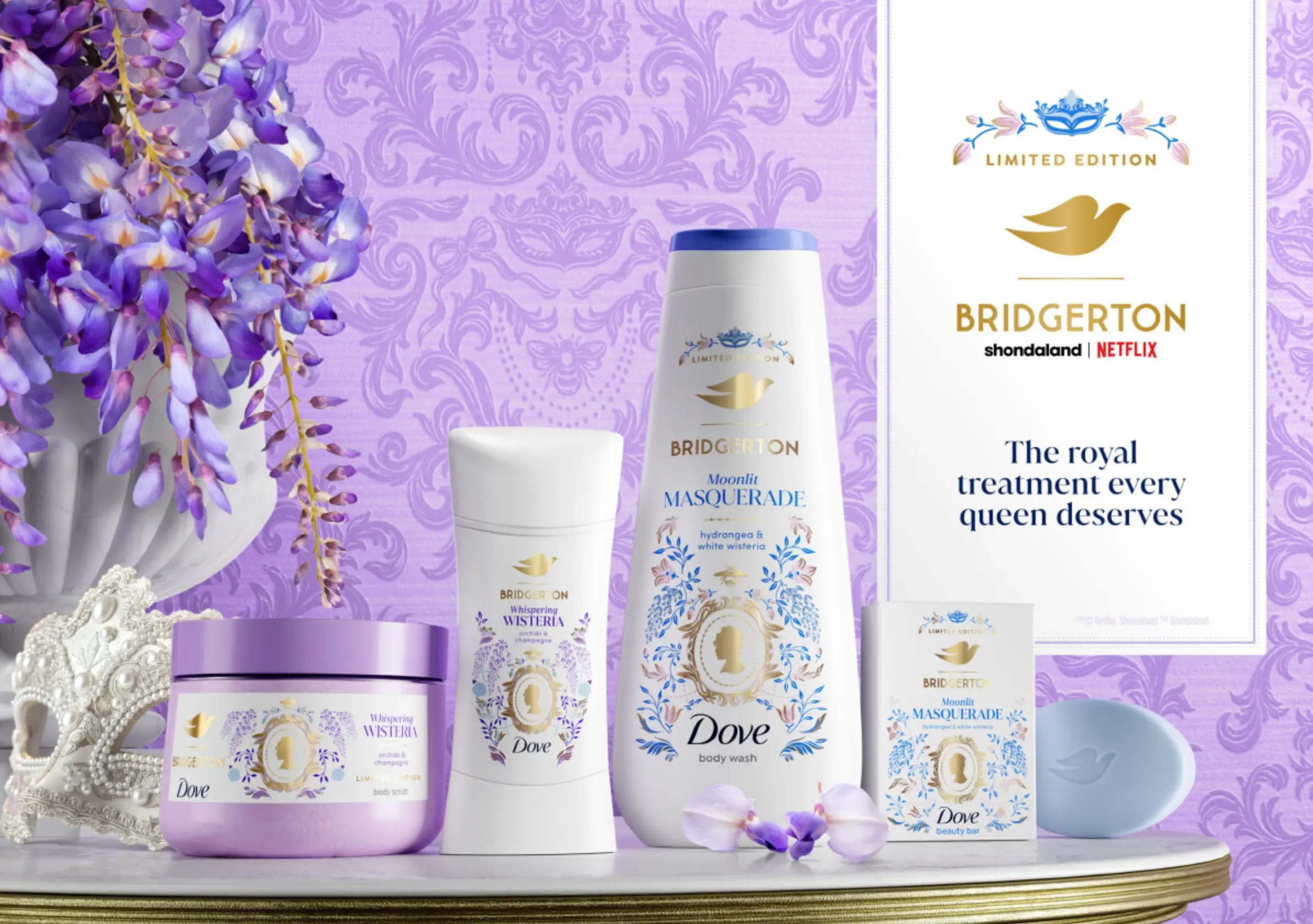
The Dove x Bridgerton collaboration is a consumer launch, but it is also a clean case study in how modern partnerships are built. It combines licensed IP, retail exclusivity, a tightly controlled creative system, and a measurement surface that is easier to read than most social-first activations.
That matters in 2025 because partnerships are no longer a novelty tactic. Brand licensing has become a scaled commercial engine, with Licensing International reporting global sales of licensed merchandise and services at $369.6B in 2024. The bar is higher, and the winners tend to look more operational than poetic. A strong collaboration behaves like a product system and a distribution plan, not a slogan. (Licensing International’s 2025 Global Study summary)
The Dove x Bridgerton limited-edition collection also arrives with a clear calendar anchor. Netflix has published Bridgerton Season 4 dates, with Part 1 on Jan. 29, 2026 and Part 2 on Feb. 26, 2026. The collaboration is designed to live in that attention window, when search demand, social chatter, and retail discovery naturally rise. (Netflix Tudum Season 4 premiere date)
At A Glance
- What it is: A Dove x Bridgerton collaboration and limited-edition body care lineup tied to the Bridgerton Season 4 window. (PRNewswire)
- Where to buy: The Dove x Bridgerton collection is available exclusively at Target, including Target.com. (Target collection page)
- Launch timing: Target.com launch on Dec. 25, 2025, with in-store availability beginning Dec. 28, 2025. (PRNewswire)
- Price band: The Dove Bridgerton price range is $3.99 to $7.99, based on the official announcement. (PRNewswire)
- Scents: Four scents anchor the system: Moonlit Masquerade, Whispering Wisteria, Raspberry Rendezvous, and Love & Meadows. (PRNewswire)
- Formats: The lineup spans body wash, body scrub, hand wash, body mist, antiperspirant deodorant, and select beauty bars, depending on scent. (PRNewswire)
- Time limitation: The Dove Bridgerton limited edition collection is explicitly positioned as limited time. (PRNewswire)
What Dove and Bridgerton Actually Launched (Product + Fragrance System)
Product Formats (And The Ritual Moments They Cover)
The Dove x Bridgerton collection is built around everyday rituals. That is a strategic choice, not just a product list. It expands the number of moments the collaboration can appear in a shopper’s week, which increases exposure and repeat probability.
The formats include:
- Body wash (core volume and replenishment behavior)
- Body scrub (trade-up and gifting behavior)
- Body mist (social-friendly, fragrance-adjacent usage)
- Liquid hand wash (high-frequency household visibility)
- Antiperspirant deodorant (daily use and loyalty potential)
- Select beauty bars in multi-packs (category heritage and value signaling)
This is also why the Dove x Bridgerton Target exclusive structure matters. A retailer can merchandise bundles across these formats, which encourages multi-item baskets and improves unit economics. You can see this behavior directly on Target’s collection page through value bundles. (Target collection page)
The Four Scents And Their Notes
The Dove Bridgerton scents are the center of the system. The story is consistent, but the execution stays grounded in recognizable notes. According to the official announcement, the four scents and notes are:
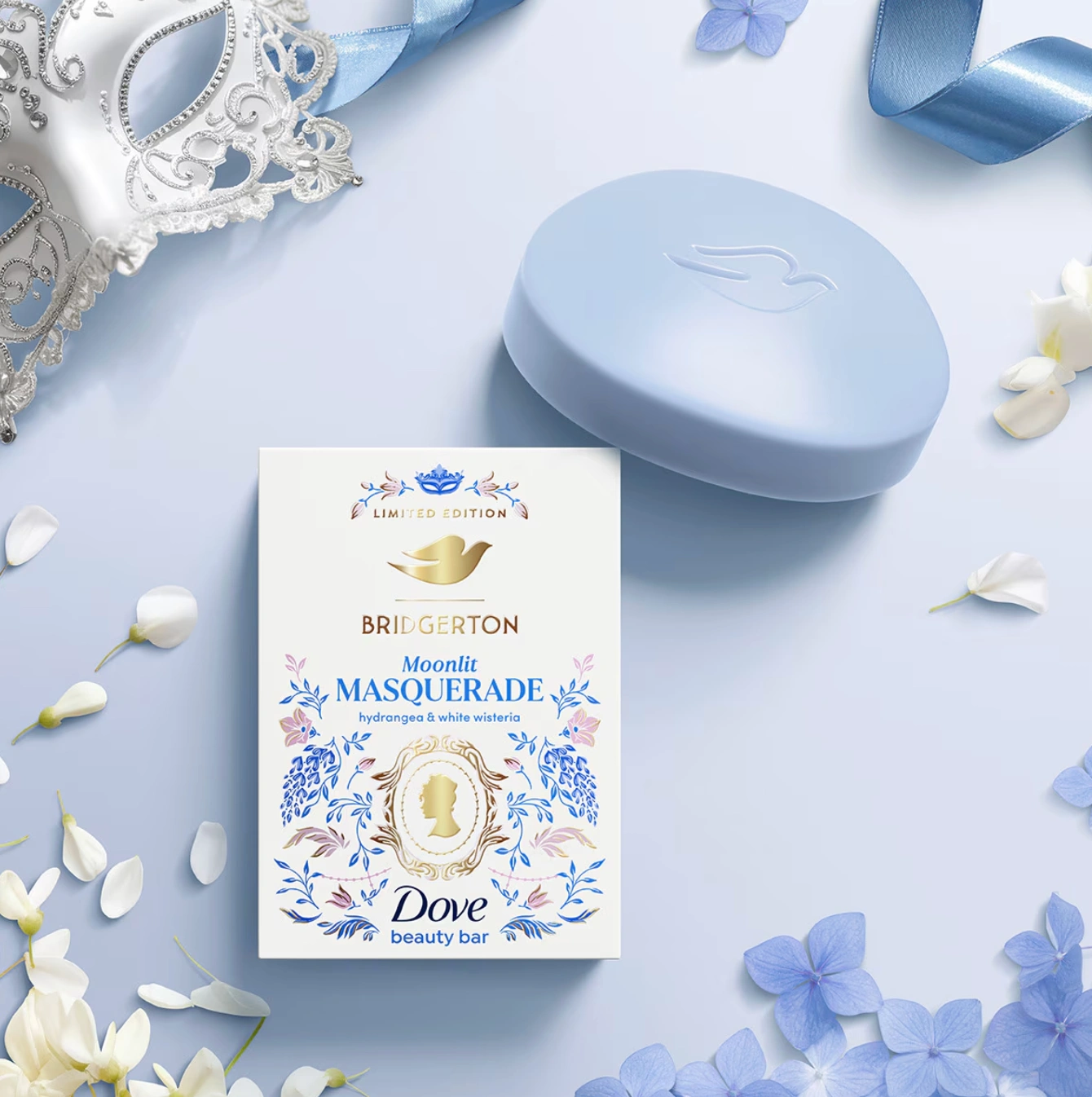
- Moonlit Masquerade: hydrangea, eucalyptus, warm musk
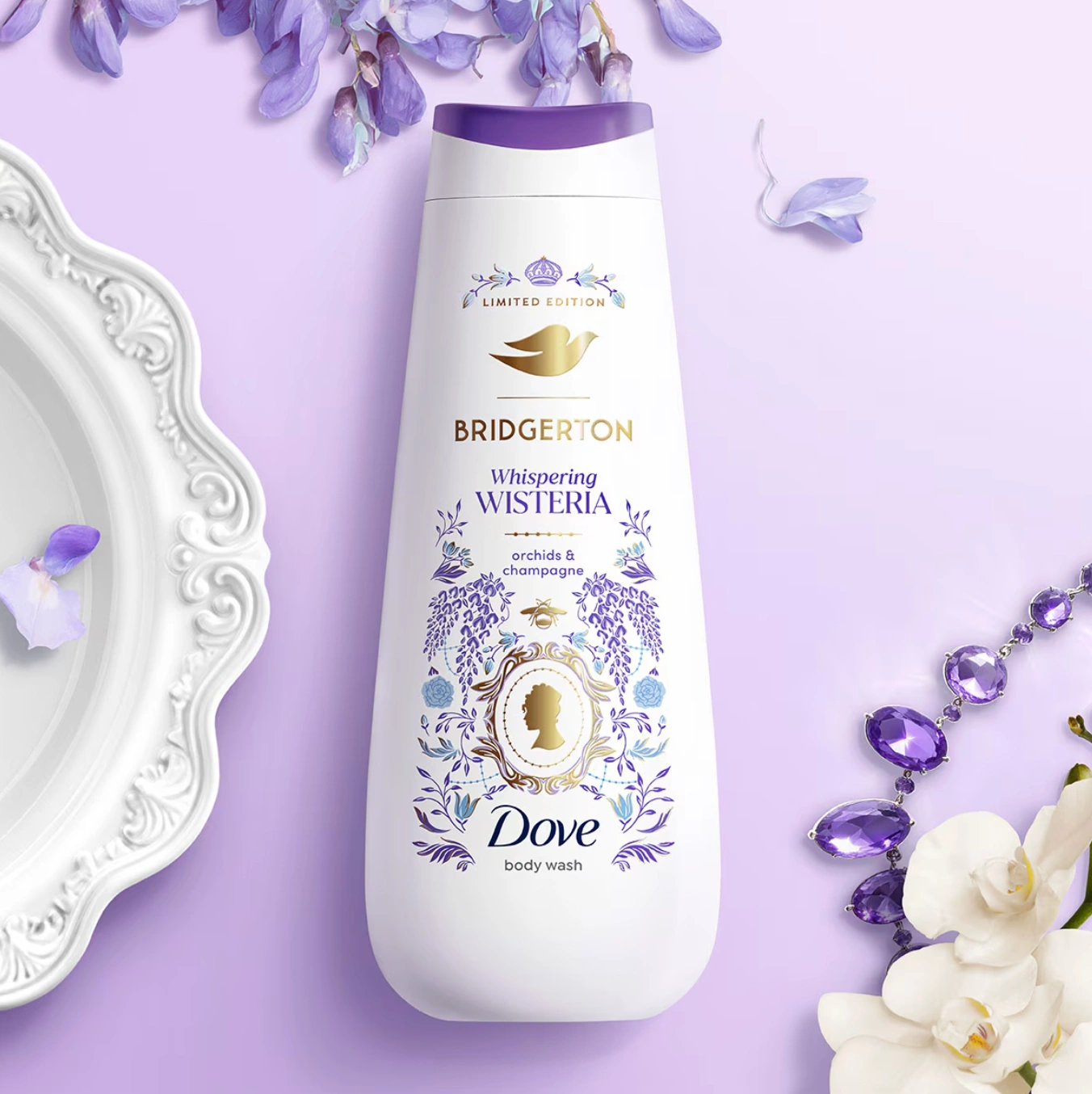
- Whispering Wisteria: orchid, champagne, watery florals
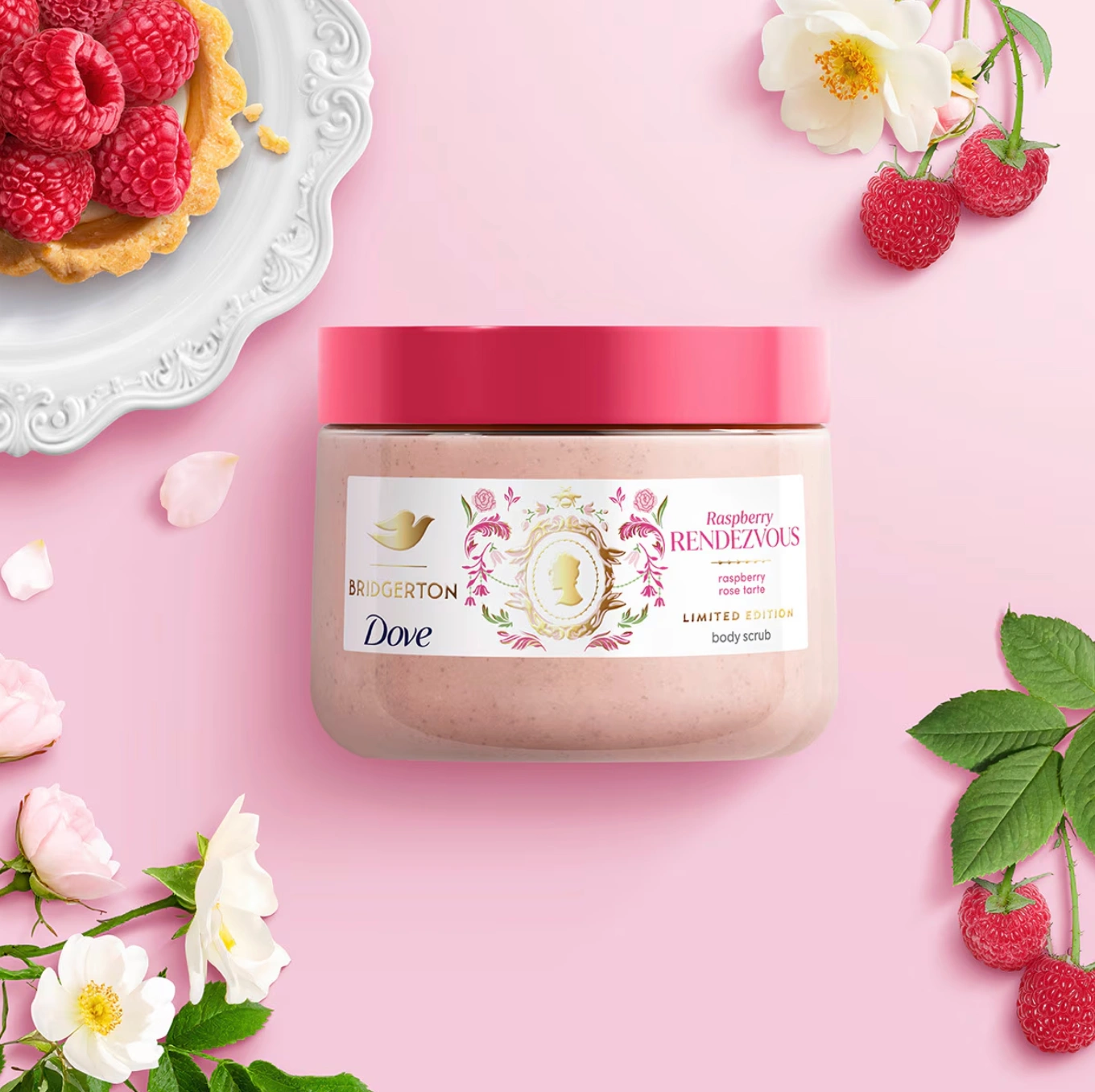
- Raspberry Rendezvous: raspberry, rose, peony, whipped cream
- Love & Meadows: bergamot, wildflowers and rose, amber, cedarwood
In collaboration work, scent notes function like product naming architecture. They are a memory hook, and they also prevent a limited run from feeling arbitrary. (PRNewswire)
Collection Matrix (Scent x Format)
A practical way to read the Dove x Bridgerton limited-edition collection is as a matrix. Each scent is not equally available across formats, which creates natural “collector” behavior without forcing scarcity messaging.
- Moonlit Masquerade: body mist, body wash, body scrub, antiperspirant deodorant, select beauty bars
- Whispering Wisteria: body mist, body wash, body scrub, hand wash, antiperspirant deodorant
- Raspberry Rendezvous: body mist, body wash, body scrub, hand wash, antiperspirant deodorant
- Love & Meadows: body mist, body wash, body scrub, antiperspirant deodorant, select beauty bars
If you are planning your own collaboration, this is a useful pattern. It helps teams build one cohesive “world” while still giving merchandising and paid media multiple entry points. (PRNewswire)
View this post on Instagram
A post shared by Dove Global Channel 🌎 (@dove)
Why This Timing Matters (Bridgerton Season 4 + Cultural Demand)
The Calendar Effect (Why Entertainment IP Still Moves Demand)
The biggest advantage of entertainment IP is that it creates predictable peaks. When a series has known premiere dates, brands can plan creative, retail readiness, and paid placements around moments when audiences are already primed to search and share.
Netflix has framed Bridgerton Season 4 as a two-part release, with Part 1 on Jan. 29, 2026 and Part 2 on Feb. 26, 2026. The Dove x Bridgerton collaboration is explicitly positioned as arriving ahead of that premiere window. (Netflix Tudum)
Scale still matters, too. Netflix’s own “Most Popular TV” list shows Bridgerton Season 3 at 106M views all time. That does not guarantee purchase, but it increases the probability that a collaboration can cut through without needing to invent demand from zero. (Netflix)
What This Means For Search And Retail Discovery
For marketers, the practical point is not fandom. The practical point is discoverability. Entertainment moments change how people search.
In a typical window like this, you see:
- A rise in branded queries tied to the show. That spills into related searches for “Bridgerton” plus products, gifts, and “where to buy.”
- Increased retailer search behavior. Many shoppers skip brand sites and search directly in Target.
- Higher conversion rates on bundles and limited sets, because the shopper’s intent is already warm.
This is where search engine optimization becomes less about generic category terms and more about capturing branded demand without confusion. The brands that win these windows reduce friction, keep product naming consistent, and make “where to buy” unmistakable.
.webp)
The Partnership Strategy (CPG x Entertainment IP) in One Framework
The Collaboration Scorecard
A partnership looks good in a deck when the creative is strong. It looks good in the P&L when the system is coherent. A scorecard helps teams decide whether a collaboration is likely to work before they spend months on approvals and production.
Use this simple scorecard:
- Fit
- Does the IP align with the brand’s actual audience, not just its aspirational audience?
- Does it support the brand’s existing positioning and brand strategy without forcing a new story?
- Moment
- Is there a clear timing catalyst, such as a premiere, tour, or seasonal buying period?
- Can the team support a two-wave plan if the moment is split?
- Distribution Advantage
- Do you have a channel that gives you visibility, measurement, and merchandising support?
- Can a retailer, marketplace, or platform make the launch feel bigger than your owned channels can?
- Product System
- Is the collaboration a one-off SKU, or a matrix that supports discovery and replenishment?
- Can the system scale across different use cases?
- Creative System
- Does the collaboration have consistent naming, packaging, and copy rules, not just one hero image?
- Can the system live on shelves, on a PDP, and in performance ads without losing clarity?
- Measurement Plan
- Do you know which metrics define success, and which partners control the data?
- Can you separate hype from lift?
Dove x Bridgerton Through The Scorecard
The Dove x Bridgerton collaboration scores well on distribution advantage and product system. The retail exclusivity is explicit, and the matrix supports multiple ritual moments. The pricing is also accessible, which reduces purchase friction for a limited run. (PRNewswire)
The “moment” category is also clear. The collection is tied to published Season 4 dates, which creates a predictable attention window. (Netflix Tudum)
From a creative system standpoint, the strongest choice is that the scents do the narrative work. That keeps the branding readable for mass retail, where shoppers have seconds, not minutes, to understand what is in front of them.
Retail Exclusivity as a Growth Lever (Why Target Is the Point)
Why Exclusivity Can Outperform Broad Distribution
The Dove Bridgerton Target exclusive approach is not only about availability. It is a channel strategy.
In 2025, retail media is one of the most measurable and scalable paid surfaces available to consumer brands. Nielsen cites eMarketer projections that U.S. retail media spending will reach $60B in 2025 and $100B by 2028. This shifts collaborations from “earned moment” thinking into “paid and measurable” thinking. (Nielsen on retail media)
A retail-exclusive launch tends to improve a few fundamentals:
- Clear purchase path: one retailer simplifies “where to buy,” which reduces drop-off.
- Stronger merchandising: exclusivity gives the retailer a reason to support bundles, endcaps, or sponsored placements.
- Cleaner measurement: retailer reporting can connect ad exposure to purchase more directly than many open-web environments.
It also changes how creative needs to behave. If the retailer PDP is the conversion page, the creative system must read quickly on mobile, in search results, and on a product grid.
Retail Readiness Checklist (What Must Be True Before Launch)
Before a collaboration goes live, confirm these are true:
- Naming rules are consistent across packaging, PR copy, retailer listings, and paid creative.
- Every SKU has a clear primary descriptor that survives truncation on a mobile grid.
- PDP image sets include at least one frame that communicates “what it is” without context.
- Reviews and Q&A are monitored in the first two weeks, with an escalation path for recurring issues.
- Bundles are planned intentionally. Bundles should map to rituals, not just margin.
In practice, many launches fail quietly because teams treat the retailer PDP as a commodity page. That is rarely true. The PDP is often your highest-value landing page during the peak demand window.
Creative System Breakdown (Packaging, Naming, and Sensory Identity)
The Building Blocks of a Cohesive Creative System
The Dove x Bridgerton collaboration uses a straightforward system: four scents, repeated across formats, with bespoke packaging cues. That is the right level of complexity for mass retail.
A cohesive creative system usually includes:
- A naming architecture that scales (scent family names, consistent descriptors, consistent formatting)
- A distinct but readable packaging system (color coding, pattern rules, iconography)
- A short-form copy template that works on shelves and PDPs
- A photo style guide that is consistent across brand and retailer assets
- A governance layer that prevents “creative drift” when deadlines compress
These are the same elements that make a strong visual identity system work. The difference is the channel reality. Retail listings, paid social crops, and search cards compress everything.
.webp)
How To Translate IP Without Becoming Costume Marketing
Entertainment collaborations often over-index on references that only superfans understand. That can create confusion at the shelf.
A more durable approach looks like this:
- Use IP cues as texture, not as the headline.
- Keep the product proposition primary: scent, benefit, format, and price should remain legible.
- Build a “recognition layer” for fans that does not block comprehension for everyone else.
The Dove x Bridgerton limited edition collection avoids the hardest trap. It does not force shoppers to understand plot details to understand the product. That keeps the conversion path clean.
The Shopper Journey (From Social/PR to Target PDP to Repeat Purchase)
Funnel Map (What A Real Journey Looks Like)
The shopper journey for a retail-exclusive collaboration is usually simple. It is also easy to break if any step introduces uncertainty.
A realistic journey looks like this:
- Awareness
- PR coverage, influencer content, or a friend’s share introduces the collaboration.
- Validation
- The shopper searches “Dove x Bridgerton collection” or “Dove Bridgerton scents,” then checks where to buy.
- Retail Discovery
- The shopper lands on the Target collection page or a specific product listing. (Target collection)
- Conversion
- The shopper chooses a scent and format, then adds one SKU or a bundle.
- Repeat
- If the product performs, repeat purchases shift from collaboration behavior to routine behavior.
The marketing work lives in steps 2 through 4. That is where most friction shows up.
PDP And Landing Page Requirements (UX, Accessibility, Performance)
If your conversion happens on a retailer PDP, you still control key inputs: naming, images, and the clarity of the product story. These inputs are design and UX decisions.
This is where a strong web design agency and an experienced UI UX design agency add value, even when the purchase occurs off-site. The same principles apply: reduce cognitive load, keep the hierarchy clean, and ensure pages are usable on mobile.
For collaboration PDPs and landing pages, the requirements are practical:
- Performance: pages must load quickly on mobile networks. The peak demand window amplifies every drop in conversion rate.
- Accessibility: image text, contrast, and legible type sizing matter, especially for product grids.
- Clarity: scent notes and format benefits should be visible without scrolling through long blocks of copy.
- Variant logic: if scents are variants, the default selection needs to be clear and stable.
Maintainability And Governance (The Part Most Teams Miss)
Limited-edition does not mean low-governance. It often means high risk, because timelines are short and assets multiply.
Maintainability looks like:
- One source of truth for naming and scent notes.
- A structured asset library with version control.
- Clear rules for how bundles are named and how images are labeled.
- A defined approval chain that can move quickly without drifting from the system.
In Brand Vision audits, one common issue is mismatch between retailer listings and paid creative language. That mismatch creates confusion, which looks like “low conversion” but is often a clarity problem.
What to Measure (KPIs That Prove the Collab Worked)
KPIs By Stage (Awareness, Consideration, Conversion, Repeat)
Collaboration measurement should be staged. Week-one metrics are not the same as week-six metrics.
Consider using a simple stack:
Awareness and Demand
- Branded search lift for “Dove x Bridgerton collaboration” and scent names
- Share of voice in social mentions (use consistent query rules)
Retail Consideration
- Product page views and add-to-cart rate
- Bundle click-through versus single SKU click-through
Conversion
- Unit sales, conversion rate, and average order value on the retailer
- New-to-brand rate where available
Repeat and Halo
- Repeat purchase signals (especially for wash and deodorant)
- Category halo effects, if the retailer provides reporting
This is also where search engine optimization intersects with analytics. Collaboration search is highly branded, and the best-performing pages tend to be those that answer “what is it,” “where to buy,” and “what’s included” without ambiguity.
A Simple Measurement Timeline (Week 1 Through Week 8)
Week 1
- Confirm discoverability: search visibility, retailer collection page indexing, and SKU findability.
- Read friction: top questions in reviews and Q&A.
Week 2 to Week 4
- Evaluate conversion drivers: bundles, top scents, top formats, and ad placements.
- Watch fatigue: declining click-through or rising returns often indicate mismatched expectations.
Week 5 to Week 8
- Evaluate repeat and halo: which formats are sustaining demand, and which are novelty-only.
- Capture learnings for the next collaboration cycle.
Instrumentation Basics (So Data Is Comparable)
A collaboration can generate a lot of activity that is hard to interpret. Basic instrumentation prevents “busy” from being mistaken for “effective.”
The essentials:
- Consistent naming across campaigns and reporting.
- Clear channel taxonomy for paid, PR, influencer, and retail media.
- A defined baseline period so you can measure lift against something stable.
If your internal data is fragmented, a structured marketing consultation and audit can be the difference between a postmortem that is actionable and one that is only descriptive.
-1.webp)
Risks and Guardrails (Brand Fit, Inventory, Backlash, Fatigue)
The Common Failure Modes
Most collaboration failures are operational, not creative.
Common failure modes include:
- Fit drift: the IP story overwhelms the brand promise.
- Confusing assortment: too many variants with no clear hierarchy.
- Inventory imbalance: hero SKUs sell out while others sit, weakening the collection narrative.
- Retail execution gaps: the PDP and imagery do not match the story told in PR and paid.
- Measurement gaps: no baseline, no clear definition of success, no separation between attention and conversion.
Guardrails That Protect The Brand And The P&L
A few guardrails reduce risk without slowing teams down:
- Fit guardrail: define what the brand will not do visually or verbally, even if the IP invites it.
- Clarity guardrail: require one “plain-language” descriptor for every SKU.
- Data guardrail: define three primary KPIs before creative is approved.
- Governance guardrail: appoint one owner for naming and one owner for imagery consistency.
Guardrails are not bureaucracy. They are what allow a collaboration to scale without losing coherence.
The Playbook (How to Run an IP Collaboration End to End)
End To End Timeline (From Partner Selection To Postmortem)
A collaboration timeline varies, but the stages are consistent:
- Partner Selection
- Define the audience overlap and the business goal.
- Confirm channel reality early. Exclusivity decisions change everything downstream.
- Concept And System Design
- Build the matrix: scents, formats, bundles, and naming rules.
- Create a packaging and asset system that scales.
- Channel And Measurement Plan
- Lock the conversion destination and the content requirements for that destination.
- Define KPIs and the reporting cadence.
- Production And Retail Readiness
- Finalize packaging, imagery, and copy for retailer ingestion.
- Stress test for mobile readability and product grid clarity.
- Launch And Optimization
- Monitor search behavior, retailer discoverability, and early reviews.
- Adjust creative and bundling based on actual performance, not assumptions.
- Postmortem
- Document what drove lift, what drove confusion, and what should be reused.
Asset And Channel Checklist (So The Launch Is Consistent)
Use a short checklist to avoid last-minute drift:
- One naming sheet with scent notes, format naming, and approved descriptors
- A standardized PDP image set per SKU (hero, back, texture, ingredient or benefit frame where relevant)
- One copy template that works in PR, retailer listings, and paid creative
- A bundle strategy that maps to rituals (shower set, fragrance set, travel set)
- A measurement brief that defines KPIs, baselines, and reporting owners
Executive Takeaways (What Marketers Should Steal, and What They Shouldn’t)
- Treat collaborations as systems: assortment, naming, packaging, and conversion path.
- Use timing catalysts. Published release windows are free signal, and they reduce forecasting guesswork.
- Favor clarity over references. If a shopper needs context to understand the product, conversion will suffer.
- Choose distribution for measurement, not only reach. Retail media and retailer reporting can create a cleaner read of lift. (Nielsen on retail media)
- Build a creative system that scales across SKUs. This is a design problem before it is a marketing problem.
- Treat the PDP as a primary asset. It is often the highest-value landing page during the demand window.
- Define success metrics early. Without KPIs, teams will measure the wrong things and call it learning.
- Do not copy what you cannot support operationally. A collaboration can fail even when demand is real.
For more campaign breakdowns and practical brand analysis, explore Brand Vision Insights.
FAQ
Where Can You Buy The Dove x Bridgerton Collection?
The Dove x Bridgerton collection is available at Target and on Target.com.
Is The Dove x Bridgerton Collection A Target Exclusive?
Yes. The Dove x Bridgerton collaboration is positioned as a Target exclusive in the official announcement.
What Is The Dove x Bridgerton Launch Date (Online And In Stores)?
The Dove Bridgerton launch date is listed as Dec. 25, 2025 on Target.com, with Target store availability beginning Dec. 28, 2025.
What Are The Dove x Bridgerton Scents?
The Dove Bridgerton scents are Moonlit Masquerade, Whispering Wisteria, Raspberry Rendezvous, and Love & Meadows, each with distinct notes listed in the official release.
What Is The Dove x Bridgerton Price Range?
The Dove Bridgerton price range is listed as $3.99 to $7.99 in the official announcement. Individual SKU prices can vary by product type and retailer listing.
Is The Dove x Bridgerton Limited Edition Collection Time Limited?
Yes. The Dove Bridgerton limited edition collection is described as available for a limited time.
How Does This Tie To Bridgerton Season 4?
The collaboration is positioned ahead of Bridgerton Season 4. Netflix has announced Part 1 for Jan. 29, 2026 and Part 2 for Feb. 26, 2026.
What Can Marketers Learn From The Dove x Bridgerton Collaboration?
The clearest lessons are structural: retail exclusivity simplifies the purchase path, the product matrix increases ritual frequency, and the creative system keeps the collection legible across shelf, PDP, and paid placements. This is the collaboration playbook that tends to scale, especially in a retail media environment.
If you are planning a partnership launch and want a system-level plan that aligns creative, channel, and measurement, start a conversation with Brand Vision.

%2520(1).png)
.png)