
A luxury hotel often sells its first room before the building has walls. The image leads. Investors, leasing partners, brand licensors, and early-stage media see the property through renderings long before they can walk a corridor or feel the marble underfoot.
By the time the construction crane comes down, the brand has already shipped thousands of impressions into the market, and almost all of them have been visual.
That visual story is now operating against a hospitality sector that crossed US$11.6 trillion in 2025, roughly 9.8 percent of the world economy in travel and tourism contribution. The category is large and competitive enough that brand-asset development can no longer be treated as a downstream marketing task handled after architects finish their work.
For a five-star or boutique property, the architectural rendering is the brand's first product. It has to communicate atmosphere, service level, guest type, and emotional pace before any guest has booked a stay.
The Strategic Cost of Treating Rendering as a Pre-Opening Afterthought
Hospitality groups still routinely treat architectural rendering as a CAD-driven deliverable produced by whichever studio the design firm recommends. The result is a portfolio of technically clean images that say nothing about the brand and a marketing team that inherits assets it cannot use.
The cost shows up in two places. First, in the hospitality and visual identity work that has to be rebuilt later when the marketing team realises the renderings do not match the brand voice they have written. Second, in the pre-opening commercial calendar, where investor pitches, leasing decks, PR teasers, and booking-platform listings all need branded visual assets months before the building exists.
Neither cost is small. A typical luxury hospitality opening runs marketing for twelve to eighteen months before doors open, and every channel in that calendar depends on visual assets that match the written brand.
When the renderings do not align, marketing teams either spend additional budget on photography substitutes or push assets into market that quietly undermine the brand positioning the same team is paying to develop.
CBRE's H2 2025 hotel outlook revised full-year US RevPAR growth down to 0.1 percent. That compression is exactly the operating context in which pre-opening visual marketing becomes a competitive advantage rather than a nice-to-have. When ADR and occupancy assumptions are tight, the brand asset has to do more work earlier.
What Hospitality Brand-Quality Rendering Actually Captures
The technical baseline for premium architectural rendering, photorealistic textures, accurate light simulation, scale fidelity, is now table stakes. Most established studios can clear it. What separates a render that supports a hospitality brand from a render that just shows a building comes down to four less obvious qualities.
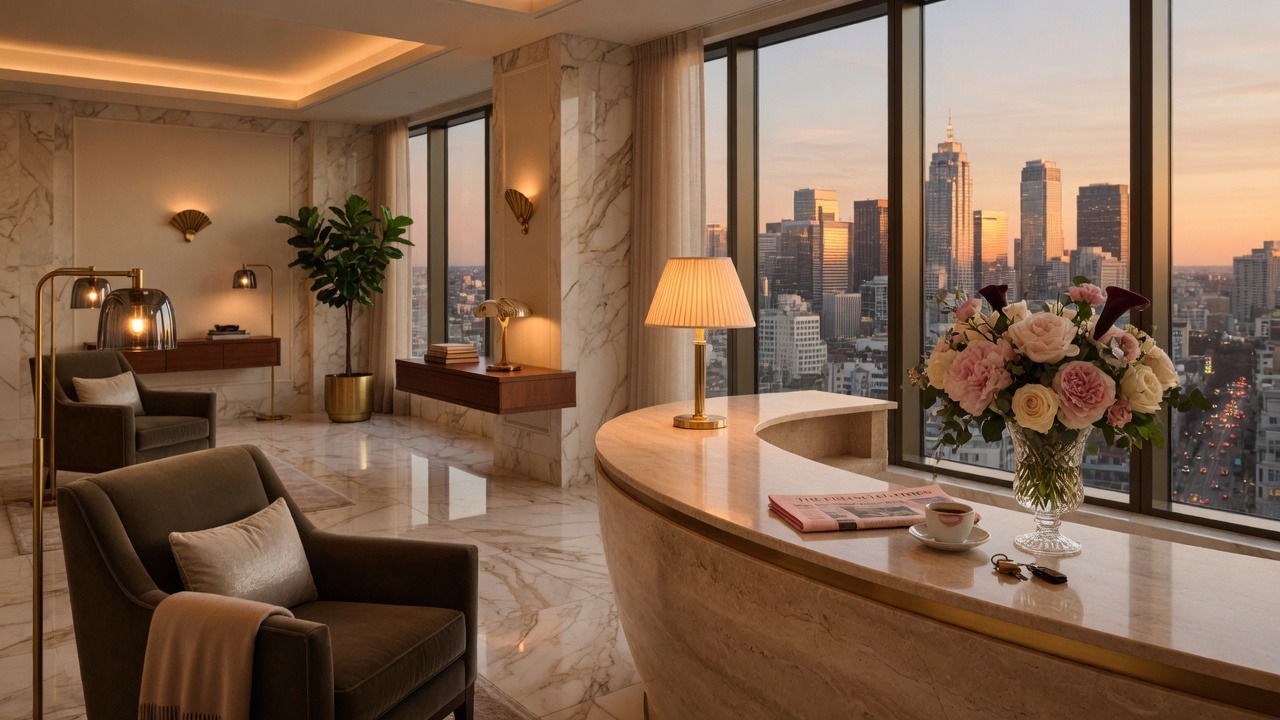
- Mood specificity. A lobby at 7:30 in the evening feels different from a lobby at 11:00 in the morning. The choice of hour, light temperature, and the implied moment in the guest's arrival sequence is itself a brand decision. Generic daylight kills the asset.
- Implied service signal. Empty rooms are sterile. Rooms with a fresh tray on the desk, an open book, a soft pillow indent, communicate that someone has been here recently, that the operation is alive, that the property has staff. This is hospitality storytelling, not real estate marketing.
- Material and finish honesty. Marble can be photographed accurately and still look cheap if the rendering does not show how it interacts with adjacent finishes, ambient sound, and the human-scale objects around it. Luxury reads through context.
- Single visual language across the asset set. A resort with thirty assets in market needs all thirty to feel like the same property. Inconsistency in colour grading, time of day, or aspect ratio breaks the brand before a guest has clicked through.
Studios that specialise in this work treat the render as a brand deliverable, not a CAD render. The production model matters as much as the technical execution: an asset set built around scale consistency is structurally different from a one-off architectural render produced by a freelancer.
As one example, Render Vision describes itself as having delivered 29,000-plus architectural visualisations since 2012 across 15 countries. The 3D render services the studio offers are positioned around scale consistency across multi-asset hospitality projects, with output described as 5K standard.
Whether a specific brand chooses that particular studio or not, the underlying point holds. A partner built for multi-asset hospitality work will produce a different result than a partner sized for single-building architectural visualisation, and pre-opening teams need to brief accordingly.
The Pre-Opening Asset Set That Actually Performs
A pre-opening hospitality programme typically needs renderings across five distinct distribution contexts, and the asset brief for each is different.
- Investor and leasing decks. High resolution, restrained mood, conservative angles, anchored on architectural ambition rather than guest scene. These are read by financial decision-makers, not consumers, and they need to communicate quality at scale.
- Brand PR and editorial outreach. Mid-resolution renderings with strong composition and a clear single subject. Editors at travel publications use these as supporting imagery for previews, and they need to function as standalone images rather than as part of a deck.
- Booking platform and direct booking visuals. Closer to the guest experience. Suite views, public spaces, amenity shots. These compete on Booking.com, Expedia, and the brand's own site against thousands of other properties, and they have to communicate the actual stay quickly.
- Social teaser content. Cropped, vertical, often animated. Short loops of an arrival sequence, a pool at dusk, a restaurant fill. The asset has to read on a 6-inch screen in three seconds.
- Sales sheets and trade collateral. Print-quality, brand-aligned, often used in luxury travel advisor channels and at trade shows. These have a longer lifespan than digital assets and need to age well.
A studio that can deliver one of these competently is common. A studio that can deliver all five with a unified brand mood is rare, and the difference shows up directly in pre-opening marketing effectiveness.
The asset-set composition is itself a travel and hospitality marketing decision, not a production scheduling decision, because it determines what the brand has available to say across the full pre-opening calendar.

How AI Is Reshaping the Hospitality Visual Production Model
The render production model is changing fast. Deloitte's 2025 travel industry outlook identified AI acceleration across customer service, operations, and discovery as one of the four defining shifts in travel for the year, and pre-opening hotel marketing is now part of that shift.
Three production-side changes matter for hospitality brand teams.
- Real-time rendering for stakeholder review. Investors and operators increasingly expect to scrub through time of day, change a material palette, or swap an event setup inside a single branded scene. This was a feasibility-study deliverable two years ago; it is becoming a pre-opening expectation now.
- AI-assisted mood exploration. Early-stage brand-direction work that used to take weeks of art direction can now be compressed into days, with AI generating dozens of mood variants for human review and selection. Final-quality output still requires human art direction, but the front end of the pipeline is faster.
- Sustainability storytelling through visual proof. Solar shading, planted roofs, daylight strategy, water-sensitive landscape design: the sustainability claims that hospitality brands now make in their positioning need to be visible in the renderings, not just stated in the press release. Visual proof is starting to matter as much as written claim.
What none of these production changes resolve is the brief itself. The brief sent to an architectural rendering partner determines almost everything that comes back. Hospitality teams that brief weakly get generic output; teams that brief precisely get brand assets they can deploy across the full pre-opening calendar.
A strong brief covers the brand positioning in one paragraph, the target guest persona in one paragraph, the operational tone (formal, relaxed, social, quiet) in one short list, the time of day for each scene with a one-line reason, the asset set across all five distribution contexts above, and the consistency requirements across the full delivery.
Marketing teams operating without that briefing rigour tend to inherit asset libraries that look polished individually but fall apart at portfolio level. The pre-opening visual programme becomes a series of one-off renders rather than a coherent brand expression.
What This Means for Hospitality Brand Strategy
For a hospitality brand building toward an opening, the architectural rendering work is not a downstream production task. It is the first product the brand ships. The choice of studio, the briefing rigour, the asset-set composition, and the visual consistency across the full pre-opening calendar are brand strategy decisions, not production decisions.
The brands that treat them that way build a market presence months before opening day and convert that presence into bookings, partner interest, and PR coverage that compounds. The brands that treat rendering as the last item on a construction punch list keep paying for that decision well into their first operating year.


%2520(1).png)