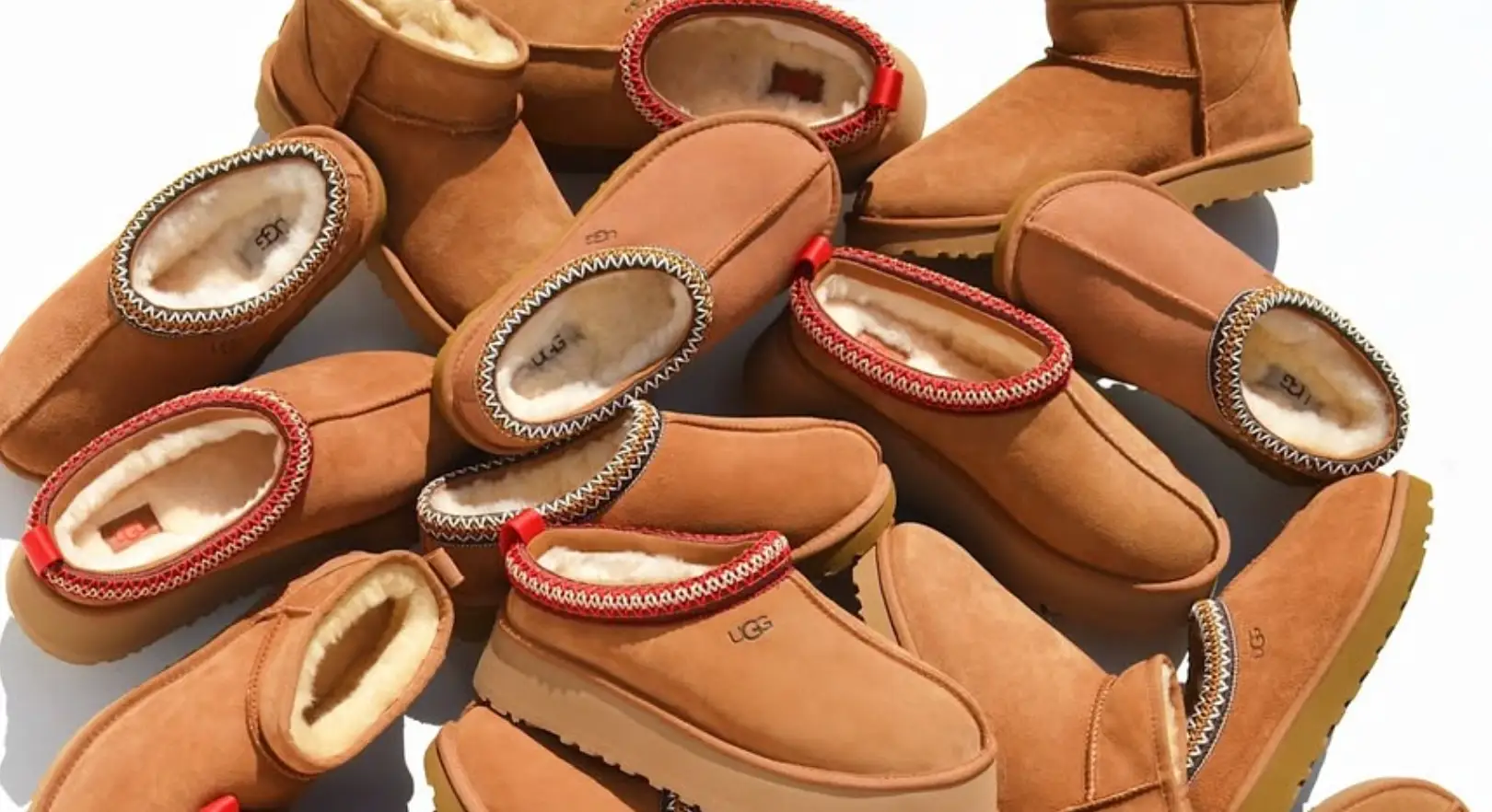
UGG’s marketing strategy in 2025 shows how a legacy footwear brand can make comfort feel current without abandoning the products people already recognize. Under Deckers Brands, UGG updated classic silhouettes, expanded slippers and platforms, worked with fashion collaborators, and benefited from renewed celebrity and social visibility. For marketers, it is a useful fashion marketing case study in balancing brand memory with cultural movement.
- UGG’s success shows how a brand can ride trend waves without abandoning its core product.
- The most popular UGGs now function as both comfort gear and style language across generations.
Brand Vision uses UGG here as an independent case study, not as an example of work our agency created for the brand. The focus is on transferable choices around positioning, product storytelling, distribution, and cultural relevance.
At a Glance
Deckers’ reporting confirms that UGG’s momentum was financial as well as cultural. In fiscal 2025, UGG brand net sales increased 13.1 percent to $2.531 billion from $2.239 billion a year earlier. (Deckers FY 2025) In the second quarter of fiscal 2026, ended September 30, 2025, UGG brand net sales increased 10.1 percent to $759.6 million. (Deckers Q2 FY 2026) These are UGG brand sales, not Deckers-wide revenue.
- WorldFootwear notes that UGG’s full-year 2025 net sales rose 13.1 percent on a comparable basis, confirming steady momentum. (WorldFootwear)
- Deckers has also documented UGG product-responsibility initiatives, including the UGGrenew refurbishment program. (Deckers)
Brand Positioning: Comfort As Fashion
UGG’s positioning works because comfort is treated as part of fashion rather than an apology for it. Modern Retail’s overview of the brand’s comeback ties renewed interest to comfort-first and “ugly chic” footwear, with UGG updating silhouettes and styling while keeping recognizable materials and shapes. (Modern Retail) The broader brand strategy lesson is to make a functional benefit distinctive enough that it can travel into new cultural contexts.
- UGG’s marketing strategy focuses on emotional benefits such as warmth and ease, then shows how those can anchor high-fashion outfits.
- This positioning gives UGG room to appear in casual, streetwear, and fashion contexts without pretending the product’s comfort is secondary.

UGG’s Growth Strategy: Innovate Around Icons
UGG’s growth strategy has been to protect and reinterpret recognizable products instead of abandoning them. The brand has extended its product language through platforms, slippers, clogs, weather-ready options, and new materials while keeping familiar shapes in view. That kind of evolution depends on consistent visual and product identity, so newness still reads as UGG.
- Rather than chasing constant reinvention, UGG iterates on classics like the Classic Boot, Tasman and Ultra Mini, which keep the line coherent.
- New materials, soles and treatments add performance and fashion credibility while still reading instantly as “UGGs.”
History And The Power Of The Classic Boot
The UGG brand dates to 1978, when Australian surfer Brian Smith brought the idea to Southern California and built the Classic Boot around post-surf comfort. UGG’s own history traces the brand from California surf culture into everyday style and global fashion. (UGG) A 2025 Vogue Australia history piece similarly follows the broader sheepskin-boot story from surf culture to fashion. (Vogue Australia) Retailers continue to merchandise Classic tall, short, mini, and ultra-mini silhouettes across the range. (Journeys)
- The Classic Boot remains at the heart of UGG’s success and brand recognition even as silhouettes shift.
- UGG’s marketing strategy uses the heritage story when it adds credibility, but always connects it to current fashion language.
Celebrity Visibility: From Bella Hadid To Rihanna
Celebrity visibility has repeatedly helped UGG re-enter fashion conversation, but not every appearance should be described as a paid partnership. Bella Hadid’s 2022 street-style look in Classic Ultra Mini Platform boots became a widely covered fashion moment. (Harper’s Bazaar) In December 2025, Rihanna was photographed wearing UGG Bea Mary Jane slippers with a Louis Vuitton Speedy bag and fur stole. (Marie Claire) These examples show earned cultural visibility; the cited coverage does not establish that either appearance was a paid UGG placement.
- When recognizable UGG silhouettes appear in high-fashion styling, the contrast can refresh how the product is interpreted without changing the product itself.
- For marketers, the important distinction is between organic celebrity adoption, confirmed creator partnerships, and paid media; they should not be measured as the same tactic.
View this post on Instagram
TikTok, Street Style And Gen Z “Cozy Core”
Social platforms have amplified UGG styling cycles, especially around shorter boots and slipper silhouettes. Fashion coverage has documented the Ultra Mini, Mini, and Tasman in Gen Z and Y2K-inspired outfits, (Marie Claire outfits) while Glamour has covered periodic predictions about the return of tall UGG boots. (Glamour) Those signals are useful for creative and merchandising teams, but social attention by itself does not prove which silhouette caused sales growth.
- UGG can respond to social styling cycles through content and merchandising without treating a viral trend as a guaranteed demand forecast.
- For other brands, integrated marketing should connect creator activity, paid distribution, retail, and owned channels so cultural attention has somewhere useful to go.
Product And Fashion Collaborations
UGG has also used collaborations to reinterpret familiar products for different fashion audiences. Partnerships with labels and designers including Telfar, BAPE, Palace, and Feng Chen Wang place UGG shapes inside streetwear and runway contexts. Specific sales effects are not consistently disclosed, so the stronger lesson is strategic rather than financial: collaborations can let an established brand experiment with new codes while the main line stays recognizable. That pattern also appears across broader fashion marketing strategies.
- Collaborations can introduce UGG to adjacent fashion communities without requiring the entire core assortment to change.
- This approach lets UGG experiment with bolder shapes and materials without risking its core staples.

Retail And Omnichannel Execution
Beyond product, UGG operates across direct-to-consumer and wholesale channels. Deckers reports company-level DTC and wholesale performance while UGG is sold through brand-owned ecommerce and stores as well as selected retail partners. (Deckers FY 2025) For a consumer brand, B2C and ecommerce marketing has to connect product storytelling, retail discovery, and the owned digital experience rather than treat each channel as a separate brand.
- The strategic trade-off is brand control versus reach: owned channels offer more control over the experience, while wholesale expands access and distribution.
- Limited assortments or retailer-specific products can create distinction, but the article does not have evidence to quantify their effect on demand or discounting.
Regional Growth And International Momentum
International growth is important to Deckers, but the cited Reuters figure needs to be kept at the company level. Reuters reported that Deckers’ international net sales rose almost 50 percent in the quarter ended June 2025, helping offset weaker domestic sales. (Reuters) That figure combines Deckers brands and should not be presented as UGG-specific geographic growth. Separately, UGG brand sales rose 10.1 percent overall in Deckers’ following quarter.
- For global consumer brands, the practical challenge is to adapt assortment and campaign execution by market while keeping the core brand message consistent.
- Cultural references travel unevenly across markets, so local research should determine which styling and nostalgia cues actually translate.

Sustainability And Brand Responsibility
Sustainability and product responsibility are part of UGG’s corporate story, although they should not be treated as proven drivers of demand. Deckers has documented initiatives including UGGrenew, responsible sourcing, waste reduction, and recycled or plant-based materials in selected products. (Deckers) The responsible way to discuss those efforts is as documented programs and materials, not as proof that values messaging automatically creates loyalty.
- Responsibility claims are most credible when they identify a concrete program, material, or sourcing practice rather than relying on broad sustainability language.
- For marketers, product-responsibility messaging should be separated from unsupported claims about loyalty or purchase intent unless customer research demonstrates the connection.
Most Popular UGGs In 2025
Retail assortments in 2025 highlighted how much UGG’s everyday range had broadened beyond the original tall boot. Journeys and Little Burgundy featured Classic Mini and Ultra Mini variations, slipper-style products, and cold-weather boots across their UGG assortments. (Journeys) (Little Burgundy) These retailer pages are useful snapshots of merchandising, but they are not audited sales rankings for every UGG style.
- Shorter silhouettes and slipper-style products were prominent in retailer assortments, while the Classic Boot family remained part of the brand’s recognizable core.
- UGG’s marketing strategy keeps these staples in focus each season with new colours, platforms and occasional limited editions.

Headwinds And Risks
Strong brand sales do not remove channel or macroeconomic risk. Deckers’ second-quarter fiscal 2026 results showed company-wide DTC sales down 0.8 percent and domestic sales down 1.7 percent even as UGG brand sales increased 10.1 percent overall. (Deckers Q2 FY 2026) The important distinction is that Deckers-wide channel softness is not the same as a documented decline in UGG DTC sales.
- UGG’s success has to be balanced against the risk of oversaturation and consumer fatigue, especially if the market softens.
- Maintaining a sense of desirability will require ongoing innovation and smart inventory management as trends evolve.
What UGG’s Marketing Strategy Shows
UGG’s marketing strategy shows how a legacy brand can evolve around recognizable product codes instead of erasing them. Product updates, cultural visibility, collaborations, and channel expansion all reinforce the same underlying idea: comfort can be styled rather than hidden. The transferable lesson is to evolve the context around an icon while keeping enough continuity for people to recognize what made the brand distinctive in the first place.
- The brand’s ability to balance nostalgia, comfort and newness is what keeps UGGs relevant in 2025.
- Other brands can learn from UGG’s focus on core products, clear positioning and patient, culturally aware marketing.
How Business Owners Can Apply UGG’s Marketing Strategy
For business owners, the useful lesson is not to copy UGG’s cozy aesthetic. It is to identify one product or emotional benefit the market can associate with you, protect the recognizable parts of that promise, and update the surrounding story as culture changes. Premium brand cues work the same way: consistency matters more than adding decorative signals for their own sake.
Start with positioning and customer evidence, then turn that strategy into a consistent visual identity, product story, website, and channel plan. For consumer brands serving Canada, a Canadian branding and marketing agency can also help adapt retail calendars, ecommerce journeys, and campaign execution to local market context without changing the core brand code.
- Build a clear positioning foundation with a branding agency that can define what you want to own in your category.
- Pressure test your messaging and ICP using brand research so your “comfort benefit” equivalent is rooted in real demand.
- Turn that positioning into a conversion-ready site with a web design agency that treats UX as part of the marketing system.
- Improve flow, product pages, and navigation with a UI UX design agency so the experience feels as intentional as the brand story.
- If organic visibility is a growth lever for you, work with an SEO agency to build durable demand, not just short spikes.
- If you’re unsure what to fix first, a marketing consultation can help you prioritize the highest-impact moves across brand, site, and channels.
If you want an outside view on how your product, brand, and channels fit together, discuss your growth strategy with Brand Vision.
FAQ
What is the core marketing strategy of UGGs?
UGG’s marketing strategy pairs recognizable comfort products with fashion-aware styling, product evolution, collaborations, retail distribution, and cultural visibility. The strength is the consistency between the product code and the new contexts in which it appears.
How has UGG’s growth strategy evolved in recent years?
UGG’s growth strategy has evolved from a winter-heavy boot brand to a year-round comfort label, building out clogs, slippers and slides, expanding internationally and investing in both direct-to-consumer and wholesale channels while innovating on classic silhouettes.
Why are UGGs so popular again in 2025?
UGG’s 2025 visibility reflected several overlapping forces, including Y2K nostalgia, shorter and slipper-style silhouettes, celebrity street style, fashion collaborations, and social styling. Those factors help explain renewed attention, but none should be treated as a single proven cause of sales growth.
What are the most popular UGGs right now?
Retailer assortments in 2025 prominently featured Classic Mini and Ultra Mini variations, slipper-style products such as Tasman, and other Classic-family silhouettes. Those merchandising pages are useful snapshots, but they are not universal audited rankings of every UGG product.
What can other brands learn from UGG’s success?
Other brands can learn to lean into their distinctive products, evolve them thoughtfully, use cultural moments rather than only ads to drive desirability, and build a growth strategy that respects both brand equity and modern consumer behaviour.










.webp)