
Standing out isn’t about shouting louder; it’s about being unique in a crowd that does the expected. If you’ve been wondering how to make a marketing campaign stand out, start by engineering memory, not noise: a fluent device, a few distinctive brand assets, and scenes that map to real buying moments. Then pair that creativity with practical reach and simple, fast paths to action. The result is momentum you can measure.
Think of this as your successful marketing campaign guide. You’ll learn how to create a successful marketing campaign that balances brand building with short-term wins, reaches more category buyers without wasting budget, and uses unique marketing campaign strategies that scale across channels.
At a glance
- Balance brand building and activation; both are essential for growth.
- Creative quality is the top sales driver, responsible for about half of lift.
- Distinctive brand assets and category entry points build mental availability at the moments buyers decide.
- Plan for reach across category buyers, not just narrow targets.
- Design for micro-moments and remove friction from the journey.
1) Start with a fluent, branded idea
A campaign that stands out starts with a single fluent device people can recognise in seconds, even on mute and half-attention. Treat your core idea like a character or ritual that can show up anywhere and still feel unmistakably you. Creative quality drives outsized sales impact, so over-invest in the first 10 seconds and the first frame—logo slams are lazy; branded fluency is smarter. Build a repeatable “scene grammar” that your editors and partners can deploy without guesswork (Nielsen) (IAB AU).
- Insider tips: write your opening as a storyboard, not a line. Test three cold-opens that hook in under 2 seconds.
- Make the brand role tangible in the plot: problem enters, brand intervenes, life improves—shown, not told.
- Build a “kit of parts” for creators: hero line, sonic sting, framing, colour rules, and a default end-card.
2) Build and use distinctive brand assets
Distinctive assets are your cheat code for recall. Audit brand identity elements: which colours, shapes, characters, pack shots, taglines, and audio cues are truly famous—then protect and overuse them. Rotate stories, not the code. When budgets are tight, lead with assets in the first frame and in the last frame to bookend recognition (Ehrenberg-Bass).
- Insider tips: run a 5-minute asset fluency test with naïve respondents each quarter.
- Give your editor a “must-show” list: 2s logo presence, 1s pack shot, sonic logo within 5s.
- Add a visual “rarity” flourish: a framing device or motion motif people can spot at a glance.
.webp)
3) Map category entry points, not personas
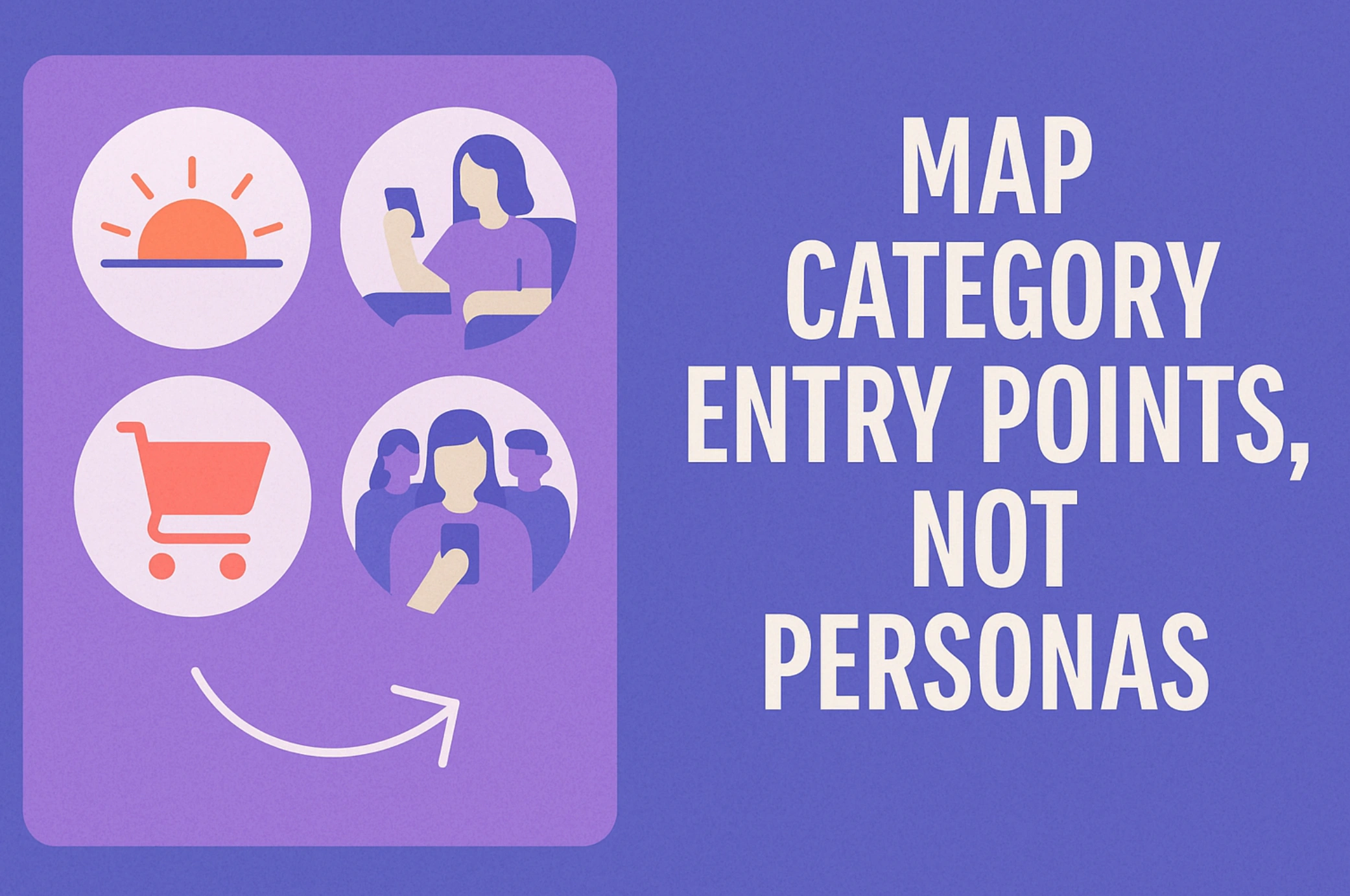
People buy in contexts, not in demographics. List the 8 to 12 situations your buyers are actually in when they decide: time of day, mood, location, social setting, and write creative that literally names or depicts those moments. Your job is to associate your brand to more of these doors than your competitors (Ehrenberg-Bass CEPs).
- Insider tips: scrape search queries, CRM notes, and reviews for “when” and “because” language to discover CEPs.
- Build a “CEP calendar”: seasonality by moment, not by demographic.
- One execution per CEP; don’t cram five occasions into one ad.
4) Balance long and short to compound results
A campaign that stands out in market marries emotional, broad-reach brand work with sharp activation that captures demand now. Plan these as a portfolio: brand creates future cash flows, activation harvests today’s. Allocate spend and KPIs separately, then join them with creative continuity so the short reminds people of the long (IPA: Binet & Field).
- Insider tips: recycle the same hero device across both layers; swap only the offer.
- Use 60/40 or your variant as a starting point; track mental availability, not just CPA.
- Code each activation with your assets so cheap clicks still build memory.
5) Plan for reach, then precision
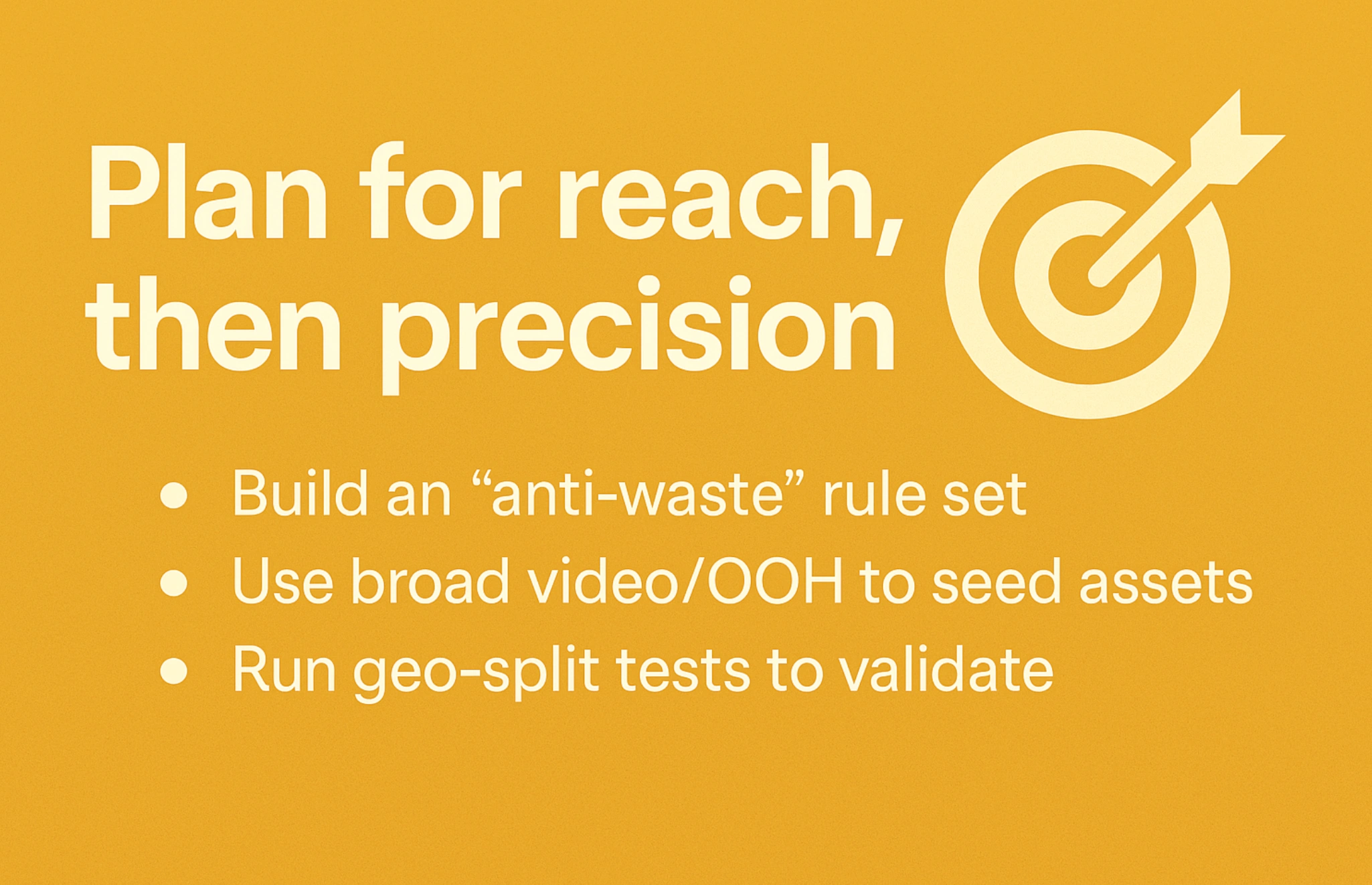
To grow, reach more category buyers more often, then add precision where it proves incremental. Over-targeting is the most common growth killer. Start wide, verify frequency capping, then layer segments that show true lift instead of cannibalising natural demand (LinkedIn B2B Institute).
- Insider tips: build an “anti-waste” rule set—cap at person-level, rotate formats weekly, rotate contexts monthly.
- Use broad video/OOH to seed assets; retarget with creative variety, not just tighter audiences.
- Run geo-split tests to validate reach assumptions before scaling.
6) Design for micro-moments and remove friction
Every execution should win a specific intent: I-want-to-know, go, do, or buy. Align the creative promise with a landing flow that delivers in one screen. If the ad says “near me,” show a map. If it teases proof, show the proof, not a homepage. Treat speed as creative—slow pages ruin great ideas (Think with Google).
- Insider tips: write one “next best action” per placement and ban multi-CTA end cards.
- Build landers as “ad-native”: same headline, same hero, same offer within the first viewport.
- Prebuild wallet-ready flows for mobile; don’t make people pinch-zoom a form.
.webp)
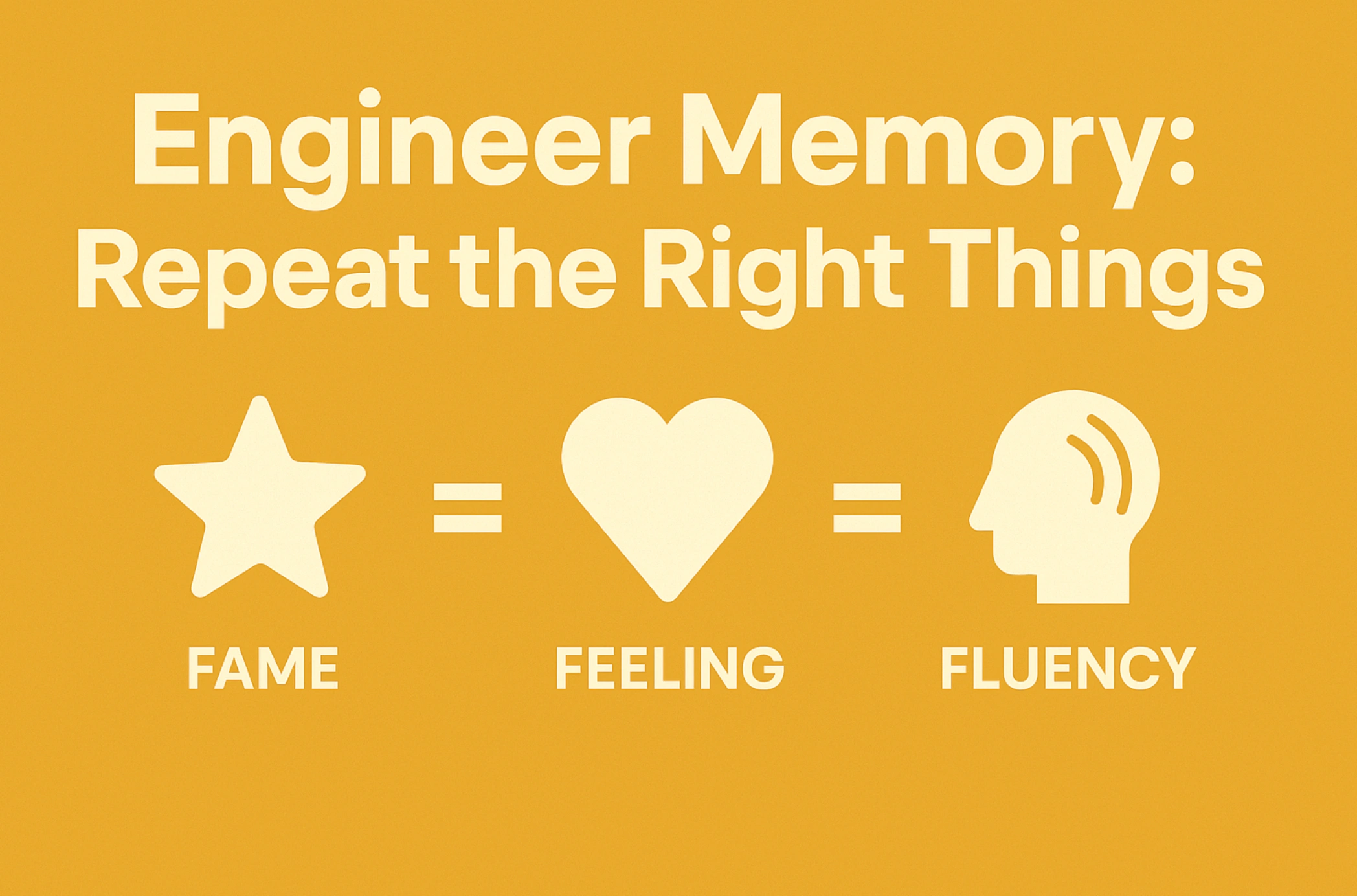
7) Engineer memory: repeat the right things
Fame, feeling, fluency. Make people know you, like you, and recognise you under low attention. The trick is repetition without boredom: keep the brand code constant and vary the story world. Use your sonic sting and device in short cuts, then reward attention with deeper scenes in long cuts (System1 summary).
- Insider tips: publish a “three-beat” structure for shorts: hook, brand cue, payoff.
- Score each edit for asset presence before it ships: no cue, no media.
- Re-run top creatives quarterly; frequency beats novelty over time.
8) Set ESOV and pacing you can actually sustain
Excess share of voice above your share of market tends to drive growth, but only if you sustain it. Spiky bursts cause memory to decay between flights. Aim for a level of presence you won’t need to retreat from, and ladder bursts to the category entry points where decisions cluster (Effectiveness in Context, Binet & Field).
- Insider tips: hold back 10 to 15 percent of budget as an “opportunity pot” to ride unexpected cultural moments.
- Use daypart rules: heavy in decision windows, light in low-intent hours.
- Pre-negotiate make-goods; keep continuity even if one channel underdelivers.
9) Measure like a realist, not a romantic
Judge activation on short-term sales and CPA. Judge brand on reach, asset recognition, mental availability, and penetration. MMM or geo-experiments tell you what actually moved the needle; last-click dashboards will lie. Tie creative diagnostics to sales so you protect what works even when platform metrics wobble (Nielsen).
- Insider tips: add two survey questions to always-on: asset recognition and “brand at time of need.”
- Run quarterly creative-lift tests; keep the winners, kill the rest.
- Build a single “effectiveness board” that merges MMM signals with creative scores.

10) Codify learnings into a repeatable playbook
Standing out once is luck; standing out repeatedly is systems thinking. Document the device, assets, CEPs, lines, pacing, and channel guardrails in a playbook, then enforce it in briefs and creative reviews. Your future team should be able to ship recognisably “you” work in a week, not a month (LinkedIn B2B Institute).
- Insider tips: keep a 10-slide “campaign DNA” deck in every brief; include do/don’t examples.
- Maintain an asset library with edit-ready files and usage rules.
- Run post-mortems that end with two changes to the playbook, every time.
.webp)
FAQ
What’s the fastest way to make a marketing campaign stand out without big budgets?
Lead with distinctive assets in the first frame, tie one asset to one high-value category entry point, and buy broad, efficient reach. Keep the device and sonic sting constant; rotate stories around them.
How to create a successful marketing campaign when sales needs leads now?
Run brand and activation in parallel. Use the same device in your DR units so every cheap click still builds memory; measure both sales now and mental availability later.
How many audiences should I target?
Start wide across category buyers, then layer precision only where tests show true incremental lift; avoid over-narrowing that caps growth.
How do micro-moments change the creative brief?
Write the primary intent in the headline, design one obvious next action, and land users on a matching, fast screen—no generic homepages.
How do I keep the team from drifting off strategy over time?
Use a tight playbook, run asset-fluency checks quarterly, and make creative reviews score for brand cues, not just polish. Promote editors who keep the code intact.
Make it unmissable
If you want to know how to make a marketing campaign stand out, engineer memory, not noise. Start with a fluent device, wire it to the moments buyers decide, reach broadly, and keep the experience effortless when attention shows up. That’s the repeatable system behind a successful marketing campaign guide—unique marketing campaign strategies that don’t just win attention, they win recall and results.

%2520(1).png)
.png)