
Selecting the right technology partner is one of the most consequential decisions a nonprofit organization makes. The wrong choice creates operational disruption, diverts resources from mission-critical work, and produces systems that do not reflect how the organisation actually functions. A specialist software development company with genuine nonprofit sector experience approaches these engagements differently from general commercial software vendors—understanding that donor management, volunteer coordination, grant reporting, and board governance have distinct operational requirements that off-the-shelf solutions rarely accommodate well.
The challenge for most nonprofits is that the vendor selection process itself is unfamiliar territory. With hundreds of firms presenting similar claims, distinguishing meaningful capability from effective sales presentation requires a structured evaluation approach. Whether you are building a custom platform or simply integrating tools to organize member data, this framework will help you identify technology partners who deliver operationally aligned solutions.

1. Define Requirements Before Approaching Vendors
The most common mistake in nonprofit software procurement is initiating vendor conversations before internal requirements have been clearly documented. Without a precise understanding of what the organisation needs, it is impossible to evaluate whether any given solution actually addresses the problem—and vendors will fill that gap with their own framing.
A useful starting point is a requirements document that maps current workflows, identifies the processes that are failing or generating unnecessary administrative burden, and defines the user groups who will interact with the system—staff, volunteers, donors, board members, and any external partners. This document should also prioritize features explicitly: what is essential to mission delivery, what would improve operations, and what can be deferred. Organizations that complete this preparation before engaging vendors are significantly better positioned to assess whether a proposed technology investment aligns with mission objectives rather than simply adding capability for its own sake.
2. Prioritise Nonprofit Sector Experience
Technical capability is a baseline requirement, not a differentiator. The factor that most reliably separates effective nonprofit technology partners from general software vendors is depth of sector experience. Nonprofit organizations operate under constraints and requirements that have no equivalent in commercial software environments: fundraising campaign structures, grant management and reporting cycles, volunteer coordination at scale, and board governance processes all require specific domain understanding.
When evaluating sector experience, case studies from comparable organizations carry more weight than general nonprofit credentials. Relevant evidence includes demonstrated outcomes in fundraising efficiency, volunteer engagement, or reporting accuracy — not simply a list of nonprofit clients. Integration experience with sector-standard platforms such as Salesforce Nonprofit Cloud, Bloomerang, or Blackbaud is also a meaningful indicator: a partner familiar with the existing infrastructure landscape can build solutions that connect to these platforms cleanly rather than creating data silos.
Data security and compliance competence are non-negotiable components of this evaluation. Nonprofit organisations handle sensitive donor information, payment data, and volunteer records. Partners should demonstrate clear understanding of relevant frameworks including PCI DSS for payment processing, GDPR or CCPA for data privacy, and SOC 2 standards for cloud-based services.
3. Evaluate Technical Capability Systematically
Once sector experience has been established, technical evaluation should focus on three areas. First, the quality and scalability of past work: portfolio review should examine architectural decisions, UI/UX standards, and code quality — and live demonstrations or client references that can speak to system performance under real conditions are more informative than presentations alone.
Second, the partner's approach to future-proofing: strong partners build on modern development frameworks and cloud architectures that accommodate growth without requiring full rebuilds. The organisation should be able to articulate clearly how it handles system updates, integration with new platforms, and long-term maintenance. Third, security practices should be documented rather than described — encryption standards, access control protocols, incident response procedures, and relevant certifications should be available for review. A partner that cannot readily provide this documentation presents an unacceptable risk for organisations handling donor and beneficiary data.
4. Test Communication Standards Early
Communication quality is frequently a more reliable predictor of project success than technical credentials. Nonprofit teams often include staff without deep technology backgrounds, and a partner that communicates in accessible language — explaining architectural decisions and trade-offs clearly, without relying on technical jargon — creates significantly better conditions for alignment throughout the project.
Response times during the evaluation process are a direct signal of how the partner will behave once engaged. Delayed responses to straightforward questions before a contract is signed typically indicate more significant communication gaps during active development. Evaluators should also ask for a detailed project methodology — covering discovery and planning phases, development milestones, testing procedures, and post-launch support — and assess whether the process reflects genuine experience managing nonprofit technology projects or a generic software development template.

5. Verify References Beyond the Vendor's Selection
Reference checks are most valuable when they extend beyond the contacts a vendor provides. Vendor-supplied references will naturally reflect positive experiences; the more informative conversations are with organisations that worked with the partner but were not listed as references. LinkedIn, nonprofit technology forums, and sector networks are effective channels for identifying these independent perspectives.
When conducting reference conversations, questions should be specific rather than general. How the partner managed delays, communicated during problems, and handled post-launch issues reveals more about the working relationship than a summary endorsement. Research on vendor management in the nonprofit sector consistently identifies reference quality — rather than reference volume — as the most predictive factor in long-term partnership satisfaction.
6. Evaluate Total Cost of Ownership
Initial development cost is rarely the largest cost component over a software system's operational lifetime. Licensing and subscription fees, implementation and data migration costs, onboarding time, integration work, ongoing maintenance, and future feature development all contribute to the total cost of ownership — and vendors that present attractively low initial estimates frequently recover margin through these downstream costs.
A rigorous evaluation asks vendors to break down all cost categories explicitly: base licensing or subscription fees, per-user or per-module charges, renewal escalation policies, data migration scope and cost, and the terms under which ongoing support is provided. Organisations that compare vendors on total cost of ownership rather than initial project price make better long-term decisions and avoid the significant disruption that comes from discovering material cost gaps mid-engagement.
7. Apply an Objective Evaluation Framework
Vendor selection decisions benefit from a structured scoring framework that allows the organization's leadership, board members, and relevant stakeholders to evaluate proposals against a consistent set of criteria. The following weighting reflects the relative importance of each factor across a typical nonprofit software procurement:
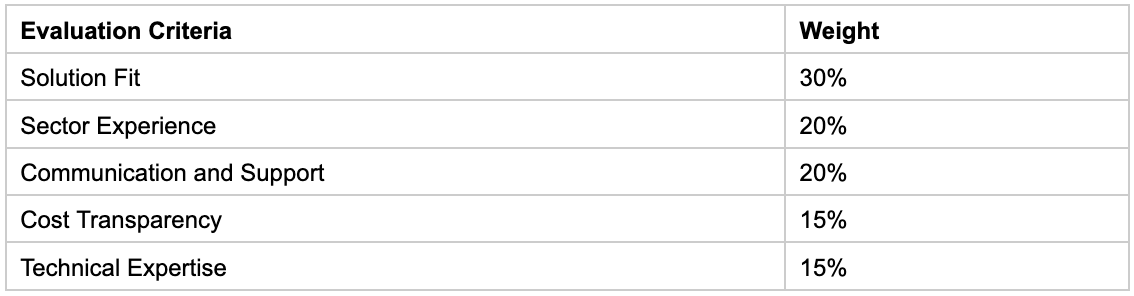
Assigning explicit weights to each criterion reduces the influence of presentation quality on the final decision and creates a documented rationale that supports board-level accountability. Each evaluator should score vendors independently before comparing results—divergent scores often surface important organizational disagreements about priorities that are worth resolving before a partner is selected.
Conclusion
The selection of a nonprofit software development partner carries long-term implications for operational capacity, staff experience, and mission delivery. The decision merits the same rigour applied to any major strategic investment—beginning with clearly defined internal requirements, evaluating sector experience and technical capability systematically, verifying claims through independent reference checks, and assessing total cost of ownership across the full software lifecycle.
Organizations that approach this process with a structured framework select partners who function as genuine operational extensions of their teams—building solutions that reflect how the organization works, scale with its growth, and sustain their impact over time. For a complementary perspective on technology investment and operational growth strategy, the Brand Vision Insights guide to conversion and growth provides additional context on evaluating vendor partnerships at scale.


%2520(1).png)