Most founders treat branding as something to sort out later, after the product is built or funding is secured. That is a costly mistake.
A brand shapes how customers perceive you from the first Google result to the first invoice. Getting it right from day one saves time, money, and repositioning headaches down the line.
This guide covers the practical steps every startup founder should take to build a brand that scales, starting before the first line of code is written.
Step 1: Start with the Legal Foundation
Your brand cannot exist without a legal entity behind it. Choosing the right structure protects your personal assets, enables you to open business bank accounts, and signals credibility to investors and partners.
Most startups choose between an LLC and a C-Corp. C-Corps are preferred if you plan to raise venture capital, while LLCs offer simplicity and tax flexibility for bootstrapped businesses.
Streamlined company formation services allow founders to register a U.S. entity online in days, regardless of where they are based, which removes one of the earliest blockers to launching a legitimate brand.
Step 2: Define Your Brand Positioning
Brand positioning answers three questions: who you are for, what problem you solve, and why someone should choose you over alternatives. Get these wrong and every other branding decision becomes harder.
Rand Fishkin, founder of SparkToro, has written extensively on this: 'The biggest mistake startups make is trying to appeal to everyone. Specificity builds trust and drives word of mouth.'
Write a one-sentence positioning statement before designing anything. It should name your target customer, the outcome you deliver, and what differentiates you from existing options.
Step 3: Build a Visual Identity That Scales
A visual identity is more than a logo. It includes your colour palette, typography, spacing principles, and the way these elements combine across a website, pitch deck, and social media.
Startups often over-invest in custom illustration early and under-invest in typographic consistency. A clean, well-chosen typeface with a strong primary colour will outperform an elaborate logo with no brand system behind it.
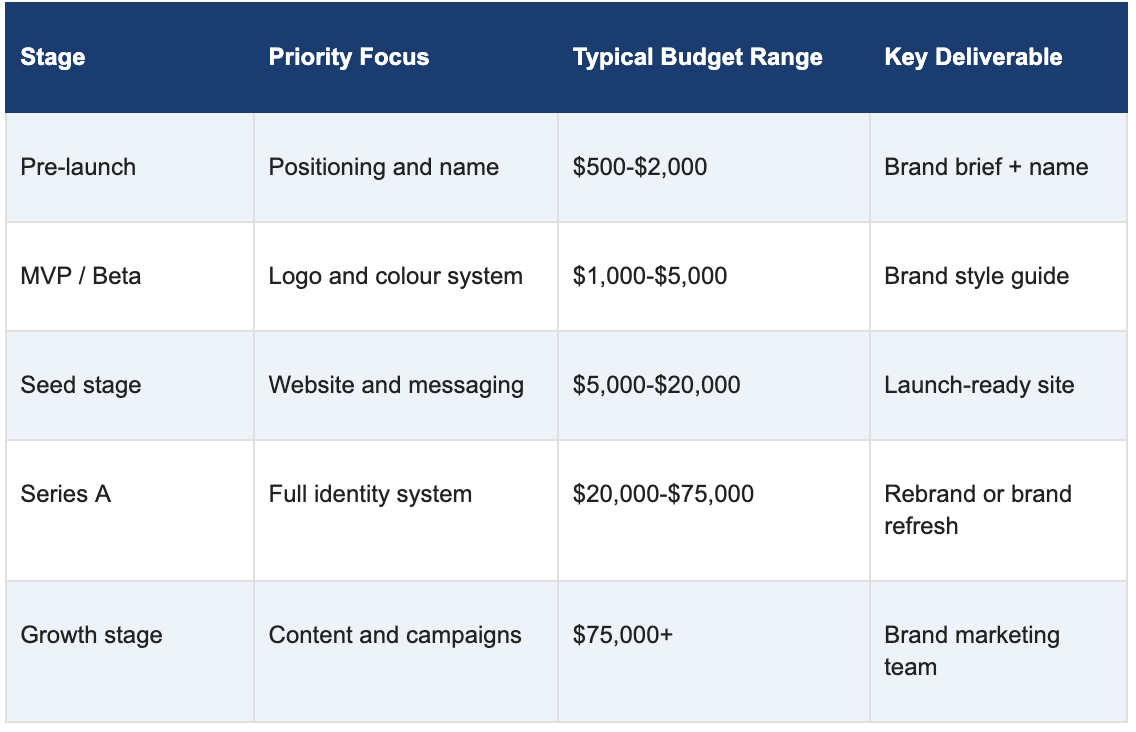
Brand Investment by Startup Stage
Step 4: Write Your Core Messaging Framework
A messaging framework documents your value proposition, key proof points, and the tone your brand uses across all channels. Without it, your website, ads, and pitch decks will each tell a slightly different story.
What a Messaging Framework Includes
Tagline: a short statement of what you do and for whom.
Value proposition: one to two sentences explaining the benefit you deliver and why it matters.
Proof points: three to five factual claims that support your value proposition, such as customer numbers, time savings, or case study outcomes.
Tone guide: the personality behind your words. Formal or casual? Technical or accessible? Confident or collaborative? Document it and enforce it.
Step 5: Launch a Brand-Ready Digital Presence
Your website is your most important brand asset at launch. It should communicate your positioning in the first eight seconds a visitor lands on it, and make the next step obvious.
Search engines reward structured content and technical performance. Build your site on a platform that supports clean HTML, fast load times, and easy content updates. Avoid page builders that generate bloated code.
SEO and Brand Discoverability
Brand discoverability starts before your launch. Reserve your brand name across major social platforms. Register your domain. Ensure your Google Business Profile matches your registered business name exactly.
According to a 2024 BrightEdge report, 68 percent of online experiences begin with a search engine. Founders who treat SEO as a brand channel from day one build compounding authority that paid ads cannot replicate.
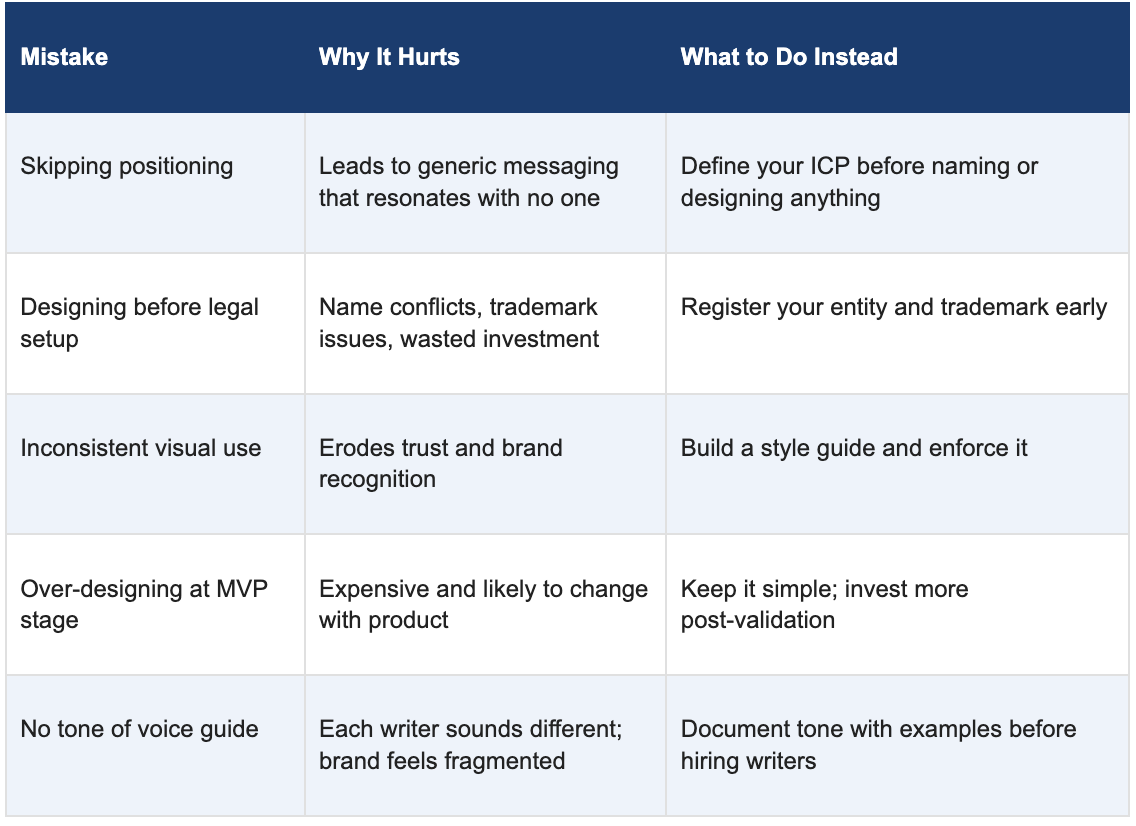
Common Startup Branding Mistakes to Avoid
Frequently Asked Questions
When should a startup start thinking about branding?
Before you name the company. Your name, legal structure, and brand positioning are all interconnected. Founders who treat branding as a post-launch activity often end up rebranding within the first two years, which is expensive and disruptive to early customers.
Do I need a professional designer at the pre-launch stage?
Not necessarily a full agency, but a professional brand brief and at minimum a professional logo are worth the investment. DIY logos signal lack of investment to early customers and potential investors. A freelance brand designer at the pre-seed stage is a reasonable middle ground.
What legal structure is best for a startup that wants to raise funding?
A Delaware C-Corp is the standard choice for startups planning to raise venture capital. Most U.S. institutional investors require it. LLCs are better suited for service businesses, solo founders, or companies that do not plan to take on outside investment.
How long does it take to build a strong brand?
Brand recognition typically takes consistent effort over 18 to 36 months. However, the foundational work — positioning, visual identity, and messaging — can be completed in four to eight weeks if a founder prioritises it.
Should startup branding look polished or authentic and scrappy?
It depends on your market. B2B SaaS buyers expect polish and clarity. Consumer-facing direct-to-consumer brands can succeed with a more raw, founder-led aesthetic. Know your buyer and match the aesthetic to the expectation they already hold in that category.


%2520(1).png)