
Travel is active again, but consumer attention is fragmented. BÉIS is a useful 2026 case because its growth story is not only about founder visibility. The BÉIS marketing strategy connects product design, content, pop-ups, and owned channels around a repeatable promise: make travel feel easier and more organized.
This piece breaks down the BÉIS marketing strategy in decision-maker terms. You will see how Shay Mitchell BÉIS positioning created a travel essentials brand that feels practical, personal, and shareable. You will also see what BÉIS luggage marketing does differently from legacy luggage and modern competitors, and how to adapt the lessons without a celebrity founder.
The Short Version: What BÉIS Gets Right In 2026
BÉIS is often described as a travel bag brand, but the engine is broader. The BÉIS marketing strategy treats travel as a lifestyle rhythm, not a product category. That framing changes everything: the content people share, the reasons they repurchase, and the way the brand shows up offline.
Key moves that make the system work:
- Clear category choice. BÉIS positions as a travel essentials brand with design-led utility, not a luggage status symbol.
- Product as proof. Features are easy to show on camera, easy to explain, and easy to believe when the founder uses them in real contexts.
- Human content. Shay Mitchell BÉIS's credibility is amplified through employees and behind-the-scenes storytelling, not just polished ads.
- Owned channel discipline. SMS, email, and app-like mechanics convert excitement into repeat orders and predictable demand.
- Pop-ups with measurement. Retail moments are treated as performance events that lift traffic and customer value, not as brand theater.
A few proof points help illustrate the scale without turning historical figures into current revenue claims. Forbes reported BÉIS at roughly $200 million in revenue in January 2024 and positioned the brand as a disruptor in a large luggage market (Forbes). Shopify’s case study cites more than $200 million in annual revenue in 2023, along with measurable results from pop-up markets and peak traffic periods (Shopify case study). The durable lesson is the operating pattern behind those dated results.
The Brand Snapshot: What BÉIS Sells, Who It’s For, Why It Wins
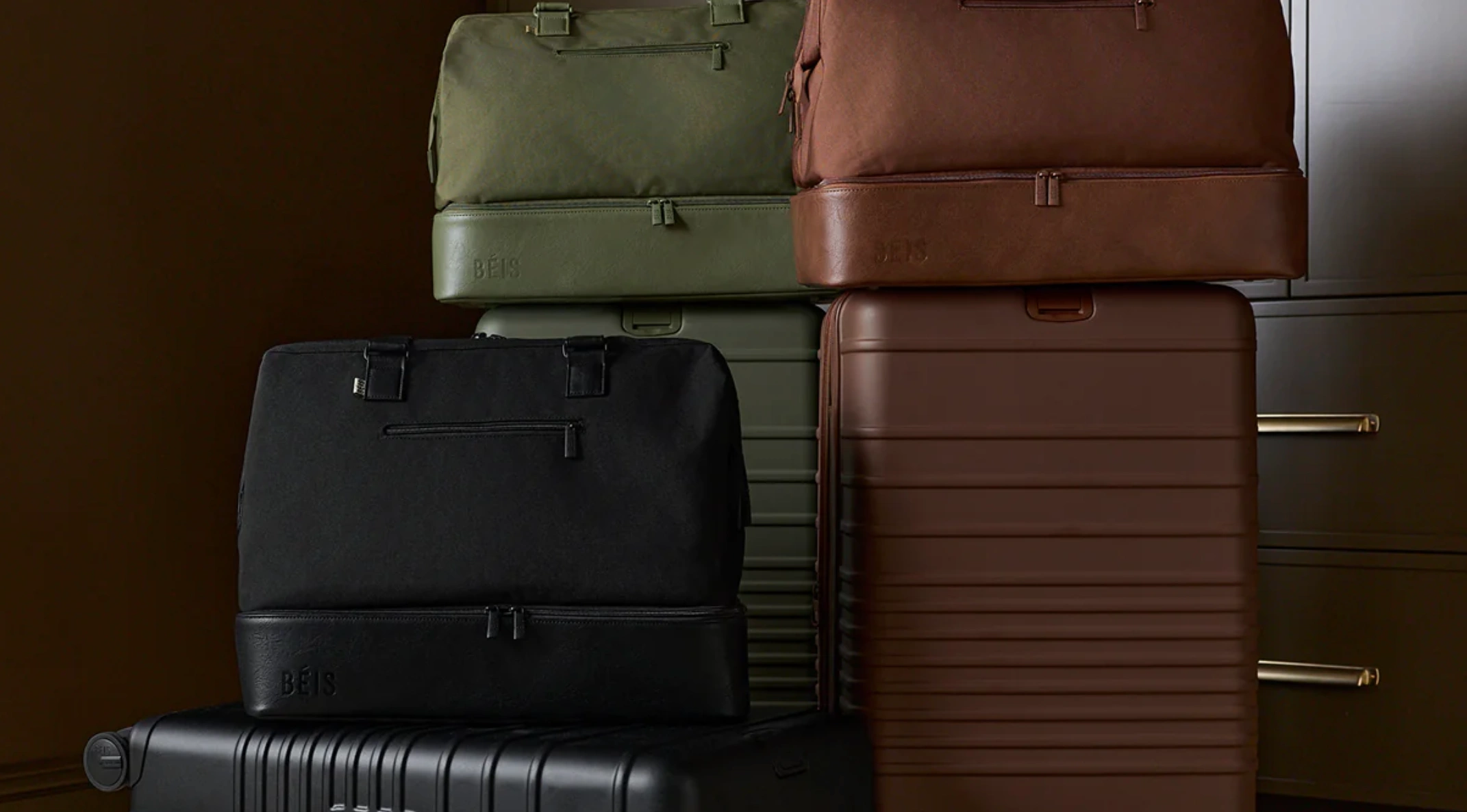
BÉIS sells travel bags, accessories, and organizational essentials, but it markets a feeling of control in transit. That is the heart of the BÉIS brand strategy. The customer is not buying luggage alone. They are buying a more composed travel day, with fewer small failures.
The travel essentials brand angle also broadens the audience. It speaks to frequent travelers, parents, commuters, and anyone who treats movement as part of work and life. This is one reason BÉIS luggage marketing travels well across channels. The product is visual, but the promise is emotional and functional at the same time.
In practice, the BÉIS marketing strategy is built around three truths:
- The customer wants ease more than luxury.
- The customer wants proof more than claims.
- The customer wants consistency across touchpoints, from social content to checkout to post purchase support.
For many scaling brands, this is where the system breaks: the story is strong, but the experience is uneven. Investing in web design agency fundamentals and UI UX design agency rigor can make the marketing promise easier to carry through discovery, comparison, checkout, and support. Site experience is one retention input, not a substitute for product value.
Positioning: Making Functional Feel Aspirational
A practical positioning triangle
The most useful way to explain the BÉIS brand strategy is to reduce it to a positioning triangle. This keeps the discussion grounded and helps teams see what is actually doing the work.
Audience: People who travel and carry their day with them.
Promise: Travel feels smoother when your gear is built for real use.
Proof: Features, organization, durability cues, and real context usage that are easy to demonstrate.
This triangle is why the BÉIS marketing strategy does not need constant reinvention. When a brand has a clean promise and repeatable proof, content and product support each other. Shay Mitchell BÉIS content can stay consistent without feeling repetitive, because the situations change while the job stays the same.
Proof points that reinforce the promise
BÉIS luggage marketing leans on proof that is easy to see. Compartments, pockets, wipeable materials, and thoughtful sizing are not only product features. They are marketing units. Each feature can become a clip, a carousel, a customer review moment, and a merchandising module on the site.
This is also where teams should be careful with tone. BÉIS rarely needs grand claims because the product design does the speaking. That is the lesson for any travel essentials brand or adjacent category: your language should not outpace what the customer will experience.
If your brand needs help clarifying this promise and proof system, it is typically branding work first, not channel work. That is the role of a branding agency: define what must remain true across every campaign, every landing page, and every product launch.

Product Strategy: The Hero Item To Ecosystem Ladder
Why “features” are really content prompts
The BÉIS marketing strategy starts with the assumption that the product must carry the message. That is why the hero item matters. A hero product is not only the best seller. It is the clearest demonstration of the promise.
From there, BÉIS extends into an ecosystem that supports repeat purchasing. The travel essentials brand category is naturally modular. Customers can add organizers, smaller bags, and accessories over time. Each purchase improves the travel routine, which makes a second purchase feel reasonable.
For teams building a similar ladder, the key is to avoid expansion that changes the job. The BÉIS brand strategy stays focused on travel utility and a specific visual language. That keeps Shay Mitchell BÉIS communication coherent even as the assortment expands.
Merchandising and site UX decisions that protect conversion
There is a quiet discipline in how fast growing brands present complexity. More products can create more confusion. The BÉIS marketing strategy avoids this by making shopping feel like planning. Bundles, sets, and travel use cases reduce decision fatigue.
This is where web design connects to conversion quality and customer understanding. A clearer taxonomy, stronger search, and better on-site education can reduce decision friction. Product detail pages are also a proof layer for the BÉIS brand strategy, where features, use cases, and expectations should be easy to verify before purchase.
We often see brands over invest in new campaigns while under investing in site governance. If launches require custom work every time, performance suffers. Maintainable templates and consistent content patterns matter as much as creativity. A strong UI UX design agency partner focuses on that operating model, not only on visuals.
Content System: Social Proof, Airport Visibility, And Shareable Utility
Employee-led content as credibility, not gimmick
A notable part of BÉIS luggage marketing is how the brand uses human presence beyond the founder. Adweek has covered BÉIS’s push to feature employees and behind the scenes moments as a way to humanize content and build familiarity (Adweek). This matters because it converts brand attention into trust. It also makes the content engine less dependent on one face.
For brands without a celebrity founder, this is good news. The BÉIS marketing strategy shows that internal advocates can provide credibility if the content is grounded in real work. Product shoots, customer feedback, and operational moments can become content. The key is restraint. The goal is not to be loud. The goal is to be believable.
Utility content that earns shares
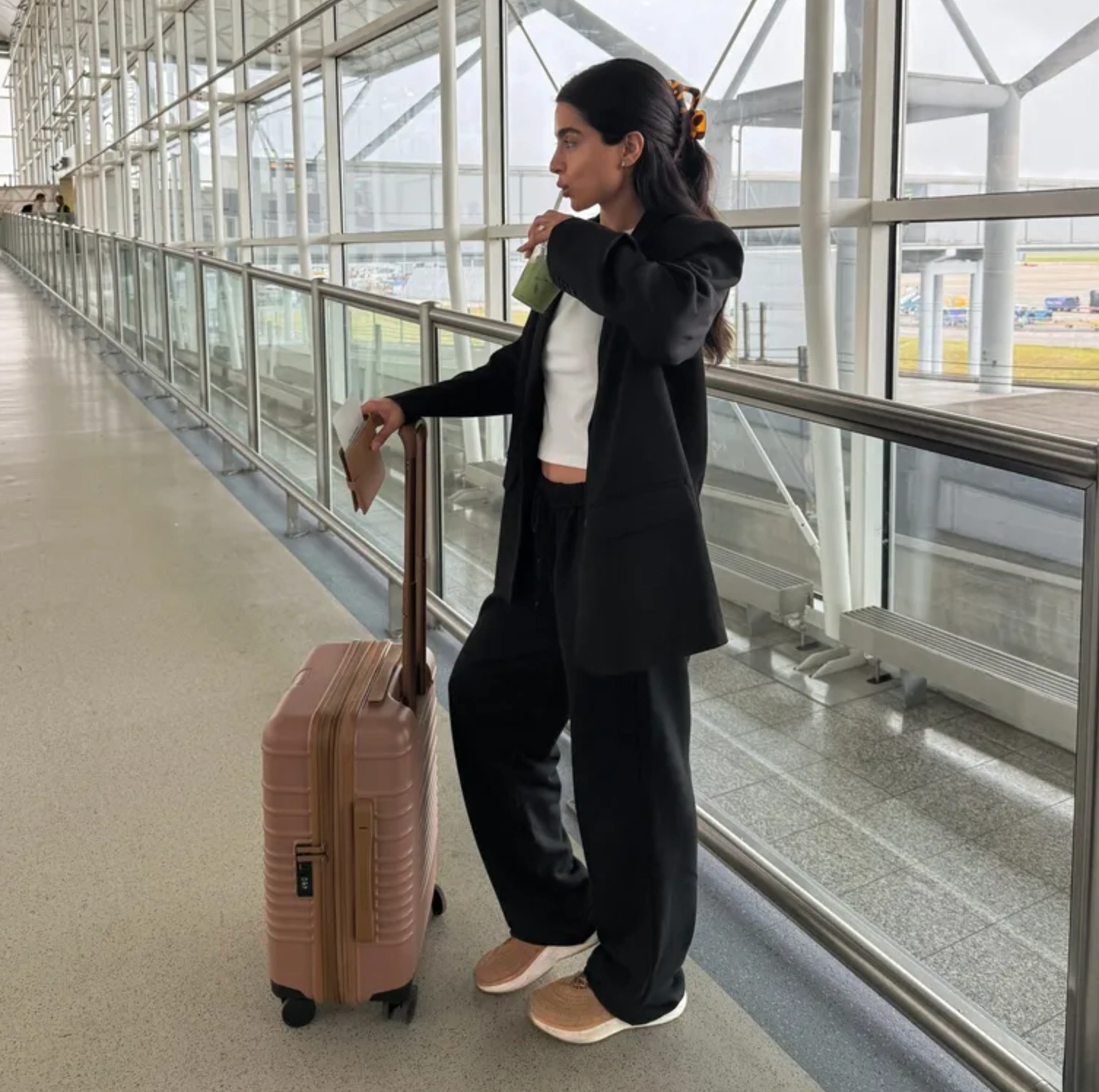
The travel essentials brand category has a natural content advantage. Packing tips, airport routines, and travel organization are inherently useful. The BÉIS brand strategy turns those routines into repeatable formats that people save and share.
Three content types tend to perform well in this model:
- Demonstrations of features in real use
- “What’s in my bag” and packing workflows
- Side by side comparisons that clarify which bag fits which trip
Shay Mitchell BÉIS content often uses a familiar, travel-savvy tone rather than a formal ad-read style. That tone is an operational choice: it shapes what gets approved, how quickly content can ship, and how consistently product utility is explained.
If you want to build a content system like this, pair creative discipline with demand capture. A strong SEO agency helps ensure the utility content does not live only on social. In 2026, the best systems reuse the same proof across short form, landing pages, and evergreen pages, without forcing it.

Community And Retention: Why BÉIS Doesn’t Feel Like A One-Time Purchase
Owned channels that compound
Modern brands often treat retention as a set of tactics. A more useful reading of the BÉIS marketing strategy is that owned channels extend the same product promise after purchase: education, product discovery, and relevant add-ons can happen without relying entirely on paid media.
Attentive has featured BÉIS leadership discussing digital and e-commerce priorities and the role of owned channels in customer experience (Attentive). Shopify’s case study separately documents platform reliability during peak periods, which matters because downtime or slow performance can interrupt demand when traffic surges (Shopify case study).
Retention metrics that matter
The BÉIS brand strategy is strongest when measured as a relationship, not a campaign. If you are building a similar loop, track metrics that tell you whether your promise is compounding:
- Returning customer revenue share
- Repeat purchase rate by product family
- Time to second purchase
- Subscriber growth for email and SMS
- Customer support contact rate per order
Travel products create repeated moments for customers to notice whether the design solves real friction. A travel essentials brand can use those moments for education, accessories, and post-purchase support without assuming that frequency alone creates loyalty.
From a UX perspective, accessibility and performance matter because slower pages, unclear navigation, or inconsistent templates can add friction to repeat shopping and support. This is why many growing brands invest in web design agency improvements before scaling spend.
IRL Growth: Pop Ups As Performance Marketing
The IRL to digital handoff
Pop-ups are not only about presence. In the BÉIS marketing strategy, they create product trial, social content, and a measurable local activation. Shopify’s case study reports an average 30 percent traffic increase during pop-up activation and an average 10 percent revenue lift (Shopify case study). Those are documented BÉIS results, not a benchmark every brand should expect.
The key is the handoff. A pop up that does not capture an ongoing relationship is expensive theater. A pop up that captures email, SMS, and repeat intent becomes a customer acquisition channel with a different kind of trust.
A clean handoff usually includes:
- QR capture with a clear value exchange
- Post-visit email or SMS sequence tied to what the customer tried
- A landing page that matches the pop-up assortment and language
- Simple return and support policies that reduce risk
How to measure pop-up impact without guessing
Teams often argue about whether pop ups “work” because measurement is weak. The BÉIS brand strategy is a reminder to define success in advance, with a small set of metrics:
- Traffic lift in the market during the event window
- New subscribers acquired from the market
- Conversion rate for the market compared to baseline
- Repeat purchase rate for customers acquired during the pop up period
Pop ups also expose operational gaps. If inventory is inconsistent, checkout is slow, or post-purchase support is unclear, the brand promise can fracture. For teams adapting a national activation to West Coast retail, local production, or market-specific creative, a Los Angeles branding agency can support the regional execution without changing the core brand system.
If your business lives in travel, hospitality, or location based experiences, the model becomes even more relevant. A good reference point for category context is Brand Vision’s travel and hospitality marketing agency work, where brand story and conversion design have to stay aligned across channels.
Partnerships And Collaborations: Expansion Without Dilution
A collaboration filter that prevents dilution
Collaborations can extend reach, but they can also confuse customers. The BÉIS marketing strategy uses collaborations as a controlled expansion tool, not as a constant novelty machine. When you evaluate partnerships, treat them like product decisions, not publicity decisions.
A simple filter:
- Does it reinforce the travel job, or distract from it?
- Does it add a new use case that the customer can understand in one sentence?
- Can the collaboration generate proof, not only attention?
Business media has covered BÉIS’s growth and strategic next steps as the brand expands, which underscores the need for clarity as scale increases (Business of Fashion). If the collaboration does not strengthen the BÉIS brand strategy, it risks weakening the signal that makes BÉIS luggage marketing effective.
For Shay Mitchell BÉIS, collaborations also have an authenticity test. The founder’s presence raises the bar. The audience expects taste plus utility, not only a logo swap. That expectation is one reason the travel essentials brand positioning remains durable.

The Competitive Frame: BÉIS vs Away, Monos, And Traditional Luggage
Category mapping and perceptual tradeoffs
BÉIS competes in luggage, but it frames itself differently. Away and Monos often lean into minimal design cues and a premium travel identity. Traditional luggage leans on durability heritage and distribution. The BÉIS marketing strategy leans on the lived experience of travel, and the small frictions that ruin a day.
This creates a useful tradeoff map:
- If you want status signaling, you may choose a classic luxury route.
- If you want minimalist prestige, you may choose a modern luggage competitor.
- If you want a travel essentials brand that solves the messy details, BÉIS is an easy yes.
This framing is why the BÉIS brand strategy travels beyond luggage. It is not locked to a single product. It is locked to a job. That is also why BÉIS luggage marketing can support a wider assortment without breaking the story.
For operators, the takeaway is not to copy a competitor’s voice. Use brand research to understand the category, choose a job the brand can credibly own, and defend it with visible proof. For another consumer brand balancing function, identity, and a broader lifestyle story, see The North Face marketing strategy.
The BÉIS Flywheel: A Simple Model You Can Steal
The five step loop
The cleanest way to summarize the BÉIS marketing strategy is as a flywheel. Each step reinforces the next, and each step can be owned by a team with clear metrics.
- Product utility becomes visible proof
- Proof becomes content people save and share
- Content creates demand for IRL trial and social proof
- IRL moments capture owned audiences
- Owned audiences drive repeat purchase and referrals
The value of the flywheel is diversification rather than guaranteed resilience. If one channel weakens, teams can still learn from product proof, owned audiences, search demand, and IRL activity while keeping one positioning system across the mix.
One metric and one operating habit per step
Step 1 metric: Product review sentiment and return rate
Habit: Ship fewer SKUs, but build stronger proof per SKU
Step 2 metric: Save rate and completion rate on core content formats
Habit: Maintain a content library of repeatable demos and use cases
Step 3 metric: Direct and branded search lift during campaign windows
Habit: Coordinate launches so social and site merchandising change together
Step 4 metric: Subscriber capture rate by event or market
Habit: Build one landing page template for every pop up and activation
Step 5 metric: Time to second purchase and repeat rate
Habit: Create post purchase education that reduces support load and increases usage
This is where web experience becomes part of growth execution. Strong information architecture, accessible design, and reliable performance help the site support product education, launches, and repeat shopping. Teams may treat this as technical debt, but it also affects demand capture and customer experience, which is why leaders invest in web design agency and UI UX design agency improvements as part of growth planning.
If you want a grounding statistic, Shopify’s case study references site speed at 2.5 seconds during surge periods and a 200 percent increase in site traffic during BFCM 2023 without downtime (Shopify case study). The specific number is less important than the operational principle. Reliability is a marketing asset in 2026.
What Business Owners Can Apply In 2026
A 30 day implementation plan
You do not need a celebrity founder to learn from the BÉIS marketing strategy. The transferable value is the system. Below is a practical 30 day plan that applies to a travel essentials brand, a service business, or a B2B product category.
Week 1: Clarify positioning and proof
- Write your positioning triangle in one page.
- List three proof points the customer can see, not just hear.
- Audit your homepage and top landing pages for proof clarity.
If you need help tightening the signal, start with a branding agency engagement, not a campaign brainstorm.
Week 2: Build two repeatable content formats
- Choose one demo format and one utility format.
- Create a content library folder with scripts, shots, and examples.
- Make sure the content maps to your top products or services.
This is the part of BÉIS luggage marketing many teams admire, but the discipline is what makes it work. Repeatable formats reduce creative chaos.
Week 3: Fix the conversion path
- Simplify navigation and product education.
- Improve page speed and mobile usability.
- Make your post purchase flow clear and calm.
This is where leaders should treat UX like pipeline. A strong web design agency partner will focus on maintainability, accessibility, and governance so improvements stick.
Week 4: Create one retention loop
- Build a post purchase education sequence.
- Add a reorder or add on path that fits the job.
- Track repeat purchase and subscriber growth weekly.
This is how the BÉIS brand strategy compounds. It is not a one time conversion. It is a relationship.
Where teams usually overbuild
Most teams overbuild in the wrong places:
- Too many campaigns, not enough proof
- Too many SKUs, not enough clarity
- Too many tools, not enough operating habits
The Shay Mitchell BÉIS story can make the brand feel unique, but the mechanics are familiar. Clear positioning, demonstrable proof, and an operating model that does not change every month. That is the durable lesson from the BÉIS marketing strategy, and it is why the travel essentials brand framing is powerful.
If your next growth phase includes a site rebuild, new product architecture, or a more disciplined content system, start with the part of the system creating the most friction. Explore Brand Vision on the Brand Vision homepage, speak with our SEO agency team if demand capture is the priority, or contact Brand Vision for a scoped project discussion.
FAQ
What is the core BÉIS marketing strategy in one sentence?
The core BÉIS marketing strategy turns product design into proof, then uses that proof across social content, pop-ups, and owned channels to create repeat demand. This is why the BÉIS brand strategy stays consistent even as the assortment grows. It also explains why BÉIS luggage marketing feels practical rather than promotional.
How did Shay Mitchell BÉIS help the brand grow without feeling like a typical celebrity line?
Shay Mitchell BÉIS' credibility works because it is paired with visible product proof and a daily life use case. The founder's presence is not only a logo or a spokesperson moment. It is part of the proof system. That keeps the travel essentials brand story grounded and reduces the need for exaggerated claims.
What makes BÉIS different from other luggage brands?
BÉIS is positioned as a travel essentials brand built around everyday travel friction rather than status or heritage. The BÉIS brand strategy emphasizes organization, usability, and real-context demonstrations. That positioning gives the brand clear material for short-form content and creates logical paths into organizers, smaller bags, and accessories without guaranteeing add-on purchases.
Do pop ups actually drive measurable growth for BÉIS?
Yes, there are credible indicators that pop-ups have measurable effects. Shopify’s case study notes traffic increases in markets where BÉIS runs a pop-up, along with other performance outcomes tied to omnichannel operations (Shopify case study). The broader lesson for any brand is to treat pop-ups like performance events with clear capture and measurement, not only like brand moments.
What should a smaller brand copy from BÉIS marketing strategy first?
Start with the parts that do not require scale. Define your positioning triangle, strengthen proof on your site, and build two repeatable content formats. Then create one retention loop that educates customers and makes the second purchase feel natural. If the site experience is a bottleneck, invest in conversion fundamentals through a UI UX design agency or web design agency partner so the system can compound.
Speak with our team. If you want a practical project outline that connects positioning, UX, and demand capture, start with Brand Vision and request a scoped roadmap.