

A website can look polished and still underperform. In 2026, that gap usually shows up as quiet leakage: paid traffic that bounces, strong brand demand that stalls on forms, and high-intent visitors who hesitate because the path is unclear. The fix is rarely “make it prettier.” The fix is clarity, proof, and prioritization.
That’s why UX audit deliverables matter. A strong set of UX audit deliverables turns scattered feedback into a plan your marketing team can defend, your product team can ship, and your leadership team can fund. It becomes part of marketing strategy because it protects pipeline, improves conversion rate optimization, and reduces the cost of every acquisition channel.
The UX Audit Deliverables That Matter
A complete set of UX audit deliverables from a UI/UX agency should include:
- A UX audit report that ties findings to revenue, risk, and focus areas
- A website UX audit view of top journeys, key pages, and form paths
- A heuristic evaluation scorecard that flags friction fast using established heuristics (Nielsen Norman Group)
- Usability testing evidence, including clips and quotes that show what users actually do
- Analytics review that explains behavior, not just metrics
- A conversion rate optimization roadmap with prioritized recommendations, effort sizing, and owners
- A measurement plan that proves impact after changes ship

Methodology: How A Strong UX Audit Gets Built
- Combine a website UX audit across journeys with a heuristic evaluation and usability testing, then validate with analytics.
- Treat the UX audit report as a decision tool: clear problems, proof, and a ranked plan for conversion rate optimization.
- Cross-check experience issues against technical realities like Core Web Vitals and interaction quality (Google Search Central).
Why UX Audit Deliverables Belong In Marketing Strategy
Marketing strategy depends on the integrity of the conversion path. Every campaign assumes the site can carry intent from ad click to form submit, from landing page to sales call, from email to demo request. When the experience breaks, the brand pays twice: once for traffic, and again for the lost opportunity.
UX audit deliverables from the agency you work with can translate experience problems into marketing consequences, so you can see what urgently needs to be fixed. They show where message match fails, where trust drops, and where forms introduce hesitation. They also help a team choose the right kind of fix. Sometimes it is a landing page rewrite. Sometimes it is an interaction change. Sometimes it is a deeper information architecture issue that keeps users from finding the right page at all.
This is also where the work stops being subjective. A strong UX audit report gives conversion rate optimization a foundation. It replaces “opinions about design” with evidence from usability testing, behavioral data, and a structured heuristic evaluation. That level of rigor is what makes UX audit deliverables useful at the executive level, not just inside design reviews.
When teams want a broader view that includes positioning and channel performance, a marketing consultation and audit can sit beside UX audit deliverables and connect the site experience to the full funnel.
.webp)
The UX Audit Report: Five Core Sections You Should Expect
A UX audit report should be easy to skim, hard to argue with, and practical to act on. A professional UI/UX agency will organize the report into core sections so the work can move from insight to implementation without translation.
According to Hamoun Ani, Creative Director at Brand Vision, a high-quality UX audit starts with context, because recommendations only matter when they are anchored to how the site actually drives leads or sales.
Executive Summary And Decision Log
The executive summary is not a recap. It is a decision tool. It should state what is hurting conversion rate optimization, what is putting revenue at risk, and what should change first. It should also clarify what is out of scope, so teams do not chase edge cases.
In a strong UX audit report, this section usually includes: current performance baseline, top frictions by journey, and a short list of recommended priorities. If a website UX audit touches lead generation, it should call out where intent drops, where form completion fails, and where trust cues are missing.
Findings By Journey And Page Type
This is the backbone of UX audit deliverables. The report should group issues by how users actually move, not by random page lists. A brand’s marketing strategy is executed through journeys: learn, compare, decide, convert. A website UX audit should reflect that reality.
Common groupings include: homepage to service page, blog to service page, landing page to form, and navigation to key proof points like case studies. When the journey framing is strong, it becomes much easier to plan conversion rate optimization work without rewriting the entire site.
Evidence Library
Every serious UX audit report needs an evidence library. This is where usability testing clips, annotated screenshots, and analytics notes live together. It keeps stakeholders aligned because it shows the same friction from multiple angles.
For instance, an issue like “users do not notice the primary CTA” should be supported by usability testing quotes and the on-page behavior pattern that confirms it. A heuristic evaluation can then classify the issue and explain why it happens.
Recommendations And Effort Sizing
This is where UX audit deliverables either become useful or get ignored. Recommendations must be specific enough to implement and constrained enough to prioritize. Each recommendation should include a clear outcome, a suggested approach, and an estimate of effort.
For conversion rate optimization, it helps to format each recommendation as: problem, evidence, fix, and expected impact. When the UX audit report follows that structure, teams can move straight into tickets and design tasks.
Measurement Plan
Marketing strategy requires proof. A measurement plan defines what changes after fixes ship, what metrics will be used, and what tracking improvements are needed. This is also where analytics review becomes part of UX audit deliverables, not a separate artifact.
If the site’s tracking is incomplete, the UX audit report should say so directly. A measurement plan that relies on unreliable data is not a plan.
Journey And Funnel Findings: Where Users Drop And Why
A website UX audit should map the journeys that matter most to revenue and brand perception. That usually means the highest-intent paths: service discovery, proof validation, and lead capture. For many brands, it also includes a content-to-conversion journey where articles or resources introduce credibility, then guide a reader toward action.
Top Journeys And Intent Paths
Strong UX audit deliverables define the top journeys explicitly. Not “users browse the site,” but a clear path like: Landing page, service detail, proof, contact. That definition matters because it drives the rest of the UX audit report, including what gets tested, what gets scored in the heuristic evaluation, and what the conversion rate optimization roadmap prioritizes.
A practical website UX audit will also include journey variants by device. Mobile flows often surface different friction because users scroll differently, interact differently, and abandon forms sooner.
Form And Lead Flow Review
If lead gen is part of the site, UX audit deliverables should include a form review that goes beyond the form itself. The friction often starts earlier: vague CTAs, unclear expectations, missing trust signals, or a poor transition from “learn” to “act.”
This is where usability testing becomes essential. Users will tell you what they are afraid of, even if they do not use that language. The UX audit report should capture those patterns clearly so conversion rate optimization work targets the real blocker.
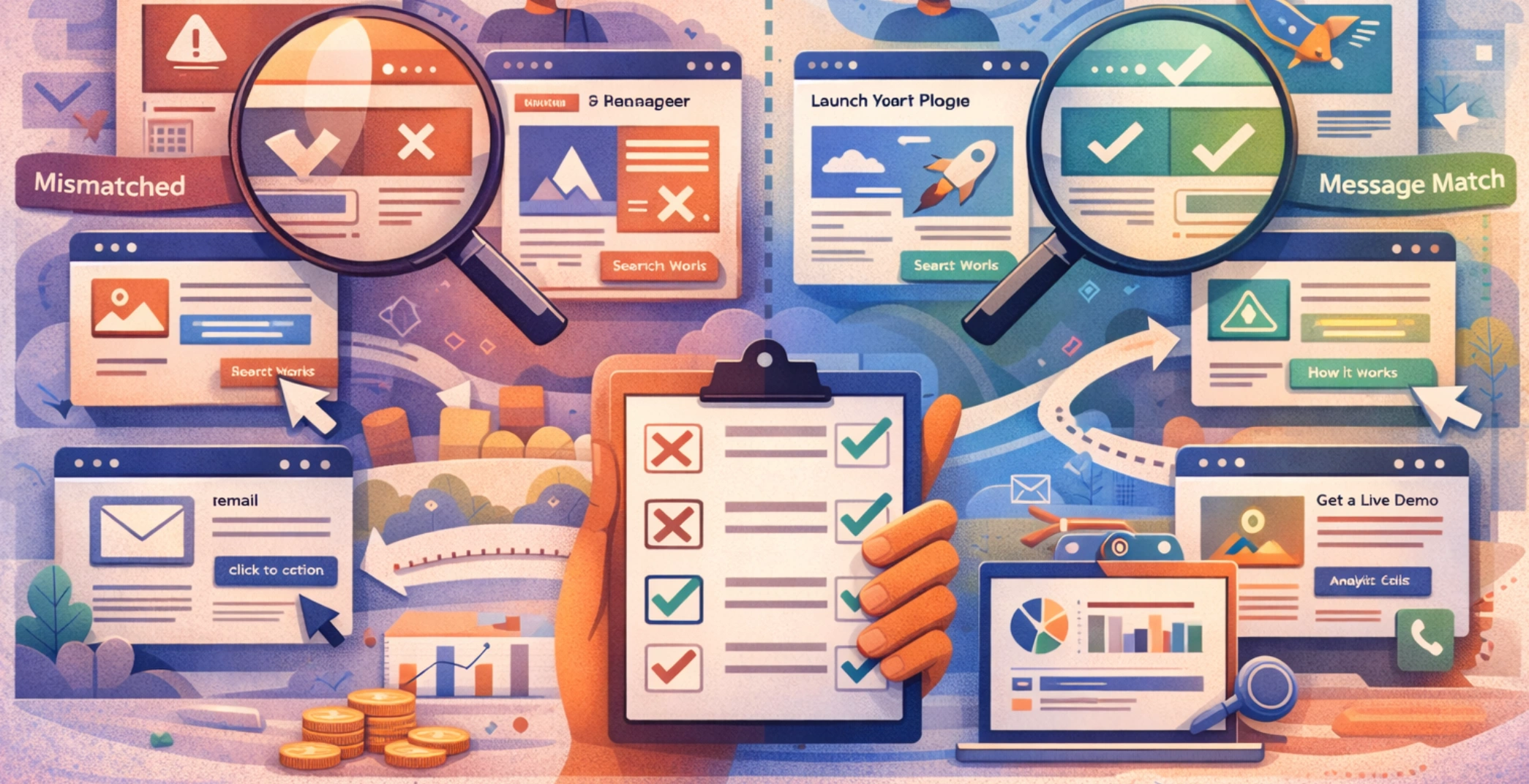
Content Clarity And Message Match
A marketing strategy can be strong and still fail if the page copy does not match the promise that brought the user there. A website UX audit should include message match checks for top acquisition paths: paid ads, search results, and email.
A strong UX audit report documents where users expect one thing and get another. It can be as small as a headline that is too abstract, or as large as a navigation structure that hides the service the visitor came for. The deliverable is not “rewrite everything.” The deliverable is a focused set of changes that reduce confusion.
For teams rethinking positioning alongside experience, brand strategy work can complement UX audit deliverables by tightening the story the site is trying to tell.
Heuristic Evaluation Scorecard: The Fastest Way To Spot Friction
A heuristic evaluation is one of the most efficient parts of a website UX audit because it surfaces issues quickly and consistently. It also creates a shared language. Instead of debating taste, the team can discuss principles like consistency, error prevention, and system feedback (Nielsen Norman Group).
A heuristic evaluation scorecard should be a visible deliverable inside the UX audit report. It should rate major templates and key flows, note severity, and connect each issue to a user impact.
In strong UX audit deliverables, the heuristic evaluation is not the whole story. It is the first pass that guides where usability testing should go deeper, and where analytics review should confirm patterns.
A useful heuristic evaluation section typically includes:
- The heuristic set used and how evaluators applied it
- Scored templates and flows, not isolated pages
- Severity ratings tied to conversion rate optimization impact
- Examples that show the issue, not just descriptions
When brands plan to implement changes, these findings often translate into interaction and layout updates by the UI UX design agency,who will have expert opinion on next steps.
Usability Testing Evidence: Clips, Quotes, And Patterns You Can Reuse
Usability testing turns assumptions into proof. It shows what users try first, what they ignore, what confuses them, and what language they use when they are uncertain. The deliverables matter because this evidence is reusable. It can inform product changes, content changes, and conversion rate optimization decisions across the funnel.
A strong UX audit report should include: short clips, key quotes, and a synthesis that highlights patterns, not anecdotes. If the deliverables are only a written summary, the team loses the most persuasive part of usability testing. Video clips reduce debate because they make friction visible.
Usability testing also helps marketing strategy because it reveals the gap between brand intent and user interpretation. Brands often overestimate how clear their offers are. A website UX audit that includes usability testing will show exactly where clarity breaks.
To keep usability testing actionable, the deliverables should categorize findings by journey stage: discover, evaluate, decide, convert. That structure keeps the UX audit report aligned to real user intent and to conversion rate optimization priorities.
Analytics And Performance Diagnostics: Proof Beyond Opinions
Even strong usability testing benefits from behavioral confirmation. Analytics review is what turns a compelling clip into a scalable pattern. It also helps teams avoid fixing rare edge cases while ignoring major leaks.
Core Web Vitals And Interaction Quality
Marketing strategy now has a performance layer. Slow pages and unstable layouts change behavior and can distort campaign results. A complete UX audit report should include a technical experience snapshot, including Core Web Vitals, because it affects both user satisfaction and site quality signals (Google Search Central). Since interaction quality has shifted with INP, teams should also understand what responsiveness means in modern measurement (Google Search Blog).
These are not vanity metrics. They influence bounce behavior, especially on mobile. UX audit deliverables should translate them into practical implications. For example, “the primary CTA loads late and shifts position” is more useful than “CLS is poor.”
Tracking Gaps And Data Reliability
An analytics review should assess whether the data can be trusted. Many sites lack consistent event tracking for key actions, which makes conversion rate optimization decisions harder to prove. If form starts are not tracked, or if thank-you pages are missing, the team cannot see where the funnel breaks.
A strong UX audit report calls out these gaps clearly and recommends a minimal tracking fix. This can be the highest-leverage deliverable in the whole website UX audit, because it improves every future decision.
Segment Insights That Change Priorities
Good analytics review segments behavior by device, channel, and intent. It should answer questions like: do paid users behave differently than organic users, and where do they drop. If a brand’s marketing strategy leans on content, the UX audit deliverables should evaluate how content visitors move toward service pages and whether internal navigation supports that motion.
This is also where industry benchmarks can be used carefully to add context. For e-commerce, Baymard’s large-scale checkout research offers a credible reference point for what “typical” friction looks like and how much improvement is often available through better flows (Baymard Institute).
Prioritized Recommendations And Roadmap: What To Fix First
The most valuable UX audit deliverables end with a roadmap that a team can execute. It should not be a wishlist. It should be a prioritized plan for conversion rate optimization, mapped to effort and impact.
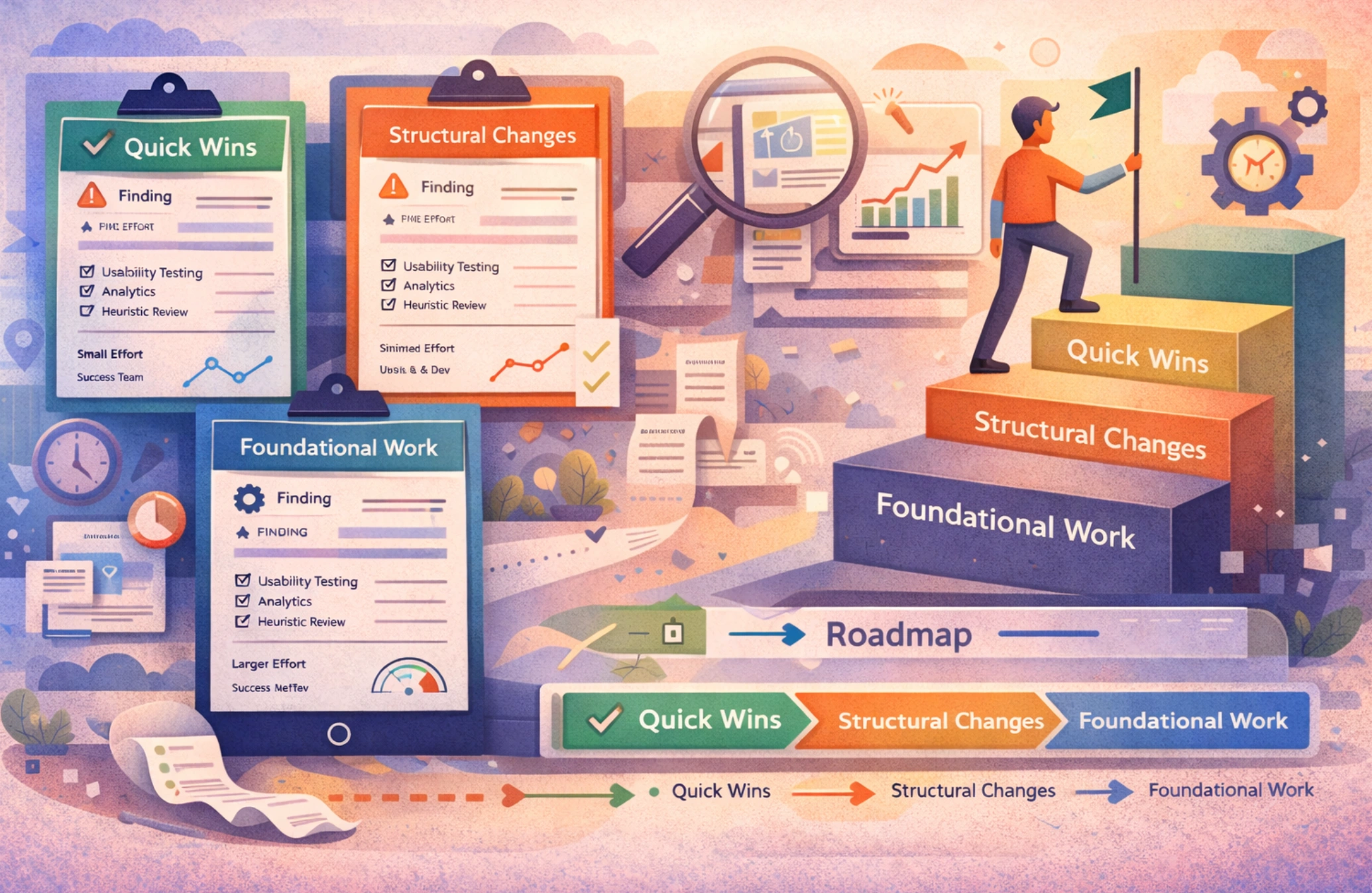
A practical roadmap often includes three layers:
- Quick wins that remove obvious friction with minimal engineering
- Structural changes that improve clarity across key journeys
- Foundational work that improves measurement, accessibility, and performance
Each recommendation should have:
- The finding and why it matters to the user journey
- Evidence from usability testing, heuristic evaluation, and analytics review
- A clear implementation direction
- A suggested owner and an effort estimate
- A success metric tied to the measurement plan
This is also the point where a website UX audit should connect to governance. If recommendations require ongoing upkeep, the UX audit report should say so. Otherwise, teams ship improvements and then drift back into inconsistency.
Many brands treat this as a web rebuild discussion. Sometimes that is correct, but often it is a focused rebuild of a few templates and flows. If deeper work is needed, the roadmap can connect naturally to web design services that prioritize maintainability, performance, and conversion rate optimization.
What “Good” Looks Like: Quality Checks Before You Act
Before acting on UX audit deliverables, teams should confirm the deliverables are usable. This is a quiet but important step. A UX audit report can be technically accurate and still fail if it is not structured for decisions.
Use these quality checks to assess whether the UX audit deliverables are truly complete:
- The website UX audit is organized by journeys and page types, not random notes
- Every major claim is backed by evidence from usability testing or analytics review
- The heuristic evaluation is scored consistently and includes severity ratings
- Recommendations are specific, testable, and tied to conversion rate optimization outcomes
- The measurement plan is realistic and accounts for tracking gaps
- The roadmap includes effort sizing and sequencing, not just priorities
- Accessibility is treated as part of UX, aligned with recognized standards (W3C WCAG)
If these checks pass, the work is ready to become tickets, content updates, and design iterations. If they do not, the UX audit report is more likely to become a static PDF.
As Hamoun Ani, Creative Director at Brand Vision, often notes, the difference between a useful UX audit and a generic one is relevance: strong audits tie every finding to a real business goal, not abstract best practices.
For brands that want the UX audit deliverables to ladder into a broader brand system, branding work can help align visual identity and messaging so the experience feels coherent across touchpoints.
-1.webp)
FAQ
What are UX audit deliverables, exactly?
UX audit deliverables are the tangible outputs of a website UX audit, usually packaged as a UX audit report plus supporting artifacts like a heuristic evaluation scorecard, usability testing evidence, analytics review notes, and a prioritized roadmap. The key is that UX audit deliverables are decision-ready. They should tell a team what is wrong, why it matters, and what to fix first for conversion rate optimization.
How long should a UX audit report be?
A UX audit report should be as long as it needs to be to support decisions. Many strong UX audit deliverables land in the 25 to 60 page range when screenshots and evidence are included, but length is not the point. The structure matters more: journey framing, clear severity, usable recommendations, and a measurement plan. If the report is long but not actionable, it will not drive conversion rate optimization.
Is a heuristic evaluation enough for a website UX audit?
A heuristic evaluation is a powerful component of a website UX audit, but it is rarely enough on its own. It identifies friction quickly, yet it does not confirm what real users do under pressure. Strong UX audit deliverables combine a heuristic evaluation with usability testing and analytics review so findings are both principled and proven.
How many usability testing sessions are needed to support UX audit deliverables?
It depends on audience diversity and the number of journeys, but many teams get strong directional evidence with 5 to 8 usability testing sessions per primary audience or journey. The more important point is what the UX audit deliverables include: clips, quotes, and synthesized patterns that connect to the UX audit report. A smaller set of well-run usability testing sessions can outperform a larger set with weak synthesis.
How do UX audit deliverables support marketing strategy?
UX audit deliverables support marketing strategy by protecting the conversion path. They improve message match, reduce friction across key journeys, strengthen trust, and clarify what changes will have the greatest impact on conversion rate optimization. They also create alignment. When leadership, marketing, and product teams share the same UX audit report and evidence library, execution speeds up and debates get smaller.
Turn Findings Into A Better Site
UX audit deliverables are not a one-time critique. They are a practical mechanism for turning user behavior into better decisions. A strong UX audit report clarifies where the site leaks intent, why it happens, and what to do next, supported by heuristic evaluation structure, usability testing proof, and analytics review validation.
If you want the findings to translate into shipped improvements, treat the roadmap as a sequencing tool, not a list. Fix the issues that block the journey first, then improve clarity and trust, then refine the experience through ongoing conversion rate optimization. That is how a website UX audit becomes durable performance, not just a document.
When you are ready to scope the next iteration, start a conversation with Brand Vision or request a project outline through our UI UX design agency team.



%2520(1).png)