
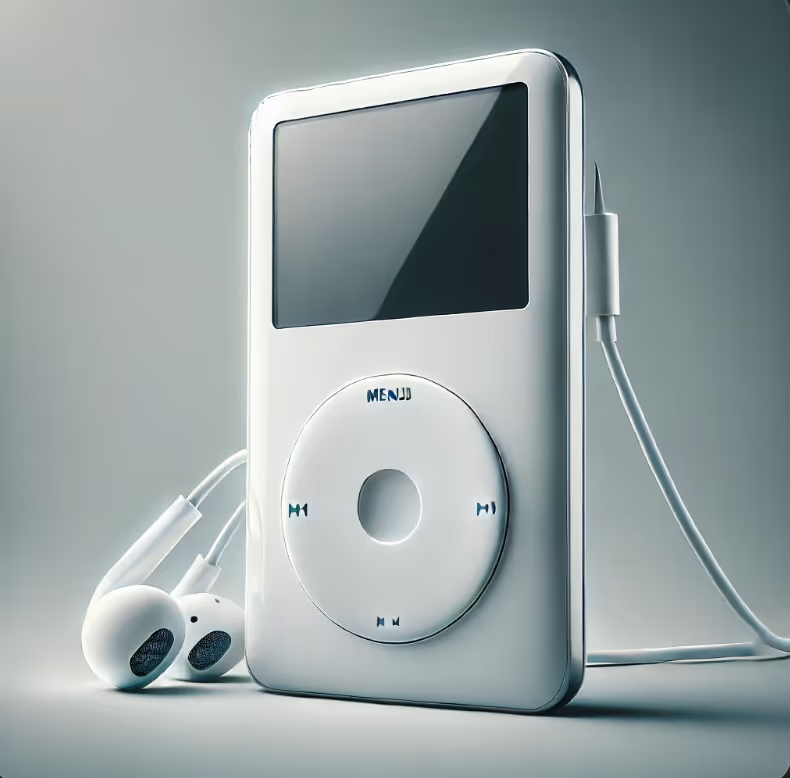
When Apple launched the iPod in 2001, the team did not lead with storage capacity. The headline was "1,000 songs in your pocket." That single line contained no technical jargon, no complex specifications, and no visual clutter. It was minimalist branding operating at its highest level: a human benefit, clearly stated.
The iPod campaign has since become one of the most studied examples in brand and marketing strategy. But its legacy extends well beyond a product launch. Apple's simplicity principle has shaped how serious organizations approach minimalist web design, brand identity systems, and campaign clarity across every touchpoint.
This article unpacks what that principle actually means, how it translated into one of the most iconic visual identities in history, and what brand leaders and design teams can apply today.

Why Apple's Simplicity Principle Still Defines Modern Branding
Apple's approach to minimalist branding was not an aesthetic default. It was a strategic discipline rooted in subtraction. As Inkbot Design's deep analysis of Apple's brand philosophy articulates, the simplicity visible in Apple's products and campaigns is the result of thousands of deliberate "no" decisions before a single "yes" was made. It is essentialism, not minimalism for its own sake.
Steve Jobs framed this clearly: "Simplicity is the ultimate sophistication." That statement was not a design motto. It was a business operating principle. Every product, campaign, packaging choice, and retail environment was filtered through one question: does this serve the user, or does it create noise?
For brands operating in competitive markets today, that question remains the most important one in any design or communications brief. Minimalist branding built on genuine clarity outperforms visual complexity at almost every stage of the buyer journey. It reduces cognitive load, strengthens brand recognition, and allows the core message to reach the audience without friction.
The psychological case is well-established. The Nielsen Norman Group identifies aesthetic and minimalist design as one of the ten foundational usability heuristics, noting that every extra element in an interface competes with the relevant content and diminishes the signal. When brands remove unnecessary elements, the signal becomes the experience.
From "1,000 Songs in Your Pocket": What the iPod Campaign Teaches About Campaign Clarity
The iPod silhouette campaign is a masterclass in what happens when minimalist branding principles are applied to marketing execution. The visuals were structured: a black silhouette, white earbuds, a vibrant solid background. No product specifications. No supporting copy. Pure emotional communication anchored by Apple's simplicity philosophy.
The campaign architecture reflected three principles that any brand can systematize:
- Lead with benefit, not feature. Apple did not advertise MP3 storage. It sold the experience of having an entire music library in a pocket. The user's life was the headline, and the campaign clarity that followed made it impossible to misunderstand the product's value.
- Maximize visual contrast, minimize visual noise. The use of bold, flat color backgrounds against black silhouettes removed all distraction and directed attention to the product and the earbuds. White space was a functional tool, not an aesthetic indulgence. That deliberate use of white space remains a defining element of clean design at scale.
- Align every touchpoint to a single brand idea. The iPod campaign did not exist in isolation. It extended coherently into packaging, retail environments, the iTunes interface, and the device itself. Minimalist branding works when it is a system, not a one-off campaign.
The lesson for brand leaders is that campaign clarity is not about simplification for its own sake. It is about the discipline to remove anything that dilutes the message, and to ensure every remaining element earns its place.
How Minimalist Branding Builds Brand Identity Systems That Scale
Minimalist branding is not a visual style that a brand adopts with a font swap and a color palette adjustment. As the Apple case demonstrates, it is a structural commitment that runs through brand strategy, visual identity, product design, and every customer-facing surface. When the system is built correctly, it scales. When it is applied superficially, it erodes.
Effective brand identity systems built on minimalist principles share several defining characteristics:
- A constrained visual vocabulary. Fewer colors, fewer typefaces, and fewer graphic elements. The constraint is what creates recognition. Apple's consistent use of white space, clean typography, and product photography has made its brand identity immediately identifiable at thumbnail scale.
- Alignment between positioning and visual expression. Minimalist branding works when the visual restraint reflects a genuine positioning commitment. If the brand stands for clarity, precision, and quality, the design system must embody those values. Visual simplicity without positioning clarity reads as emptiness rather than sophistication.
- Consistency across every touchpoint. A brand identity system designed for minimalism must operate coherently across digital, print, environmental, and product contexts. Inconsistency in a minimal system is far more disruptive than inconsistency in a complex one, because there are fewer elements to absorb variation.
The Roots of Minimalism in Web Design, as analyzed by the Nielsen Norman Group, identifies flat textures, limited color palettes, and disciplined use of negative space as the defining characteristics of minimalist design done well. These are not aesthetic preferences. They are structural decisions with direct usability implications.
For organizations building or rebuilding their brand identity, the work of a structured visual identity design agency should begin with the positioning architecture, not the color palette. The visual system is the expression of a strategy that must already be in place.

Applying Minimalist Web Design: UX, White Space, and Visual Hierarchy
Apple's digital environments are among the most studied examples of minimalist web design in the world. The Apple website does not compete with itself. Every page maintains a clear hierarchy: one primary message, one primary action, and supporting content structured to inform without overwhelming. That is Apple's simplicity principle translated into a user experience [UX] architecture.
That structure is measurable. According to SQ Magazine's 2025 web design research, minimalist web design leads to a 23% increase in user engagement on average, and well-structured landing pages convert up to 68% better than cluttered ones. The data reflects what brands applying minimalist web design principles consistently report: improvements in engagement, time on page, and conversion performance that trace directly to the clarity that surfaces once visual complexity is removed.
A high-caliber web design agency approaches minimalist web design with the following structural principles:
- Visual hierarchy through scale and spacing. Large headlines communicate priority. White space signals where the eye should rest. Hierarchy is established through contrast and structure, not decoration or visual noise.
- Typography as a primary design element. In minimalist web design, typography does not support the design. It is the design. Well-selected, well-scaled type creates rhythm, authority, and brand personality without additional visual elements.
- Navigation designed for clarity. Minimalist web design does not mean hiding navigation. It means presenting only what serves the user at any point in the journey, and progressively revealing depth as needed. Sparse menus that remove wayfinding entirely create confusion, not sophistication.
- Purposeful white space. White space is not empty space. It is an active design element that reduces cognitive load, guides attention, and creates breathing room for content to register at the pace the user can absorb it.
- Performance as a user experience standard. Minimal interfaces are structurally faster. Fewer elements, fewer requests, faster load times. A fast, mobile-friendly website is not a technical specification in isolation; it is a core component of the user experience a brand delivers.
The discipline of UI UX design in minimalist environments demands that every removed element is a considered decision. A structured UI UX design agency evaluates each design element against one criterion: does it serve the user's next meaningful action, or does it create friction? That question is the operating principle behind every clean design decision Apple has made.
.webp)
How to Apply Apple's Simplicity Principle to Your Visual Identity
Apple's visual identity system demonstrates what happens when minimalist branding is treated as a long-term structural asset. The evolution of Apple's logo illustrates this directly: from a detailed illustrated apple in 1976, to the rainbow mark of the Jobs era, to the monochromatic form that has remained essentially unchanged since 1998. Each evolution moved toward greater simplicity. Each move toward greater simplicity compounded brand recognition.
For brand leaders assessing their own visual identity, the Apple framework offers a set of clarifying questions:
- Does every element in the brand system serve a distinct communicative purpose, or does it exist by default?
- Does the visual identity express the brand's positioning, or does it follow a visual trend without strategic grounding?
- Would the brand remain recognizable with half its current visual elements removed?
- Is the system scalable and consistent across all formats, from billboard to favicon to mobile interface?
A rigorous brand strategy process will surface the answers to these questions before any design work begins. Brand research that maps audience perception, competitive differentiation, and positioning clarity is the foundation from which a coherent minimalist branding system can be built.
The most common failure in applying minimalist principles to visual identity is removing elements without first establishing what the brand actually stands for. Subtraction without clarity produces emptiness. Subtraction with clarity produces sophistication. That distinction is the entire gap between a brand that looks minimal and one that is strategically minimal.
Minimalist Branding in Practice: What Most Brands Get Wrong
Most organizations that pursue minimalist branding approach it as a cosmetic exercise. They reduce the color palette, simplify the logo, and deploy more white space on the website. The visual system becomes cleaner. But the underlying brand remains undefined, and the simplicity reads as generic rather than intentional.
Digital Silk's analysis of minimalist web design trends identifies several critical failure modes: oversimplified navigation that removes necessary wayfinding, diluted brand personality that makes organizations feel interchangeable, and under-communicated value that leaves prospects uncertain about what is actually offered. These are not design failures. They are brand strategy failures that happen to manifest in the design.
Effective minimalist branding requires a different starting point:
- Positioning clarity before visual simplicity. The brand must know precisely what it stands for and who it serves before any element is removed from the system. A brand that removes visual complexity without resolving strategic complexity simply moves confusion from the visual layer to the messaging layer.
- A constrained but expressive design vocabulary. Minimalist does not mean neutral. Apple's design system is immediately recognizable. It is restrained, but it carries personality, warmth, and authority. Clean design at the highest level has a distinct voice.
- Governance across every brand surface. Minimalist branding degrades faster than complex systems when standards are not enforced. Fewer elements means each element carries more weight. A deviation in a minimal system is proportionally more damaging than the same deviation in a dense one.
For B2B organizations in particular, the clarity demands are higher. A B2B marketing agency working with professional services firms, SaaS businesses, or enterprise clients must translate minimalist branding principles into environments where the buyer journey is long, decision-makers are multiple, and trust must be established before preference. That requires a level of strategic rigour that purely aesthetic minimalism cannot deliver.
Building a Minimalist Brand Strategy: A Framework for Ambitious Teams
Apple's simplicity principle is not a design brief. It is a strategic operating principle applied at every level of the organization. Translating that principle into a practical brand strategy framework requires disciplined work across four stages:
Stage 1: Positioning Clarity. Define what the brand stands for with enough precision that any team member, in any function, can use it to make a decision. Apple's core idea was "technology so simple that everyone can be part of the future." Every design and communications decision followed from that statement. The clarity of the idea is what makes the simplicity of the execution possible.
Stage 2: Brand Architecture Simplification. Audit every service line, product category, and messaging layer the brand currently maintains. Remove anything that does not reinforce the core positioning. Minimalist branding at the strategic level means saying no to good things to create space for essential things. This is where most brands stall, because the work requires choices that feel like losses.
Stage 3: Visual and Verbal System Design. Build the visual identity and verbal identity in parallel, applying the same discipline of constraint to both. The verbal system should reflect the same minimalist branding philosophy as the visual one: fewer words, more precision, higher signal value. A brand voice that is refined and authoritative reinforces clean design rather than undercutting it.
Stage 4: Governance and Consistency. Establish the standards that maintain the system as the brand scales. Minimalist branding requires more governance than complex systems because there are fewer elements to absorb inconsistency. A structured
For teams assessing where their current system is breaking down, a comprehensive marketing audit and consultation provides a structured starting point. It maps current state across brand, web, and marketing channels, identifies where clarity has eroded, and establishes the priorities for rebuilding the system from a position of strategic strength.
The SEO Case for Minimalist Web Design
Minimalist web design is not only a user experience principle. It is also a measurable SEO advantage.
Pages with clean architecture, clear heading hierarchies, and focused content perform more predictably in search because the signal-to-noise ratio in the content matches what search engines reward. A minimalist web design system that structures content around clear heading hierarchies, uses purposeful internal linking, and maintains fast load times provides the technical and structural foundation that SEO performance requires.
The alignment between minimalist branding and SEO is direct: both disciplines reward clarity, structure, and relevance over complexity, volume, and visual or verbal noise. An SEO agency that understands brand systems will recognize this alignment and build content architectures that reinforce rather than dilute the brand's minimalist identity.
For organizations building or redesigning digital environments, the minimalist web design architecture should be established before SEO strategy is mapped. The design system determines what content can be placed, how it is structured, and how clearly it communicates to both users and search engines. That structural foundation is not a downstream concern. It is the starting condition for everything that performs.

What Brand Vision Applies From Apple's Simplicity Framework
Brand Vision approaches minimalist branding from the same structural discipline that made Apple's simplicity principle so durable. Clarity before aesthetics. Positioning before design. System before execution.
The work we build for marketing leaders, founders, and growth-oriented organizations is designed to perform at every level: brand identity systems that maintain coherence at scale, minimalist web design environments that convert, and brand strategy frameworks that give every team member a clear operating principle to build from. As a full-service branding agency, we integrate positioning, visual identity, web design, UI UX design, and performance marketing into a single, aligned system.
The " 1,000 songs in your pocket" framework remains the most instructive brief in modern brand history: one line, one benefit, zero noise. When the system is right, execution becomes that precise. That is the standard Brand Vision works toward for every client.
-1.webp)
Less, But Better
The iPod campaign did not succeed because it was simple. It succeeded because the simplicity was earned through disciplined strategic thinking. Minimalist branding at its highest level is not the absence of complexity. It is the result of resolving complexity so completely that what remains appears effortless.
That standard applies to brand identity systems, minimalist web design environments, campaign clarity, and user experience architecture alike. It requires the willingness to remove things that are merely good in order to preserve space for things that are genuinely essential.
To explore how Brand Vision architects minimalist branding systems for ambitious organizations, visit our branding agency page or connect with our team through a structured marketing consultation and audit.



%2520(1).png)






