M&M’s x Marvel Goes Global in 2026: The Year Long Campaign Launches
Updated on
Published on
Senior teams are under pressure to make brand work do more than earn attention. It needs to move product, build owned audiences, and create repeatable demand without exhausting budgets or teams. The M&M’s x Marvel 2026 campaign is worth studying because it treats a collaboration like a full operating system, not just a flashy brand add-on.
This is not only a pop culture play. The M&M’s Marvel collaboration ties packaging, digital engagement, and incentives into a year-long loop across more than 65 markets, with Marvel M&M’s limited edition packs and QR-driven participation at the center. The M&M’s Marvel campaign is also timed to Marvel’s broader calendar, including Marvel Studios’ Avengers: Doomsday release date in December 2026, which keeps the cultural backdrop active all year.
For decision makers planning a brand collaboration campaign in 2026, this case is useful because it blends licensed IP marketing, co-branding strategy, and practical execution across retail and digital. It is also a strong example of fandom marketing that stays simple enough to scale.
At a Glance
The M&M’s x Marvel 2026 campaign is a global, year long partnership between Mars and The Walt Disney Company that brings Marvel characters into M&M’s brand assets across 65 plus markets. Details are outlined in Mars’ official announcement of the Mars Disney collaboration 2026 plan. (Mars press release)
Key components of the M&M’s Marvel global campaign include:
- Marvel M&M’s limited edition packs featuring character mashups and multiple product formats
- Packaging QR code marketing linking purchase to digital content, rewards, and participation
- A rolling cadence of activations, experiences, merchandise, and prizes, including travel related prize promotions in certain regions
- A structure built for localization by market while keeping one consistent creative spine for the M&M’s Marvel campaign
If you are planning a brand collaboration campaign, a co-branding strategy, or any form of licensed IP marketing, this case shows how to build a system that can run all year while still feeling current. It also shows how experiential brand activation can support a retail first program without turning it into a one time spectacle.
The North Star and the Conflict Behind the M&M’s Marvel Global Campaign
The North Star in one sentence
The North Star of the M&M’s Marvel campaign is straightforward: turn a familiar impulse purchase into a repeatable participation loop that works at shelf, on mobile, and across markets. The M&M’s x Marvel 2026 campaign uses a simple sequence that makes the collaboration easy to understand.
This is why the M&M’s x Marvel 2026 campaign is designed as a year long program, not a short burst. The M&M’s Marvel collaboration is meant to create multiple reasons to re engage, collect, scan, and share, without requiring consumers to learn a new product category. In practice, it is a co-branding strategy engineered for frequency.
The conflict it’s designed to solve
Most mass reach campaigns face the same conflict in 2026. Attention is fragmented, retail is competitive, and it is harder to prove impact when platform attribution is noisy. The M&M’s Marvel global campaign answers that conflict by anchoring the experience on packaging and participation, not platform trends.
Packaging is the media unit. Packaging QR code marketing turns packaging into a measurable bridge. Collectability and prizes create repeat behavior. That combination makes the M&M’s Marvel collaboration a practical model for licensed IP marketing, especially when the goal is scale, not niche buzz.
If you are building a brand collaboration campaign outside CPG, the logic still holds. Put the conversion path where people already are. Make the next step obvious. Then measure the loop end to end.
What’s Included in the M&M’s x Marvel 2026 Campaign
The product layer
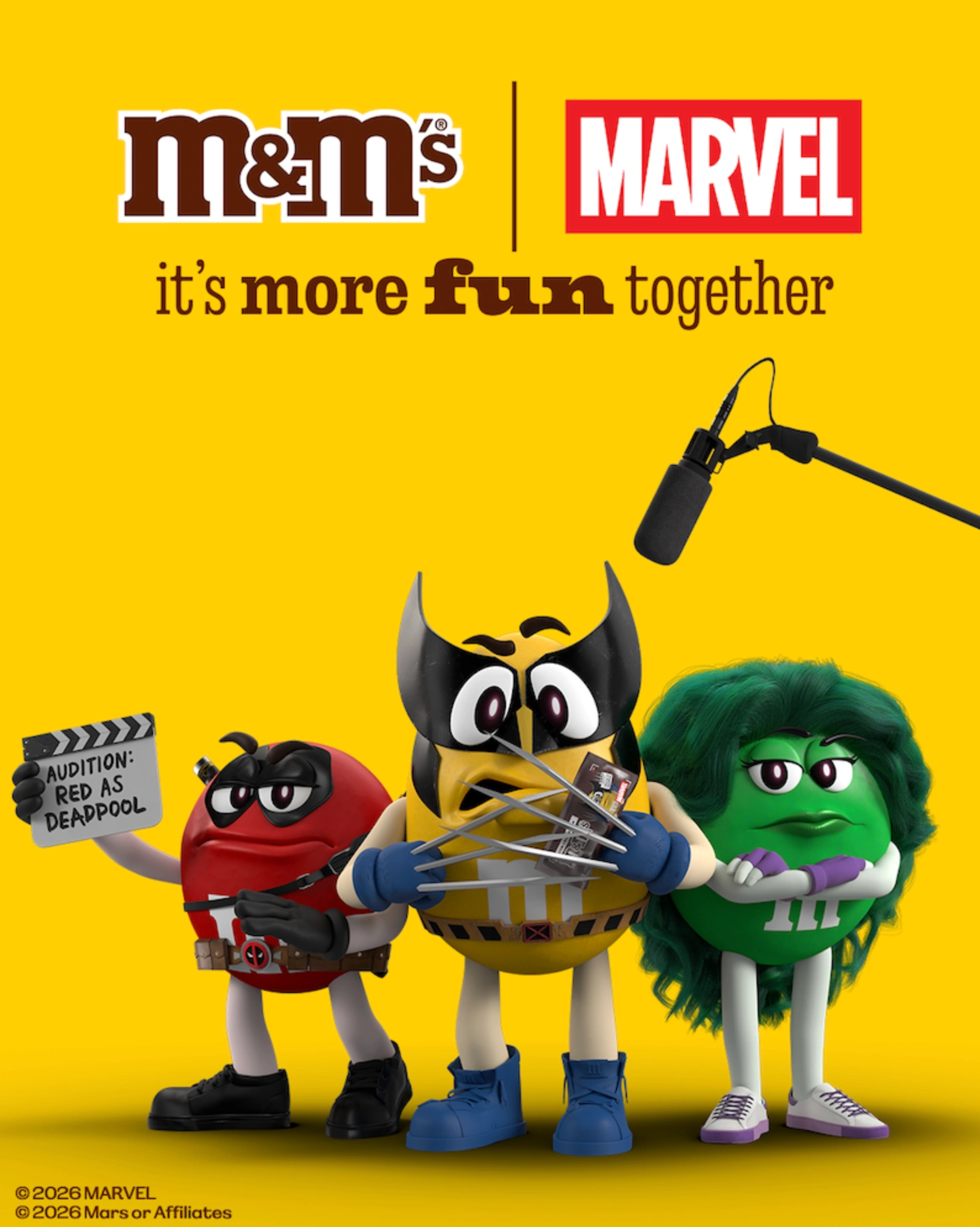
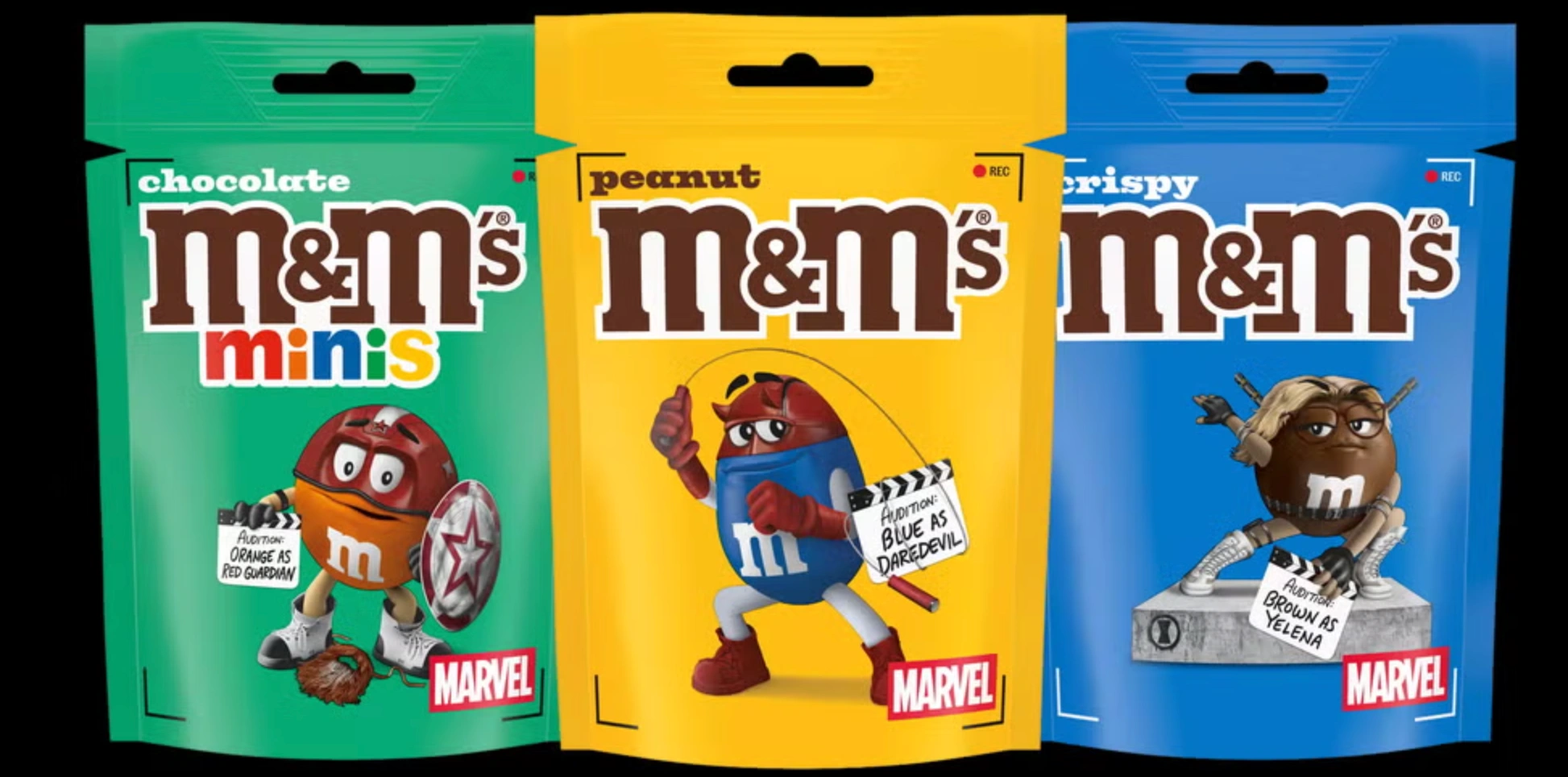
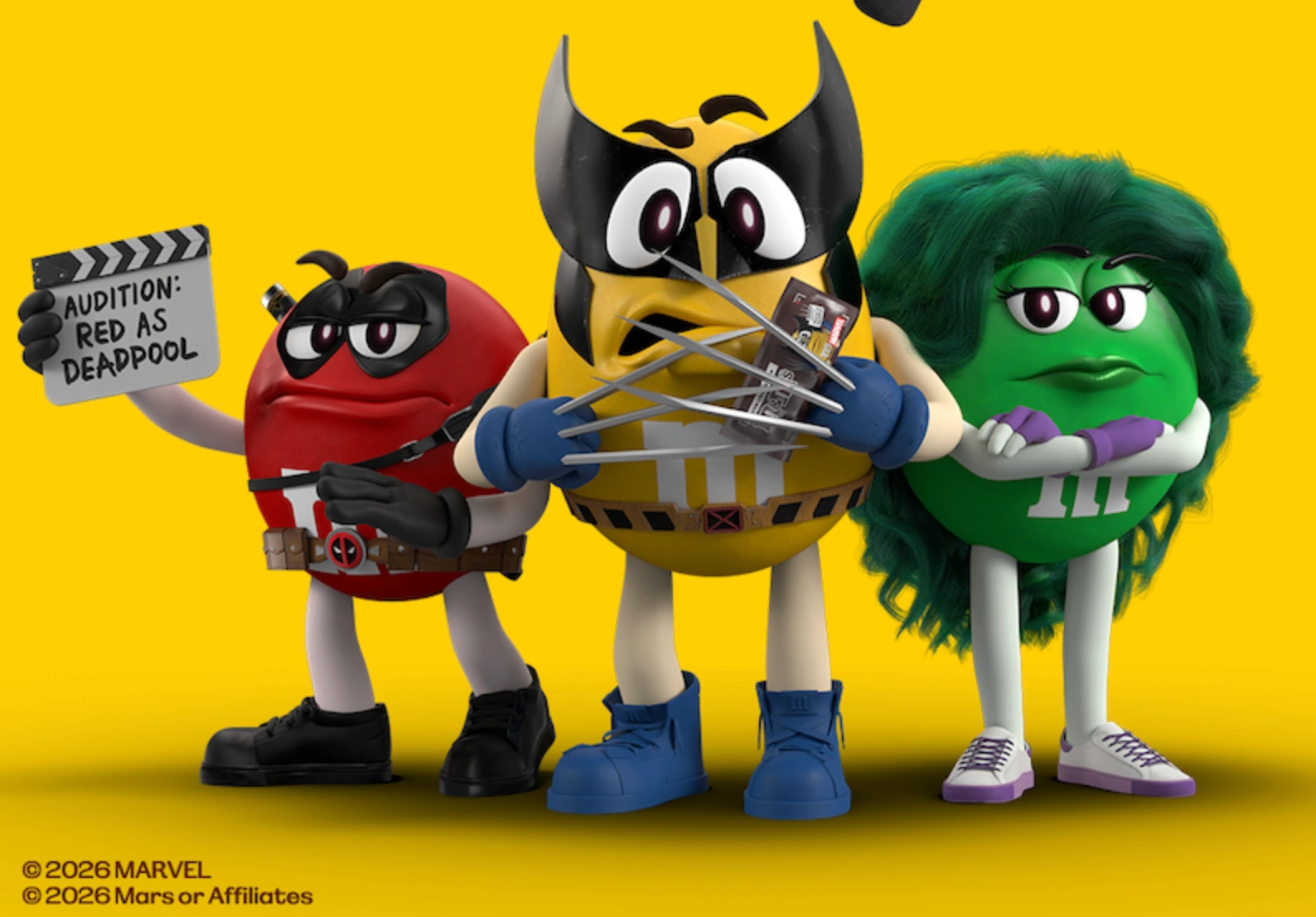
The product layer of the M&M’s x Marvel 2026 campaign is built around Marvel M&M’s limited edition packs. The program includes character mashups that place M&M’s spokescandies into Marvel roles, with different pack formats and flavors depending on market. M&M’s Marvel campaign page
This product layer matters because it makes the co-branding strategy visible at the exact moment of purchase. The M&M’s Marvel campaign does not rely on someone seeing a post first. The shelf does the first job. For a brand collaboration campaign, that is a meaningful advantage.
In simple terms, the M&M’s superhero packs 2026 concept turns packaging into a collectible surface. That is a classic mechanism in fandom marketing, applied to a high frequency category.
The digital layer
The digital layer of the M&M’s x Marvel 2026 campaign is centered on packaging QR code marketing. Promotional packs include QR experiences that unlock digital content and rewards, creating a direct link between physical purchase and digital engagement. M&M’s Marvel campaign hub
This is the conversion bridge many brand collaboration campaign plans miss. Without a clean digital layer, you get awareness but you do not get a measurable loop. In the M&M’s Marvel collaboration, the scan creates a trackable action that can be optimized by market, creative, and timing.
Done well, packaging QR code marketing also supports licensed IP marketing governance. It is easier to update landing pages and content rules than it is to reprint packs. That flexibility helps a year long M&M’s Marvel campaign stay fresh.
The experience and prize layer
The experience layer is the part that stretches the timeline of the M&M’s Marvel global campaign. The M&M’s x Marvel 2026 campaign includes activations, immersive experiences, and prize mechanics in certain regions, including a Disneyland Paris prize page tied to Marvel themed experiences. (Disneyland Paris prize details)
This layer supports experiential brand activation, but it is also a retention tool. Prizes give late adopters a reason to join. Experiences give superfans a reason to stay engaged. This is why the M&M’s Marvel campaign can run all year without feeling like one repeated message.
From a co-branding strategy standpoint, experiences also create earned stories. They give press and social a reason to talk about the M&M’s Marvel collaboration beyond the packs.
Origins and Evolution: Why This Partnership Works Now
From one-off tie-ins to a campaign system
Many partnerships fail because they are treated as a logo swap or a limited drop. The M&M’s x Marvel 2026 campaign is structured differently. It behaves like a program with multiple releases, multiple participation prompts, and a built in rhythm.
That is the key evolution. The M&M’s Marvel campaign turns a co-branding strategy into an operating cadence. It also gives the M&M’s Marvel collaboration a consistent structure that can handle a year of content without drifting.
For leaders planning licensed IP marketing, the lesson is not “do more.” The lesson is “design a system that does not collapse under its own complexity.”
Why the global rollout matters
A global rollout across 65 plus markets changes the design requirements. The campaign needs a simple idea that can travel, a flexible kit of assets, and a system that can be localized without rewriting the core message. Mars describes that global scale directly in its announcement of the Mars Disney collaboration 2026 effort. (Mars collaboration announcement)
For leaders building a M&M’s Marvel global campaign style rollout in other categories, the lesson is operational. You need a stable creative spine, but modular components so each market can choose the right pack focus, prize focus, and activation focus.
This is also where fandom marketing becomes tricky. What feels iconic in one market can feel unfamiliar in another. A year long brand collaboration campaign needs guardrails for localization, not a free for all.
The Marketing Framework: 4Ps, SWOT, and Positioning
4Ps analysis
Product
The product is still M&M’s, but the wrapper becomes the new product feature. The Marvel M&M’s limited edition packs and character mashups create a reason to choose one pack over another. This is licensed IP marketing applied to a high-frequency category, built to support a year-long M&M’s Marvel campaign.
Price
Nothing about the M&M’s x Marvel 2026 campaign requires premium pricing to work. The value is perceived through collectability and access, not through raising price points. That makes the brand collaboration campaign scalable across markets with different price sensitivities.
Place
Place is where this strategy is strongest. The M&M’s Marvel global campaign lives in retail first, then extends into digital through packaging QR code marketing. The shelf is the acquisition channel, and the scan is the bridge to owned engagement.
Promotion
Promotion runs on a three-part mix: M&M’s superhero packs 2026, QR engagement, and periodic experiential brand activation. This is a repeatable co-branding strategy pattern because each layer supports a different stage of the funnel.
SWOT snapshot
Strengths
- Massive distribution and strong brand familiarity that supports a global brand collaboration campaign
- High fit between Marvel fandom and collectible behavior, a core lever in fandom marketing
- Clear participation mechanic through packaging QR code marketing that supports measurement
Weaknesses
- Limited ability to tell complex stories on pack real estate inside Marvel M&M’s limited edition packs
- Risk of campaign fatigue if releases feel repetitive across the year long M&M’s Marvel campaign
- Complexity in global governance for approvals and localization across the M&M’s Marvel global campaign
Opportunities
- Use QR to build opt in channels and measurement clarity within the M&M’s Marvel collaboration
- Use market specific experiences to drive earned attention through experiential brand activation
- Tie releases to Marvel calendar moments, including Avengers: Doomsday in December 2026. (Marvel release date)
Threats
- Over saturation of collaborations reducing differentiation in licensed IP marketing
- Retail clutter with competing limited editions
- Privacy and platform measurement constraints that reduce certainty on attribution for any brand collaboration campaign
Positioning map: where it lands in the mind
In a positioning sense, the M&M’s x Marvel 2026 campaign sits at the intersection of playful familiarity and cultural legitimacy. It is not trying to become a collector brand in the way a niche drop brand would. It is using the logic of collectability to increase frequency through the M&M’s Marvel collaboration.
That distinction matters for other teams planning a brand collaboration campaign. The goal is not to become the IP. The goal is to borrow attention, then convert it into repeat purchase and measurable engagement using a disciplined co-branding strategy.
Audience Segmentation and Jobs to Be Done
Core segments
The M&M’s Marvel collaboration is effectively segmented even if the packs look broad. There are clear audience tiers inside the M&M’s Marvel global campaign:
- Core Marvel fans who respond to character specificity, M&M’s superhero packs 2026, and collectibles
- Casual snack buyers who respond to novelty and shelf visibility from Marvel M&M’s limited edition packs
- Family buyers who respond to shared experiences and prize incentives tied to experiential brand activation
- Digital-first participants who respond to packaging QR code marketing and rewards
This segmentation is what makes the M&M’s Marvel campaign durable. It does not require one perfect message. It offers different doors into the same program, which is a strong co-branding strategy pattern.
Jobs to be done
The jobs to be done inside the M&M’s x Marvel 2026 campaign are practical:
- Make a routine snack purchase feel new through Marvel M&M’s limited edition packs
- Provide a simple reason to choose this pack today within a crowded retail setting
- Create a small moment of surprise through packaging QR code marketing and rewards
- Give fans a sense of participation through fandom marketing cues and collectible logic
For other categories, this is the transferable lesson from licensed IP marketing. The job is not always entertainment. Often it is decision simplification at the point of choice, plus a measurable engagement loop.
Campaign and Creative Execution: Content Pillars and the X Factor
Flagship creative bets
The flagship bet in the M&M’s Marvel campaign is character mashups as a creative system. It provides instant recognition and a reason to collect. It also creates a steady stream of content prompts without requiring the brand to invent a new concept each month, which is essential in a year long brand collaboration campaign.
A second bet is the light narrative framing referenced in campaign materials, which gives the M&M’s Marvel collaboration an arc without overcomplication. It helps experiential brand activation moments feel connected rather than random.
Content pillars
Most year-long programs work best with a few pillars. The M&M’s x Marvel 2026 campaign naturally fits into four:
- Collect and compare: Marvel M&M’s limited edition packs, characters, formats
- Scan and play: packaging QR code marketing as the interaction layer
- Win and experience: prizes and experiential brand activation
- Share and show: social proof through fandom marketing participation
For teams building a brand collaboration campaign, pillars are a governance tool. They keep internal teams and regional partners aligned without constant reinvention. That is the quiet advantage of a solid co-branding strategy.
The creative X factor
The X factor is restraint. The M&M’s Marvel collaboration does not overload the consumer with complexity. It uses recognizable assets, simple participation mechanics, and a steady cadence that can scale across the M&M’s Marvel global campaign.
This is why licensed IP marketing works best when the core behavior is easy. The M&M’s Marvel campaign keeps the behavior consistent. Buy, notice, scan, participate. That consistency is what makes it repeatable.
Collaborations and Distribution: Paid, Earned, Owned
Strategic alliances and retail realities
The partnership itself is the headline, but the real alliance is with distribution. The M&M’s Marvel global campaign is designed to win in-store, where packaging is a billboard and where limited edition visibility can trigger impulse behavior.
A well-built co-branding strategy respects retail realities:
- Clear pack differentiation at a glance for Marvel M&M’s limited edition packs
- Display assets that work across store formats
- Releases timed to local promotional calendars across the M&M’s x Marvel 2026 campaign
- Minimal reliance on any single digital channel for a resilient brand collaboration campaign
This is the operating advantage of a physical first brand collaboration campaign. You can still run paid media, but the shelf does meaningful work.
Omnichannel mix
The omnichannel mix in the M&M’s Marvel campaign is deliberate:
Primary channels
- Retail presence and in-store visibility driven by M&M’s superhero packs 2026
- Packaging QR code marketing linking to a mobile experience
- Owned campaign pages for participation and rewards. M&M’s campaign hub
Supportive channels
- Social content that highlights collectible packs and participation through fandom marketing dynamics
- PR and entertainment coverage tied to Marvel’s broader calendar
- Experiential brand activation moments that create spikes of attention
The key is the handoff. The M&M’s x Marvel 2026 campaign does not treat channels as separate efforts. It treats them as steps in one loop.
Paid vs earned vs owned balance
This is where many licensed IP marketing efforts fall short. Earned attention is helpful, but it is unpredictable. Paid attention is controllable, but expensive. Owned attention is durable, but hard to build.
The M&M’s Marvel collaboration uses packaging to drive owned actions. The QR scan is the pivot point. It is one reason this co-branding strategy is worth copying even outside entertainment partnerships, especially for teams planning a measurable brand collaboration campaign.
The Technical Stack and Metrics: From Scan to Sale
Likely martech stack
At scale, a M&M’s Marvel global campaign needs a dependable stack. Even if vendors differ by region, the pattern is consistent for any year long brand collaboration campaign:
- Analytics for web and app experiences
- CRM and email for opt ins where permitted
- Tag management and event tracking for packaging QR code marketing flows
- A content system that supports frequent updates without heavy developer dependency
This is where strong web design services matter. QR driven experiences fail quickly when landing pages are slow, confusing, or hard to update. A year long M&M’s Marvel campaign needs maintainability, not heroic launches.
-1.webp)
Funnel flow: awareness to conversion
Awareness
The shelf is the first impression. Character packs create a fast recognition moment. This is the first step in the M&M’s Marvel campaign, driven by Marvel M&M’s limited edition packs and clear visual hierarchy.
Consideration
The scan provides the second step. Packaging QR code marketing turns curiosity into an action, then routes the user into content, rewards, or entry mechanics. The scan is where a co-branding strategy becomes measurable.
Conversion
Conversion is not only purchase. It can be opt in, repeat scan, repeat purchase, or prize entry completion. In a brand collaboration campaign, conversion should be defined in layers, especially when the campaign is designed to run year long like the M&M’s x Marvel 2026 campaign.
For teams that want to build this properly, the UX needs to be clean and accessible. That is why the work of a UI UX design agency often determines whether QR experiences feel simple or frustrating.
KPIs that prove ROI
To evaluate a co-branding strategy like the M&M’s Marvel collaboration, leaders should track a layered KPI set:
Retail and demand
- Sales lift by SKU and by store cohort for M&M’s superhero packs 2026 releases
- Repeat purchase signals where available
- Display compliance and shelf visibility
Engagement
- QR scan rate per pack type within the M&M’s Marvel campaign
- Landing page completion rate tied to packaging QR code marketing
- Reward claim rate
Owned audience
- Opt in rate where permitted
- Returning visitor rate
- Email engagement or account engagement metrics if used
Brand outcomes
- Brand search lift and campaign query lift for the M&M’s x Marvel 2026 campaign
- Sentiment and share of voice in relevant windows
- Longitudinal brand tracking where possible
This is where a strong SEO agency can support measurement, especially around branded query patterns and discoverability. It is also where disciplined tagging and governance prevent data gaps for any brand collaboration campaign.
.webp)
Critique and Actionable Takeaways for Any Brand
Where this can fail
The M&M’s Marvel collaboration is well structured, but the risks are real in any year long brand collaboration campaign:
- If the QR experience is slow or confusing, packaging QR code marketing becomes friction, not value
- If content updates stall, the year long promise of the M&M’s Marvel campaign feels empty
- If localization is inconsistent, the M&M’s Marvel global campaign feels fragmented
- If rewards are too complex, participation drops and fandom marketing energy fades
The most common failure mode in licensed IP marketing is treating operations as secondary. A year long program is a delivery problem before it is a creative problem.
What to copy at smaller scale
Most teams do not have Mars scale. That is not the point. The transferable ideas in the M&M’s x Marvel 2026 campaign are design and system choices:
- Build a simple participation loop
- One clear action tied to packaging QR code marketing
- One clear reward
- One clear next step
- Treat packaging as media
- Tight hierarchy
- One focal message
- One path to participation, even if you are not using Marvel M&M’s limited edition packs
- Make the web experience easy to maintain
- Modular pages
- Reusable components
- A lightweight workflow for updates
What to Watch Next: AI, Privacy, and the Future of Licensed IP Marketing
AI-assisted creative systems
AI will not replace the creative core of licensed IP marketing, but it will shape production and testing. For programs like the M&M’s Marvel campaign, AI can help generate variations, translate copy, and speed up asset adaptation across markets.
The best use case is operational. AI supports the modular system approach that the M&M’s x Marvel 2026 campaign already reflects. If you have clear pillars and clear templates, AI becomes a production assistant rather than a creative director.
Privacy and measurement constraints
Privacy constraints continue to tighten. This makes first party participation even more valuable. Packaging QR code marketing is attractive because it can create a voluntary action. Still, brands need to be careful with consent, data minimization, and clarity.
This is another reason the M&M’s Marvel collaboration is worth studying. The QR layer can be built to respect privacy while still enabling measurement. If you rely only on third party attribution, you will struggle to prove a co-branding strategy worked. If you build a clear owned loop, you can.
Closing: Start With the System, Not the Stunt
The M&M’s x Marvel 2026 campaign works because it is a complete system. The M&M’s Marvel campaign connects shelf visibility, packaging QR code marketing, and rolling participation in a way that can scale across markets. The M&M’s Marvel global campaign is not only a creative idea. It is an operating model for a modern brand collaboration campaign.
If you are planning a M&M’s Marvel collaboration style initiative, start with the loop. Define the behavior, design the experience, and choose metrics that prove impact. Then build the creative on top. That is how licensed IP marketing becomes measurable work, not a headline.
If you want a second set of eyes on your campaign system, site experience, or measurement plan, start a conversation with our team at Brand Vision or request a project outline through Brand Vision Insights.
How business owners can apply these lessons in 2026
You do not need the Marvel scale to learn from the M&M’s x Marvel 2026 campaign. What you need is a repeatable system that turns attention into a measurable action. The simplest way to borrow the logic of this M&M’s Marvel collaboration is to design one clear participation loop, build a clean conversion surface, and measure the results week by week.
Here is what we recommend to founders and marketing leaders:
- Choose one primary action that matters, such as a scan, sign up, booking, or demo request. Make it the center of your brand collaboration campaign.
- Make the next step frictionless. If the experience after the click or scan is slow or confusing, you lose the moment. This is where strong web design services and thoughtful UI UX design agency support pay off.
- Use a quick partnership fit test before you commit to any co-branding strategy: audience overlap, meaning overlap, and a real distribution advantage. If one is missing, choose a smaller partner with tighter relevance.
- Track a small KPI set that proves impact in 2026: conversion rate on the campaign page, engagement rate, and branded search lift. When teams need sharper visibility, our SEO agency helps connect campaign activity to demand signals.
- If you plan to run recurring launches, build a stable foundation first. A clear brand system makes repeated campaigns faster and more consistent. That is usually where a branding agency becomes the best first move.