
Marvel is a rare brand that markets at two speeds at once. It can drive immediate demand for a single release, and it can keep a long narrative engine running for years without losing recognizability. For leadership teams, the value is not entertainment trivia. It is a repeatable model for attention, trust, and revenue expansion across a portfolio.
The Marvel marketing strategy also matters because it reflects the reality most businesses now face. Fragmented channels. Shorter attention spans. Higher expectations for consistency across product, brand, and experience. When the system works, marketing does not start at launch and end at conversion. It becomes an operating layer that compounds.
What Marvel Is Actually Selling (It’s Bigger Than Movies)
The product stack
Marvel’s marketing campaigns make more sense when you treat Marvel as a portfolio business. The product is layered. A theatrical release is one layer, but it sits above an ecosystem of characters, formats, and consumer behaviors that keep the engine running.
The stack looks roughly like this:
- Tentpole films and series as attention spikes
- Characters as long-lived brand assets
- Story continuity as retention and anticipation
- Consumer products and licensing as scale revenue
- Partnerships as distribution and cultural placement
- Owned channels as the always-on front door
This is why Marvel branding strategy is so disciplined. If the portfolio is the product, then the brand must be stable enough to connect very different experiences. That stability is what gives the company the right to extend into new formats without feeling random.

Brand Architecture: How Marvel Stays Coherent at Massive Scale
Marvel vs Marvel Studios vs the MCU
Part of Marvel’s advantage is structural clarity. “Marvel” is not one thing. There is the Marvel master brand, Marvel Studios as the content engine, and the MCU as the universe framework audiences follow. That separation helps the organization make clearer decisions about tone, rollout, and continuity.
For a business audience, this maps to brand architecture. Many companies operate with multiple products, services, and audiences, but they present themselves like a single flat offering. That makes every campaign carry too much explanatory weight. Marvel reduces that burden with a stable frame. The universe is the frame.
If you are building your own structure, a branding agency can help define what sits at the master brand level versus product level. The goal is not complexity. It is coherence.
Identity systems that scale
Marvel’s identity system is not only a logo. It is a repeatable visual and narrative language that can flex across genres. A comedy can still feel like Marvel. A darker storyline can still feel like Marvel. That coherence is what allows broad experimentation without losing recognizability.
At an execution level, this is about asset governance. Many organizations have the raw ingredients of a strong brand but lack operating discipline. Files live in the wrong place. Templates are inconsistent. Teams improvise. The result is a brand that slowly drifts.
A stable system usually includes:
- Clear rules for tone, typography, and imagery
- Templates that reduce decision load for teams
- Version control so old assets do not resurface
- Review gates tied to brand risk, not preference
The practical link to digital work is obvious. Your web experience is where the brand system becomes real. When the front end is inconsistent or slow, the brand promise weakens. That is why web design and UI UX decisions are part of brand strategy, not afterthoughts.
The Franchise Flywheel: A Framework Brands Can Copy
Marvel’s model is easiest to apply when you treat it as a flywheel. Each phase creates energy for the next, and each touchpoint is designed to carry forward momentum without exhausting the audience.
Tease
The teaser phase is about controlled information. Marvel uses early signals to set the shape of what is coming, often without giving away the core story. This creates anticipation while preserving curiosity.
For business teams, “tease” is about pre launch clarity. A roadmap, a narrative hook, a clear problem, and a consistent look. You do not need a trailer. You need a disciplined reveal sequence.
Key components:
- A single promise that can be repeated
- Visual consistency across every early asset
- Scarcity of details so the audience fills in the gaps
Ritual
Ritual is where community does marketing work. In the MCU, rituals include trailer breakdown culture, post credit expectations, casting chatter, and speculation cycles. These behaviors are not accidental. The strategy makes space for them.
Brands can build rituals in quieter ways. Regular product drops. Community briefings. Founder updates. Quarterly showcases. The point is rhythm. Rhythm reduces the cost of reacquiring attention.
Key components:
- Repeatable cadence the audience recognizes
- Simple participation behaviors that feel natural
- Clear ownership of channels and community rules
Event
An event is a moment designed for amplification. In Marvel’s world, that includes major convention reveals, trailers released as cultural moments, or high profile premieres. The event is not only for fans in the room. It is built for downstream clips, headlines, and replays.
For companies, events can be product keynotes, customer summits, or research releases. The event works when it is designed for distribution. That means the content must travel.
Key components:
- One clear headline message
- Assets built for each channel’s format
- A post event distribution plan, not an afterthought
Extend
Extension is where Marvel keeps the demand curve alive. Behind-the-scenes content, interviews, character explainers, and partner activations extend the story past opening weekend. This is where many brands stop too early.
Extension is also where brand identity is tested. If your post-launch materials look and sound different, trust weakens. If they are governed, the campaign compounds.
Key components:
- Post-launch content plan tied to real questions
- Partner activations that add distribution, not noise
- Clear narrative continuity across channels
Retain
Retention is the long tail. Streaming, future tie-ins, merchandise, games, and community discussion keep the system active between major releases. This is the part many businesses underestimate. Retention lowers future acquisition costs.
Retention is rarely solved by a single campaign. It is solved by a consistent system, and often by smart SEO strategy that captures demand for the questions people ask before, during, and after a launch.
Key components:
- Durable content hubs and evergreen pages
- A plan for updates, not just publishing
- Measurement that tracks repeat engagement
Demand Engineering: Teasers, Trailers, and the Art of Not Over Revealing
Marvel’s teaser and trailer strategy is not only about creative. It is about information economics. Each release is positioned as part of a broader story, but the details are metered so curiosity survives. That balance protects the audience from feeling like they have already seen the film.
There is also a second effect. Controlled information invites interpretation, and interpretation creates free distribution. Trailer breakdowns, theory threads, and reaction content are effectively a decentralized media layer. Marvel supplies the spark. The audience supplies the spread.
For companies, the equivalent is simple. Do not leak your whole product narrative in the first touchpoint. Build a sequence. Make the sequence coherent. Use a consistent visual system so the audience recognizes the story even when the message changes.
Practical takeaways:
- Build reveal stages, each with a specific job
- Protect a core surprise so interest stays alive
- Use a repeatable asset kit so teams do not improvise
Event Marketing as Distribution: Comic Con, D23, and the Power of a Moment
When presence matters
San Diego Comic Con and Disney’s D23 are not just fan events. They are distribution engines. A strong Hall H moment produces press coverage, social clips, creator commentary, and sustained conversation across platforms. The event becomes a content factory, not a single day.
The tactical lesson is that events should be designed backward from the output. What clips will circulate. What headlines will be written. What questions will follow. If leadership cannot answer those questions, the event is a cost center. If they can, it becomes a lever.
When absence is the move
Marvel also shows that sometimes the strongest move is not showing up. In 2025, Marvel Studios opted to skip its Hall H presentation at Comic-Con, with reporting noting a smaller presence. (Variety on Marvel skipping Hall H in 2025) Entertainment Weekly described the decision as part of a broader recalibration, tied to production timing and a focus on rebuilding anticipation. Entertainment Weekly on Marvel’s 2025 Comic Con decision
This is a useful leadership lesson. If the pipeline is not ready, forcing a major reveal can create risk. Overpromising creates future marketing debt. Absence can also restore scarcity, which makes the next moment more valuable.
Practical takeaways:
- Treat events as a distribution plan, not a calendar obligation
- Use scarcity strategically, especially after saturation
- Align reveals to product readiness and delivery confidence
View this post on Instagram
A post shared by Marvel Entertainment (@marvel)
Collaborations and Co Marketing: Borrowed Audiences, Retail Reach, Cultural Relevance
Marvel collaborations work because they are not random. They are structured as audience borrowing and retail distribution. A collaboration puts Marvel into places where people already are, with a low friction path from awareness to participation.
The strongest collaborations also respect brand fit. The partner gets cultural energy. Marvel gets reach, shelf presence, and a new touchpoint between releases. When done well, both sides gain distribution without eroding their identity.
Case study: Coca Cola x Marvel
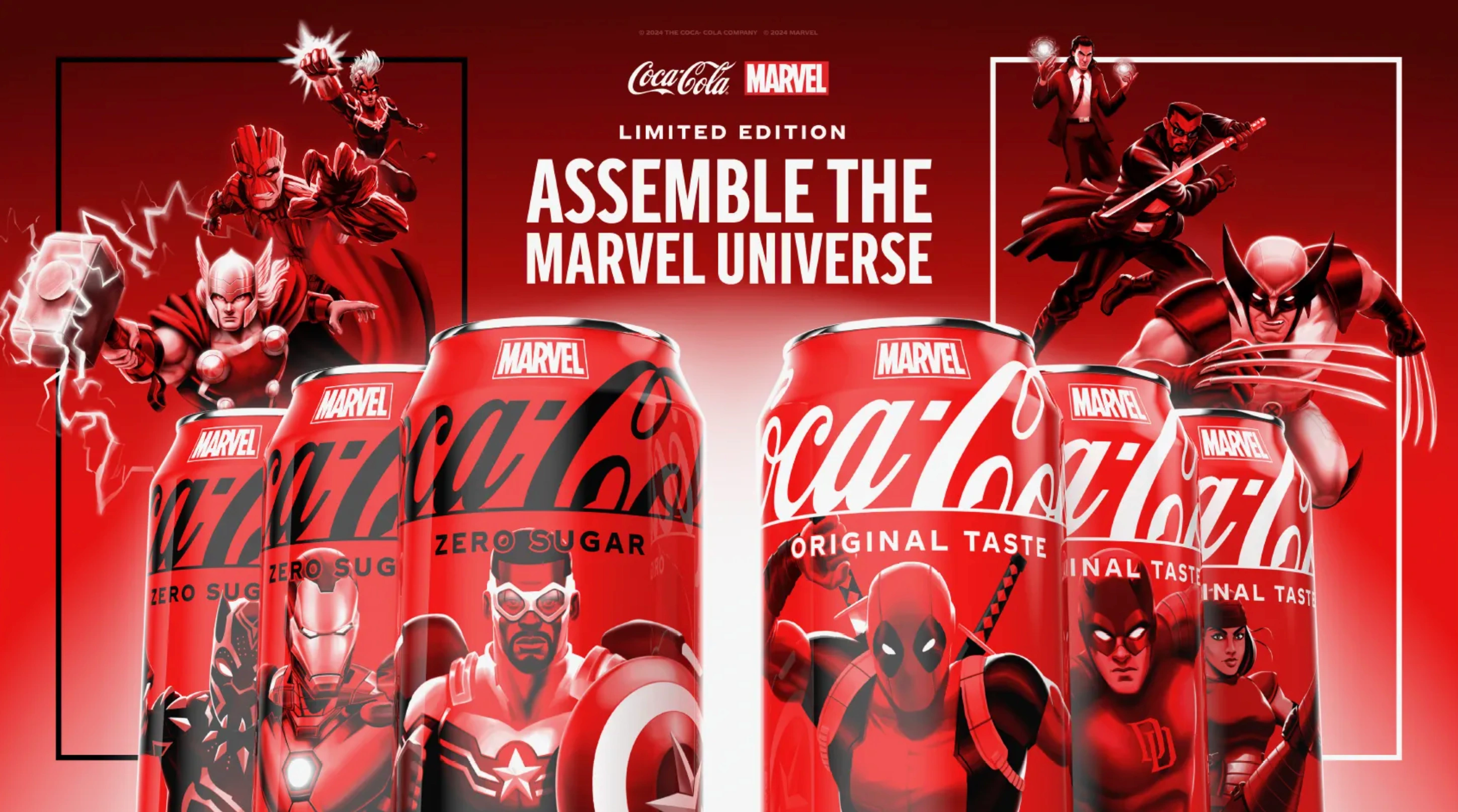
In 2024, Coca Cola extended its partnership with Marvel through limited edition packaging and a broader storytelling campaign, including a cinematic commercial. (Coca Cola’s official campaign release) Disney also highlighted global availability across more than 50 countries, which signals scale and distribution intent. (Walt Disney)
The campaign mechanics are instructive. Scannable packaging created a bridge between physical retail and digital engagement. Trade reporting described AR experiences, collectibles, and multi channel placements across video and out of home. (Marketing Dive)
Why this matters for operators is simple. Collaboration is not only a creative idea. It is a path to distribution and data. It gives a brand a reason to show up in a retail environment, and it creates a trackable interaction loop without forcing a purchase of the core product.
Collaboration patterns brands can borrow
Most companies will not do global packaging collaborations. They can still borrow the pattern. The pattern is to create a joint experience that is native to where the audience already spends time.
Effective patterns include:
- A partner channel that expands reach, not just credibility
- A physical or digital touchpoint that reduces friction
- A reason to engage that is not purely promotional
- A clear brand fit, with guardrails for tone and design
The Owned Media Machine: Social, Streaming, and the Digital Front Door
Owned media is where Marvel’s brand system becomes measurable. It is also where many businesses underinvest. Social posts come and go. The website and content hubs remain. If the owned ecosystem is slow, confusing, or inconsistent, paid media has to work harder.
For teams running modern growth, the digital front door is the real campaign destination. A landing page, a product experience, a streaming hub, or a content library is where interest turns into a decision. That is why owned media requires cross functional discipline.
The digital front door (UX, accessibility, performance)
When attention is expensive, performance and usability become strategic. A page that loads slowly or forces unnecessary steps increases drop off. Accessibility issues also create risk, and they signal lack of care. In many organizations, these problems persist because no one owns governance.
A strong owned media system typically includes:
- Clear information hierarchy so visitors can self-navigate
- Fast load and stable layout so the experience feels reliable
- Accessible design patterns that work for all users
- Analytics tied to user behavior, not vanity metrics
This is where UI UX design becomes a revenue lever. It reduces friction from interest to inquiry. It also protects the brand from inconsistent execution across teams.
Governance and asset discipline
Marvel’s consistency implies strong governance. Most brands struggle here. In practice, teams often have plenty of creative talent but lack a shared operating system for assets and approvals. The result is drift. Landing pages do not match campaigns. Decks use old logos. Product screenshots vary by team.
A calm way to fix this is to treat brand assets like infrastructure. That means:
- A single source of truth for templates and files
- Clear ownership for approvals and updates
- Rules for how campaigns adapt across channels
- Periodic audits so inconsistencies do not accumulate
This is a common point of failure Brand Vision sees when companies scale. A strong brand exists, but the system around it has not caught up. The gap shows up in pipeline performance because prospects sense inconsistency.
Monetization Loops: Licensing, Merch, Games, and Post Release Demand
Marvel’s marketing does not end after a premiere. It flows into consumer products, games, and ongoing engagement. This is not just a merchandising story. It is demand continuity. The story creates interest. Interest creates collectability. Collectability reinforces identity. Identity makes the next release easier to market.
Disney’s reporting shows how consumer products licensing and IP monetization are treated as part of the broader business system, including references to royalties on consumer products generated by IP created by entertainment segments. (Disney’s 2024 annual report PDF) The point for business readers is that the marketing system connects storytelling to monetization pathways that persist.
For non-entertainment companies, the equivalent is post-sale expansion. Onboarding, customer education, upgrades, cross-sell, community, and renewal. If marketing stops at acquisition, the company misses the most profitable part of the curve.
Practical takeaways:
- Plan post-launch content and retention upfront
- Build evergreen hubs that keep intent captured over time
- Treat brand assets as reusable, not disposable
The 2025 Reality Check: What Changes When Hype Isn’t Automatic
The strongest brand systems are visible when conditions are harder. When a franchise is peaking, marketing feels easy because demand is already high. The more instructive period is when attention softens, competition rises, or the audience feels saturated.
Marvel’s recent recalibration shows a common maturity pattern. Reduce volume. Tighten focus. Protect the quality signal. Choose fewer moments and make them stronger. The decision to scale back a traditional Hall H presence in 2025 is a good example of choosing timing over habit. (Variety on Marvel skipping Hall H in 2025)
For business leaders, the parallel is brand trust. When a product line expands too fast, or messaging shifts without governance, people disengage. The fix is rarely a louder campaign. It is a clearer focus and consistent execution.
Signals that a reset is needed:
- Too many launches, too little distinction
- Promises that outrun delivery
- Inconsistent visual and verbal identity
- Declining engagement despite rising spend
FAQ
What is Marvel’s marketing strategy in simple terms?
Marvel’s marketing strategy is to build demand for a connected universe by using consistent brand identity, controlled reveals, community rituals, event moments, and collaborations that extend reach and keep audiences engaged between releases.
Why is the MCU marketing strategy so effective for long-term growth?
It creates a flywheel where each film or series raises interest in the next, while licensing, partnerships, and owned media keep the brand present even when there is no major release.
How does Marvel maintain brand consistency across so many stories and characters?
Marvel relies on clear brand architecture, repeatable identity systems, and strong asset governance so different tones and genres still feel recognizably part of the same brand world.
What role do collaborations play in Marvel marketing campaigns?
Collaborations function as distribution and cultural placement, putting Marvel into retail and media environments where new audiences can engage through low friction experiences like scannable packaging and digital activations.
What can a B2B company learn from Marvel’s branding strategy without copying entertainment tactics?
A B2B company can borrow the operating principles by building a coherent brand system, planning reveal sequences, designing campaigns for distribution, and investing in the website experience that turns interest into a qualified pipeline.
How should a company apply the Marvel flywheel if it has limited budget?
Start with a stable brand foundation, choose a consistent content rhythm, run fewer but clearer launch moments, and focus on owned channels and SEO so each campaign creates assets that remain useful over time.
When should a mature brand choose to reduce marketing “noise” instead of increasing it?
When launches feel repetitive, engagement declines, or promises outpace delivery, reducing volume and increasing clarity usually restores trust faster than increasing spend or pushing louder creative.



%2520(1).png)