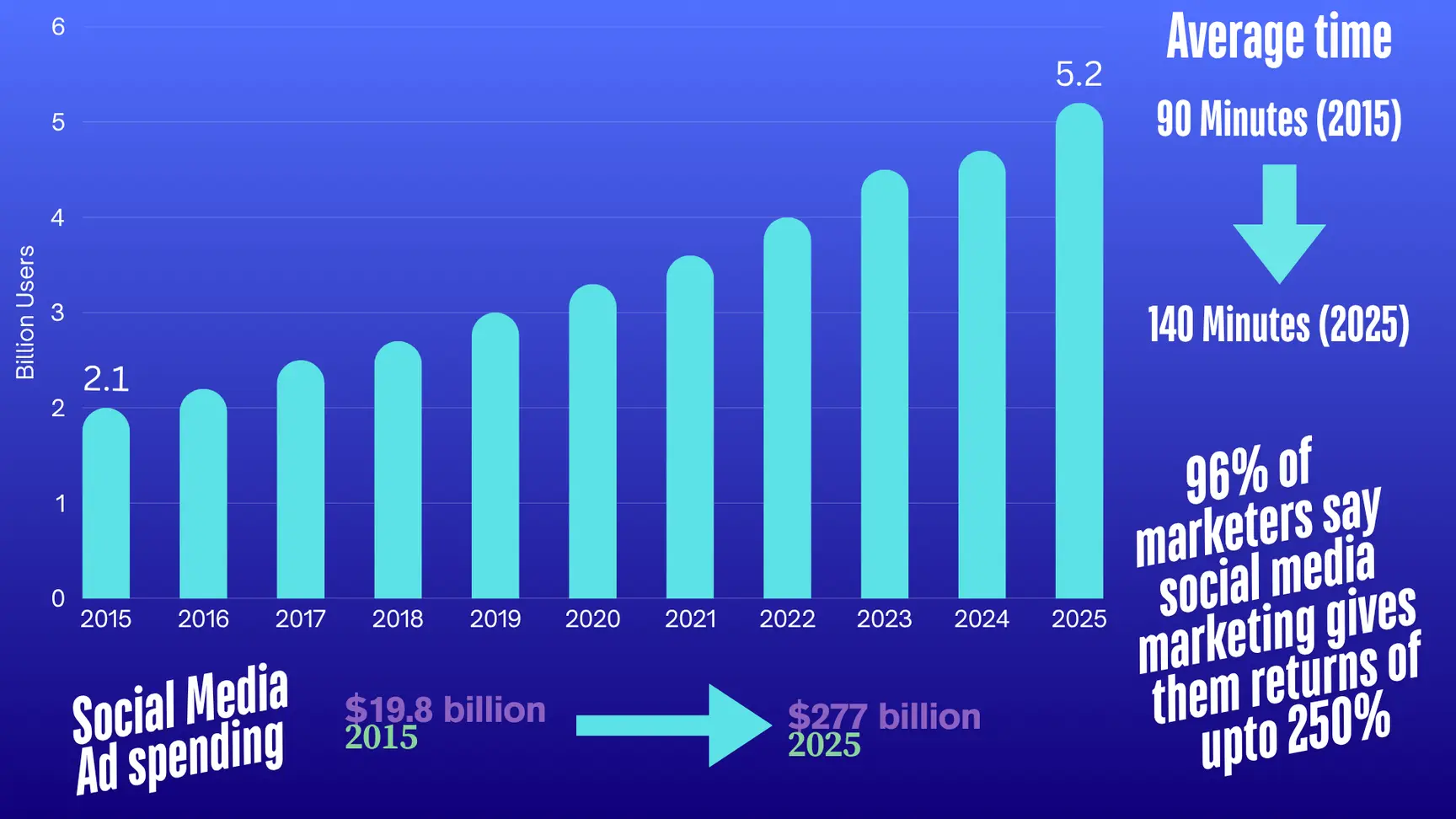
Social media statistics in 2025 are most useful when the underlying metric is clear. DataReportal estimated 5.24 billion active social media user identities worldwide at the start of the year, equal to 63.9% of the global population. Statista's market summaries rounded the worldwide audience to about 5.3 billion. Those totals are close, but neither should be read as a perfect count of unique people because individuals can hold multiple accounts.
For platform comparisons, this guide distinguishes monthly active users, registered members, and advertising reach instead of treating them as interchangeable. That matters when comparing Facebook, Instagram, YouTube, TikTok, X, LinkedIn, and Pinterest.
Overall Growth (2015–2025)
- User growth: Long-run estimates rose from roughly 2.1 billion social users in 2015 to more than five billion in 2025, though methodology differs by source and year.
- Time spent: GWI data summarized by DataReportal put typical daily social media use at 141 minutes in 2025. Importantly, DataReportal noted that time spent had declined from its level two years earlier.
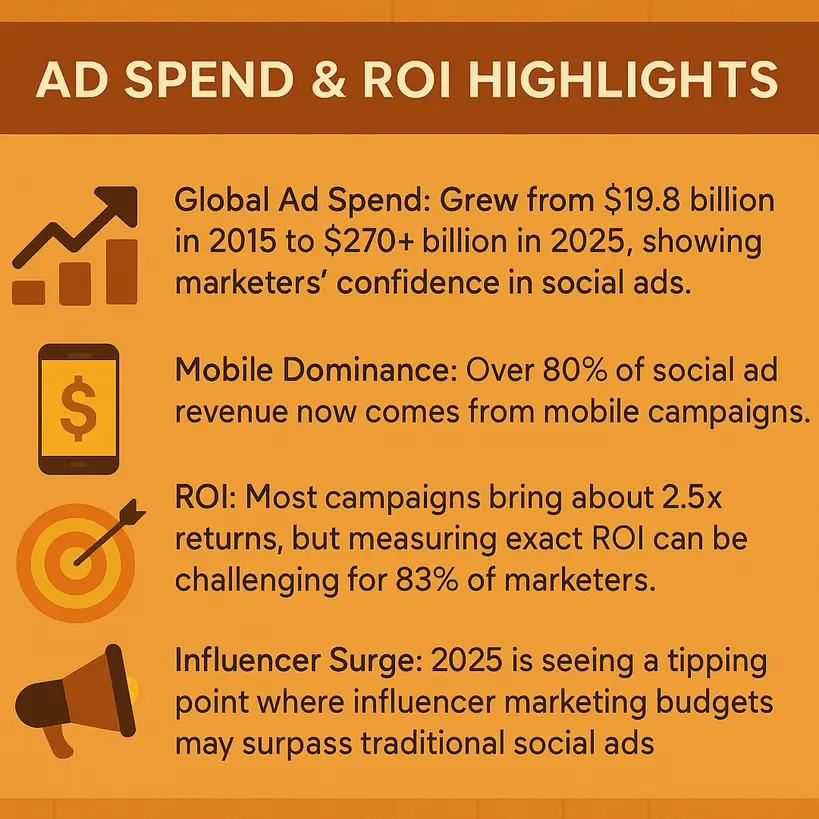
- Ad spend: Statista projected worldwide social media advertising at roughly $270–277 billion in 2025, with a specific forecast of $276.72 billion.
- Measurement: There is no credible universal social-media ROI percentage. Results depend on objective, margin, attribution, creative, and conversion path, so teams should define marketing performance metrics before comparing channels.
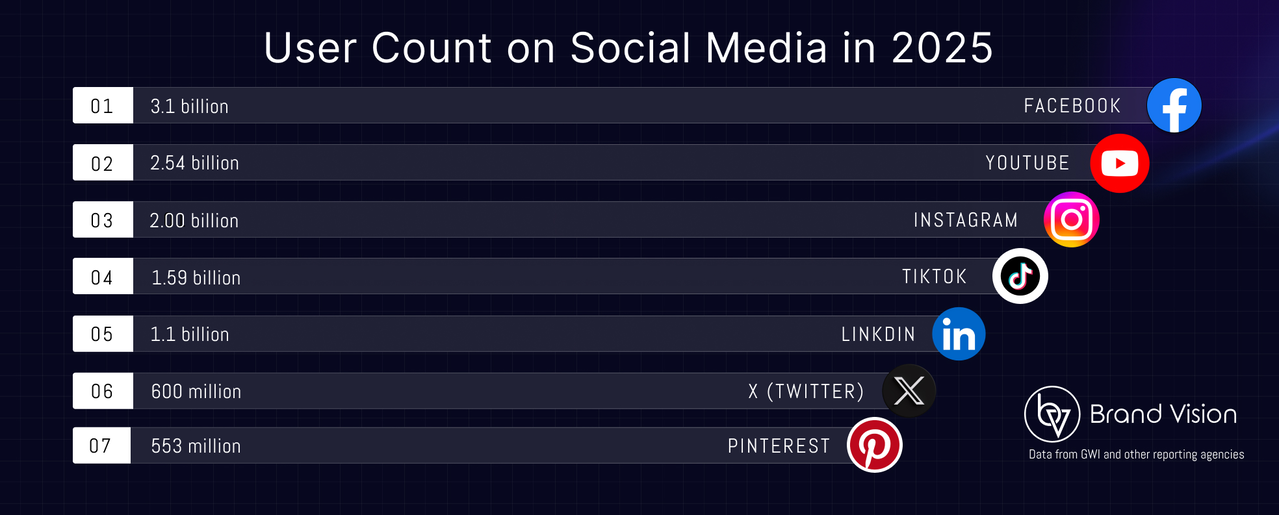
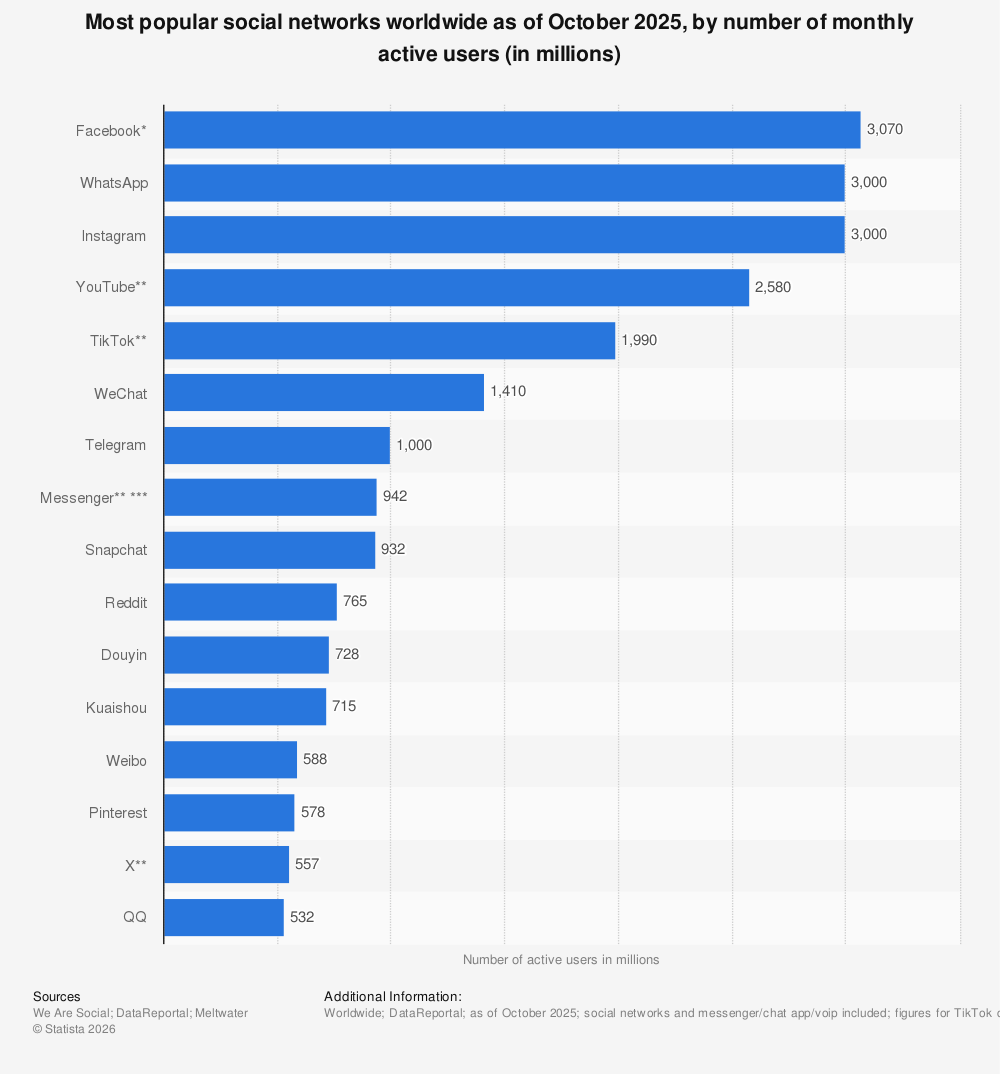
- Scale: Facebook remained one of the world's largest platforms. Meta's last published Facebook-specific MAU count was 3.07 billion at the end of 2023, which is why many 2025 summaries still described the platform as roughly 3 billion users.
- 2025 ad reach: Meta's planning tools indicated about 2.28 billion potential ad reach globally in January 2025. Advertising reach is not the same as monthly active users.
- Audience: Facebook's demographics skew broader and older than many newer platforms, which can make it useful for mass reach and established consumer categories.
- Marketer surveys: Older survey-based reporting found 44% of marketers naming Facebook as their most important platform. That figure is survey-specific, not a universal 2025 market share.
- Audience size: Instagram was commonly described as having around 2 billion users. Meta's ad tools showed 1.74 billion potential ad reach in January 2025, up 5.5% year over year.
- Content focus: Reels, Stories, creator content, product discovery, and visual brand storytelling continued to define the platform.
- Creative implication: Performance depends on the quality and consistency of social campaign graphics, short-form video, and landing-page continuity, not audience size alone.
- Regional execution: A consumer brand comparing a Miami marketing agency should ask how Instagram creative, local audience targeting, conversion tracking, and the post-click experience work together.
YouTube
- 2025 ad reach: YouTube had the largest platform-reported social advertising audience in DataReportal's January 2025 comparison, with Google tools indicating at least 2.53 billion users in potential ad reach.
- Format range: Long-form video, tutorials, product demonstrations, interviews, livestreams, and Shorts give marketers more format range than most social networks.
- Marketing role: YouTube can support both demand generation and search-like discovery. A strong video marketing plan should separate awareness, watch-time, lead, and conversion goals.
TikTok
- Scale: TikTok passed the 1+ billion user threshold well before 2025. ByteDance's ad tools indicated 1.59 billion users in potential ad reach in January 2025.
- Growth: DataReportal reported TikTok's potential ad audience up about 2.0% year over year at the start of 2025, a more defensible comparison than the draft's 16% claim.
- Role: Short-form video, creator participation, trends, and social commerce make TikTok especially useful when the brand can produce native-feeling creative rather than simply repurpose conventional ads.
X (Formerly Twitter)
- Audience estimates vary: Some 2025 estimates put X near 650 million users, but the platform's own ad tools indicated 586 million potential ad reach in January 2025.
- Trend: DataReportal reported X's potential ad reach down 5.3% year over year. That does not prove the same change in monthly active users, but it contradicts a simple growth narrative.
- Marketing role: X remained relevant for real-time news, technology, public conversation, and some B2B communities, while brand suitability varied significantly by audience and category.
- Member count: LinkedIn reported about 1.20 billion registered members in its advertising tools in January 2025, up 17.1% year over year.
- Important caveat: LinkedIn's reported advertising audience is based on registered members, not monthly active users, so it should not be compared directly with active-user figures from other platforms.
- B2B role: The professional graph makes LinkedIn structurally useful for B2B marketing, thought leadership, recruiting, webinars, case studies, and decision-maker targeting.
- Regional execution: A B2B company evaluating a San Francisco branding and marketing agency should ask how LinkedIn content, paid distribution, lead capture, and CRM follow-up connect.
- Monthly active users: Pinterest reported 553 million global MAUs for Q4 2024, up 11% year over year. Earlier audience summaries often cited about 450 million.
- Advertising reach: Pinterest's ad tools indicated roughly 340 million potential ad reach globally in January 2025, which is lower than the MAU figure because the metrics cover different populations.
- Demographics: Older U.S. summaries sometimes cited a female share near 78%. DataReportal's global January 2025 ad-audience split was 70.3% female, 22.4% male, and 7.3% unspecified.
- Marketing role: Pinterest remains useful for visual discovery, planning, home, fashion, food, travel, and product research where users often arrive with intent to save or act later.
Ad Spend & ROI Highlights
- Global spend: Statista projected $276.72 billion in worldwide social media advertising spend for 2025.
- Channel economics: Paid social results vary by platform, audience, offer, creative, and attribution window. Teams comparing paid social campaign management should separate platform-reported conversions from business outcomes.
- ROI: A single “average social ROI” is misleading. Revenue, contribution margin, customer acquisition cost, assisted conversions, lead quality, and repeat purchases may all matter depending on the objective.
- Influencer and creator spend: Creator partnerships continued to absorb a larger share of social budgets, but they should be evaluated against the same commercial goals as paid media.
B2B vs. B2C: Key Stats
- B2B: LinkedIn's 1.20 billion registered-member advertising audience made it a major professional channel in 2025, but channel choice should follow audience behavior rather than a blanket “B2B equals LinkedIn” rule. Webinars, case studies, expert content, and lead-nurture sequences remain common B2B formats.
- B2C: Facebook, Instagram, YouTube, TikTok, and Pinterest offer different combinations of reach, video, creator content, visual discovery, and commerce. B2C brands should compare reach with conversion economics rather than choose a platform by popularity alone.
Trending Shifts in 2025
- Short-form video: TikTok, Instagram Reels, and YouTube Shorts made vertical video a core creative format, while long-form video still served education, search, and higher-consideration journeys.
- Social commerce: Product discovery increasingly happens inside social feeds, but checkout behavior varies by country, category, and platform. Discovery and purchase should be measured separately.
- Private and interest-based communities: Groups, Discord servers, Reddit communities, and direct messaging can support deeper interaction than public feeds when the community has a clear reason to exist.
- Privacy and first-party data: Platform targeting continues to adapt to privacy restrictions, increasing the value of consented customer data, strong analytics, and clean conversion tracking.
FAQ: Social Media Marketing Statistics
How many people use social media in 2025?
DataReportal estimated 5.24 billion active social media user identities worldwide at the start of 2025, equal to 63.9% of the global population. The “user identities” label matters because one person can operate multiple accounts.
Which platform had the largest reported advertising reach in early 2025?
YouTube led the platform-reported ad-reach comparison at roughly 2.53 billion, followed by Facebook at about 2.28 billion. These are advertising audience estimates, not directly comparable monthly-active-user counts.
Is social media marketing profitable?
It can be, but there is no universal ROI benchmark that applies to every brand. Profitability depends on media cost, creative, offer, margin, attribution, and the conversion path. Turning social traffic into revenue also requires a web design built for conversion and an SEO strategy that can capture demand beyond the feed.
Where does social commerce matter most?
Instagram, TikTok, Pinterest, Facebook, and YouTube all support product discovery in different ways. The best platform depends on the product category, market, creator ecosystem, and whether customers prefer in-platform actions or a separate ecommerce experience.
How does B2B social strategy differ from B2C?
B2B programs often emphasize expert content, lead capture, sales follow-up, and professional audiences. B2C programs more often emphasize reach, creators, product discovery, short-form video, and direct-response offers. The distinction is useful, but the actual channel mix should follow customer behavior.
Social media in 2025 was large, still growing, and increasingly specialized by format and audience. The most important planning lesson is to compare like-for-like metrics and connect platform activity to business outcomes rather than treating reach as ROI.
If you need help turning platform data into a channel plan, Brand Vision can provide a focused marketing consultation covering channel roles, measurement, creative priorities, and conversion handoffs.